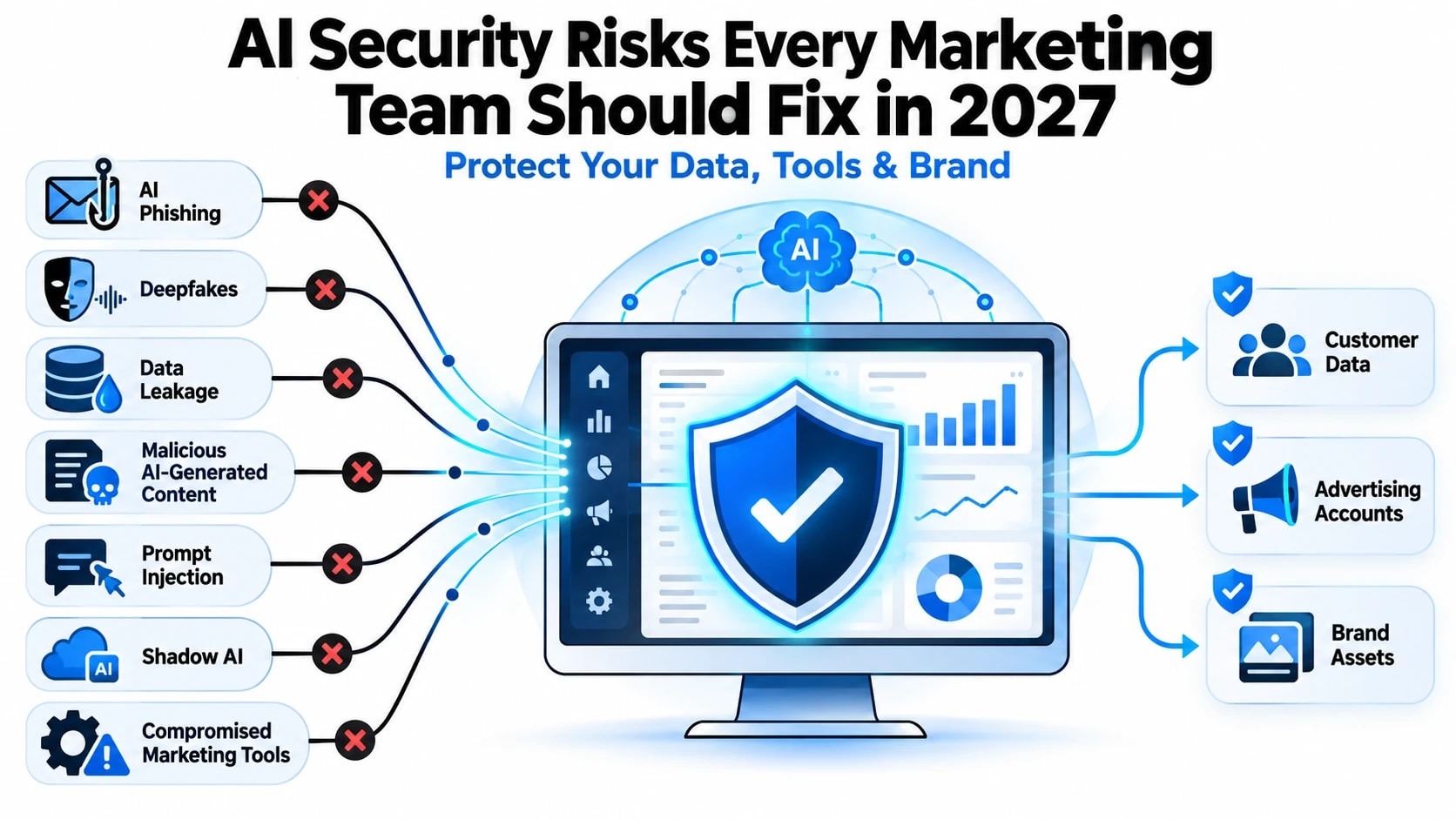
Every marketing team today runs on AI, and that has created an AI security risk nobody was hired to handle. You draft copy with it. You plan whole campaigns around it. You let it chat with your customers. And every one of those tools reaches into data that used to be locked up tight, with nobody in security looking.
And that is exactly what we are going to sort out here. We will show you AI security challenges that turn a genuinely useful AI tool into a real data-risk problem. Then how to shut them down without grinding your campaigns to a halt. And no, you won't need to become a security engineer.
Why Marketing Is More Prone to AI Security Risks: 4 Key Reasons
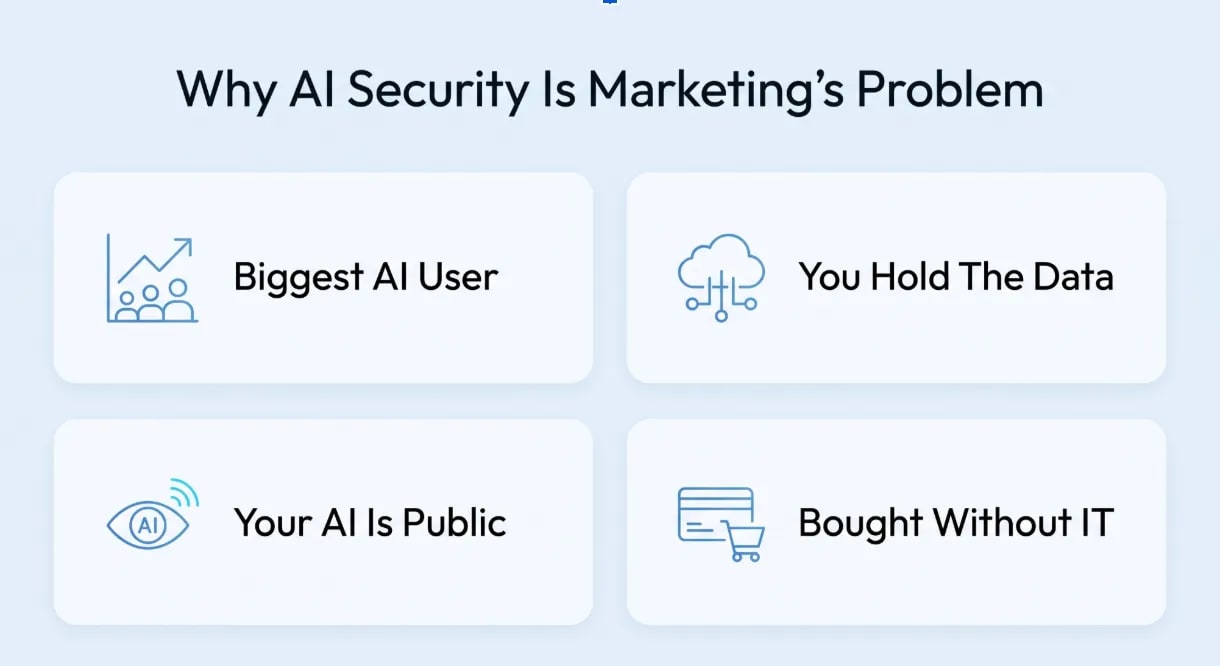
Security used to be someone else's headache, down the hall in IT. Artificial intelligence moved a big piece of it onto your desk, whether you asked for it or not.
1. You Are The Biggest AI User In The Building
Marketing never waited around for permission to use AI. It is part of your whole day now, from the first rough draft to the audience research to the ads themselves. That makes your team the single heaviest AI user in the company. And every generative AI tool you touch is one more way into systems that security is on the hook to protect.
And the scale is genuinely wild. Roughly 68% of employees now reach for free AI tools through their own personal accounts. Over half have already typed sensitive company data straight into them.
2. You Hold The Data Attackers Want
Marketing is where all the customer data ends up. Your email lists and purchase histories flow through your tools daily. So do your segments and those detailed behavior profiles. That is exactly what attackers and data brokers are hungry for. Hook it up to an AI tool, and you have handed the crown jewels to a system you don't fully control.
3. Your AI Faces The Public
Most of what marketing makes with AI points straight outward. Chatbots chat with real customers. AI-written content goes up on your public site. AI ads run in front of millions of people. When an internal tool glitches, it is a quiet private headache. When your public AI makes a mistake, everyone watches it happen. And it is your brand left holding the mistake.
4. IT Never Signed Off On Half Your Tools
Marketing buys its own tools, plain and simple. You spot a new AI writer and drop it on the company card. You are up and running before lunch. No security review. No ticket to IT. No vendor check at all. That speed is great for campaigns. So half your AI systems slipped in through a side door the security team doesn't know exists.
The AI Security Risks Marketing Teams Need To Take Seriously
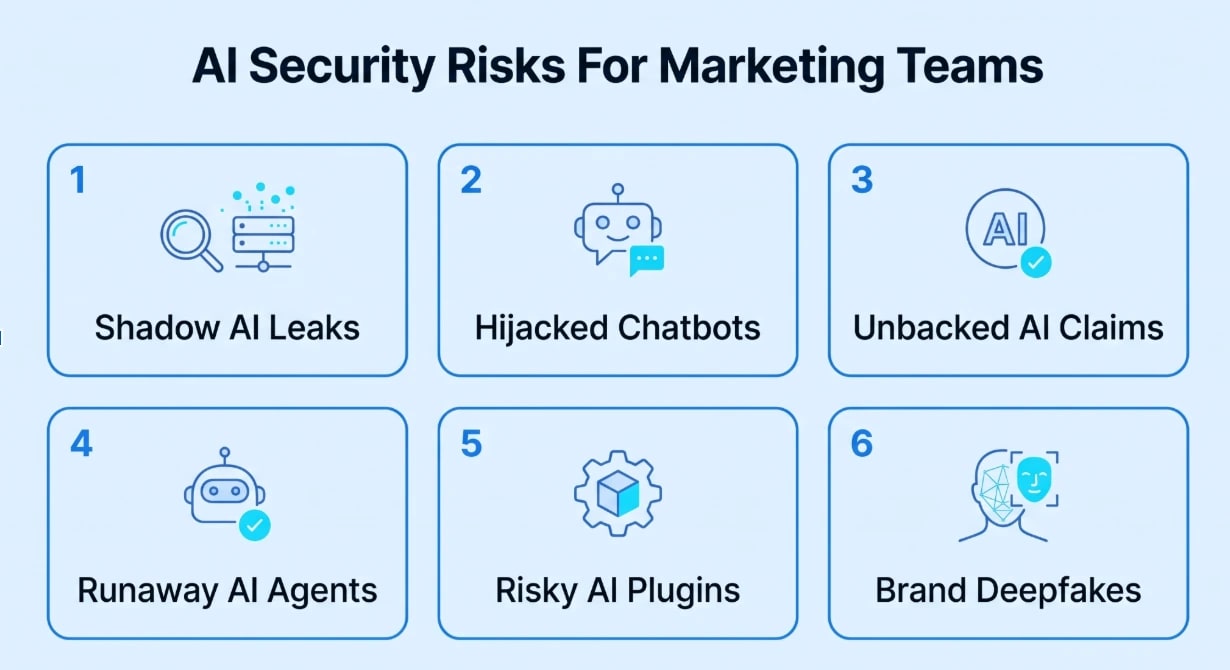
These are the generative AI security risks that genuinely matter for a marketing team, not some generic enterprise checklist. Every one is active right now, and each hits marketing teams differently than it hits IT. Rules such as the EU AI Act also put more attention on how organizations manage AI risks.
1. Shadow AI Is Leaking Your Customer Data
This is the less obvious one, and it is everywhere. Someone drops a customer list into a chatbot to tidy it up. Or feeds campaign numbers into a free machine learning tool to summarize. Loads of those tools train on whatever you paste in.
That can expose sensitive data outside the systems your company actually controls. Your private data becomes part of an AI model’s training data you will never own, with no button to claw it back. And you don't know how your sensitive information is handled within the training datasets.
And this isn't theoretical. Per IBM's breach report, shadow AI had a hand in 20% of breaches and added roughly $670K to the average cost. That kind of leak rarely has an undo.
2. Your Customer-Facing AI Can Be Hijacked
If there is a chatbot or AI assistant running on your site, it can be turned against you. The right deceptive message can talk it into breaking its rules or leaking data it shouldn't. It might even get coaxed into pushing a link you never approved.
That is a prompt injection attack, and it turns your helpful little bot into an unlocked door. Testing model behavior under hostile prompts can reveal problems before customers find them.
How serious this system prompt leakage gets is tied to how much your bot does. On a store selling cheap simple stuff, a chatbot is basically decoration. But the pricier the purchase, the more that assistant becomes a real salesperson. Shoppers grill it for days before buying. It ends up knowing your full catalog and current pricing. Sometimes even a customer's order history.
Take this online store selling bidets. An AI assistant handling sizing and installation questions could end up connected to product information and customer data behind the scenes. A clever attacker could word a message that makes it dump its hidden instructions or leak another shopper's info. It could even get steered into pushing a malicious link to a trusting buyer.
Because this is a high-ticket purchase, the repercussions can be serious. A leaked customer record can create a privacy incident. A bad recommendation can also lead to an expensive purchase decision based on information the business never approved. This really bites any store where the assistant does serious sales work, not a plain FAQ box.
3. AI Content Can Publish Claims You Can't Back Up
AI writes with total confidence whether it is right or wrong. Ask it for a stat or a comparison, and it will cheerfully make one up that sounds legit. Publish these AI outputs without a second look, and there is a false claim out there with your brand's name on it. Depending on your industry, that is anything from an awkward edit to a regulator's letter.
This jumps from annoying to dangerous the second your words carry legal or medical weight. In tightly regulated fields, one wrong line isn't a harmless typo. It can push a frightened person toward a bad decision at the worst moment.
And it can drag you before a licensing board or into a courtroom. The accuracy bar here is brutally high, and AI's confident guessing is a terrible match.
Consider this medical malpractice lawyer from Atlanta, GA. Its marketing walks anxious readers through complicated legal and medical territory, and every word gets scrutinized. If an AI draft overstated a likely payout, it could give someone a false idea of what their case is worth.
If it misstated a filing deadline, a potential client could also delay taking action and miss an important legal deadline. From there, the firm could face a bar complaint or a malpractice claim.
This AI-related risk hits hardest in legal and medical marketing. Finance and insurance are right beside them. So anything touching these industries gets a second set of expert eyes first.
4. AI Agents With Too Much Freedom
The newest tools don't just answer; they act. An AI agent can schedule posts and send emails on its own. It can adjust ad spend or update records. Brilliant time-saver, until one gets a bad or booby-trapped input. Then it isn't a typo. It is an automated action at machine speed, with real budget on the line.
5. Every AI Plugin Widens Your Attack Surface
Every AI feature you add is another company with a key to your sensitive data. The review summarizer plugs in. So does the recommendation widget and search bar. Each one wires into your systems and customer records.
Now you are trusting their security systems as much as your own. And one flimsy vendor is all it takes for a breach because their security vulnerabilities can become your problem too. There is also a data poisoning risk if an attacker manages to feed malicious data into a connected AI system.
This model poisoning risk grows right alongside your catalog. A shop with a few products might run one or two integrations. But a retailer with hundreds of items leans on AI for nearly everything, from summarizing reviews to running search. The wider your range, the more AI tools you gather. Your exposure creeps outward, and nobody ever decided it should.
Think of this retailer with a wide supplement range across dozens of categories. To keep all those pages useful, it will need to add different AI plugins for reviews and search. Every one of those plugins can read customer and order data. If just one has a weak password, an attacker strolls in through that vendor rather than your front door.
Fixing it isn't glamorous, but it works. Give each tool the bare minimum access it needs, not a scrap more. And before connecting a new vendor, check hard how they handle security and data. This impacts busy eCommerce and SaaS shops especially, where integrations multiply faster than anyone tracks.
6. Deepfakes Wearing Your Brand
AI can now clone a voice or face from a handful of clips. Attackers use that to impersonate your executives or your brand in scams aimed at your customers and staff. A fake voicemail from the "CEO" telling finance to wire money isn't some rare event anymore. Neither is a deepfaked spokesperson hawking a product you never made.
And these social engineering attacks are scaling fast. In a Gartner survey, 62% of organizations said they had faced a deepfake attack in just the past year. For a brand, the hit comes twice over. It burns the people who got scammed, then it burns the trust you spent years earning.
How to Mitigate AI Security Risks Without Disrupting Your Workflow: 4 Proven Strategies
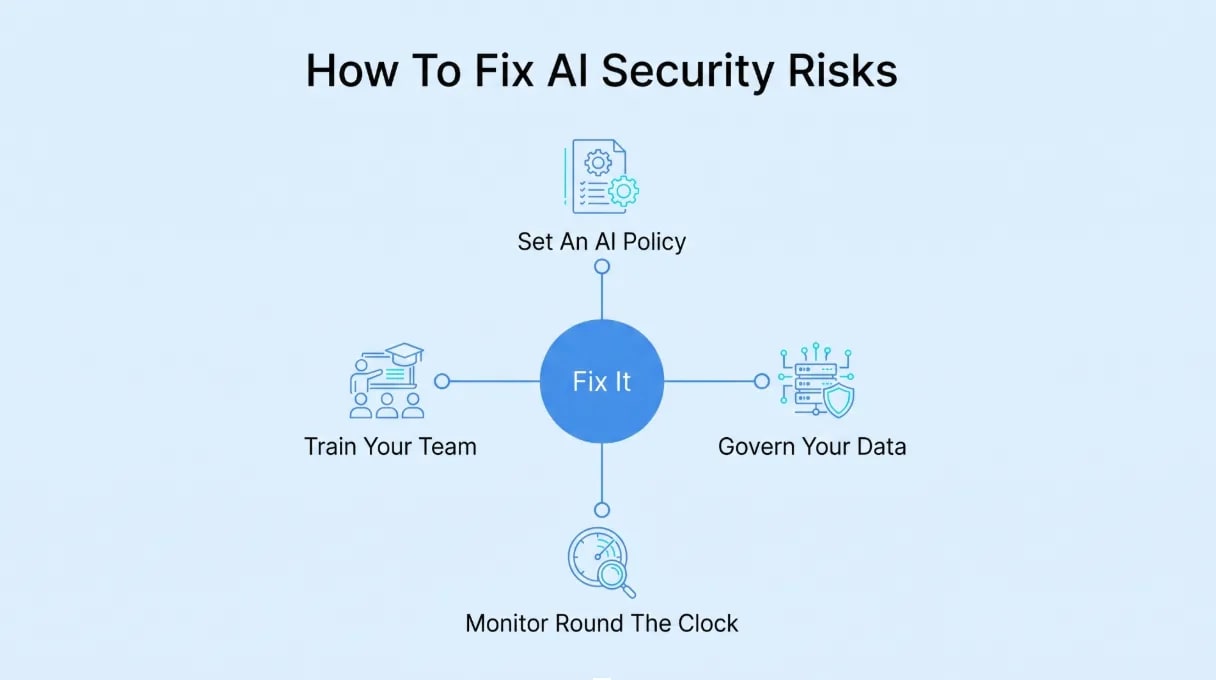
None of this means tearing AI out of your workflow. The whole idea is to keep your speed while fixing the issues, and these strategies pull that off without any security degree.
1. Write An AI Usage Policy People Actually Follow
Most AI trouble starts because nobody said what is okay. People aren't reckless, just assuming with zero guidance. A short, plain policy clears that up. That policy becomes the starting point for practical AI governance.
It says which tools are approved and what data stays out. It names who to ask when something is confusing. It is not a legal brick nobody opens. It gives your team a basic risk management process and security protocols instead of leaving every decision to individual judgment.
Spell out exactly which AI-powered tools your team is allowed to use here
Define clearly what customer data must never be pasted into any AI tool
Name one person who must sign off on any new AI tool first
Revisit the entire policy every quarter, since new AI technologies appear constantly
2. Get Your Scattered Data Into One Governed Place
A big slice of your leak risk is data stored in multiple systems. That customer list is in your email tool and a spreadsheet. It is also in your CDP and old exports nobody deleted. Spread that thin, you can't really say who is touching it. You can't protect what you can't even locate. So the real fix starts underneath it all, at the data.
Microsoft Fabric gives you a way to pull that data into one governed environment. Instead of stray copies in every tool, you can bring your data together with access controls and lineage built in. You can see who is using what and shut off risky access. You can also make sure AI tools only touch data that is approved and cleaned.
Getting that set up properly is real specialist work, which is why plenty of teams bring in Microsoft Fabric development services. They tidy up your scattered sources and wrap solid rules around them. What you are left with is one controlled spot your AI can safely draw from, not a dozen leaky ones.
Less loose data floating around means fewer ways for any of it to slip out. And honestly, there is a lot less to sweat every single time a new AI tool shows up.
Map out every single place a copy of your customer data exists today
Delete every old export and duplicate customer list you no longer actually need
Give each AI tool access to only one approved and cleaned data source
Set strict access controls so only a few named people can ever export data
3. Put Real Monitoring On It, Around The Clock
Even with a tight policy and clean data, things get through. The only way you spot a problem early in your AI environment is by watching for it. That means continuous monitoring of what your AI tools and accounts are really up to. A strange login at 3 am or a sudden data dump should set off an alarm, not get noticed weeks later.
Turn on detailed activity logging for every AI tool your team touches
Set instant alerts for unusual logins and any sudden large data export
Decide in advance exactly who responds the second a real alert fires
Run a short drill so the whole team actually knows the response steps
The problem is that watching around the clock is a genuine full-time job, and most marketing teams simply can't staff it. You are not about to run a 24-hour security desk between launching campaigns. This is exactly where managed services like agentic security operations pay for themselves.
It pairs AI agents with real human analysts to keep watch on your systems non-stop. The agents analyze the mountain of alerts and surface the handful that actually matter. The humans make the judgment calls on anything serious. So you get enterprise-grade eyes on your AI activity without ever hiring an analyst.
For a marketing team, that is the whole gap between spotting a leak in minutes and hearing about it from a journalist.
4. Turn Your Team Into The First Line Of Defense
Tools and policies only carry you so far. Your team also needs to know how to protect AI systems when something suspicious shows up. That matters because AI security threats keep changing as the technology and attacks evolve.
Most AI attacks work by fooling a person, not beating a firewall. A believable deepfake voicemail or AI-generated phishing lures one busy marketer into clicking without thinking. So your team's instinct is the real control here.
People who know what a modern AI scam looks like are much harder to fool. And that kind of cybersecurity awareness costs a fraction of any tool. It is genuinely worth putting money into proper, hands-on security training rather than the yearly slideshow everyone clicks through on autopilot.
Show your team real, recent examples of AI phishing and deepfake scams
Teach everyone a simple way to verify any urgent or unusual request quickly
Make reporting any suspicious message genuinely easy and completely blame-free for everyone
Refresh the training quickly whenever a genuinely new AI threat starts appearing
Signs Your Team Already Has An AI Security Problem
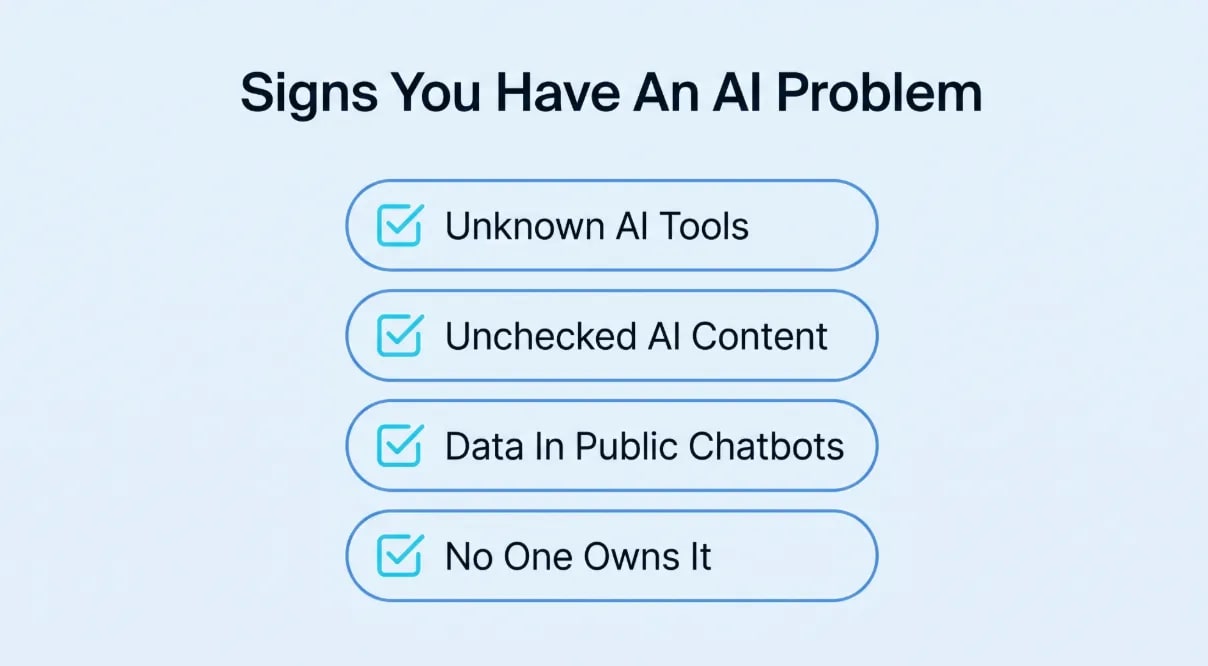
You might not need to prevent AI security threats. You might already be knee-deep in them. The tricky bit is that AI problems love to hide in plain sight. Without the forensic tools to trace what a tool actually got into, they stay invisible. Run down the checklist. If more than a couple hit a nerve, you have work ahead.
Warning Sign | Why It Matters |
You can't name every AI tool the team uses | Unknown tools mean unknown data exposure |
AI-generated content gets published without a human check | One invented claim can become a public liability |
Customer data has been pasted into a public chatbot | That data may now train an AI development model you don't control |
An AI tool has access nobody remembers granting | Old, forgotten access is an easy way in |
No single person owns AI security on the team | Problems get spotted late, if at all |
Nobody would notice a strange login for weeks | Attacks run longest when nothing is watching |
3 AI Security Mistakes To Avoid While You Tighten Things Up
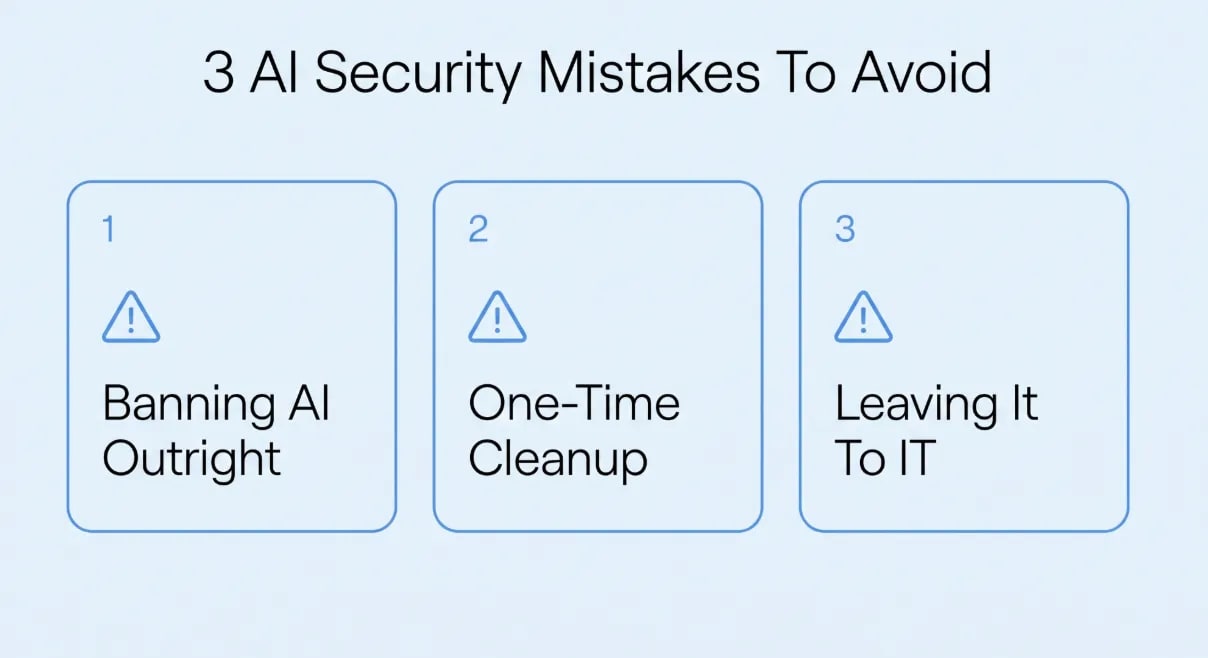
Fixing your AI security issues is the right move. But fixing them the wrong way can leave you worse off than when you started. These three cause more problems for well-meaning teams than any others.
1. Banning AI Outright
Once the AI risks sink in, the instinct is to ban the whole lot. It never works. People are too attached to these tools. So they switch to personal accounts and phones, where you see nothing. A blanket ban doesn't kill the risk. It just buries it, turning a manageable problem into invisible shadow AI you can't touch.
How to Fix: Hand people a safe, sanctioned way to use AI instead. Approve a few genuinely good tools and lay out clear rules. Then make that approved route easier than any workaround. People always take the path of least resistance, so make the secure path the simple one.
2. Treating It As A One-Time Cleanup
You blitz everything for a week, then move on feeling pleased. Meanwhile, the tools update weekly, and attackers come up with fresh tricks monthly. A setup that looked airtight in January is riddled with issues by June. AI security isn't a project you simply complete. It is more of a standing habit, closer to ongoing hands-on practice than a one-time audit.
How to Fix: Put AI security on a repeating calendar. Give your tools and access a proper look every quarter. Re-read your policy any time a big new tool or threat turns up. Small, steady reviews beat one heroic cleanup that slowly comes undone.
3. Assuming It Is IT's Job, Not Yours
It is tempting to file this under IT and forget it. But IT has no clue which AI tools your team signed up for. They can't see the chatbot on your campaign page or your email data. You know how AI runs inside marketing. Waiting on IT to fix what they can't see keeps security gaps open for months.
How to Fix: Own the slice only you can own. Keep the running list of marketing's AI tools yourself. Team up with IT and security, but bring them the visibility they are flat-out missing. You don't have to turn into the expert. You just have to be the person willing to raise a hand.
Conclusion
The real change is accepting that AI security risk is now part of the marketing job. Not the whole job, and not overnight. But it is a standing responsibility, not going back to IT. The teams that get this right won't make headlines over a leaked list. They will just move faster with AI, because they trust their setup.
That is the bit we take care of at Cyber Lad. We help teams with no security department build and run one, from round-the-clock SOC monitoring to hands-on incident response. If your set of AI tools has outgrown your ability to keep an eye on it, that is the exact gap we close. Come see how we help over at Cyber Lad.