Data Risk Management Framework: Strategy (2026)
Table of Contents
Data is now the primary operational asset for most organizations. It drives revenue decisions, customer experience, automation, and regulatory reporting. At the same time, it creates exposure. Sensitive data flows across cloud platforms, SaaS tools, APIs, endpoints, and third-party vendors. A single visibility gap can lead to regulatory penalties, reputational damage, or operational disruption.
A data risk management framework provides structured control over that exposure. It defines how data is identified, classified, protected, monitored, and governed across its lifecycle. In 2026, this is no longer a compliance exercise.
It is a business continuity requirement. Organizations that treat data risk as a strategic discipline outperform those that treat it as a security afterthought.
This guide explains the strategy behind a modern data risk management framework, compares leading models, and breaks down implementation into practical steps.
Check out our latest blog on Cybersecurity vs Data Analytics in 2026
What Is a Data Risk Management Framework

A data risk management framework is a structured system for identifying, assessing, mitigating, and monitoring risks related specifically to data assets. Unlike traditional IT risk frameworks, which focus on infrastructure and systems, this framework centers on the data itself.
The foundation begins with understanding where sensitive data resides. That includes structured databases, unstructured repositories, cloud storage, collaboration tools, backup systems, and endpoint devices. Once discovered, data must be classified based on sensitivity, regulatory impact, and business value. Classification informs access control, encryption requirements, retention policies, and monitoring thresholds.
The framework then maps potential threat scenarios. These may include insider misuse, privilege abuse, third-party exposure, misconfiguration in cloud storage, ransomware targeting sensitive repositories, or unauthorized API access. Each scenario is evaluated using likelihood and impact analysis.
A mature framework also integrates governance elements. This includes defined ownership, data stewards, escalation processes, audit logging, and review cycles. Without ownership, controls degrade over time. Without review mechanisms, risks evolve undetected.
In 2026, the most effective frameworks are dynamic. They incorporate automated risk scoring, continuous monitoring, and policy validation across hybrid environments. Static documentation is not enough. A data risk management framework must function as a living control system embedded in daily operations.
Many online threats today are linked to account takeover fraud, where attackers gain access to your account using stolen login details.
You can check our guide on Data Governance Frameworks: A Practical Guide
Strategic Pillars of a Modern Data Risk Management Framework
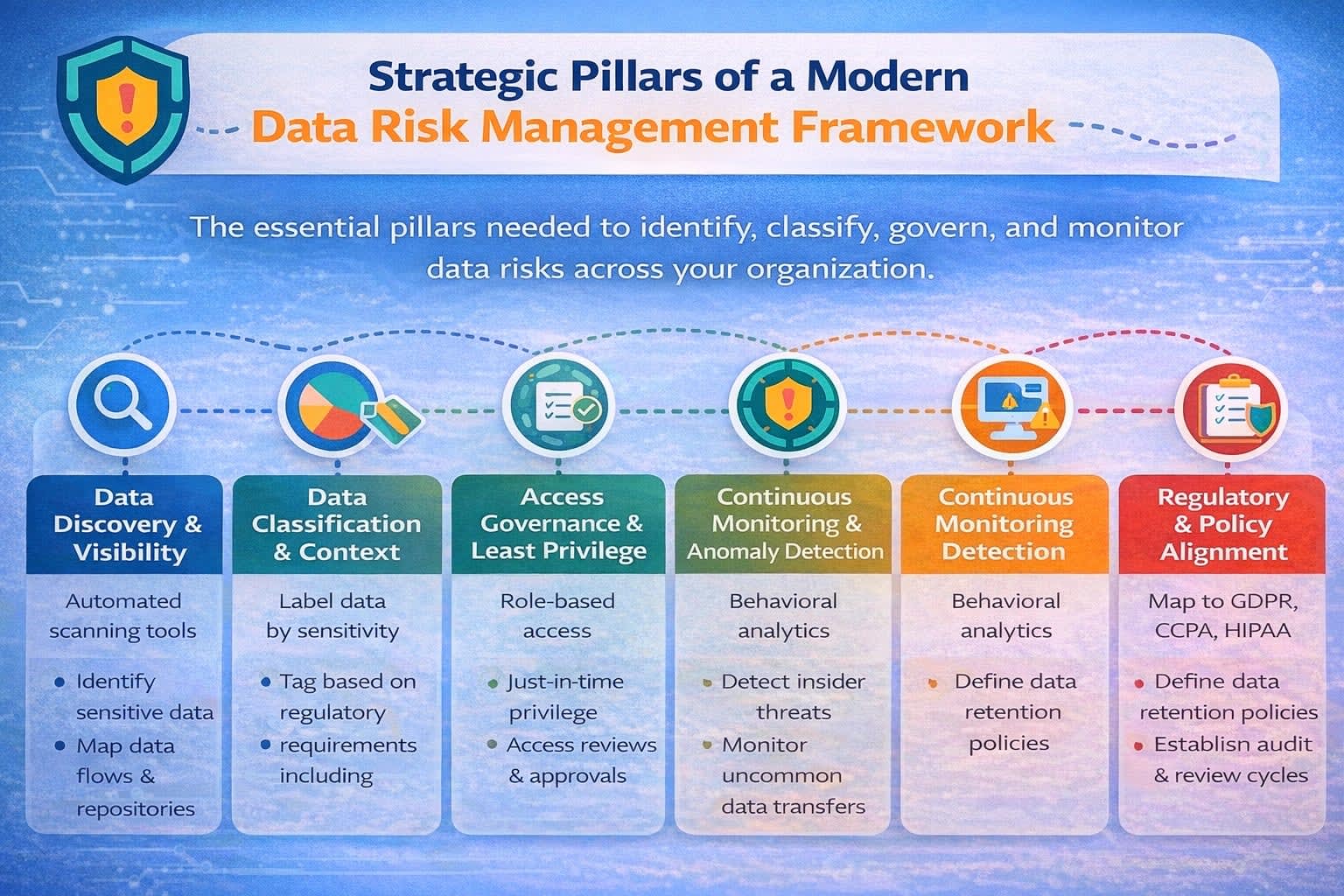
A robust framework rests on clearly defined strategic pillars. Without them, implementation becomes fragmented.
1. Data Discovery and Visibility
You cannot protect what you cannot see. Automated data discovery tools scan environments to locate personal data, intellectual property, financial records, and regulated information. Visibility includes shadow data and dormant repositories that are often overlooked.
2. Data Classification and Context
Classification must reflect real business risk. Labels such as Public, Internal, Confidential, and Restricted should map to regulatory exposure and operational sensitivity. Context matters. The same dataset may carry different risk levels depending on geography or usage.
3. Access Governance and Least Privilege
Data risk often originates from excessive access. Role-based access control, just-in-time privilege, and regular entitlement reviews reduce exposure. Privileged accounts require additional monitoring and approval workflows.
4. Continuous Monitoring and Anomaly Detection
Modern frameworks rely on behavioral analytics. Unusual download volumes, after-hours access, or data transfers to external storage trigger an investigation. Integration with SIEM and UEBA platforms strengthens detection capability.
5. Regulatory and Policy Alignment
Frameworks must align with regulations such as GDPR, HIPAA, CCPA, and sector-specific mandates. Policy mapping ensures controls are defensible during audits.
The strategy must connect these pillars under executive oversight. Data risk is not solely an IT function. It intersects legal, compliance, operations, and executive leadership.
Understand how sensitive information can end up in unauthorized systems in our guide to cybersecurity spillage and how to prevent it.
Comparison of Leading Data Risk Management Models
Several established models influence how organizations structure their frameworks. Each has strengths depending on the maturity level and industry.
Model | Focus | Strength | Limitation |
|---|---|---|---|
NIST Risk Management Framework | System-level risk governance | Structured and widely recognized | Less data-specific guidance |
ISO 27005 | Information security risk | Strong documentation discipline | Requires adaptation for data lifecycle focus |
FAIR Model | Quantitative risk analysis | Financial impact modeling | Complex to operationalize |
CIS Controls | Tactical security safeguards | Practical implementation | Not exclusively data-centric |
Custom Data-Centric Framework | Data lifecycle governance | Tailored to organization | Requires internal expertise |
A hybrid approach is common. Many enterprises use NIST for structure, FAIR for financial quantification, and internal policy overlays for data lifecycle controls.
The decision should reflect regulatory exposure, organizational size, and operational complexity.
Read More On: Data Leak Prevention: Complete Guide, Tools & Best Practices
Implementation Roadmap: Step-by-Step Approach

Implementing a data risk management framework requires phased execution.
Phase 1: Assessment and Baseline
Begin with a current state assessment. Identify:
Data repositories
Existing classification standards
Access control models
Logging capabilities
Compliance gaps
Document high-risk areas and prioritize based on regulatory and operational exposure.
Phase 2: Data Inventory and Classification Rollout
Deploy automated discovery tools. Create standardized classification labels and enforce tagging policies across systems. Integrate classification with DLP and encryption controls.
Phase 3: Risk Modeling and Policy Alignment
Define risk scenarios:
Insider data theft
Misconfigured cloud buckets
Unauthorized third-party API access
Ransomware targeting sensitive archives
Score each scenario based on impact and probability. Align mitigation controls accordingly.
Phase 4: Technical Control Integration
Implement:
DLP systems
Encryption key management
Access governance tools
CASB for SaaS visibility
SIEM integration for monitoring
Ensure logs feed into centralized analytics for risk correlation.
Phase 5: Continuous Review and Reporting
Establish review cycles. Quarterly access audits, automated risk dashboards, and executive reporting keep the framework operational rather than static.
Implementation should be iterative. Attempting full maturity in one phase leads to fatigue and incomplete adoption.
Check out our latest blog on Digital Risk Protection for Enterprise Security
Technology Stack Components
A data risk management framework relies on integrated technologies.
Component | Purpose |
|---|---|
Data Discovery Tools | Identify sensitive data across environments |
Data Loss Prevention | Prevent unauthorized transmission |
Encryption Platforms | Protect data at rest and in transit |
Identity Governance | Manage access and privilege |
SIEM / UEBA | Detect abnormal data behavior |
CASB | Monitor cloud application usage |
GRC Platforms | Align controls with regulatory requirements |
Integration between these tools is critical. Disconnected systems create blind spots.
Common Pitfalls in Data Risk Framework Deployment
Organizations frequently encounter similar challenges.
Overclassification without enforcement
Manual processes that do not scale
Ignoring third-party vendor exposure
Treating compliance as the primary objective
Failing to update risk models after business changes
Avoiding these pitfalls requires executive sponsorship and cross-functional ownership.
If you are new to automation platforms, you should first learn what is n8n so you understand how workflows, credential storage, and integrations work before securing your environment.
Measuring Effectiveness
A framework must demonstrate measurable impact.
Key metrics include:
Reduction in excessive privileged accounts
Percentage of sensitive data classified
Mean time to detect data misuse
Audit findings related to data handling
Incident frequency tied to data exposure
Quantitative reporting strengthens board-level visibility.
Read More On: Google Gmail Data Breach: What’s Actually Happening (2026)
Final Thoughts
A data risk management framework is not a document. It is an operational discipline that connects visibility, governance, access control, and monitoring into a unified system.
In 2026, data exposure moves faster than infrastructure risk. Cloud adoption, remote work, AI processing, and API-driven ecosystems multiply entry points. Organizations that build structured, measurable data risk frameworks gain resilience, regulatory confidence, and competitive trust.
The difference between reactive security and proactive governance lies in how data risk is intentionally managed. Strategy must lead implementation. Tools must support policy. Oversight must remain continuous.
To better understand this threat in depth, explore our detailed guide on the golden ticket attack and how it impacts Active Directory security.
The escalation of the israel iran war has raised global cybersecurity concerns, as attacks linked to geopolitical tensions often spread beyond the original conflict zone.
Related reading: What Is an SSL Certificate Chain?
Frequently Asked Questions
What is the difference between IT risk management and data risk management?
IT risk focuses on systems, networks, and infrastructure. Data risk management centers on protecting the information itself across its lifecycle, regardless of where it resides.
How often should a data risk assessment be performed?
Formal assessments should occur at least annually, with continuous monitoring in place for high-risk data environments.
Can small organizations implement a data risk management framework?
Yes. Smaller organizations can scale the framework proportionally by focusing on critical data assets and essential controls.
Is encryption alone sufficient for managing data risk?
No. Encryption protects confidentiality but does not address access governance, monitoring, or insider misuse.
How does the FAIR model support data risk management?
FAIR helps quantify financial impact by translating risk scenarios into monetary exposure, improving executive-level decision-making.