The Real State of the Cyber Security Job Market in 2026
The numbers are stark. As of 2026, the global cybersecurity workforce gap sits at approximately 4 million unfilled positions, according to industry workforce studies. This is not a pipeline problem caused by lack of interest. It is a skills-alignment problem, where the roles employers need filled require very specific technical competencies that traditional academic programs are still slow to produce at scale.
Several forces are driving this sustained demand:
- Regulatory pressure: Frameworks like DORA in the European Union, updated SEC disclosure rules in the United States, and sector-specific mandates across healthcare, energy, and finance are forcing organisations to staff dedicated security functions they previously outsourced or ignored entirely.
- Cloud adoption complexity: As organisations distribute workloads across multi-cloud and hybrid environments, the attack surface expands, and so does the need for specialists who understand cloud-native threat vectors.
- Nation-state and ransomware activity: The frequency and sophistication of attacks targeting critical infrastructure have pushed boards to treat security headcount as a non-negotiable operational cost rather than an IT line item.
- AI-driven threat evolution: Adversaries are using machine learning to automate phishing, credential stuffing, and vulnerability discovery. Defenders need people who can counter these techniques at scale.
Salary benchmarks reflect this demand. Entry-level analysts in the United States and United Kingdom are commanding starting packages that would have been considered mid-career compensation five years ago. Senior roles in cloud security architecture, threat intelligence, and red teaming consistently attract six-figure salaries, with leadership positions in larger organisations exceeding that significantly.
For professionals already working in adjacent fields like networking, software development, or IT administration, the transition into cyber security has become one of the most financially and professionally rewarding lateral moves available in the technology sector.
Breaking Down Cyber Security Job Roles by Function
One of the most common points of confusion for people exploring jobs in cyber security is that the field is not a single career track. It is a broad discipline made up of distinct functional areas, each with its own tooling, methodologies, and career progressions. Understanding which function aligns with your existing skills and interests is critical before you start targeting specific roles.
Security Operations and Incident Response
This is the front line of defensive security. Security Operations Centre (SOC) analysts monitor networks and systems in real time, triage alerts generated by SIEM platforms, and investigate potential intrusions. The work is fast-paced and highly procedural at entry level, with increasing autonomy as analysts develop pattern recognition and threat-hunting skills.
Core tools in this space include SIEM platforms, endpoint detection and response (EDR) solutions, and network traffic analysis tools. Analysts at this level are expected to understand the MITRE ATT&CK framework, log analysis across Windows and Linux environments, and basic scripting for alert automation.
Incident response roles sit above triage work. These professionals are brought in when a breach has already occurred or is actively in progress. They perform forensic analysis, contain lateral movement, and coordinate remediation across business units, often working under significant time pressure with incomplete information.
Offensive Security and Penetration Testing
Penetration testers, red teamers, and vulnerability researchers operate on the attack side of the equation, simulating the techniques and tools used by real adversaries to identify weaknesses before malicious actors do. This function requires a deep understanding of how systems, applications, and networks can be exploited, including knowledge of common vulnerability classes like injection attacks, authentication bypasses, and privilege escalation paths.
Penetration testing roles are typically segmented by domain: web application testing, network infrastructure testing, mobile application security, and increasingly, cloud environment assessments. Red team engagements go further, simulating full adversary campaigns that test an organisation's detection and response capabilities, not just its technical defences.
Threat Intelligence
Threat intelligence analysts collect, process, and analyse data about threat actors, their motivations, their tooling, and their targeting patterns. The output of this work informs defensive priorities, incident response playbooks, and executive risk reporting. Strong candidates in this function combine technical knowledge of malware analysis and network indicators with the ability to write clear, structured intelligence reports for both technical and non-technical audiences.
Certifications That Actually Get You Hired in 2026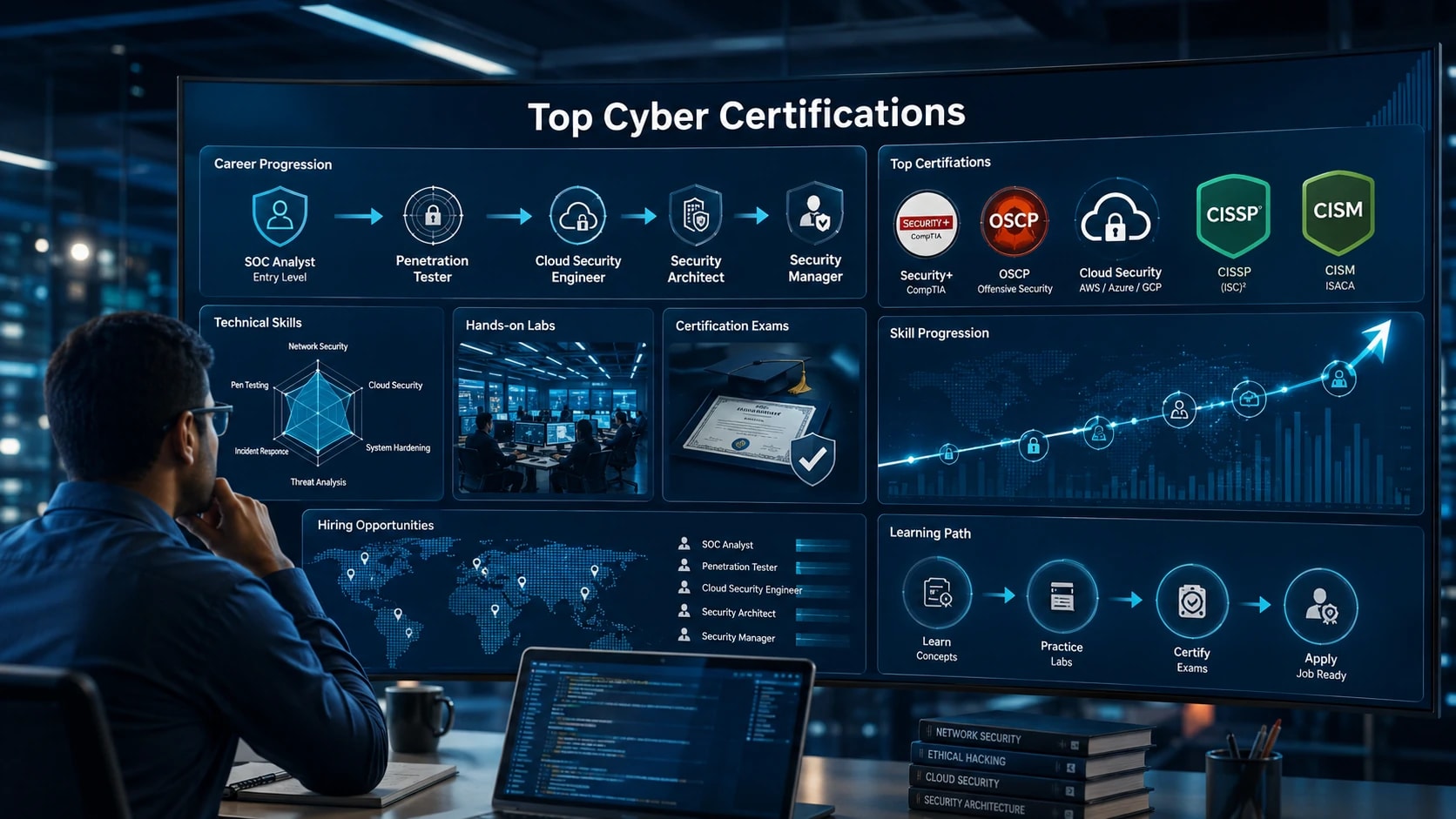
Certifications remain one of the fastest ways to signal competence to hiring managers, especially when you are transitioning into cybersecurity from another field. However, not all certifications carry equal weight in the job market. Some are recognized globally by enterprise security teams and government contractors, while others look impressive on paper but rarely move the needle during applicant screening. Understanding which credentials align with the roles you are targeting will save you months of preparation time and thousands of dollars in exam fees.
For entry-level candidates, CompTIA Security+ remains the most widely requested baseline certification, particularly for SOC analyst and IT security roles. It satisfies U.S. Department of Defense Directive 8570 requirements, which means it opens doors to government and defense contractor positions. From there, candidates typically branch into specialized tracks. Those moving toward offensive security pursue the Offensive Security Certified Professional (OSCP), which is widely considered the gold standard for penetration testing roles. Cloud-focused professionals gravitate toward AWS Security Specialty, Microsoft SC-200, or the Certified Cloud Security Professional (CCSP), all of which are in high demand as organizations continue migrating infrastructure to cloud environments.
Mid-career professionals aiming for management or architecture positions often pursue the Certified Information Systems Security Professional (CISSP) or Certified Information Security Manager (CISM). These certifications require verifiable work experience and signal strategic thinking beyond technical execution, which matters for senior hiring decisions. The table below summarizes the most employer-recognized certifications by role category in 2026.
| Role Category | Recommended Certification | Avg. Salary Uplift | Experience Required |
|---|---|---|---|
| SOC Analyst (L1/L2) | CompTIA Security+, CySA+ | +8-12% | None (entry-level) |
| Penetration Tester | OSCP, CEH | +15-20% | 1-2 years |
| Cloud Security Engineer | CCSP, AWS Security Specialty | +18-25% | 2-3 years |
| Security Architect / Manager | CISSP, CISM | +20-30% | 5+ years |
| Threat Intelligence Analyst | GIAC CTI (GCTI) | +12-18% | 2-4 years |
How to Build a Cyber Security Resume That Passes ATS and Human Review
Most large organizations and staffing agencies now run resumes through Applicant Tracking Systems before a human ever sees them. This means a resume filled with relevant experience but missing the right keywords will be filtered out automatically. Cybersecurity job postings tend to use very specific technical terminology, so your resume needs to mirror that language precisely. Phrases like "SIEM management," "vulnerability assessment," "incident response," "network traffic analysis," and "endpoint detection and response" should appear naturally throughout your document if they reflect genuine skills you possess.
Beyond keyword optimization, the structure of your resume matters significantly. Hiring managers in security roles often spend less than thirty seconds on an initial review, so clarity and specificity are critical. Lead each bullet point with a strong action verb and quantify outcomes wherever possible. Instead of writing "helped monitor network activity," write "analyzed 10,000 daily security events using Splunk, reducing mean time to detect threats by 30%." This kind of specificity demonstrates real operational experience and gives interviewers concrete topics to explore during technical screenings.
A few additional resume practices that improve both ATS scores and recruiter response rates include the following:
- Place a concise technical skills section near the top, listing tools, platforms, and frameworks such as MITRE ATT&CK, Nessus, Wireshark, or Microsoft Sentinel
- Include a certifications section with exam dates, since outdated credentials without renewal dates raise questions
- Add links to a GitHub portfolio, TryHackMe profile, or personal lab documentation to give reviewers proof of hands-on practice.
- Avoid generic phrases like "strong communicator" or "team player," which add no value in a technical screening context.
- Keep formatting clean and ATS-friendly, meaning no tables, graphics, or unusual fonts that parsing software cannot read correctly
Interview Process for Cyber Security Roles: What to Expect
Cyber security interviews typically involve multiple stages, and the format varies depending on the seniority and specialization of the role. Entry-level positions at SOC-focused organizations usually begin with a recruiter screen, followed by a technical phone interview covering fundamental concepts such as the OSI model, common attack vectors, and basic log analysis. Senior or specialized roles often include a take-home technical challenge or a live lab exercise where candidates work through a scenario in real time, such as investigating a simulated incident or identifying vulnerabilities in a test environment.
For penetration testing roles, expect scenario-based questions that require you to walk through a methodology step by step. Interviewers want to understand how you think, not just whether you know the right answer. Common questions include explaining the difference between black-box and white-box testing, describing how you would approach a web application assessment, or detailing how you have handled a situation where a test caused unintended disruption. Being able to articulate your reasoning clearly matters as much as technical accuracy, since pentesters must communicate findings to non-technical stakeholders regularly.
The table below outlines what candidates can typically expect at each interview stage across different security role types.
| Interview Stage | SOC Analyst | Penetration Tester | Cloud Security Engineer |
|---|---|---|---|
| Recruiter Screen | Background, availability, salary | Background, certifications | Background, cloud experience |
| Technical Screen | Threat triaging, SIEM basics | Attack methodology, tool use | IAM, network controls, compliance |
| Practical Assessment | Log analysis exercise | CTF or live lab | Architecture review or case study |
| Final Interview | Behavioral + team fit | Scenario walkthrough + reporting | Stakeholder communication + design |
How to Break Into Cyber Security Without Years of Experience
One of the biggest misconceptions about jobs in cyber security is that you need a computer science degree or years of IT experience before you can get started. The reality is far more accessible. Many professionals transition into cyber security from fields like law enforcement, finance, healthcare, and even teaching. What matters most is demonstrating the right skills and mindset.
Here are practical steps you can take right now to start building your cyber security career:
- Earn entry-level certifications: CompTIA Security+, Google Cybersecurity Certificate, and ISC2 Certified in Cybersecurity are widely recognised starting points that require no prior experience.
- Build a home lab: Set up virtual machines, practice network scanning with tools like Nmap, and explore platforms like TryHackMe or Hack The Box to develop hands-on skills.
- Contribute to open source security projects: GitHub is full of security tools where beginners can contribute, learn, and get noticed by employers.
- Document everything: Start a blog or GitHub portfolio where you record your learning, CTF (Capture the Flag) write-ups, and personal projects. Hiring managers value evidence of curiosity and self-motivation.
- Network actively: Join local OWASP chapters, attend BSides conferences, and connect with security professionals on LinkedIn. Many cybersecurity jobs are filled through personal connections before they are ever advertised.
- Apply for internships and junior analyst roles: Do not wait until you feel completely ready. Employers in this field expect to train entry-level hires and value attitude as much as technical knowledge.
Consistency over a period of six to twelve months of focused self-study, combined with one or two certifications and a visible online portfolio, is often enough to land a first interview in the field.
Cyber Security Salary Expectations by Role and Experience
Salaries across jobs in cyber security vary significantly depending on role, location, experience level, and industry sector. However, even entry-level positions tend to pay above the national average in most countries, reflecting the strong demand for skilled professionals.
The table below outlines typical annual salary ranges for common cybersecurity roles in the United Kingdom and the United States:
| Role | UK Salary Range | US Salary Range | Experience Level |
|---|---|---|---|
| SOC Analyst (Tier 1) | £28,000 - £38,000 | $55,000 - $75,000 | Entry |
| Penetration Tester | £45,000 - £70,000 | $80,000 - $120,000 | Mid |
| Cloud Security Engineer | £55,000 - £85,000 | $100,000 - $145,000 | Mid to Senior |
| Threat Intelligence Analyst | £50,000 - £75,000 | $85,000 - $125,000 | Mid |
| CISO | £100,000 - £180,000+ | $150,000 - $280,000+ | Senior Executive |
Beyond base salary, many cyber security professionals receive benefits including remote work flexibility, professional development budgets, performance bonuses, and employer-funded certifications. Contractors and consultants, particularly in penetration testing and incident response, can command day rates that push annual earnings well above the ranges listed above.
Choosing the Right Cyber Security Career Path for You
With so many roles available, deciding which direction to pursue can feel overwhelming. The good news is that cyber security is a field where career paths are rarely linear, and moving between specialisms is genuinely possible as your interests evolve.
Use the following questions to help identify which area might suit you best:
- Do you enjoy problem-solving under pressure? Incident response and SOC analysis roles thrive on quick thinking and calm decision-making during active threats.
- Are you naturally curious about how things break? Penetration testing and red teaming reward a hacker mindset, creativity, and persistence.
- Do you prefer strategy over technical execution? Roles in governance, risk, and compliance (GRC) or security architecture suit professionals who like designing systems and policies rather than operating them day-to-day.
- Are you drawn to research and analysis? Threat intelligence is a strong fit for those who enjoy investigating adversary behaviour, tracking campaigns, and producing written reports.
- Do you want to work across cloud platforms? Cloud security engineering is one of the fastest-growing specialisms and suits those already comfortable with AWS, Azure, or Google Cloud environments.
Firms like Cyberlad offer a range of specialist services, from SOC consulting and threat intelligence to penetration testing and cloud security, giving professionals in these disciplines the opportunity to work across real-world client engagements with genuine impact.
Conclusion
Jobs in cybersecurity represent some of the most stable, rewarding, and genuinely impactful career opportunities available today. Whether you are just starting with your first certification, transitioning from another technology role, or looking to specialise after years as a generalist, the field has a clear path for you. The skills gap is real, salaries are strong, and demand continues to grow faster than the talent pipeline can currently supply. There has never been a better time to commit to this career direction.
The key is to take deliberate action. Choose a specialism that matches your natural strengths, invest in practical skills alongside formal qualifications, and build a visible portfolio that demonstrates what you can actually do. If you want to understand what working in cyber security looks like at the sharp end of real threat defence, reach out to the team at Cyberlad. Whether you are looking for guidance on your career path or exploring how expert security services are delivered in practice, we are here to help.
Frequently Asked Questions
What qualifications do I need to get a job in cybersecurity?
There is no single required qualification. Many employers value certifications like CompTIA Security+, CEH, or CISSP depending on the role. A degree in computer science or information security is useful but not essential. Practical skills, a strong portfolio, and relevant certifications often matter more than formal academic credentials.
Is cyber security a good career choice in 2025?
Yes, cyber security remains one of the strongest career choices available. Global demand for skilled professionals continues to outpace supply, salaries are above average across all experience levels, and the work is varied and genuinely meaningful. Job security in this field is among the highest of any technology discipline.
How long does it take to get into cybersecurity from scratch?
Most people can reach an entry-level position within six to eighteen months of focused study, depending on prior technical background. Completing one or two certifications, building a home lab, and practising on platforms like TryHackMe significantly accelerates the process. Consistent effort over a defined period is more important than speed.
Can I work remotely in a cyber security job?
Many cyber security roles support remote or hybrid working arrangements, particularly in areas like threat intelligence, GRC, cloud security, and SOC analysis. Some positions, including on-site penetration testing or physical security assessments, require travel or in-person attendance. Remote opportunities have expanded significantly across the industry in recent years.
What is the highest-paying job in cyber security?
Chief Information Security Officer is typically the highest-paid role, with senior CISO positions reaching well over £150,000 or $200,000 annually. Experienced cloud security architects, security directors, and specialised penetration testing consultants also command very high earnings, particularly within financial services, government contracting, and large enterprise environments.