Cyber security SEO is the process of optimizing a cybersecurity website so it ranks higher in search results, attracts qualified security buyers, builds trust, and turns organic traffic into leads for services like MDR, SOC, penetration testing, cloud security, compliance, and incident response.
Cyber security SEO helps your company show up when prospects search for solutions to urgent, high-risk problems. These searches often come from CISOs, IT directors, compliance managers, founders, MSP owners, and security teams that need help protecting their business.
They might search for:
- “managed detection and response provider”
- “SOC as a service for healthcare”
- “ransomware incident response company”
- “penetration testing services”
- “SIEM monitoring service”
- “cloud security assessment”
- “phishing simulation platform”
- “cybersecurity compliance consultant”
Your website needs to answer those searches with clarity, authority, and trust.
Cybersecurity SEO is not just about traffic. Traffic alone does not help if it comes from students, job seekers, or people looking for free tools. The goal is to attract buyers who have real intent, real budgets, and real security problems.
For CyberLad.io, a strong cybersecurity SEO strategy should connect technical search optimization with B2B cybersecurity marketing. That means your website should explain your services, prove your expertise, answer buyer questions, and make it easy for visitors to book a call, request a quote, or download a useful resource.
Google’s own SEO guidance focuses on making pages easier to crawl, index, and understand, while also creating helpful content for people. That matters even more in cybersecurity because trust, accuracy, and expertise can affect high-stakes business decisions.
Check out our latest blog on How to Get Into Cyber Security With No Experience
Why Cyber Security SEO Deserves Serious Attention
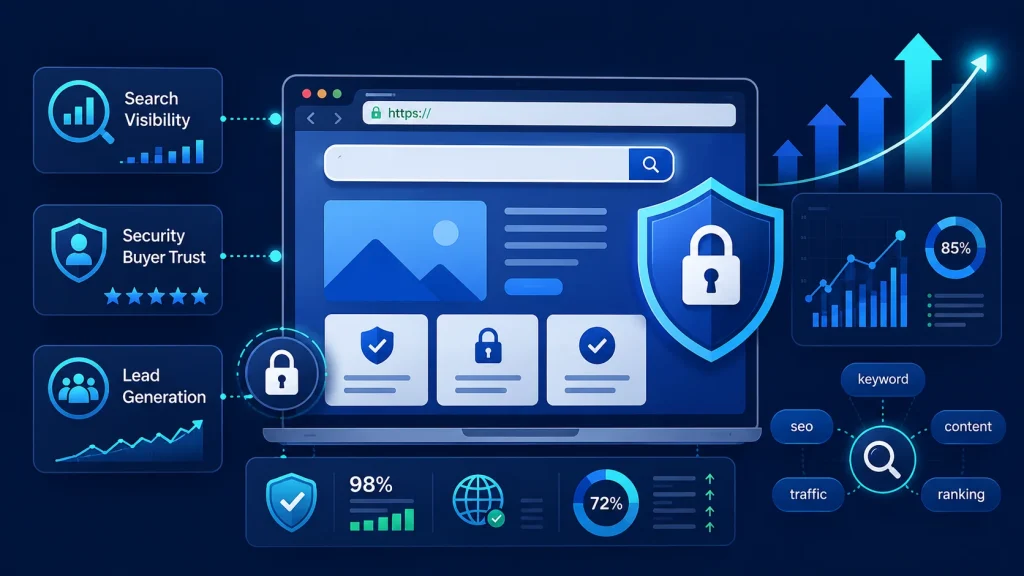
Cybersecurity buyers do not wake up one morning and casually buy MDR, XDR, SOC monitoring, penetration testing, SIEM consulting, or ransomware response services.
They search because something changed.
Maybe their board asked about risk. Maybe a client sent a security questionnaire. Maybe cyber insurance renewal exposed gaps. Maybe their team failed a phishing test. Maybe an alert from their SIEM showed suspicious behavior. Maybe they suffered a ransomware incident and need help now.
That is where cyber security seo becomes a growth channel.
When your website ranks for the right cybersecurity keywords, you meet buyers at the exact moment they’re looking for help. You do not need to interrupt them with cold emails or hope they see your ad. You answer their question, build confidence, and guide them toward the next step.
But cybersecurity SEO is hard.
You’re not selling simple products. You’re selling trust. Your buyers are technical, skeptical, and risk-aware. They know when content sounds shallow. They can spot vague claims, recycled definitions, and keyword stuffing from a mile away.
A cybersecurity company must rank and persuade at the same time. Your page needs to satisfy Google, but it also needs to satisfy a CISO who wants proof, an IT manager who wants clarity, and a CFO who wants business value.
This guide shows you how to build a cyber security SEO strategy that works for cybersecurity companies, MSPs, MDR providers, SOC service providers, SaaS security brands, and cybersecurity marketers.
Why SEO Matters for Cybersecurity Companies
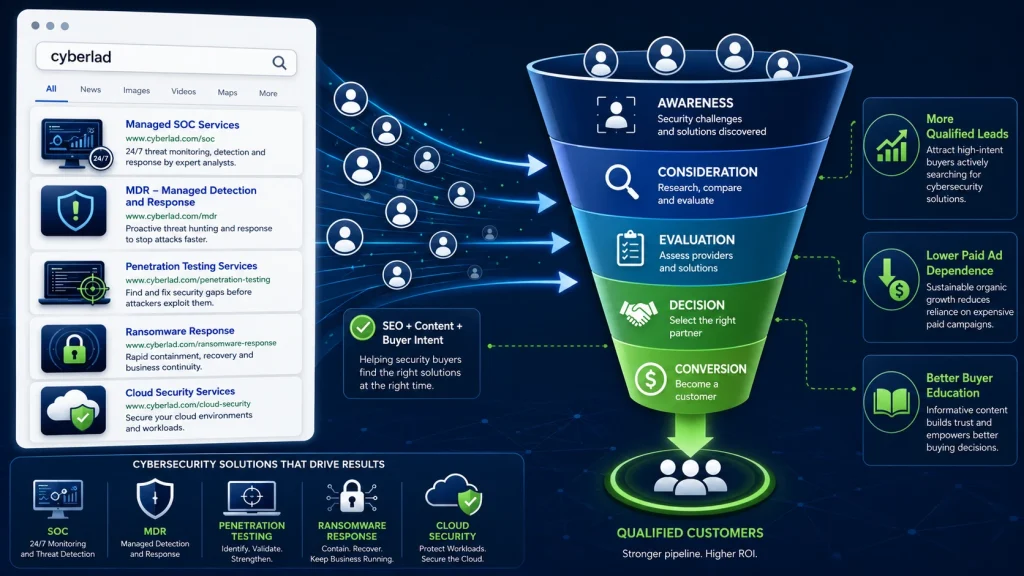
SEO matters because cybersecurity buyers use search to research risk, compare vendors, and validate trust before they speak with sales.
Paid ads can work, but they get expensive in competitive cybersecurity markets. Cold outreach can help, but many security buyers ignore generic pitches. SEO gives you a longer-term advantage because your content can keep attracting qualified leads after it is published, optimized, and ranked.
For cybersecurity companies, SEO supports several business goals at once.
First, it helps with lead generation. A buyer searching “MDR provider for financial services” is not the same as someone reading a broad cybersecurity awareness article. That search has business intent. If your page ranks and explains your MDR service well, you have a chance to capture a high-value lead.
Second, SEO supports sales education. Cybersecurity buying cycles can be long. A prospect may read your guide on ransomware readiness, download your incident response checklist, compare your SOC service page, and later book a demo. Each page helps them understand your value.
Third, SEO builds brand trust. When your company keeps appearing for useful topics like phishing prevention, cloud security posture management, SIEM tuning, compliance readiness, and penetration testing, buyers start seeing you as a credible resource.
Fourth, SEO reduces dependency on paid channels. If all your leads come from ads, your pipeline depends on budget. Organic search gives you an owned growth asset. Your rankings, content, and topic authority can strengthen over time.
Cybersecurity search intent often falls into four buckets:
| Search Intent | Example Keyword | Buyer Stage | Best Page Type |
|---|---|---|---|
| Informational | What is MDR | Early research | Educational blog |
| Problem-aware | How to stop phishing attacks | Early to middle | Guide or checklist |
| Solution-aware | MDR vs SOC as a service | Middle | Comparison page |
| Vendor-ready | best penetration testing company for SaaS | Late | Service page or landing page |
The mistake many cybersecurity companies make is focusing only on early-stage informational content. That can bring traffic, but it may not bring leads. A complete cyber security SEO plan needs content for every stage of the buying journey.
How Cyber Security SEO Is Different From Normal SEO
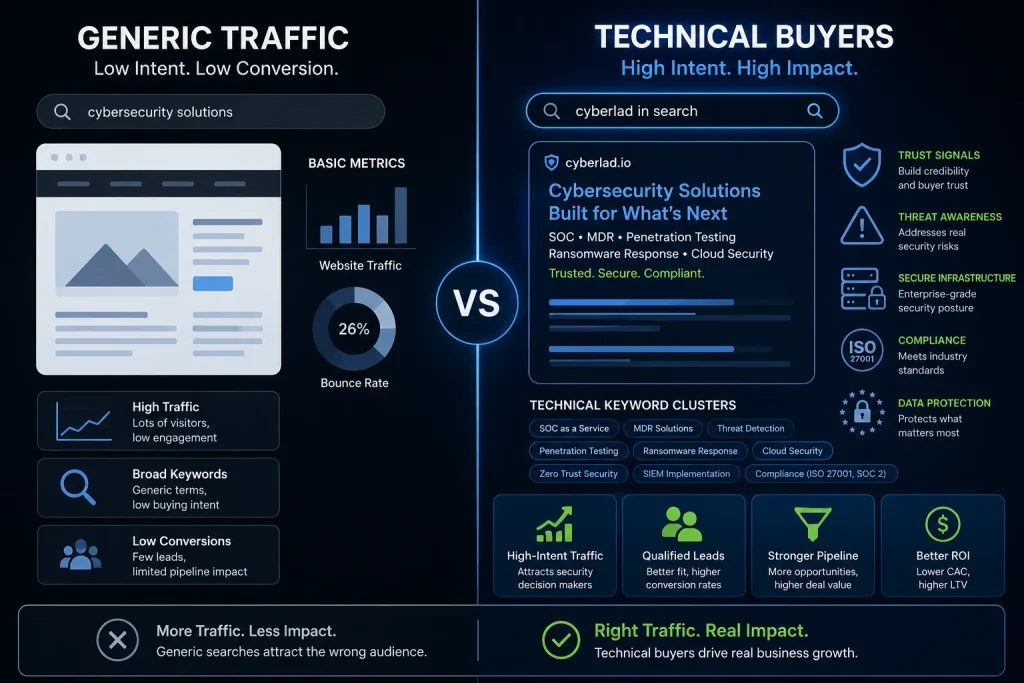
Cybersecurity SEO is different because the buyer is more technical, the stakes are higher, and trust matters more than in most industries.
A normal SEO campaign might optimize pages for local services, ecommerce products, or general SaaS features. Cybersecurity SEO has to deal with complex topics like ransomware, endpoint detection, vulnerability management, SOC operations, threat hunting, identity security, cloud security, compliance, and incident response.
Your content cannot stay on the surface.
For example, a generic SEO article might say, “Use strong passwords to prevent phishing.” A cybersecurity buyer expects more. They want practical guidance around MFA, conditional access, email security gateways, DMARC, user training, endpoint telemetry, incident response workflows, and security awareness metrics.
That level of detail changes how you create content.
You also need stronger credibility signals. In cybersecurity, your claims must be supported by experience, technical knowledge, case studies, certifications, frameworks, and clear processes. Google describes E-E-A-T as experience, expertise, authoritativeness, and trustworthiness, and its helpful content guidance explains that these signals help systems prioritize content that appears useful and reliable.
Cybersecurity SEO is also more sensitive because some topics relate to harm, privacy, regulated industries, and business continuity. A thin or inaccurate page about ransomware response, incident handling, or compliance can damage trust.
Here is what makes SEO for cybersecurity companies different:
- Longer buying cycles: Buyers may compare vendors for weeks or months.
- Multiple stakeholders: A CISO, IT director, procurement team, legal team, and CFO may all influence the decision.
- Complex keywords: Terms like SIEM, XDR, MDR, SOC, CSPM, CNAPP, IAM, and EDR require clear explanations.
- High competition: Many cybersecurity keywords are targeted by vendors, agencies, review sites, and publishers.
- Trust-heavy conversion: Buyers need proof before they submit a form.
- Technical content needs: Your pages need accuracy, not generic advice.
Normal SEO asks, “Can we rank?” Cybersecurity SEO asks, “Can we rank, earn trust, and convert a skeptical technical buyer?”
That is the standard you need to meet.
Best Cybersecurity Keywords to Target
The best cybersecurity keywords are not always the highest-volume keywords. The best keywords are the ones that match your services, buyer intent, and revenue goals.
Many companies chase broad keywords like “cybersecurity,” “malware,” or “phishing.” These can bring traffic, but they’re often too broad to convert. A better cyber security SEO strategy focuses on keyword groups that connect to specific services and buying pain points.
Start with your core offers.
If you sell MDR, target keywords around:
- managed detection and response
- MDR provider
- MDR services
- MDR for small business
- MDR vs EDR
- MDR vs SOC
- 24/7 threat monitoring
- endpoint detection and response service
If you provide SOC services, target:
- SOC as a service
- managed SOC provider
- outsourced SOC
- SOC monitoring services
- 24/7 SOC services
- security operations center services
- SIEM monitoring service
If you offer penetration testing, target:
- penetration testing services
- web application penetration testing
- network penetration testing
- SaaS penetration testing
- cloud penetration testing
- API penetration testing
- compliance penetration testing
If you handle incident response, target:
- ransomware incident response
- cyber incident response company
- data breach response services
- incident response retainer
- malware removal for business
- digital forensics and incident response
If you support compliance, target:
- cybersecurity compliance services
- SOC 2 security consultant
- HIPAA cybersecurity assessment
- PCI DSS cybersecurity compliance
- ISO 27001 readiness
- NIST cybersecurity framework consultant
NIST’s Cybersecurity Framework is a useful reference point because many organizations use it to understand and improve cybersecurity risk management. Referencing known frameworks can help your content match how buyers think about security programs.
You should also target comparison keywords because they attract serious buyers:
- MDR vs XDR
- SOC vs SIEM
- EDR vs MDR
- vulnerability assessment vs penetration testing
- SIEM vs SOAR
- CASB vs CSPM
- managed SOC vs in-house SOC
Do not ignore pain-based keywords either:
- How to prevent ransomware attacks
- How to respond to a phishing attack
- What to do after a data breach
- How to reduce alert fatigue
- How to improve cloud security
- How to prepare for cyber insurance renewal
These keywords work well for blog content, checklists, webinars, and downloadable guides.
The strongest cybersecurity keyword strategy usually includes a mix of:
- Commercial service keywords
- Industry-specific keywords
- Problem-aware keywords
- Comparison keywords
- Compliance keywords
- Tool and technology keywords
- Executive-level risk keywords
Your goal is not to rank for every cybersecurity term. Your goal is to rank for the terms your best buyers use before they contact a vendor.
Check out our latest post on GSOC Security: Global Security Operations Center
Cybersecurity SEO Strategy Step by Step
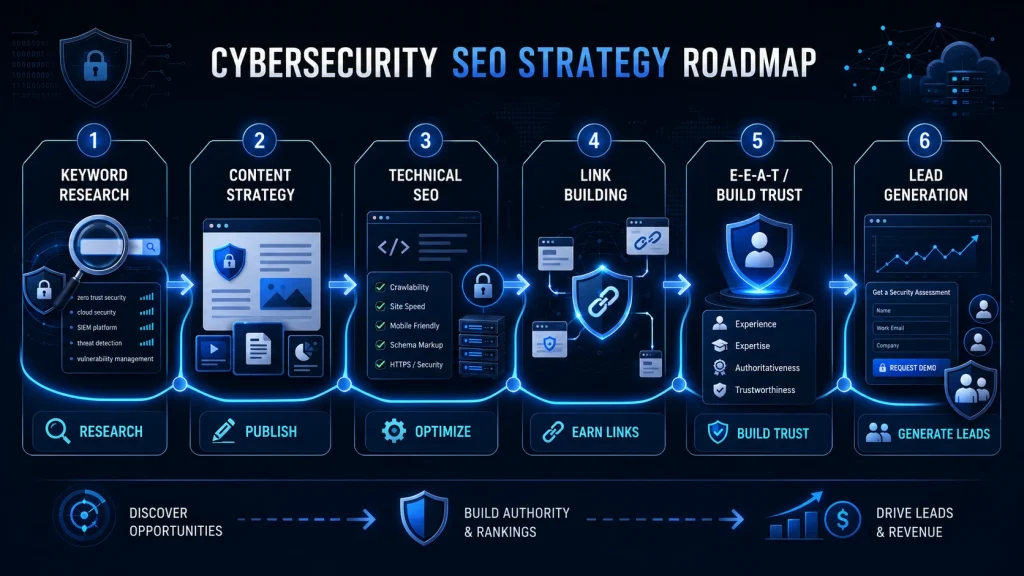
A strong cyber security SEO strategy starts with business goals, not keyword tools.
Before you write content, you need to know what you want organic search to produce. Do you want more MDR demos? More penetration testing requests? More SOC consultation calls? More SaaS trials? More compliance assessment leads?
Once you know the revenue goal, build the strategy around it.
Step 1: Define your best-fit buyer
Cybersecurity companies often serve different segments. An MSP selling security services to SMBs needs different SEO than an enterprise XDR vendor. A penetration testing firm serving SaaS startups needs different content than an incident response provider helping hospitals.
Define:
- Company size
- Industry
- Security maturity
- Main pain points
- Compliance needs
- Buying triggers
- Decision makers
- Budget level
For example, a healthcare organization may search for HIPAA security risk assessment, ransomware readiness, phishing training, and endpoint protection. A SaaS company may search for SOC 2 readiness, cloud penetration testing, API security testing, and an incident response retainer.
Step 2: Map keywords to funnel stages
Do not put every keyword into blog posts. Some keywords need service pages.
A search like “ransomware incident response company” should land on a conversion-focused service page. A search like “how does ransomware spread” can land on an educational blog.
Use this simple mapping:
| Funnel Stage | Search Example | Best Content |
|---|---|---|
| Awareness | What is XDR | Blog guide |
| Problem | alert fatigue in SOC | Thought leadership article |
| Solution | MDR vs XDR | Comparison page |
| Vendor | MDR provider for SaaS companies | Service landing page |
| Conversion | incident response retainer pricing | Sales enablement page |
Step 3: Build topic clusters
A topic cluster helps Google and buyers understand your expertise.
For example, an MDR cluster could include:
- Main page: Managed Detection and Response Services
- Blog: What Is MDR?
- Blog: MDR vs EDR
- Blog: MDR vs XDR
- Blog: How MDR Reduces Alert Fatigue
- Blog: What to Look for in an MDR Provider
- Case study: How MDR Helped Stop Lateral Movement
- Checklist: MDR Buyer Evaluation Checklist
This structure gives you internal linking opportunities and helps visitors move from education to evaluation.
Step 4: Create high-intent service pages
Many cybersecurity websites have weak service pages. They describe the service in broad language but do not answer buyer questions.
A strong service page should include:
- Who the service is for
- What problems does it solve
- What is included
- Your process
- Tools or technologies supported
- Compliance relevance
- Response times or SLAs, when applicable
- Case studies or proof
- FAQs
- Clear calls to action
Step 5: Publish expert content
Cybersecurity content should feel like it came from people who understand security operations. Use real scenarios.
For example, instead of saying “we help detect threats,” explain how your SOC investigates suspicious PowerShell activity, impossible travel alerts, endpoint detections, privilege escalation, or abnormal cloud login behavior.
That detail builds trust.
Step 6: Optimize conversion paths
Ranking is only part of the job. Your pages need clear next steps.
Use calls to action such as:
- Book a security consultation
- Request a penetration test quote
- Download the incident response checklist
- Get an MDR readiness assessment
- Schedule a SOC consultation
- Talk to a cloud security expert
Each page should match the buyer’s intent.
Content Ideas for Cybersecurity Websites
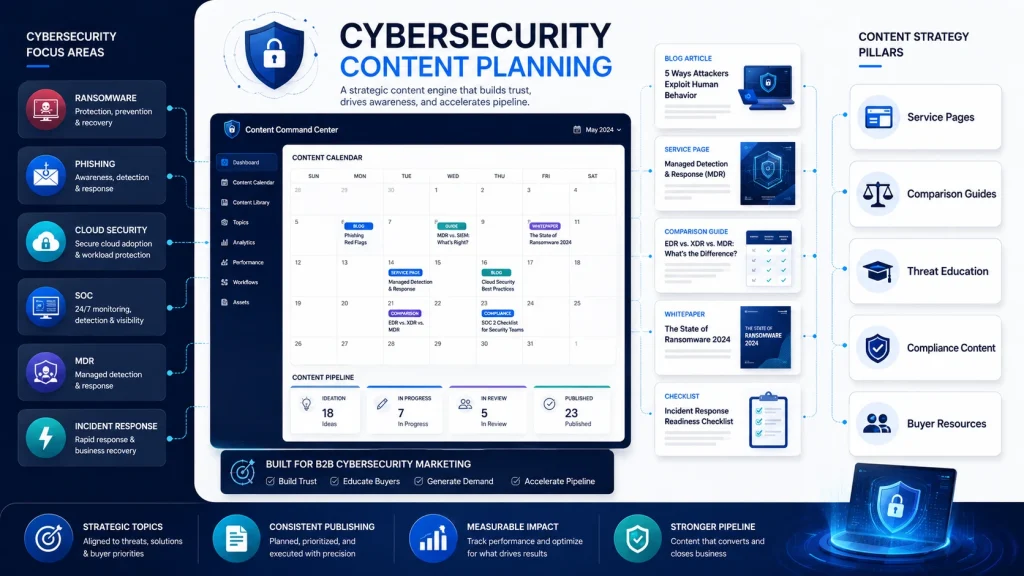
Cybersecurity websites need content that educates, proves expertise, and moves buyers toward action.
A useful cybersecurity content strategy should include service pages, comparison pages, technical guides, compliance content, incident response resources, and executive-level articles.
Here are practical content ideas.
Service page ideas
These pages target commercial intent:
- Managed Detection and Response Services
- SOC as a Service
- Ransomware Incident Response Services
- Penetration Testing Services
- Cloud Security Assessment
- SIEM Monitoring Services
- Phishing Simulation and Training
- Vulnerability Management Services
- Cybersecurity Compliance Consulting
- Incident Response Retainer
Each service page should explain the problem, your process, deliverables, timelines, and expected business outcome.
Blog guide ideas
These pages attract early and middle-stage searchers:
- What Is MDR and How Does It Work?
- MDR vs XDR: Which One Do You Need?
- SOC as a Service vs In-House SOC
- How to Prepare for a Penetration Test
- What to Do After a Phishing Attack
- How to Build a Ransomware Response Plan
- SIEM Implementation Mistakes to Avoid
- Cloud Security Best Practices for SaaS Companies
- How to Reduce False Positives in Security Alerts
- Cybersecurity Checklist for Growing Companies
Comparison of content ideas
Comparison pages help buyers make decisions:
- EDR vs MDR
- SIEM vs SOAR
- MDR vs MSSP
- Vulnerability Assessment vs Penetration Testing
- SOC 2 vs ISO 27001
- Cloud Security Assessment vs Cloud Penetration Test
Industry-specific content ideas
Industry pages can bring better-qualified leads:
- Cybersecurity Services for Healthcare
- MDR for Financial Services
- SOC as a Service for SaaS Companies
- Penetration Testing for FinTech
- Cloud Security for Technology Companies
- Ransomware Readiness for Manufacturing
Incident and risk content ideas
These topics connect to urgent buyer needs:
- Ransomware Response Checklist
- Phishing Attack Response Plan
- Business Email Compromise Guide
- Data Breach Preparation Checklist
- Cyber Insurance Readiness Guide
- Incident Response Tabletop Exercise Guide
CISA’s ransomware resources and alerts can be strong external references when creating incident response and threat-focused content, especially when you need authoritative guidance for risk reduction and response planning.
The best cybersecurity content does not just define terms. It helps the reader make a decision, avoid a mistake, or take the next step.
On-Page SEO Tips for Cybersecurity Pages
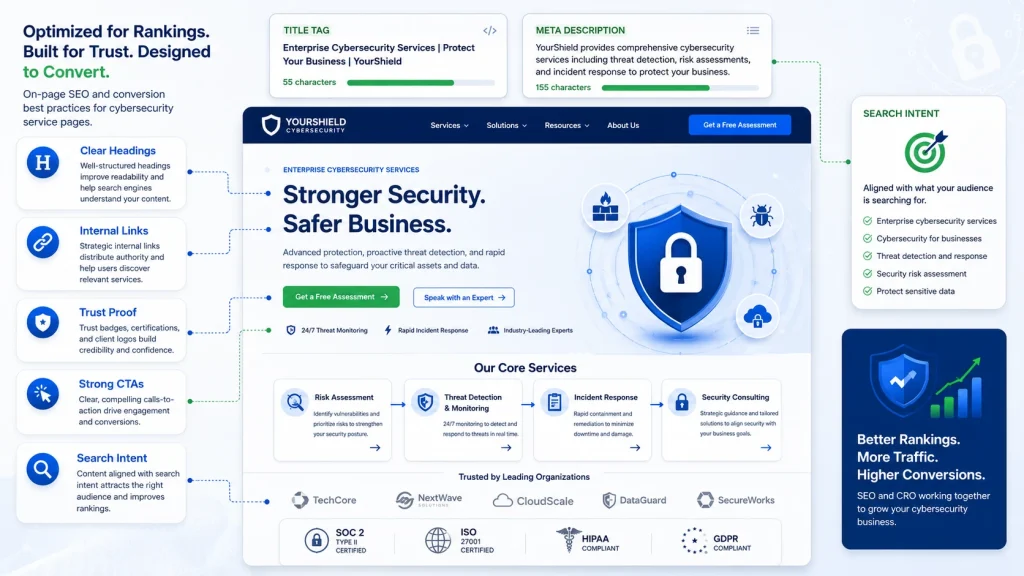
On-page SEO helps search engines and buyers understand what each page is about.
For cybersecurity pages, clarity matters. Your visitor may be technical, but they still want fast answers. Do not bury your value under vague language.
Use the main keyword in key places
For a page targeting cyber security seo, the phrase should appear in:
- SEO title
- Meta description
- H1 or page title
- Intro
- At least one H2
- Body copy
- Conclusion
- Image alt text, where relevant
Use it naturally. Do not force the keyword into every paragraph.
Write specific title tags.
Weak title:
Cybersecurity Services
Better title:
Managed SOC Services for 24/7 Threat Monitoring
Weak title:
Penetration Testing
Better title:
SaaS Penetration Testing Services for Web Apps and APIs
Specific titles help buyers and search engines.
Make intros direct
Cybersecurity buyers do not want a slow opening. Tell them what the page covers and why it matters.
For example:
“Your SIEM is only useful if your team can tune, monitor, and investigate alerts. Our SIEM monitoring service helps you reduce noise, detect threats, and respond faster.”
That is stronger than:
“In today’s digital world, cybersecurity is more important than ever.”
Use headings that answer buyer questions.
Good headings include:
- What is included in our MDR service?
- How our SOC investigates alerts
- When you need incident response support
- What you receive after a penetration test
- How we support SOC 2 and ISO 27001 readiness
- Why cloud misconfigurations create security risk
Add proof near conversion points
Do not wait until the bottom of the page to build trust. Place proof throughout the page.
Use:
- Case study summaries
- Security certifications
- Analyst mentions
- Client logos, when allowed
- Tool partnerships
- Team credentials
- Measurable outcomes
- Testimonials
- Compliance expertise
Write useful FAQs
FAQs are valuable because cybersecurity buyers have many concerns.
For an MDR page, answer:
- Do you provide 24/7 monitoring?
- What telemetry sources do you monitor?
- Do you support Microsoft Sentinel, Splunk, or other SIEM tools?
- How fast do you respond to critical alerts?
- Do you help with containment and remediation?
On-page SEO for cybersecurity pages should make the page easier to understand, easier to trust, and easier to act on.
Technical SEO for Cybersecurity Websites
Technical SEO helps search engines crawl, index, and rank your website. For cybersecurity companies, it also affects trust.
A slow, broken, insecure, or poorly structured website sends the wrong message. If you sell security but your own website has technical problems, buyers may question your credibility.
Google’s SEO documentation explains that SEO includes making your site easier for search engines to crawl, index, and understand. That starts with strong technical foundations.
Focus on these areas.
Crawlability and indexation
Make sure search engines can access your important pages.
Check:
- Robots.txt
- XML sitemap
- Noindex tags
- Canonical tags
- Redirect chains
- Broken internal links
- Orphan pages
- Duplicate pages
Your key pages should be easy to find from your navigation and internal links.
Site architecture
Group pages by service and topic.
Example structure:
- /services/managed-detection-response/
- /services/soc-as-a-service/
- /services/penetration-testing/
- /resources/mdr-vs-xdr/
- /resources/ransomware-response-checklist/
- /industries/healthcare-cybersecurity/
- /industries/saas-cybersecurity/
This helps users and search engines understand your site.
Page speed and Core Web Vitals
Cybersecurity buyers may visit from corporate networks, mobile devices, or locked-down browsers. Your site should load fast and work cleanly.
Improve:
- Image compression
- JavaScript bloat
- Server response time
- Font loading
- Layout stability
- Mobile usability
Security signals
Your website should model the security you sell.
Check:
- HTTPS across the whole site
- No mixed content
- Secure forms
- Clear privacy policy
- Cookie consent, where required
- Updated plugins and CMS
- No exposed staging pages
- No broken certificate chains
Schema markup
Use structured data where relevant:
- Organization schema
- LocalBusiness schema, if applicable
- FAQ schema
- Article schema
- Breadcrumb schema
- Product or Software Application schema for SaaS platforms
- Review the schema, where compliant and accurate
Log file and analytics review
For larger cybersecurity websites, review crawl logs and analytics. You may discover that Google crawls low-value pages often while missing key service pages.
Look for:
- Pages with impressions but low clicks
- Pages ranking on page two
- Important pages with low crawl frequency
- Technical pages that should not be indexed
- Old content that needs consolidation
Technical SEO is not glamorous, but it protects your visibility. Strong content can underperform if your site has crawl, indexation, speed, or architecture issues.
Link Building for Cybersecurity Brands
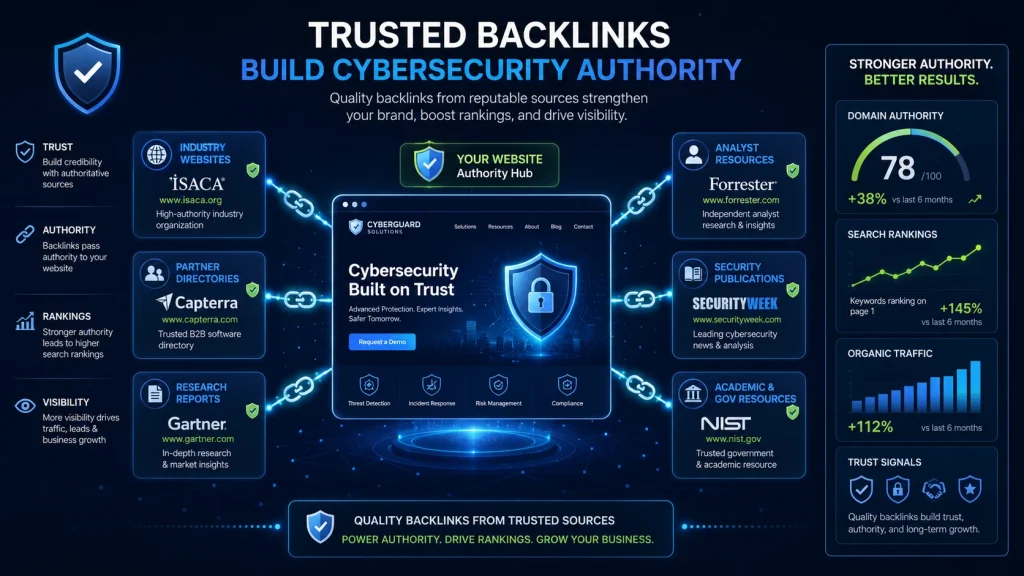
Link building helps cybersecurity brands build authority, but it must be done with care.
Bad link building can damage your reputation. Cybersecurity buyers are skeptical, and spammy guest posts or irrelevant backlinks can look unprofessional. Your goal is to earn links from relevant, trusted sources.
Good link building for cybersecurity companies usually comes from expertise, original insight, partnerships, and useful resources.
Create link-worthy assets
Useful cybersecurity assets attract links because people need credible references.
Examples:
- Ransomware readiness checklist
- Incident response plan template
- Cyber insurance readiness checklist
- Phishing simulation benchmark report
- Cloud security misconfiguration guide
- SOC alert triage framework
- MDR buyer’s guide
- SIEM rule tuning checklist
- Annual threat report
- Compliance mapping guide
Publish original data
Original data can earn links from blogs, journalists, analysts, and industry newsletters.
You can publish data from:
- Security assessments
- Penetration testing findings
- Phishing simulation results
- Cloud misconfiguration trends
- Incident response patterns
- MDR alert categories
- Vulnerability management reports
Remove client identifiers and sensitive details. Use aggregated data.
Use partner and ecosystem links
Cybersecurity companies often have natural partner link opportunities.
Look at:
- Technology partner directories
- MSP partner pages
- Cloud marketplace listings
- Integration pages
- Compliance partner pages
- Security association directories
- Event sponsorship pages
- Podcast guest profiles
- Webinar co-marketing pages
Contribute expert commentary
Founders, researchers, SOC leads, and incident responders can contribute useful insights.
Opportunities include:
- Cybersecurity podcasts
- Expert roundups
- Industry newsletters
- Conference recaps
- Vendor-neutral educational webinars
- Research collaborations
- Guest articles on respected security sites
Avoid risky link tactics
Avoid:
- Private blog networks
- Bulk link packages
- Irrelevant guest posting
- AI-generated spam articles
- Low-quality directories
- Exact-match anchor text abuse
- Links from hacked or suspicious sites
For cybersecurity brands, link quality beats link quantity. One strong link from a relevant security publication, standards body, partner directory, or respected industry resource can be worth more than dozens of low-quality links.
E-E-A-T and Trust Signals in Cybersecurity SEO
E-E-A-T matters in cybersecurity because buyers need to know who they’re trusting.
Google’s helpful content guidance explains that E-E-A-T stands for experience, expertise, authoritativeness, and trustworthiness. Google also states that trust is the most important aspect of that concept.
For cyber security SEO, E-E-A-T is not just an SEO concept. It is also a conversion concept.
A buyer may ask:
- Have you handled ransomware incidents before?
- Does your team understand SOC operations?
- Can you support our SIEM?
- Do you know our compliance requirements?
- Can you protect cloud environments?
- Do you have real penetration testing experience?
- Can we trust your recommendations?
Your website should answer those questions before the buyer speaks with sales.
Show experience
Experience means your content should reflect real-world security work.
Add:
- Incident response lessons learned
- SOC analyst insights
- Penetration testing examples
- Cloud security findings
- Phishing simulation observations
- Compliance project experience
- Tool-specific implementation notes
For example, a page about incident response should explain triage, containment, eradication, recovery, and post-incident review. It should not stop at “respond fast.”
Show expertise
Add expert authorship to technical content.
Include:
- Author names
- Job titles
- Certifications
- Relevant experience
- LinkedIn profiles
- Reviewers for sensitive topics
- Last updated dates
A ransomware article reviewed by an incident response lead feels more credible than an anonymous post.
Show authority
Authority comes from reputation.
Use:
- Case studies
- Client testimonials
- Awards
- Certifications
- Media mentions
- Conference talks
- Research reports
- Partner badges
- Security community involvement
Show trust
Trust signals should be visible across your site.
Add:
- Clear company information
- Contact details
- Privacy policy
- Secure forms
- Transparent service descriptions
- Honest limitations
- Clear pricing guidance, where possible
- No exaggerated claims
Avoid claims like “stop all cyberattacks” or “guaranteed breach prevention.” Security buyers know that no provider can promise that.
A trusted cybersecurity website is specific, honest, and evidence-based.
Common Cyber Security SEO Mistakes
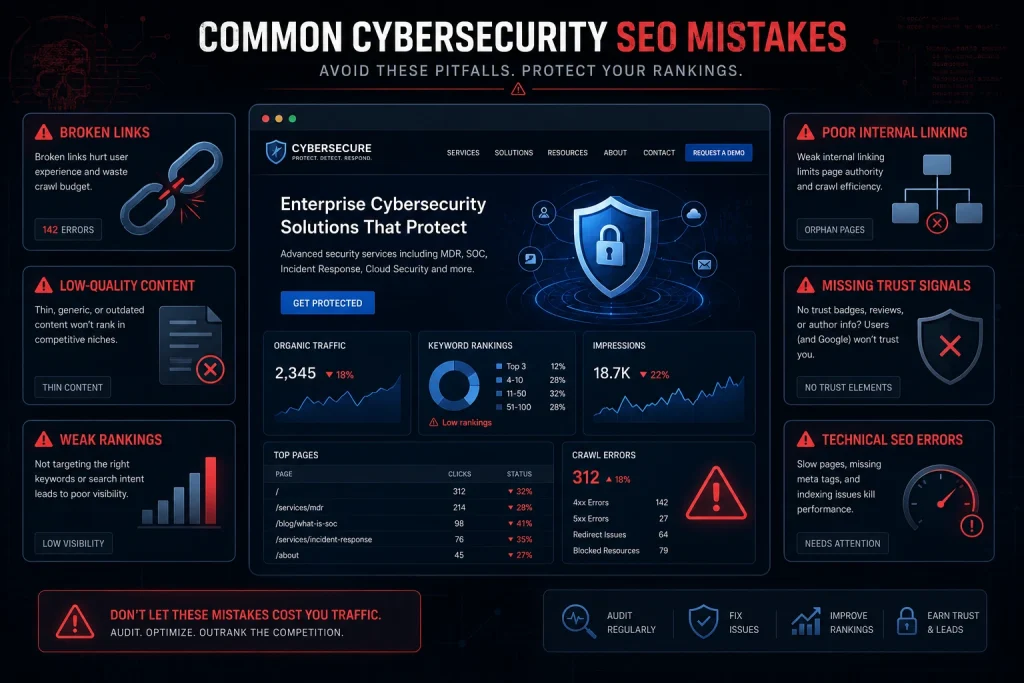
Many cybersecurity companies invest in SEO but get weak results because they focus on the wrong things.
Here are the common mistakes to avoid.
Mistake 1: Targeting only broad keywords
Ranking for “cybersecurity” sounds impressive, but it may not produce leads. A focused keyword like “SOC as a service for SaaS companies” may bring fewer visitors but better prospects.
Mistake 2: Writing generic content
Generic content does not stand out.
Weak example:
“Ransomware is dangerous, and businesses need protection.”
Better example:
“Ransomware readiness should include offline backups, MFA, endpoint detection, network segmentation, tested restoration procedures, and a documented incident response plan.”
CISA and the FBI both provide public ransomware guidance, and their resources show how response and prevention advice needs to be practical, not vague.
Mistake 3: Ignoring service pages
Some companies publish blogs but neglect commercial pages. Blogs may attract traffic, but service pages often convert leads.
Your MDR, SOC, penetration testing, incident response, and cloud security pages need strong SEO, too.
Mistake 4: Not matching search intent
A visitor searching “MDR pricing” wants buying information. Do not send them to a definition blog.
A visitor searching “what is XDR” wants education. Do not send them to an aggressive sales page.
Mistake 5: Weak internal linking
Internal links help users and search engines understand your site.
For example, your ransomware guide should link to your incident response service page. Your MDR vs XDR article should link to your MDR service page. Your SOC guide should link to your SIEM monitoring page.
Mistake 6: No proof
Cybersecurity buyers want evidence.
A page without case studies, examples, team expertise, certifications, process details, or testimonials may struggle to convert.
Mistake 7: Publishing without updating
Cybersecurity changes fast. Old content about compliance, ransomware, threat groups, or tools can become outdated. Review important pages at least twice a year.
Mistake 8: Making content too technical or too shallow
You need balance.
A CISO may want a strategy and business risk. A security engineer may want technical details. A founder may want cost, timeline, and outcome. Strong content speaks to all of them without becoming confusing.
How Long Does Cybersecurity SEO Take?
Cybersecurity SEO usually takes several months to show meaningful results, and competitive keywords can take longer.
The timeline depends on your website authority, technical health, content quality, competition, backlink profile, and how specific your target keywords are.
A new cybersecurity website targeting “MDR provider” will face tough competition. An established company targeting “MDR for regional healthcare organizations” may rank faster because the keyword is more specific.
Here is a practical timeline:
| Timeline | What Usually Happens | Main Focus |
|---|---|---|
| Month 1 | Audit, keyword research, strategy, and technical fixes | Foundation |
| Months 2 to 3 | Service page optimization, first content clusters | Relevance |
| Months 4 to 6 | Rankings improve for long-tail keywords | Momentum |
| Months 6 to 12 | More qualified traffic and leads | Authority |
| 12+ months | Stronger rankings for competitive terms | Scale |
SEO is slower than paid ads, but it compounds.
A paid campaign stops when the budget stops. A ranked guide, service page, or comparison page can keep producing leads if you maintain it.
To speed up results:
- Fix technical SEO issues early
- Optimize high-intent service pages first
- Build topic clusters around revenue-driving services
- Update underperforming pages
- Add internal links from related content
- Earn relevant backlinks
- Improve conversion paths
- Publish expert-backed content
Do not judge cybersecurity SEO only by traffic. Track qualified leads, demo requests, consultation calls, content-assisted pipeline, and ranking improvements for commercial keywords.
Cyber Security SEO Checklist
Use this cyber security SEO checklist to review your website.
Strategy checklist
- Define your best-fit cybersecurity buyer
- Identify your highest-value services
- Map keywords to buyer intent
- Build topic clusters around core services
- Prioritize commercial pages before low-intent blogs
- Create content for awareness, comparison, and vendor-ready searches
Keyword checklist
- Target MDR, SOC, XDR, SIEM, penetration testing, cloud security, compliance, phishing, ransomware, and incident response terms where relevant
- Use long-tail keywords with buyer intent
- Build industry-specific keyword groups
- Include comparison keywords
- Avoid chasing broad traffic with weak conversion potential
On-page checklist
- Use the target keyword in the title tag
- Write a clear meta description
- Use one H1
- Structure pages with helpful H2s and H3s
- Add internal links
- Add FAQs
- Include clear calls to action
- Use descriptive image alt text
- Add proof near conversion points
Content checklist
- Write for technical and business buyers
- Include real cybersecurity examples
- Explain your process
- Add practical steps
- Avoid vague security claims
- Include expert authors or reviewers
- Update important pages often
- Support claims with trusted sources
Technical SEO checklist
- Submit an XML sitemap
- Check robots.txt
- Fix broken links
- Remove unnecessary noindex tags
- Improve page speed
- Make pages mobile-friendly
- Use HTTPS
- Add schema markup
- Fix duplicate content
- Improve site architecture
Link building checklist
- Create link-worthy security resources
- Publish original research or benchmark data
- Build partner directory links
- Contribute expert commentary
- Promote useful guides to industry publications
- Avoid low-quality link schemes
Conversion checklist
- Add clear CTAs
- Offer assessments, consultations, demos, or checklists
- Use short forms
- Add trust signals
- Show case studies
- Explain the next steps
- Track form submissions and assisted conversions
Pros and Cons of Cyber Security SEO
Pros
- Builds long-term organic visibility
- Attracts high-intent cybersecurity buyers
- Supports B2B cybersecurity marketing and lead generation
- Helps educate technical and executive stakeholders
- Reduces reliance on paid ads over time
- Builds authority around cybersecurity topics
- Supports sales conversations with useful content
- Helps your brand rank for service, comparison, and problem-aware searches
Cons
- Takes time to produce strong results
- Requires technical and cybersecurity expertise
- Competitive keywords can be hard to rank for
- Content must be updated as threats and tools change
- Weak or generic content can damage trust
- Link building must be handled with care
- SEO results depend on site authority, technical health, and execution quality
Final Thoughts
Cyber security SEO helps cybersecurity companies rank for the searches that matter most, from MDR and SOC services to penetration testing, ransomware response, cloud security, SIEM, and compliance.
The goal is not just more traffic. The goal is better visibility, stronger trust, and qualified lead generation from buyers who are already looking for help.
To win, focus on clear service pages, practical content, technical SEO, strong internal links, trusted backlinks, and visible E-E-A-T signals. When your website answers real buyer questions and proves your expertise, cybersecurity SEO becomes a long-term growth channel for your business.
Frequently Asked Questions
What is cyber security SEO?
Cyber security SEO is the process of optimizing a cybersecurity company’s website to rank higher in search results for relevant cybersecurity keywords. It helps companies attract buyers searching for MDR, SOC services, penetration testing, incident response, compliance, SIEM monitoring, cloud security, and other security solutions.
Why is SEO important for cybersecurity companies?
SEO helps cybersecurity companies generate qualified leads, educate buyers, build trust, and reduce dependence on paid ads. Many buyers use Google to compare vendors, understand risks, and look for solutions before contacting sales.
What are the best keywords for cybersecurity SEO?
The best cybersecurity keywords match your services and buyer intent. Examples include managed detection and response, SOC as a service, penetration testing services, ransomware incident response, cloud security assessment, SIEM monitoring, phishing simulation, and cybersecurity compliance consulting.
How long does cyber security SEO take?
Cyber security SEO often takes 3 to 6 months to show early traction and 6 to 12 months to produce stronger results. Competitive terms may take longer, especially for newer websites. Long-tail keywords and optimized service pages can produce faster progress.
How is cybersecurity SEO different from normal SEO?
Cybersecurity SEO requires deeper expertise, stronger trust signals, technical accuracy, and buyer-focused content. Security buyers are skeptical and often evaluate risk, compliance, service quality, and vendor credibility before they convert.