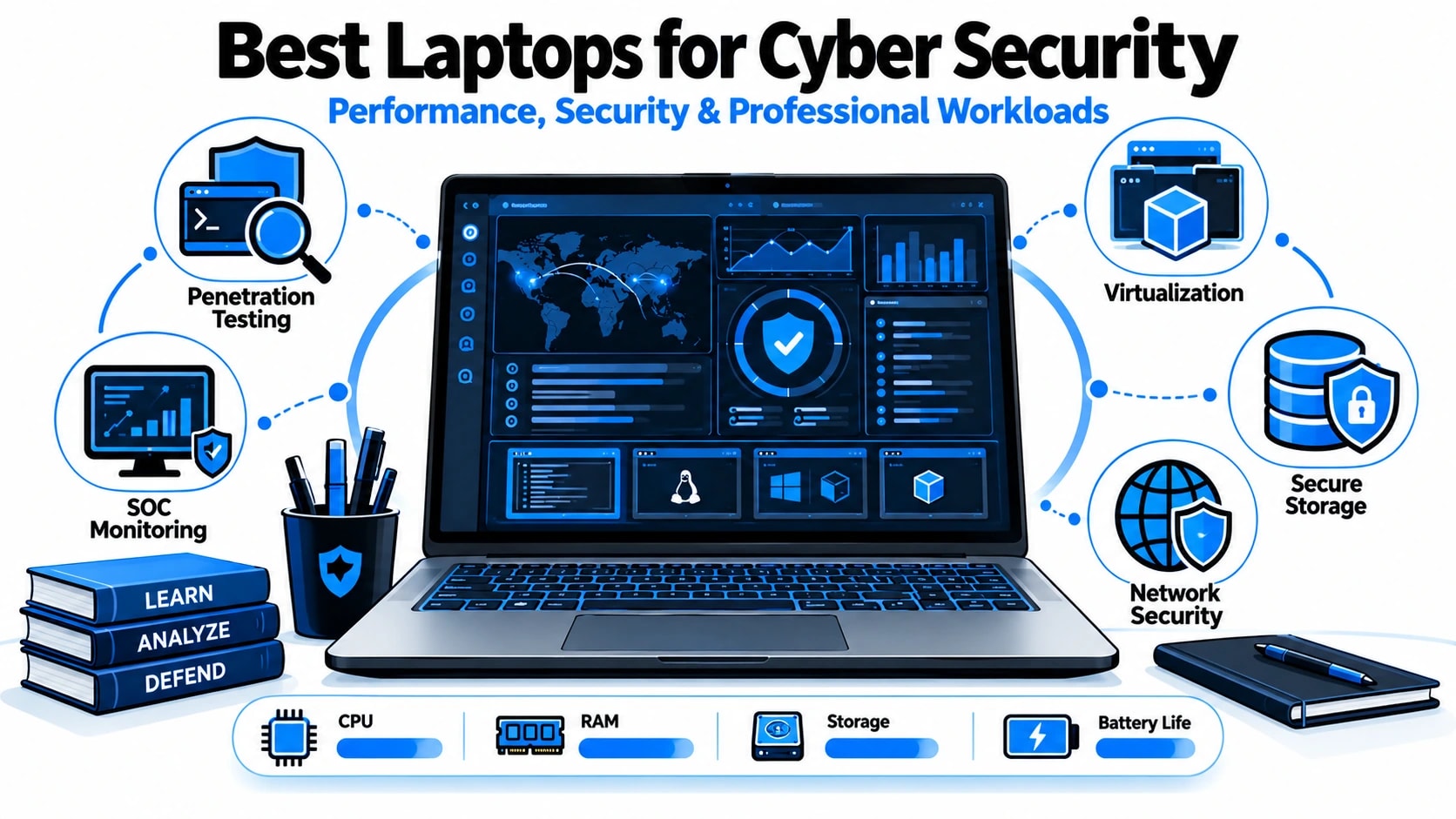
Cybersecurity work demands more from hardware than most other technical disciplines. Whether you are running virtualized attack environments, analyzing malware samples in isolated sandboxes, or managing a SOC workflow with dozens of concurrent processes, the laptop you choose directly determines how effectively you can operate under real-world conditions. This guide covers the specifications, operating system considerations, and key hardware features that matter most when selecting the best laptop for cyber security work at a professional level.
What Makes a Laptop Suitable for Cyber Security Work
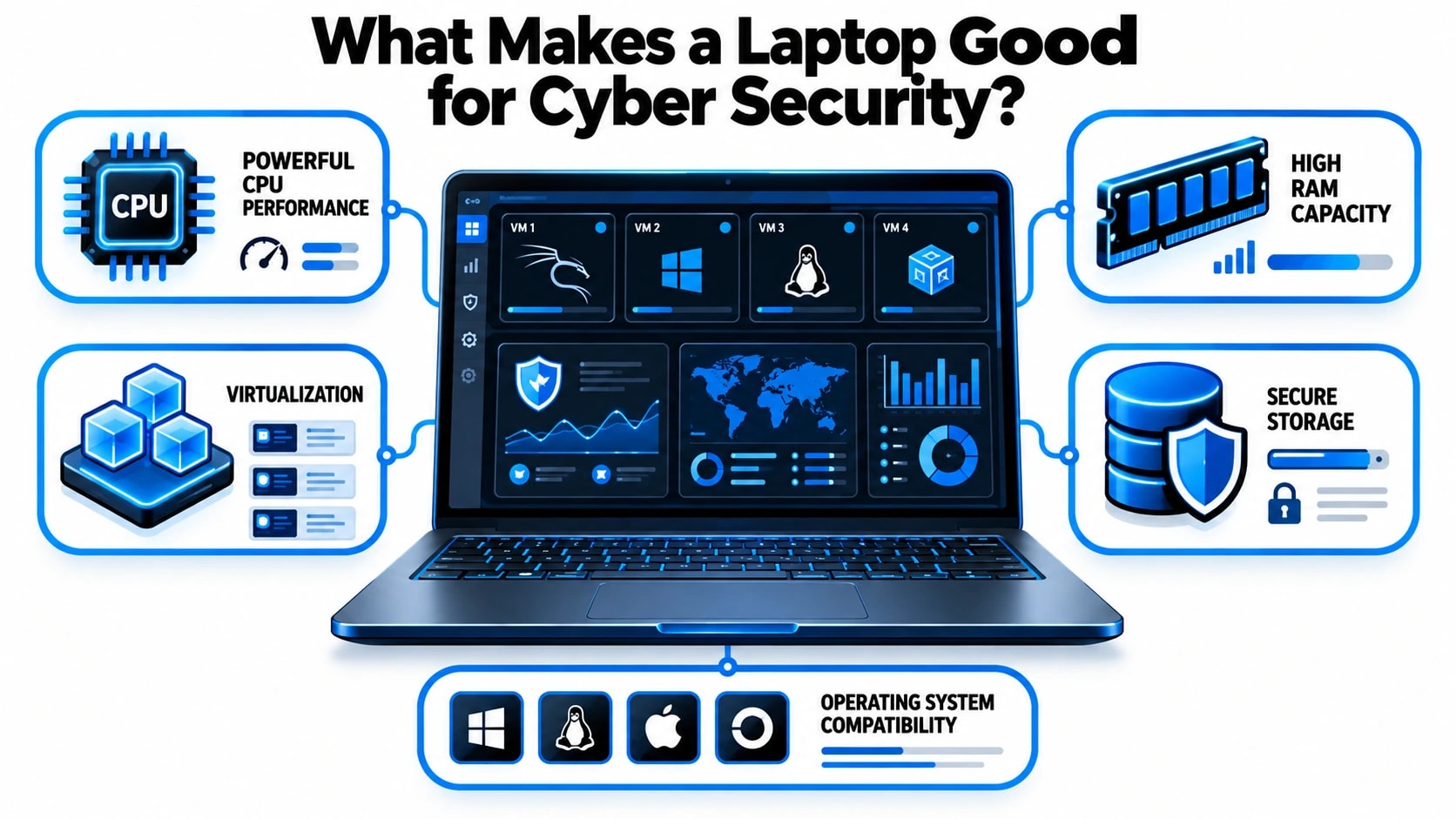
Not every high-performance laptop is suited for cyber security tasks. The requirements for this field go well beyond what a software developer or data analyst would need. Security professionals routinely push hardware to its limits through activities like running multiple virtual machines simultaneously, executing memory-intensive scanning tools, and performing real-time packet capture and analysis across high-traffic networks.
The following hardware characteristics define whether a machine can genuinely support professional cyber security workflows:
Processing Power
A minimum of an Intel Core i7 or AMD Ryzen 7 processor is generally expected for serious work. Penetration testers and red team operators who run tools like Metasploit, Burp Suite, or custom exploitation frameworks need a CPU that handles multi-threaded workloads without throttling. For tasks like password cracking or brute-force simulations, additional cores and high clock speeds make a measurable difference in how quickly results are produced. If your workflow involves heavy cryptographic operations or large-scale vulnerability scanning, stepping up to a Core i9 or Ryzen 9 is worth serious consideration.
RAM Capacity
Sixteen gigabytes of RAM is the functional minimum for professional use, but 32 GB is the standard most experienced practitioners aim for. Running two or three virtual machines alongside a host operating system, while also keeping analysis tools and browsers active, can exhaust 16 GB quickly. Malware analysts, in particular, often run isolated sandbox environments that consume significant memory on their own. Machines with 64 GB capacity or support for RAM upgrades provide more headroom for demanding scenarios.
Storage Speed and Capacity
NVMe SSDs are non-negotiable for professional cyber security laptops. The read and write speeds of NVMe drives significantly reduce the time it takes to spin up virtual machines, load large forensic disk images, or process packet capture files that can reach tens of gigabytes in size. A 512 GB drive is workable, but 1 TB or more is the practical standard when you account for OS installations, tool suites, VM disk images, and log archives.
Build Quality and Portability
Security consultants and field engineers who travel to client sites or conduct on-site assessments need machines that are both rugged and portable. MIL-SPEC durability ratings, solid chassis construction, and long battery life all contribute to reliability in environments where you cannot always count on a stable power source or a controlled workspace.
To understand Best Laptop for Cyber Security for Professionals, it helps to compare what you see in the data and what action you need to take next.
Operating System Compatibility and Security Tool Support
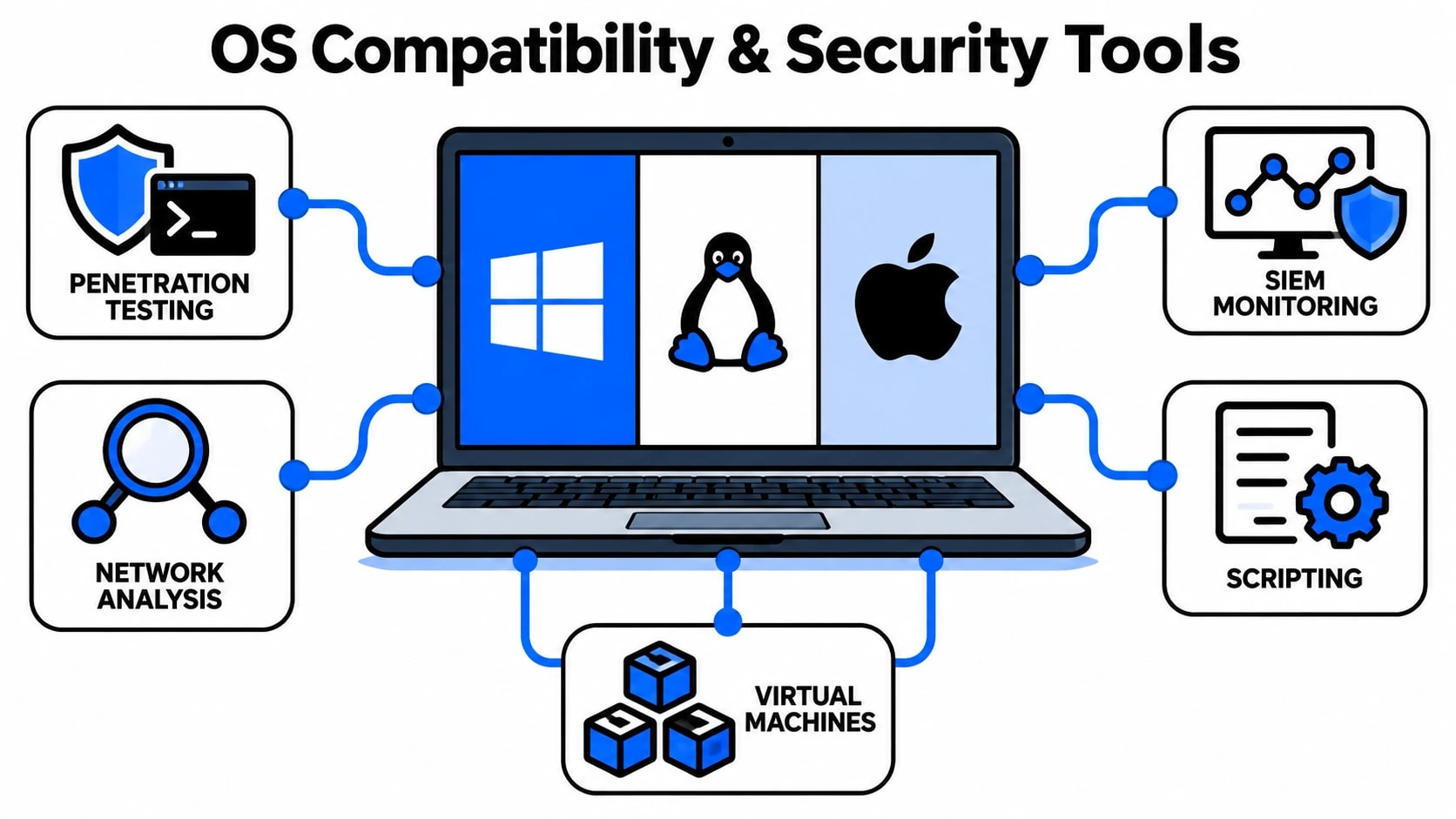
The operating system running on your laptop is not just a preference, it is a functional requirement that determines which tools you can use and how effectively your hardware supports them. Cyber security professionals work across a spectrum of tasks, and OS compatibility is central to every one of them.
Linux as the Primary Platform
The majority of professional-grade security tools are built for Linux environments. Distributions like Kali Linux and Parrot OS are purpose-built for offensive security work, shipping with hundreds of pre-installed tools covering everything from network reconnaissance to web application testing and wireless auditing. When selecting a laptop, hardware driver support under Linux is a critical factor. Wi-Fi adapters, in particular, need to support monitor mode and packet injection for wireless penetration testing, and not all chipsets are compatible out of the box.
Beyond tool availability, Linux offers greater control over system processes, network interfaces, and kernel parameters, all of which matter when configuring isolated testing environments or hardening a machine against detection during red team operations.
Windows and Dual-Boot Configurations
Windows remains relevant in cyber security, particularly for analysts working in enterprise SOC environments where tooling is built around the Microsoft ecosystem. Platforms for endpoint detection, SIEM integration, and digital forensics often have native Windows clients. Many professionals run a dual-boot setup, keeping a Windows installation for enterprise tool compatibility while maintaining a Linux partition for hands-on offensive and defensive work.
When running Windows, features like BitLocker, Secure Boot, and TPM 2.0 support add meaningful layers of hardware-backed security, which matters when a laptop contains sensitive client data or proprietary testing tools, as is common in consulting environments like those supported by Cyberlad.
macOS Considerations
macOS offers a Unix-based environment that supports a reasonable subset of security tools through package managers like Homebrew. Apple Silicon processors deliver exceptional performance-per-watt ratios and strong battery life, which appeals to security professionals who need portability. However, macOS does impose limitations on low-level hardware access and wireless adapter configuration that can restrict certain penetration testing workflows, making it a secondary choice for practitioners who need full control over their testing environment.
Form Factor and Portability Trade-offs for Security Professionals
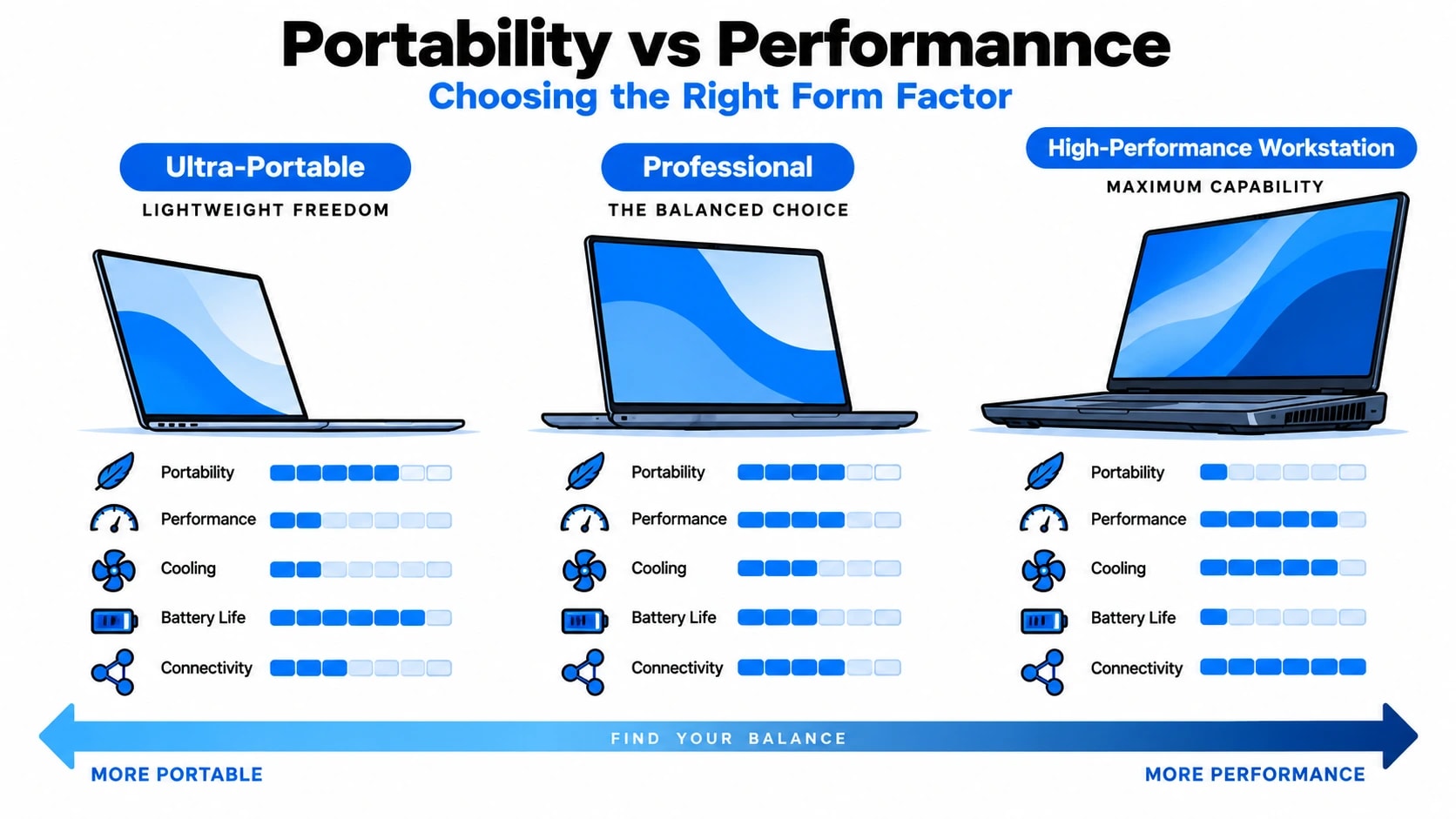
Security professionals rarely work from a single location. Penetration testers travel to client sites, threat analysts shift between home labs and office environments, and incident responders may need to deploy at a moment's notice. Choosing between a compact ultrabook and a powerful desktop-replacement machine is not simply a matter of preference; it directly affects what tools you can run, how long your battery lasts during fieldwork, and whether your physical security posture holds up in unfamiliar environments.
Larger 15- to 17-inch laptops typically offer better thermal management, support for higher-wattage CPUs, and room for dual storage drives or extra RAM slots. This matters when you are spinning up multiple virtual machines simultaneously or running intensive network scans. The trade-off is weight and battery drain. Carrying a 2.5 kg machine through airports or client offices adds up quickly, and a battery that lasts four hours under load is genuinely limiting in field scenarios. Smaller 13- to 14-inch models sacrifice raw power but offer all-day battery life and easier concealment, which carries its own security benefit when working with sensitive data in public spaces.
Screen quality is another overlooked variable. Security work involves reading dense terminal output, analyzing packet captures, and reviewing lengthy reports. A sharp, high-resolution IPS or OLED panel reduces eye strain over long sessions. Privacy screen filters, either built-in or add-on, are worth considering for anyone working in shared spaces or during travel. Some key portability factors to weigh include:
- Weight: Under 1.5 kg for travel-heavy roles, up to 2.5 kg acceptable for mostly desk-based work
- Battery life: Target 8 or more hours of moderate use for field deployment
- Port selection: At least one USB-A, USB-C with Thunderbolt, and an SD card reader for forensic imaging tasks
- Display size: 14-inch balances portability and usability for most security professionals
- Build quality: MIL-SPEC-rated chassis withstands the wear of frequent travel
Laptop Category Comparison: Security Professional Use Cases
Not every security
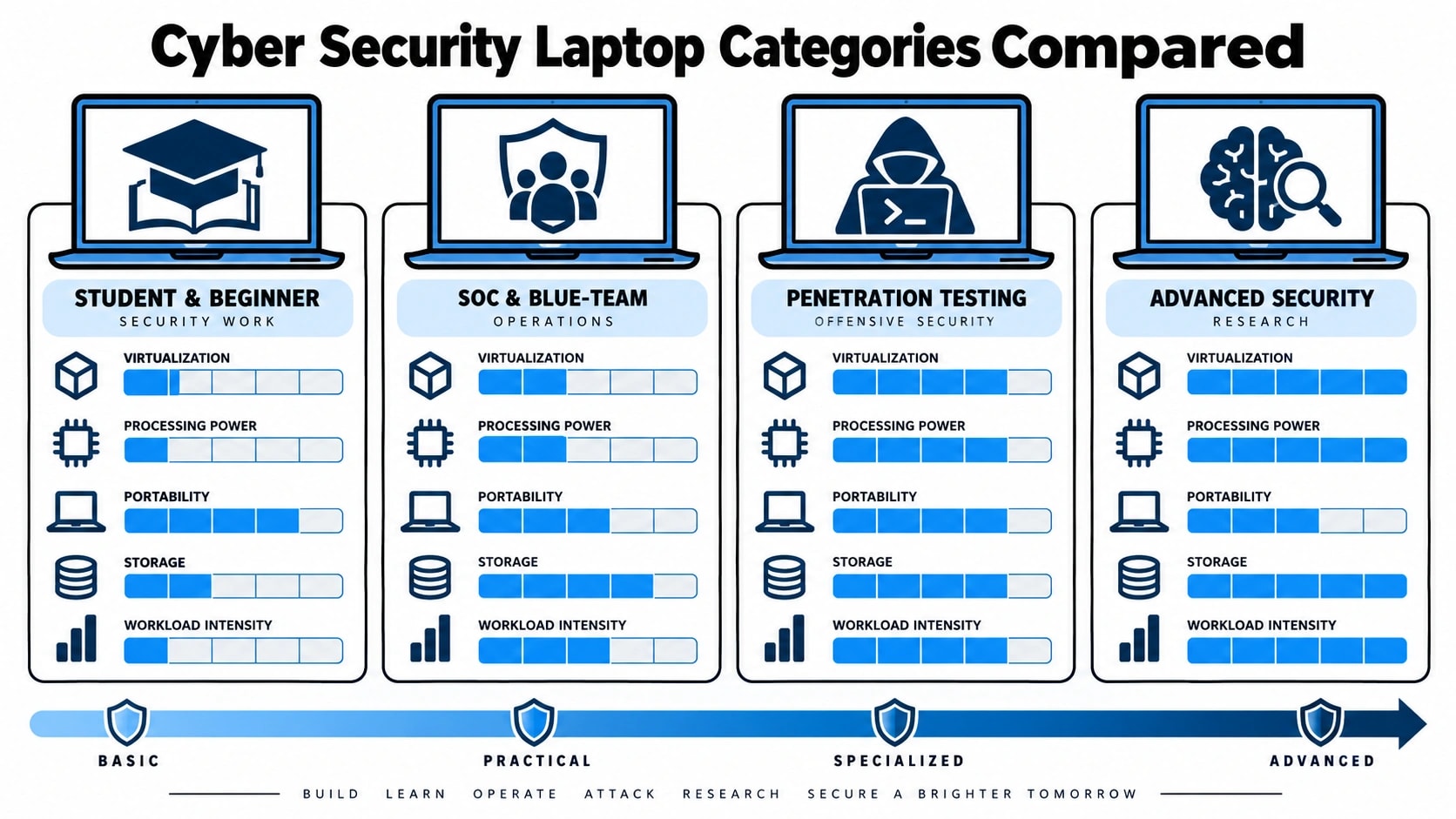
The table below breaks down common security roles against the laptop categories that suit them best, based on typical workload demands around virtualization, processing intensity, and portability requirements.
| Security Role | Recommended Category | Min RAM | Key Priority | Portability Need |
|---|---|---|---|---|
| Penetration Tester | Performance Ultrabook or Mobile Workstation | 32 GB | VM support, CPU speed | High |
| SOC Analyst | Business Ultrabook | 16 GB | Multi-monitor, battery life | Moderate |
| Threat Intelligence Analyst | Business Ultrabook | 16 GB | Display quality, OSINT tools | Moderate |
| Cloud Security Engineer | Developer Laptop or Ultrabook | 16-32 GB | Linux compatibility, CLI tools | Low to Moderate |
| Digital Forensics Examiner | Mobile Workstation | 64 GB | Storage speed, processing power | Low |
| Red Team Operator | High-Performance Laptop | 32-64 GB | Virtualization, GPU for cracking | Moderate |
GPU considerations deserve a specific mention for roles that involve password cracking, machine learning-based threat detection, or graphics-intensive malware analysis. A discrete GPU with CUDA support dramatically accelerates hash cracking tools like Hashcat. For most other security roles, integrated graphics are entirely sufficient, and avoiding a discrete GPU often improves battery life significantly.
Security-Specific Configuration Steps After Purchase
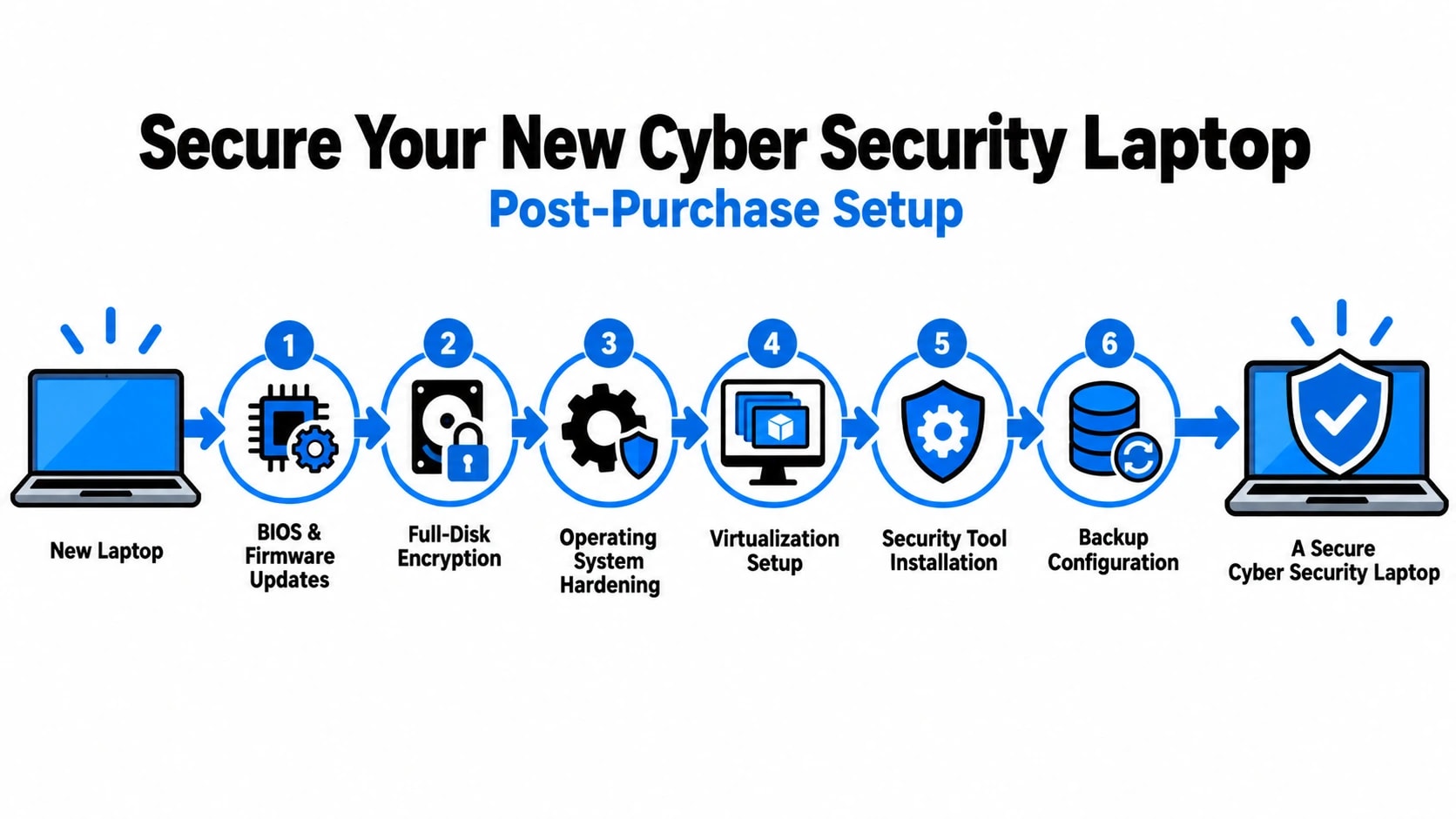
Hardware choice is only the starting point. A capable laptop running a poorly configured operating system introduces the very vulnerabilities you are being paid to find and fix in other organizations. Before using any new machine for professional security work, a baseline hardening process should be applied regardless of the OS. This is not optional hygiene; it is a credibility requirement when your laptop may hold client data, active session tokens, or sensitive investigation artifacts.
Full disk encryption should be enabled immediately, before any sensitive files are stored. On Linux, this means configuring LUKS at installation; on Windows, it means verifying BitLocker is active and tied to a TPM with a strong PIN. Firmware passwords or BIOS-level boot passwords prevent unauthorized booting from external devices, a real threat during physical security assessments or travel. Secure Boot should remain enabled where your tooling allows it. Key configuration steps to complete after initial setup include:
- Enable full disk encryption: LUKS on Linux, BitLocker on Windows, FileVault on macOS
- Set a BIOS or UEFI password: Blocks unauthorized configuration changes and external boot attempts
- Disable unused hardware interfaces: Turn off Bluetooth, Wi-Fi, and webcam in firmware when not needed
- Configure automatic screen lock: Set a timeout of two minutes or less with password required to resume
- Isolate VM networks: Use host-only or internal network adapters in your hypervisor to prevent accidental traffic leakage
- Enable firewall rules at the OS level: Restrict inbound and outbound connections by default; allow only what is explicitly required
- Audit installed software: Remove bloatware, disable telemetry where possible, and document your baseline application set
Maintaining a clean separation between your personal use environment and your professional security work environment is also worth building into your workflow from day one. Using separate browser profiles, dedicated VMs for each client engagement, and encrypted storage containers for sensitive project data reduces the risk of cross-contamination. Teams working with Cyberlad on ongoing SOC consulting or penetration testing engagements often receive tailored hardening checklists specific to their operating environment, which can serve as a useful reference alongside general best practices.
Budget vs Premium Laptops for Cyber Security Professionals
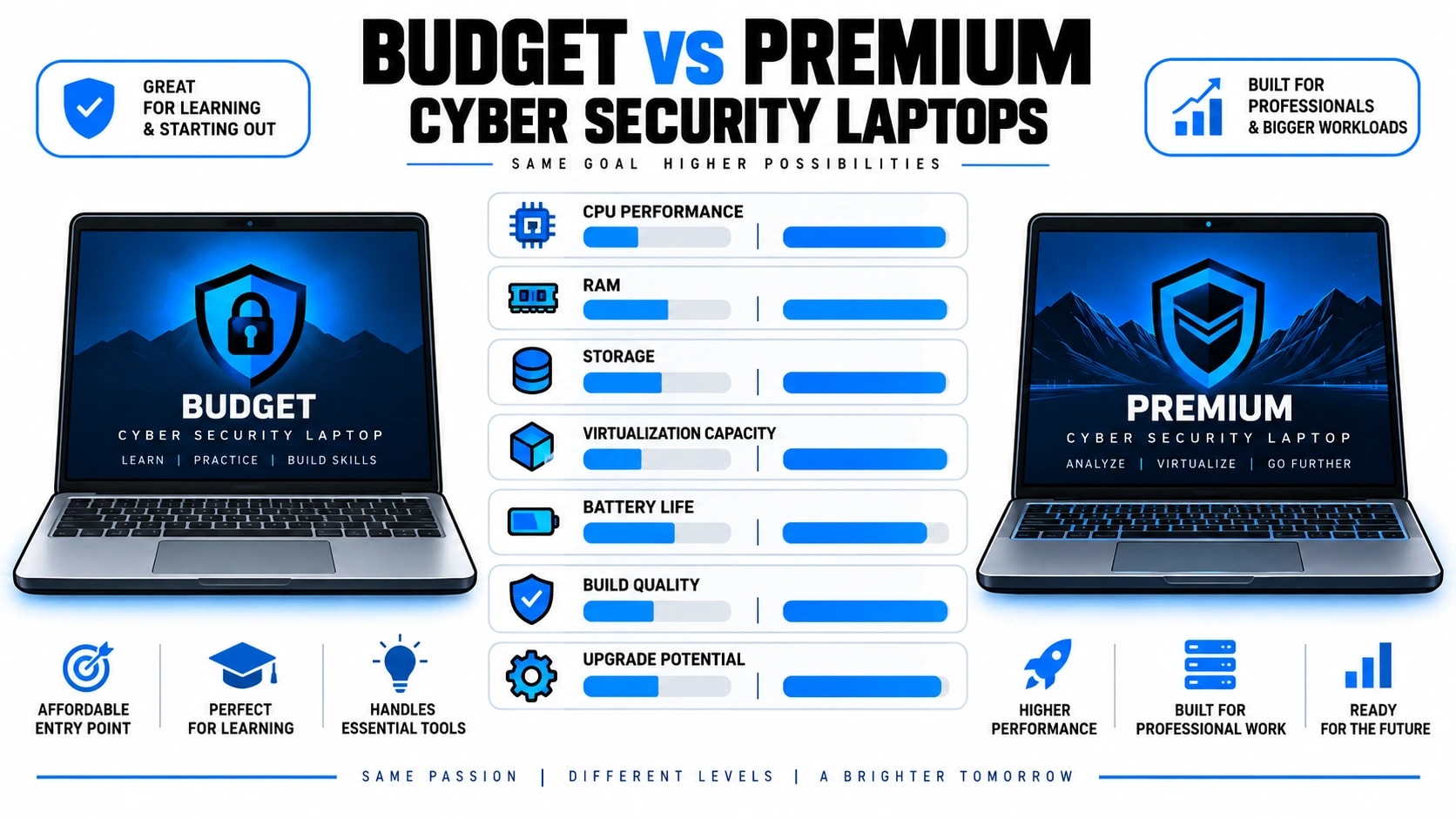
Price is one of the most debated factors when choosing a laptop for security work. Spending more does not always translate into better security outcomes, but cutting corners on hardware can create real bottlenecks when running multiple virtual machines, packet captures, or memory forensics tools simultaneously.
Understanding where the money actually goes helps professionals make smarter purchasing decisions based on their specific workload rather than brand reputation alone.
What You Get at Each Price Tier
- Under $800: Sufficient for light penetration testing, CTF participation, and single-VM environments. Expect slower RAM, limited storage expansion, and weaker build quality.
- $800 to $1,400: The sweet spot for most working professionals. Modern CPUs, 16GB to 32GB RAM, and solid thermal performance make this range capable for most real-world tasks.
- $1,400 to $2,500: Workstation-class performance, high core counts, ECC memory support on some units, and enterprise-grade chassis durability. Ideal for red team operators and cloud security analysts running heavy toolchains.
- Above $2,500: Mobile workstations with professional-grade GPUs, useful for AI-assisted threat analysis, large dataset processing, and cryptographic research.
| Price Range | RAM Sweet Spot | VM Capacity | Best Fit Role |
|---|---|---|---|
| Under $800 | 8GB to 16GB | 1 to 2 VMs | Student, CTF Player |
| $800 to $1,400 | 16GB to 32GB | 3 to 5 VMs | Pen Tester, SOC Analyst |
| $1,400 to $2,500 | 32GB to 64GB | 6 to 10 VMs | Red Team Operator, Cloud Security |
| Above $2,500 | 64GB+ | 10+ VMs | Researcher, Threat Intelligence Lead |
Battery Life, Connectivity, and Field Reliability
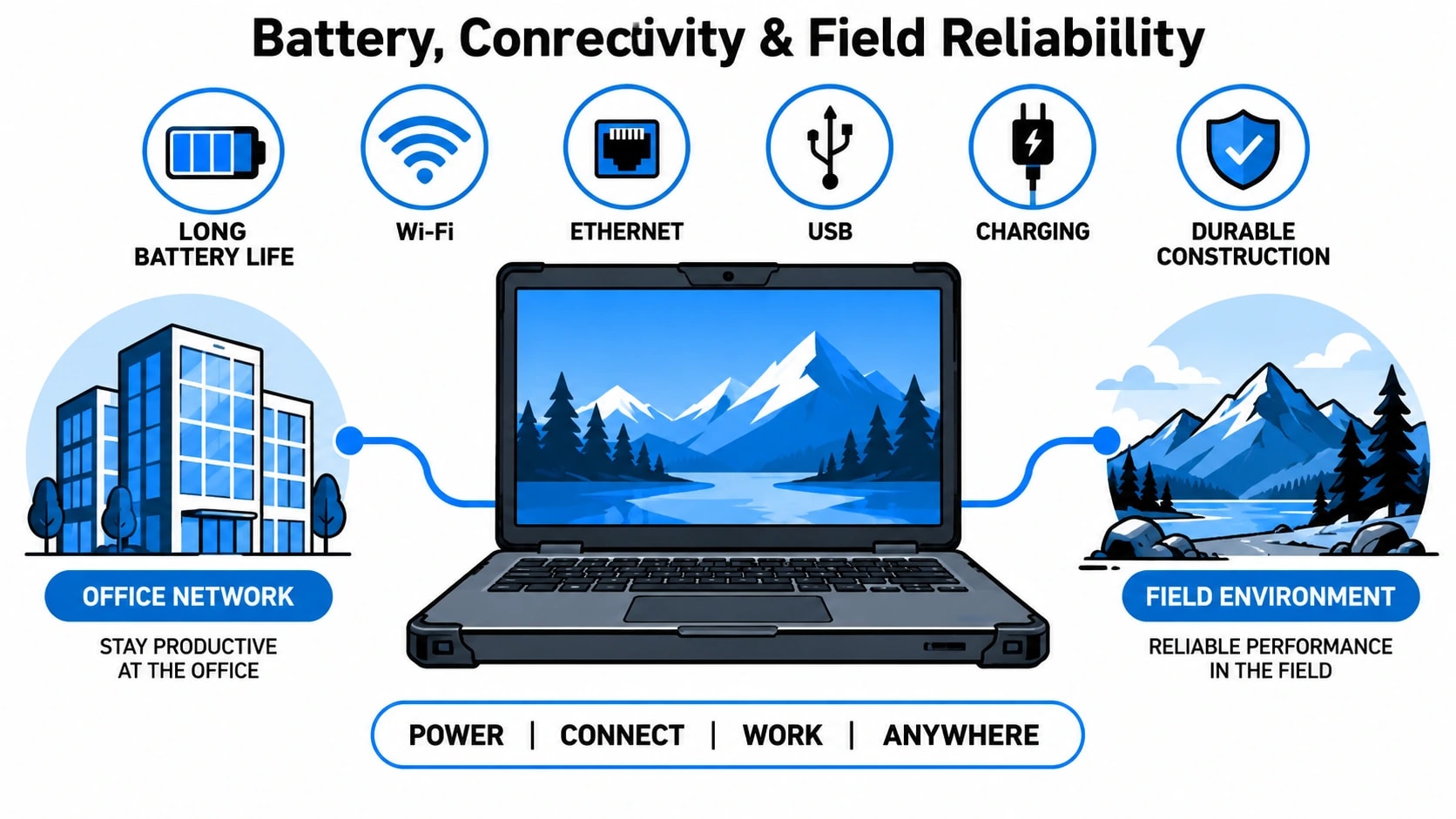
Security professionals often work in environments where wall outlets are not guaranteed. Whether conducting on-site assessments, traveling between client locations, or operating in field situations, battery performance and port availability directly affect productivity and operational capability.
Battery Expectations for Real Work Sessions
- Manufacturer battery claims are based on light usage. Under real security workloads with active VMs and wireless adapters, expect 40 to 60 percent of advertised runtime.
- A 15-inch laptop rated for 12 hours typically delivers 5 to 7 hours of genuine security work before needing a charge.
- USB-C charging support is a strong advantage, allowing top-ups from power banks in the field.
- Avoid laptops that throttle CPU performance aggressively on battery, as this creates inconsistent tool behavior during assessments.
Port and Wireless Connectivity Priorities
- USB-A ports: Essential for connecting external wireless adapters used in wireless security assessments.
- Ethernet port or included adapter: Wired connectivity remains critical for network-based testing environments.
- USB-C with Thunderbolt: Enables high-speed external storage and display connections for multi-monitor SOC setups.
- Wi-Fi 6E support: Provides faster and more stable wireless performance, particularly valuable when working across dense network environments.
- SD card slot: Useful for forensic evidence capture and transferring data from specialized hardware.
Display and Keyboard Quality for Extended Security Work
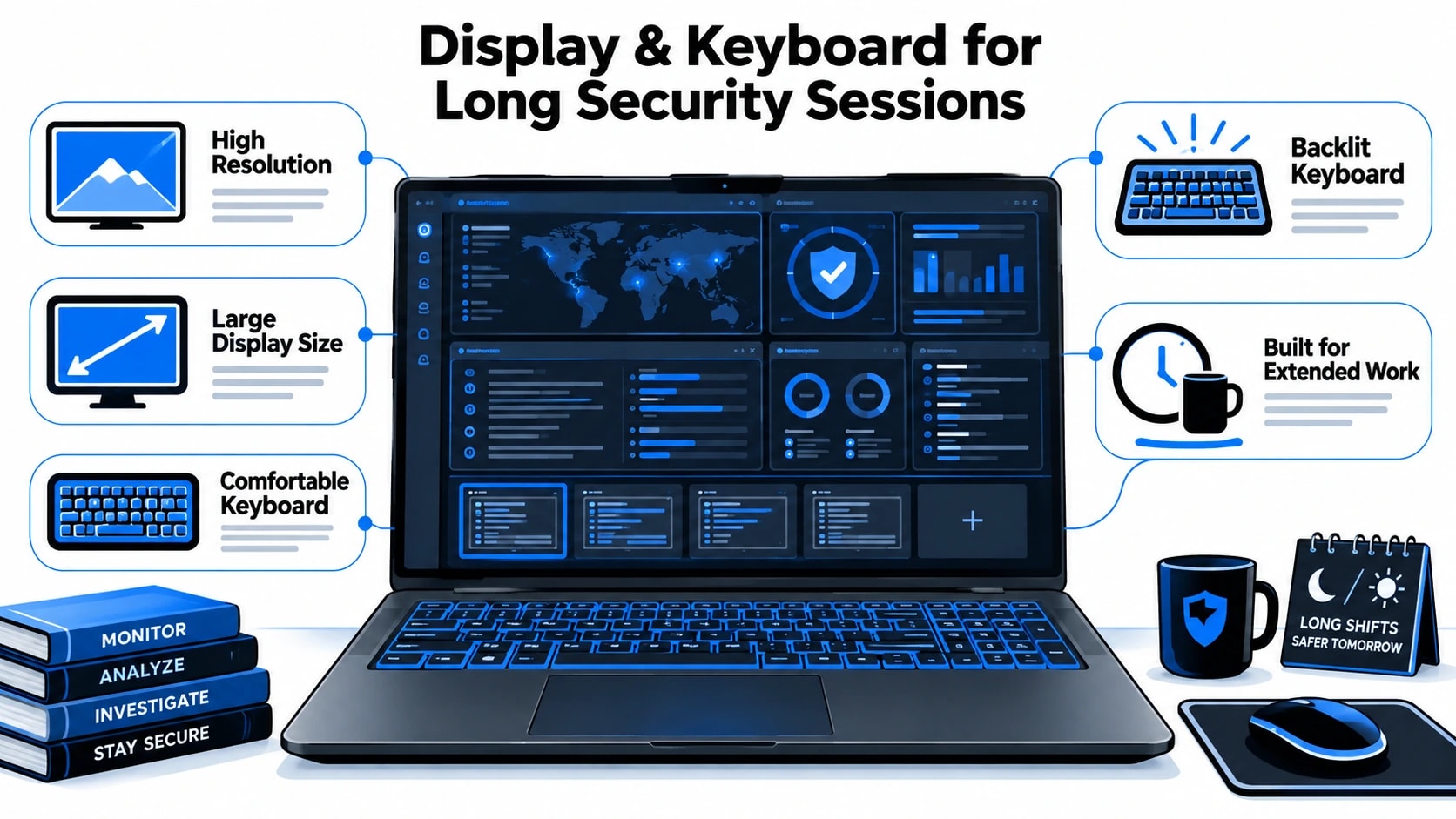
Security professionals spend long hours reading terminal output, reviewing log files, and analyzing packet captures. Display quality and keyboard feel are not cosmetic preferences; they are productivity factors that directly affect accuracy and comfort over extended sessions.
Display Specifications Worth Prioritizing
- Resolution: Full HD (1920x1080) is acceptable, but 2K or 2560x1600 displays offer noticeably sharper text, reducing eye fatigue during long documentation sessions.
- Matte finish: Glossy screens reflect ambient light poorly in field environments. Matte panels work reliably across varied lighting conditions.
- Color accuracy: sRGB coverage above 90 percent matters for professionals who also produce reports or dashboards requiring consistent color representation.
- Brightness: Minimum 300 nits for indoor use, 400 nits or above for outdoor or brightly lit spaces.
Keyboard Considerations for Code and Command-Heavy Work
- Key travel of 1.5mm or above significantly reduces typing errors during long scripting sessions.
- Backlit keyboards are essential for low-light operational environments.
- Full-size layouts with dedicated function keys prevent workflow interruptions when using keyboard shortcuts in security tools.
- Avoid island-style keyboards with shallow key travel on budget models, as they cause fatigue quickly during extended terminal sessions.
Conclusion
Choosing the best laptop for cyber security work comes down to matching hardware capabilities with your actual daily workload. A SOC analyst running log correlation tools needs fast RAM and a sharp display. A penetration tester needs strong CPU performance, reliable wireless adapter support, and enough thermal headroom to sustain intensive tasks without throttling. Portable forensics specialists need a sturdy build, broad OS compatibility, and sufficient storage for evidence handling. No single machine fits every scenario, but understanding the specifications that matter most for your specific role eliminates a lot of the guesswork.
Investing in the right hardware from the start saves significant time, reduces frustration, and prevents capability gaps during critical engagements. If you need guidance selecting, configuring, or securing the technology your security team relies on, the professionals at Cyberlad can help you build a setup that matches your operational requirements and security standards without unnecessary compromises.
Frequently Asked Questions
How much RAM do I actually need for cyber security work?
For most professional security work, 32GB is the practical minimum if you run multiple virtual machines simultaneously. 16GB works for lighter workloads with one or two VMs. Analysts running large threat detection datasets or researchers handling memory forensics regularly benefit from 64GB configurations.
Is a dedicated GPU necessary for cyber security laptops?
A dedicated GPU is not required for most security roles, but it significantly speeds up password cracking and hash analysis tasks. Professionals working in cryptographic research or running AI-assisted threat analysis tools will find GPU acceleration genuinely useful. For general penetration testing and SOC work, integrated graphics are sufficient.
Can I use a Windows laptop for cyber security work or do I need Linux?
Windows laptops work well for security professionals who run Linux distributions inside virtual machines or use Windows Subsystem for Linux. Many enterprise security tools, including certain EDR consoles and forensic suites, are Windows-native. The choice depends on your toolset, with most professionals using both operating systems across their workflow.
What screen size is best for a cyber security professional's laptop?
A 14 to 15.6-inch display offers the best balance between screen real estate and portability for most security professionals. Larger 17-inch models suit desk-based analysts who rarely travel. Compact 13-inch machines work for those prioritizing mobility, though the smaller display can become limiting during complex multi-pane analysis sessions.
How important is the laptop's build quality for security professionals?
Build quality matters considerably for security professionals who travel to client sites or work in varied environments. Military-grade durability ratings, solid hinge construction, and spill-resistant keyboards extend the working life of the machine and reduce failure risk during time-sensitive engagements where equipment reliability is critical.