Penetration testing and vulnerability assessment help you identify, analyze, and fix security weaknesses in your systems before attackers exploit them, ensuring stronger protection for your data, networks, and applications.
You’ve probably heard both terms thrown around in cybersecurity conversations: penetration testing and vulnerability assessment. They sound similar. They often get used interchangeably. But if you’re responsible for protecting systems, data, or even your own business, you need to understand the difference.
Because choosing the wrong one can leave gaps you didn’t expect.
You’re not just buying a service. You’re deciding how deeply you want to test your defenses and how far you’re willing to go to simulate a real attack.
In this guide, you’ll break down exactly what each approach does, how they differ, when you should use them, and how to make the right choice based on your goals.
Check out our latest blog on the Best Tor Search Engine for Privacy (2026)
What Is Vulnerability Assessment and Why Do You Need It?
When you start thinking about security, vulnerability assessment is usually your first step.
It’s systematic. It’s broad. And it’s designed to give you visibility.
What does it actually do?
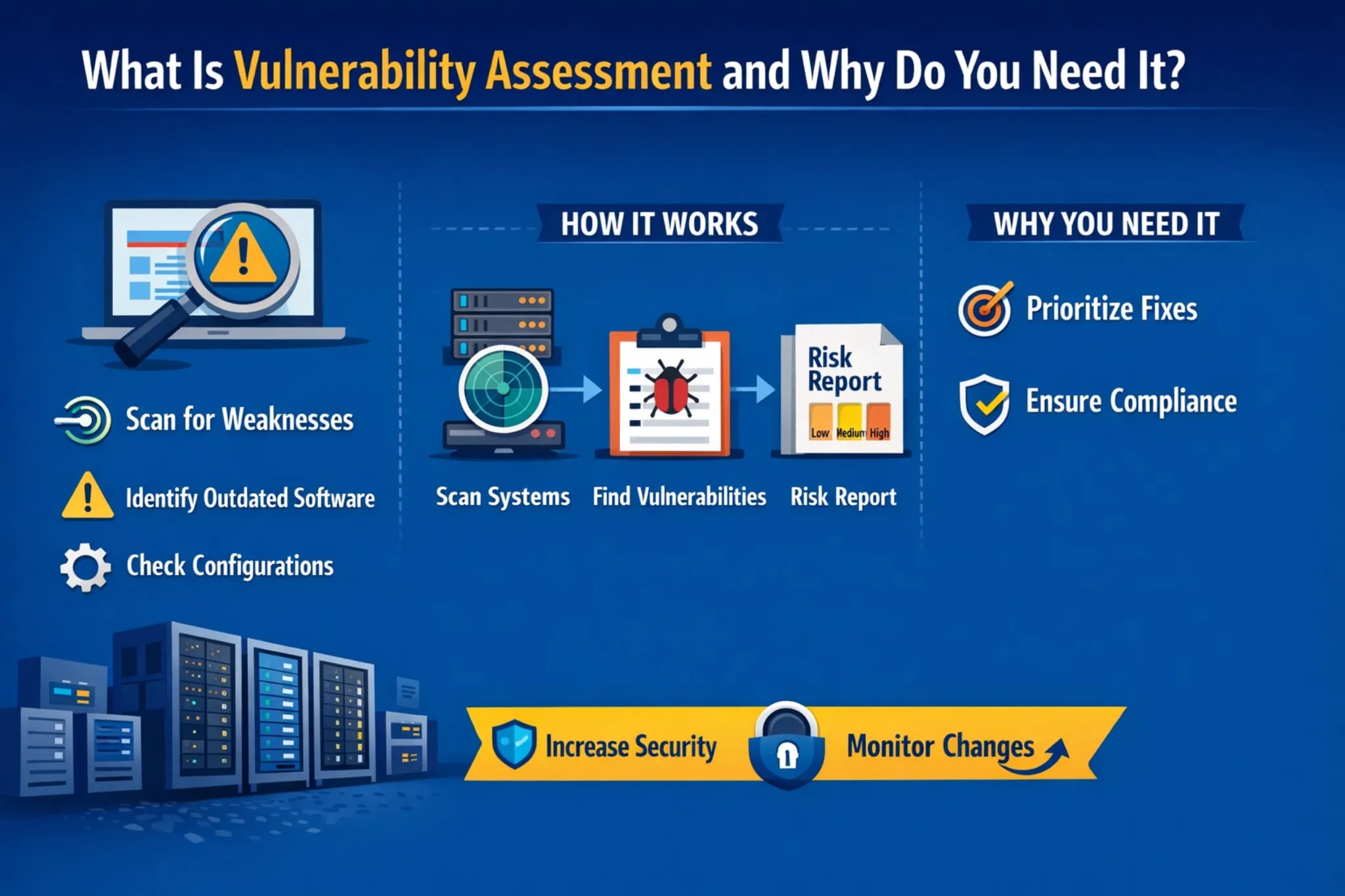
A vulnerability assessment scans your systems, networks, and applications to identify known weaknesses. Think of it as a diagnostic tool.
It answers questions like:
- Where are your systems exposed?
- What known vulnerabilities exist?
- Which software versions are outdated?
- What misconfigurations are present?
Instead of trying to break into your system, it lists all the doors that are unlocked.
How does it work in Practice?
You typically use automated tools to scan your infrastructure. These tools compare your systems against large databases of known vulnerabilities.
The process usually includes:
- Network scanning
- System and application scanning
- Configuration analysis
- Risk classification based on severity
Once complete, you get a report that prioritizes issues.
What do you gain from it?
You gain awareness.
That might sound simple, but it’s powerful.
You can:
- Identify thousands of vulnerabilities in minutes
- Prioritize fixes based on risk levels
- Maintain compliance with standards
- Monitor changes over time
If you’re running a growing system or managing multiple assets, this becomes essential.
Where It Falls Short?
Here’s where you need to be honest.
A vulnerability assessment doesn’t tell you if a weakness can actually be exploited.
It might say:
- “This port is open.”
- “This service is outdated.”
But it won’t tell you:
- Whether an attacker can chain vulnerabilities together
- How deep the damage could go
- What a real breach would look like
So while it gives you breadth, it lacks depth.
What Is Penetration Testing and Why Does It Go Deeper?
If vulnerability assessment shows you where the doors are unlocked, penetration testing tries to walk through them.
It’s aggressive. It’s realistic. And it’s designed to simulate real-world attacks.
What does it actually do?
Penetration testing, often called pentesting, involves actively exploiting vulnerabilities to see how far an attacker can go.
You’re not just identifying weaknesses. You’re testing them.
This answers critical questions:
- Can someone break in?
- What data can they access?
- How far can they move inside your system?
- Can they escalate privileges?
How does it work in Practice?
Unlike automated scans, penetration testing is largely manual and driven by skilled professionals.
A typical process includes:
- Reconnaissance and information gathering
- Identifying potential attack vectors
- Exploiting vulnerabilities
- Post-exploitation analysis
- Reporting with real attack scenarios
This approach mimics how hackers think and act.
What You Gain From It
You gain clarity.
Not theoretical risk. Real risk.
You’ll know:
- Which vulnerabilities are actually exploitable
- How attackers could chain issues together
- What assets are truly at risk
- How effective your defenses are
This is where security becomes practical.
Where It Falls Short
Penetration testing has limitations, too.
It’s:
- Time-intensive
- More expensive
- Focused on specific areas rather than everything
- Dependent on the tester’s skill
It doesn’t cover every possible vulnerability. Instead, it focuses on realistic attack paths.
Key Differences Between Penetration Testing and Vulnerability Assessment
Understanding the distinction isn’t optional. It directly affects how secure you really are.
Here’s a clear breakdown.
| Feature | Vulnerability Assessment | Penetration Testing |
|---|---|---|
| Purpose | Identify weaknesses | Exploit weaknesses |
| Approach | Automated scanning | Manual + automated |
| Depth | Broad coverage | Deep analysis |
| Output | List of vulnerabilities | Real-world attack scenarios |
| Frequency | Regular, ongoing | Periodic |
| Cost | Lower | Higher |
| Skill Requirement | Minimal | High expertise needed |
| Risk Insight | Theoretical | Practical |
What This Means for You
If you rely only on vulnerability assessment, you might feel secure but still be exposed.
If you rely only on penetration testing, you might miss many smaller vulnerabilities that could later become critical.
The reality is simple.
You don’t choose one over the other.
You use both strategically.
When You Should Use Vulnerability Assessment
There are situations where vulnerability assessment makes more sense.
You’re Managing Large Environments
If you’re running:
- Enterprise networks
- Cloud infrastructure
- Multiple applications
You need constant visibility.
A vulnerability assessment helps you stay ahead of changes.
You Need Continuous Monitoring
Security isn’t static.
New vulnerabilities appear daily.
You need:
- Regular scans
- Updated reports
- Ongoing risk management
This is where vulnerability assessment shines.
You’re Focused on Compliance
Many standards require regular vulnerability scanning, such as:
- PCI DSS
- ISO 27001
- HIPAA
These frameworks expect consistent monitoring, not occasional deep testing.
You Want Fast Results
If you need a quick overview of your security posture, this is the fastest way.
When You Should Use Penetration Testing
Now let’s talk about when you need depth instead of breadth.
Before Launching a Product
If you’re releasing:
- A web application
- A mobile app
- A SaaS platform
You need to know how it behaves under attack.
Penetration testing helps you avoid launching with critical flaws.
After Major Changes
Any time you:
- Redesign infrastructure
- Add new integrations
- Migrate to cloud environments
You introduce new risks.
Pentesting validates your new setup.
When Security Is Mission-Critical
If your business handles:
- Financial data
- Personal information
- Intellectual property
You can’t rely on surface-level checks.
You need a realistic attack simulation.
To Test Incident Response
Penetration testing helps you understand:
- How quickly your team detects threats
- How effectively you respond
- Where your processes fail
Why You Should Combine Both Approaches
Here’s the truth that most people miss.
Penetration testing and vulnerability assessment are not competitors.
They’re partners.
How They Work Together
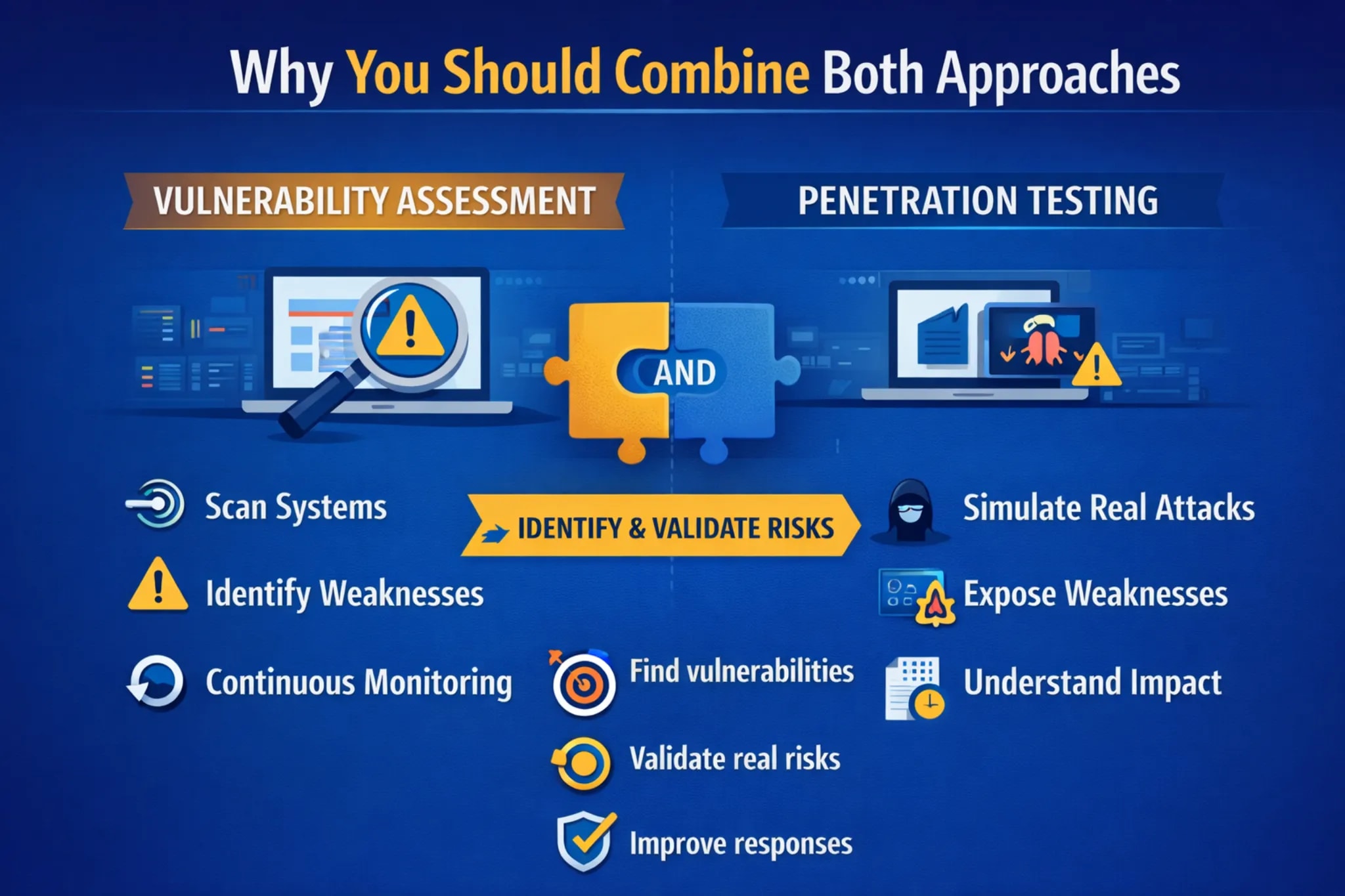
You start with vulnerability assessment to:
- Identify all potential weaknesses
- Maintain continuous monitoring
Then you use penetration testing to:
- Validate critical vulnerabilities
- Simulate real-world attacks
- Understand impact
A Practical Workflow
Here’s how you can structure it:
- Run regular vulnerability scans
- Fix high and medium issues
- Schedule penetration testing quarterly or annually
- Use results to refine your defenses
- Repeat
This creates a layered security approach.
What You Achieve
You move from:
- Reactive security
to - Proactive defense
And that’s where real protection begins.
Pros and Cons of Each Approach
Let’s break this down clearly so you can make decisions faster.
Vulnerability Assessment
Pros
- Fast and scalable
- Cost-effective
- Continuous monitoring
- Covers a wide range of systems
- Helps with compliance
Cons
- Doesn’t validate exploitability
- Can generate false positives
- Lacks real-world context
- Limited depth
Penetration Testing
Pros
- Realistic attack simulation
- Identifies true risk
- Provides actionable insights
- Tests the defense effectiveness
- Reduces false positives
Cons
- Expensive
- Time-consuming
- Limited scope
- Requires expert testers
How to Choose the Right Approach for Your Business
You’re not just picking a tool. You’re making a strategic decision.
Ask Yourself These Questions
- Do you need continuous monitoring or one-time testing?
- Are you trying to meet compliance requirements?
- How critical is your data?
- What’s your budget?
- How mature is your security posture?
If You’re Just Starting
Start with vulnerability assessment.
It gives you visibility and helps you build a foundation.
If You’re Scaling or Handling Sensitive Data
Add penetration testing.
You need deeper insight as your risk increases.
If You Want Full Coverage
Use both.
That’s the only way to balance coverage and depth.
Common Mistakes You Should Avoid
Even experienced teams get this wrong.
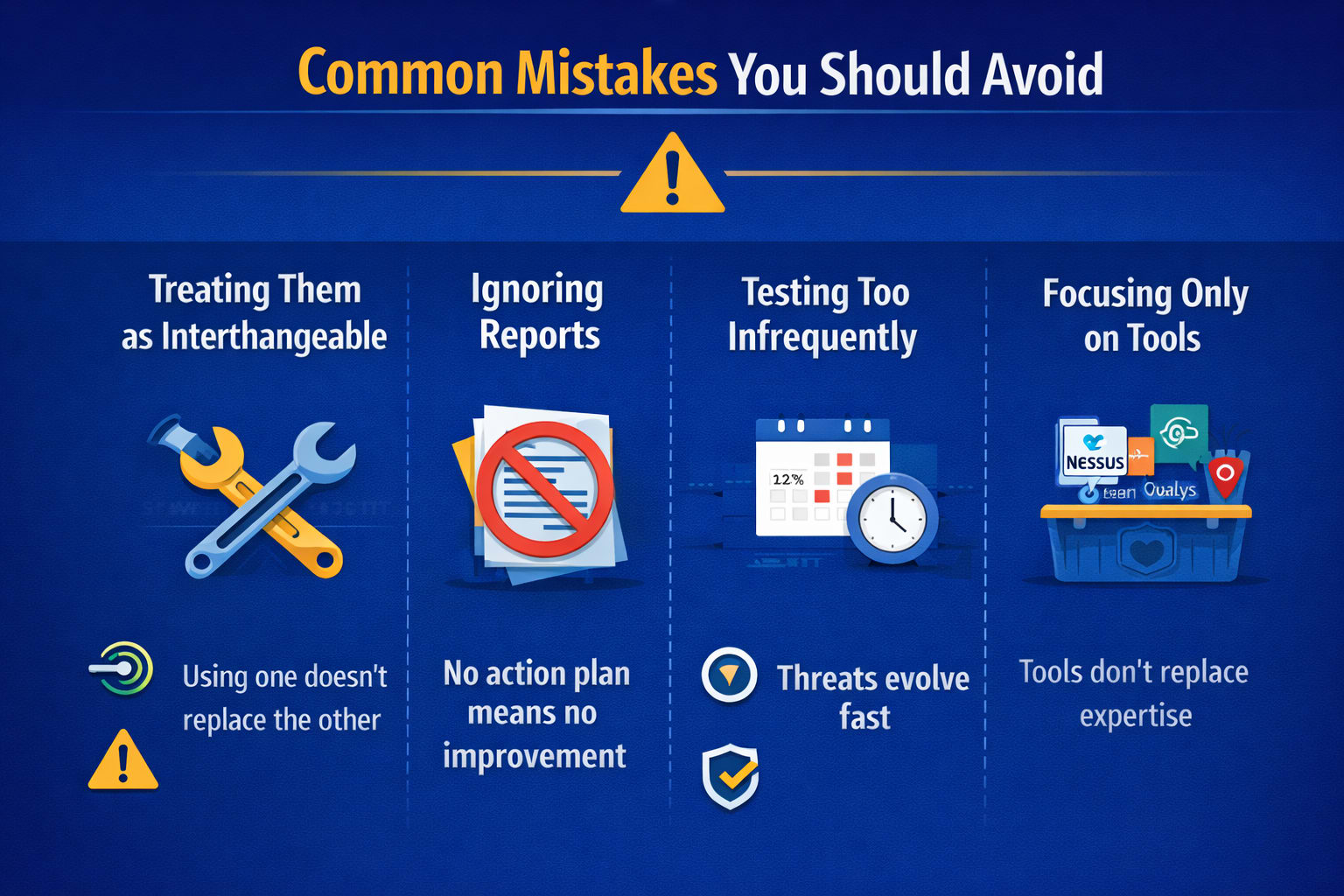
Treating Them as Interchangeable
They’re not.
Using one doesn’t replace the other.
Ignoring Reports
Running scans or tests without acting on results is pointless.
You need a remediation plan.
Testing Too Infrequently
Threats evolve fast.
Annual testing isn’t enough for many environments.
Focusing Only on Tools
Tools don’t replace expertise.
You need skilled analysis, especially for penetration testing.
Final Thoughts
If you care about security, you can’t afford to misunderstand penetration testing and vulnerability assessment.
One shows you where you’re weak. The other shows you how you can be broken.
When you combine both, you move from guessing about risk to understanding it.
And that’s the difference between hoping you’re secure and knowing you are.
Frequently Asked Questions
Is penetration testing better than vulnerability assessment?
Not better, just different. Penetration testing provides deeper insights by simulating real attacks, while vulnerability assessment offers broader coverage of potential weaknesses.
How often should you perform penetration testing?
You should perform it at least once a year, or after major system changes, product launches, or infrastructure updates.
Can small businesses benefit from vulnerability assessments?
Yes, especially if you have limited resources. It helps you identify and fix common weaknesses quickly without high costs.
Do you need both penetration testing and vulnerability assessment?
Yes, if you want a complete security strategy. One identifies risks, the other validates them.
What tools are used for vulnerability assessment?
Common tools include Nessus, OpenVAS, and Qualys. These automate scanning and reporting of known vulnerabilities.