Table of Contents
What Is Infrastructure Security in Cloud Computing and Why It Matters in 2026
Cloud Infrastructure Security Network: How You Secure and Control Traffic
Cloud Infrastructure Security Assessment: How You Identify Real Risks
Cloud Infrastructure Security vs Traditional Infrastructure Security
You pushed your systems to the cloud for speed, scalability, and flexibility. But cloud infrastructure security often becomes an afterthought until something breaks.
That’s where the real risk begins.
Cloud infrastructure security isn’t just about protection. It’s about control over your servers, networks, access, and data before they become entry points for attacks. In 2026, most security failures in cloud computing don’t happen because attackers are advanced. They happen because configurations are weak, access is too broad, and visibility is missing.
If your cloud environment isn’t actively secured, it’s exposed by default.
In this guide, you’ll learn how cloud infrastructure security actually works, where most setups fail, and what you need to do to secure your environment using proven best practices, assessment strategies, and network controls.
You can also explore our best laptop for cyber security guide to find the right device for security testing, SOC work, virtualization, and everyday cybersecurity tasks.
What Is Infrastructure Security in Cloud Computing and Why It Matters in 2026
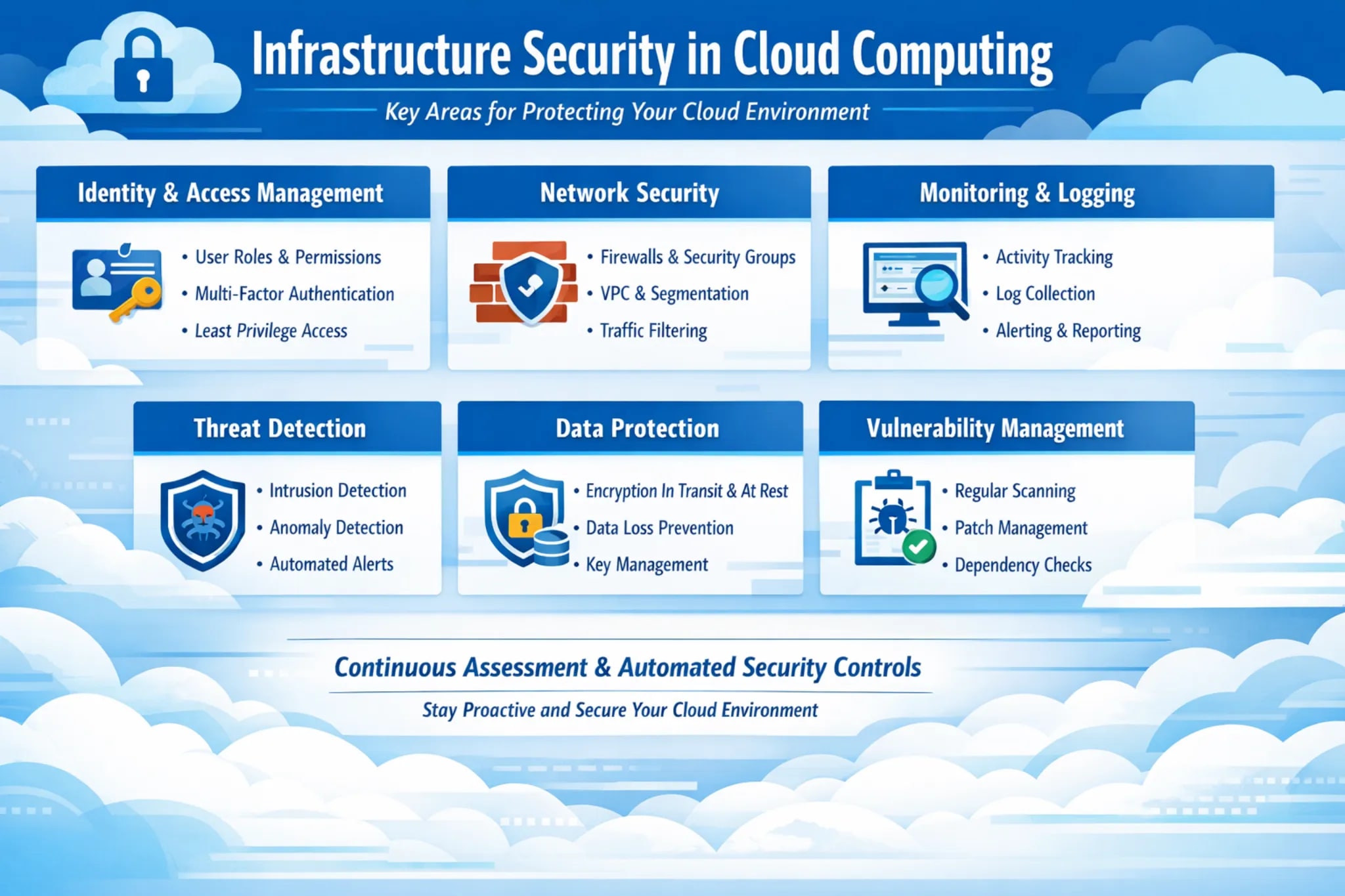
When you hear the phrase what is infrastructure security in cloud computing, it often comes wrapped in technical jargon. Strip that away, and the meaning becomes clear.
Cloud infrastructure security is everything you put in place to protect your cloud environment from unauthorized access, data breaches, and operational disruption. It covers your compute resources, storage systems, and especially your cloud infrastructure security network, where most vulnerabilities tend to appear.
In 2026, this isn’t a background concern. It’s a core part of how you build and run anything in the cloud.
Check out our cybersecurity analysis on Voozon.com: What Is Voozon? Security & Privacy Guide
The Core of Infrastructure Security in Cloud Computing
Your cloud environment isn’t a single system. It’s a collection of moving parts that need to work securely together. Infrastructure security in cloud computing focuses on controlling three critical layers.
Identity: Controlling Access at Every Level
Security starts with access control. If the wrong user gets in with the wrong permissions, the rest of your setup becomes irrelevant.
You need to define:
Who can access your systems
What actions can they perform
How they authenticate
Strong identity management, including multi-factor authentication and strict role-based access, is one of the most important cloud infrastructure security best practices you can implement.
Network: Securing the Cloud Infrastructure Security Network
Your network is where most real-world security failures happen.
The cloud infrastructure security network determines:
Which resources are exposed to the internet
How internal services communicate
Where traffic is allowed or restricted
Without proper segmentation, attackers can move laterally across your environment once they gain access. That’s why isolating services, restricting inbound traffic, and monitoring network activity are essential.
Read More On Cyber Security Assessment: Types, Process & Free Checklist
Workloads: Protecting What Actually Runs
Your applications, virtual machines, and containers are the operational layer of your cloud. They’re also a common entry point for attacks.
You need to ensure:
Systems are regularly updated
Vulnerabilities are patched quickly
Runtime behavior is monitored
Even a well-secured network won’t protect you if your application itself is exploitable.
Security Is Enhanced by Which Services in the Cloud Infrastructure
You’re not expected to build everything from scratch. Cloud providers offer built-in services that strengthen your infrastructure security.
Security is enhanced by which services in the cloud infrastructure, depending on how you configure and use them? The most important categories include:
Identity and access management services for controlling users and roles
Network security services such as firewalls and traffic filtering
Monitoring and logging tools for visibility
Threat detection systems that identify suspicious behavior
Using these services correctly is part of modern cloud infrastructure security best practices 2025 and beyond. The tools are powerful, but misconfiguration can still leave gaps.
Why This Matters More in 2026
Cloud environments are more complex than ever. Multi-cloud setups, remote teams, and rapid deployments increase the number of potential weak points.
Most security incidents today don’t happen because of advanced hacking techniques. They happen because:
Permissions are too broad
Networks are too open
Systems aren’t continuously monitored
That’s why cloud infrastructure security assessment processes are now a standard requirement. You need to regularly evaluate your setup, identify risks, and fix them before they’re exploited.
A Practical Way to Think About It
Instead of thinking in abstract terms, think in control questions:
Can you clearly define who has access to your cloud?
Do you know how traffic moves across your cloud infrastructure security network?
Are your workloads protected against known vulnerabilities?
If you can confidently answer these, you’re on the right track. If not, your next step is not more tools, but better control and visibility.
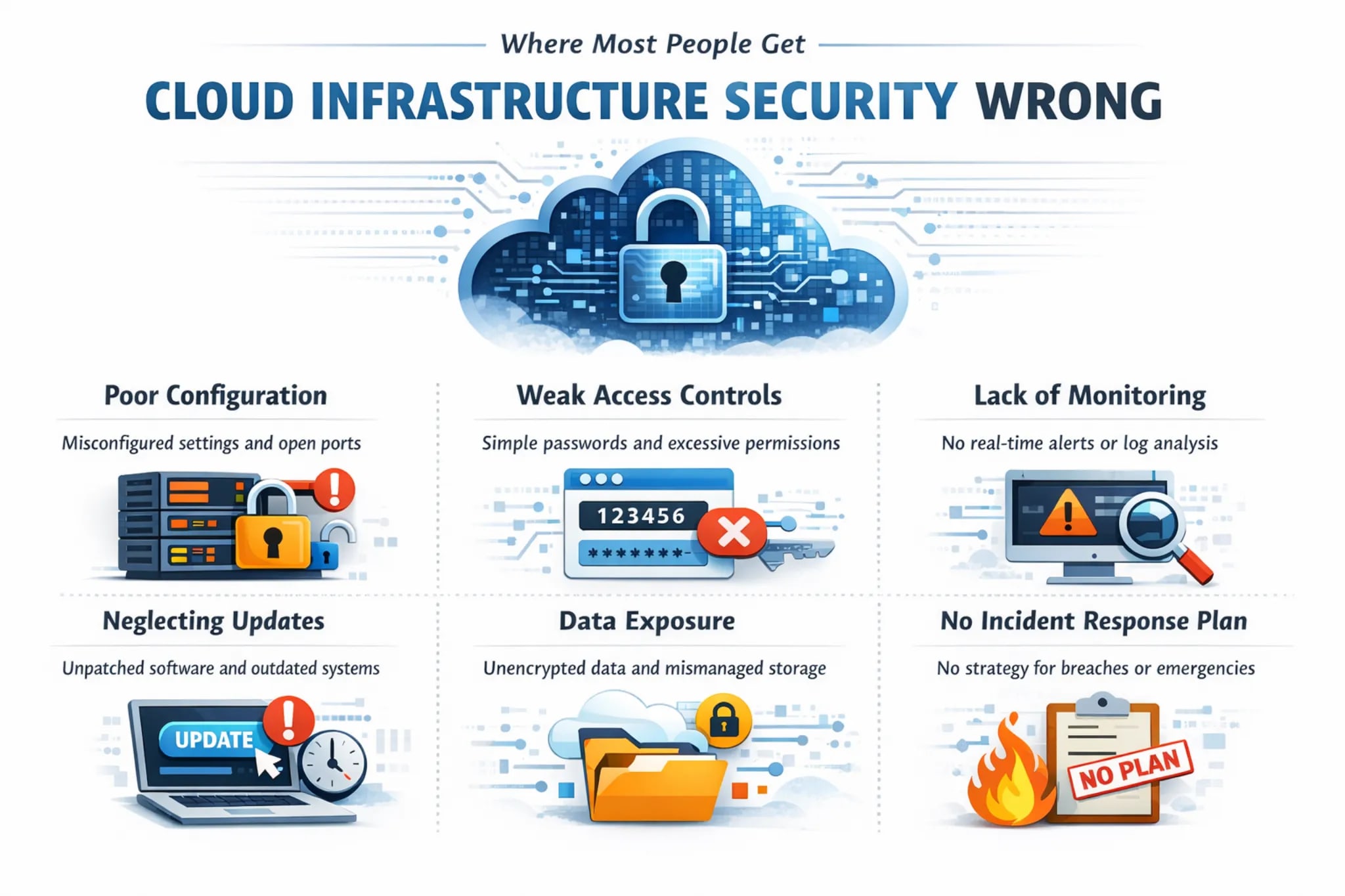
Where Most People Get Cloud Infrastructure Security Wrong

You don’t usually get cloud infrastructure security wrong because you lack tools. You get it wrong because you move fast, trust defaults, and assume the cloud provider has covered more than they actually have.
That’s where problems start.
In 2026, most cloud breaches still come down to simple mistakes. Not advanced attacks. Not zero-day exploits. Just gaps in how your infrastructure is set up and maintained.
If you understand where these mistakes happen, you can avoid most real-world risks before they turn into incidents.
You Trust Default Configurations More Than You Should
When you launch resources in the cloud, they often come with default settings. These defaults are designed for flexibility, not security.
That means:
Ports may be open
Access rules may be too broad
Logging may not be fully enabled
You assume the environment is secure because it’s running on a trusted platform. But cloud providers operate under a shared responsibility model. They secure the infrastructure itself, not how you configure it.
This is one of the biggest gaps in infrastructure security in cloud computing.
If you don’t actively tighten configurations, you’re leaving doors open without realizing it.
You Give More Access Than Necessary
Access control is one of the most overlooked areas in cloud infrastructure security.
You might:
Give admin access to speed up deployment
Share credentials across team members
Forgot to revoke permissions after a project ended
It feels efficient in the moment. It becomes a serious risk over time.
The problem isn’t just unauthorized access. It’s authorized access used in the wrong way.
Strong identity control is one of the most critical cloud infrastructure security best practices, yet it’s often ignored until something goes wrong.
Your Cloud Infrastructure Security Network Is Too Open
Your network defines what is exposed and what stays protected.
A weak cloud infrastructure security network often includes:
Publicly accessible databases
Open inbound ports
No segmentation between services
Once an attacker finds a single entry point, they don’t stop there. They move laterally across your environment.
Without proper segmentation and traffic control, your entire infrastructure becomes reachable from one weak spot.
This is why network design is not just a technical decision. It’s a security decision.
You Don’t Have Visibility Into What’s Happening
If you can’t see what’s happening in your environment, you can’t secure it.
Many setups lack:
Centralized logging
Real-time monitoring
Alerting for unusual activity
You might only discover a problem after damage has already been done.
Security is enhanced by which services in the cloud infrastructure often come down to visibility tools? Monitoring and logging services give you insight into access patterns, traffic flow, and suspicious behavior.
Without them, you’re operating blind.
You Skip Regular Cloud Infrastructure Security Assessment
A secure setup today doesn’t stay secure tomorrow.
Changes happen:
New services are deployed
Permissions are modified
Configurations drift over time
If you’re not running regular cloud infrastructure security assessment processes, you won’t catch these changes.
An effective assessment helps you:
Identify exposed resources
Detect misconfigurations
Evaluate access control risks
This isn’t a one-time task. It’s an ongoing process.
You Treat Security as a One-Time Setup
This is one of the most common mindset issues.
You set up:
Firewalls
Access controls
Basic monitoring
Then you move on, assuming your environment is secure.
But cloud environments are dynamic. New risks appear as your system evolves.
Cloud infrastructure security best practices 2025 emphasized setup. In 2026, the focus has shifted to continuous control and automation.
If you’re not actively monitoring and updating your security posture, it degrades over time.
The Pattern Behind These Mistakes
When you look at these issues together, a pattern becomes clear.
Most failures happen because:
You prioritize speed over control
You rely on assumptions instead of verification
You don’t continuously evaluate your environment
That’s why understanding what infrastructure security in cloud computing is isn’t enough. You need to apply it consistently across identity, network, and workloads.
A Simple Reality Check
Before you move forward, ask yourself:
Are your critical resources exposed to the internet?
Do you know who has access to what right now?
Can you detect suspicious activity immediately?
If any of these answers are unclear, your cloud infrastructure security needs attention.
Cloud Infrastructure Security Network: How You Secure and Control Traffic
If there’s one layer that quietly breaks your entire security posture, it’s your network.
You can have strong passwords, well-defined roles, and updated systems. But if your cloud infrastructure security network is open or poorly structured, attackers don’t need to work hard. They just follow the path you left available.
In real-world cloud setups, network misconfiguration is one of the fastest ways to get exposed.
How Attackers Actually Move Through Your Network
Most people imagine attacks as direct break-ins. That’s not how it usually works.
Here’s what actually happens:
An exposed service is discovered
Initial access is gained through a weak point
The attacker scans internal systems
They move laterally across your environment
If your network isn’t segmented, one small entry point becomes full access.
This is why infrastructure security in cloud computing puts so much weight on network control. It’s not just about blocking access. It’s about controlling movement.
Public vs Private: The First Critical Decision
Every resource in your cloud should fall into one of two categories:
Public: Accessible from the internet
Private: Accessible only to your internal network
The mistake most people make is exposing more than necessary.
You should only make something public if:
It must be accessed by external users
It’s protected and monitored
Everything else should stay private.
Databases, internal APIs, and backend services should never be publicly exposed. If they are, you’ve already increased your risk significantly.
Network Segmentation: Your First Real Defense Layer
Segmentation means separating your infrastructure into isolated sections.
Instead of everything being connected, you create boundaries.
For example:
Frontend services in one segment
Backend services in another
Databases in a restricted zone
If one segment is compromised, the attacker can’t easily move into others.
This is a core part of cloud infrastructure security best practices and becomes even more critical as your system grows.
Security Groups and Firewall Rules Done Right
Your firewall rules define what traffic is allowed.
But here’s where most setups fail:
Rules are too broad
Temporary access is never removed
“Allow all” is used for convenience
Instead, you should:
Allow only required ports
Restrict access to specific IPs or services
Regularly review and clean up rules
Security is enhanced by which services in the cloud infrastructure, which often depend on how well you configure the network control?. The tools exist. The risk comes from misuse.
Zero Trust: The Shift You Can’t Ignore in 2026
Traditional network security assumed that internal traffic is safe.
That assumption no longer works.
Zero Trust means:
No entity is trusted by default
Every request is verified
Access is continuously evaluated
Even internal services must authenticate and prove they should communicate.
This approach significantly reduces the risk of lateral movement and is now a standard part of modern cloud infrastructure security best practices 2025 and beyond.
Monitoring Traffic: Visibility Changes Everything
You can’t protect what you can’t see.
Your cloud infrastructure security network should include:
Traffic logs
Flow monitoring
Alerts for unusual patterns
Without monitoring:
Suspicious activity goes unnoticed
Breaches are discovered too late
Cloud infrastructure security assessment processes rely heavily on this data. Without visibility, your assessments won’t reflect reality.
A Simple “Before vs After” Scenario
Let’s make this practical.
Before securing your network:
The database is publicly accessible
All services can talk to each other
No traffic monitoring in place
After applying best practices:
Database moved to private subnet
Strict access rules applied
Services segmented
Monitoring and alerts enabled
Same infrastructure. Completely different risk level.
Cloud Infrastructure Security Best Practices for 2026 (Updated from 2025)
If you search for cloud infrastructure security best practices, you’ll find long lists that look impressive but don’t change how you actually secure your environment.
In 2026, best practices aren’t about knowing more. They’re about applying the few that actually reduce risk in real setups.
This section focuses on what you should implement if you want your cloud infrastructure security to hold up under real-world pressure.
Identity Controls: Limit Access Before It Becomes a Problem
Most security issues start with access, not attacks.
You might think your system is secure, but if too many users have too much control, your risk increases immediately.
Here’s what strong identity control looks like:
Every user has a defined role
Permissions are limited to what’s necessary
Multi-factor authentication is enforced everywhere
Access is reviewed regularly
This is one of the most important cloud infrastructure security best practices because it directly reduces the chances of misuse, intentional or accidental.
If you get identity wrong, everything else becomes harder to secure.
Network Controls: Reduce Exposure, Not Just Block Attacks
Your cloud infrastructure security network should not be open by default.
Instead of trying to block threats after they appear, you reduce the chances of exposure from the start.
You should:
Keep critical services in private subnets
Restrict inbound traffic to only required ports
Use strict security group rules
Separate environments such as development, staging, and production
These steps align with both cloud infrastructure security best practices 2025 and modern 2026 expectations, where exposure is minimized by design.
Data Protection: Encryption Is the Baseline, Not the Advantage
Encryption used to be a competitive advantage. Now it’s expected.
You need to ensure:
Data is encrypted at rest
Data is encrypted in transit
Encryption keys are managed securely
But encryption alone isn’t enough.
If your access controls are weak, encrypted data can still be accessed by the wrong user. That’s why data protection must work together with identity and network controls.
Continuous Monitoring: You Need Real-Time Visibility
You can’t rely on periodic checks anymore.
Your infrastructure changes constantly, which means risks appear constantly.
Your cloud infrastructure security should include:
Centralized logging
Real-time alerts
Behavior monitoring
Security is enhanced by which services in the cloud infrastructure, which often come down to monitoring tools that give you visibility into what’s happening at any moment.
Without this, you’re reacting too late.
Automation: Fix Issues Before They Escalate
Manual security doesn’t scale.
As your cloud environment grows, so does the number of configurations, users, and services.
Automation helps you:
Detect configuration drift
Enforce security policies
Remediate issues automatically
For example:
If a storage bucket becomes public, automation can immediately restrict access without waiting for manual intervention.
This is where cloud infrastructure security in 2026 separates strong setups from vulnerable ones.
Zero Trust: Verify Everything, Trust Nothing
Zero Trust is no longer optional.
Instead of assuming internal traffic is safe, you verify every request.
This means:
Every service authenticates before communication
Access decisions are continuously evaluated
Trust is never permanent
This approach directly strengthens your cloud infrastructure security network and limits the impact of any single breach.
Regular Reviews: Best Practices Only Work If You Maintain Them
This is where most teams fail.
They implement best practices once, then move on.
But cloud environments evolve:
New services are added
Permissions change
Configurations drift
That’s why cloud infrastructure security assessment should be part of your routine.
Regular reviews help you:
Identify new risks
Validate existing controls
Ensure your setup still aligns with best practices
What Changed from 2025 to 2026
Cloud infrastructure security best practices 2025 focused heavily on setup. In 2026, the focus has shifted.
Now it’s about:
Continuous monitoring instead of periodic checks
Automation instead of manual fixes
Zero Trust instead of perimeter-based security
If you’re still relying on static configurations, your security posture will degrade over time.
The Takeaway
You don’t need dozens of tools or complex frameworks.
You need control over:
Who can access your system
How your network is structured
What’s happening in real time
Cloud infrastructure security becomes manageable when you focus on these fundamentals and apply them consistently.
Cloud Infrastructure Security Assessment: How You Identify Real Risks

You can’t secure what you haven’t evaluated.
That’s the purpose of a cloud infrastructure security assessment. It’s not a checklist you run once. It’s how you continuously understand where your risks actually are.
Most teams assume their setup is secure because nothing has gone wrong yet. That assumption is exactly what creates blind spots.
In 2026, cloud environments change too fast for static security. If you’re not assessing regularly, your cloud infrastructure security is already drifting.
What a Cloud Infrastructure Security Assessment Really Means
When you hear cloud infrastructure security assessment, it’s easy to think of audits and reports.
In reality, it’s much more practical.
It answers questions like:
What resources are exposed right now?
Who has access to what?
Where are the weakest points in your setup?
This process ties directly into infrastructure security in cloud computing because it validates whether your identity, network, and workload controls are actually working.
Step 1: Build a Complete Inventory of Your Cloud Assets
Before you can assess risk, you need to know what exists.
This includes:
Virtual machines
Containers
Databases
Storage buckets
APIs and endpoints
Most environments have more resources than expected. Forgotten services are one of the most common risks.
If it exists and you’re not tracking it, it can’t be secured properly.
Step 2: Identify Exposure Points Across Your Network
Next, look at your cloud infrastructure security network.
Focus on:
Publicly accessible resources
Open ports
Unrestricted inbound traffic
This is where many vulnerabilities appear.
For example:
A database accidentally exposed to the internet
An internal service accessible without authentication
These are high-risk issues that should be addressed immediately.
Step 3: Review Identity and Access Controls
Access is one of the most critical areas in cloud infrastructure security.
During your assessment, check:
Who has administrative privileges
Whether permissions follow the least privilege principle
If inactive users still have access
Over-permissioned accounts are one of the most common causes of security incidents.
This is why identity management remains a core part of cloud infrastructure security best practices.
Step 4: Scan for Vulnerabilities in Workloads
Your applications and systems need continuous evaluation.
You should:
Scan for known vulnerabilities
Check for outdated software
Review dependency risks
Even if your network is secure, vulnerable workloads can still be exploited.
This step ensures that your infrastructure security in cloud computing is not just about access and network, but also about what’s running inside your environment.
Step 5: Evaluate Logging and Monitoring Capabilities
If something goes wrong, will you know?
A proper assessment checks:
Whether logging is enabled across services
If logs are centralized
Whether alerts are configured for suspicious activity
Security is enhanced by which services in the cloud infrastructure often depend on monitoring tools that provide visibility?
Without this, detection becomes reactive instead of proactive.
Step 6: Simulate Real Attack Paths
This is where your assessment becomes powerful.
Instead of just reviewing configurations, you test how an attacker might move through your system.
You look for:
Entry points
Paths between services
Escalation opportunities
This helps you understand how small weaknesses can connect into larger risks.
A Simple Risk Scoring Model You Can Use
You don’t need a complex framework to prioritize issues.
You can classify risks like this:
High Risk
Publicly exposed resources with weak or no authentication
Critical systems accessible from the internet
Medium Risk
Internal services with excessive permissions
Limited monitoring or logging
Low Risk
Isolated systems with strict access control
Fully monitored and regularly reviewed resources
This approach helps you focus on what matters most instead of trying to fix everything at once.
How Often Should You Run an Assessment?
This is where many teams fall behind.
A cloud infrastructure security assessment should not be occasional.
You should:
Run automated checks continuously
Perform deeper reviews regularly
Reassess after major changes
Cloud infrastructure security best practices 2025 recommend periodic audits. In 2026, continuous assessment is becoming the standard.
The Real Value of Assessment
Assessment isn’t about finding problems. It’s about maintaining control.
It gives you:
Visibility into your environment
Clarity on your risks
Confidence in your security posture
Without it, you’re relying on assumptions.
Security Is Enhanced by Which Services in the Cloud Infrastructure
When you ask security is enhanced by which services in the cloud infrastructure, the real answer isn’t a list of tools. It’s about understanding what role each service plays in controlling risk.
Cloud providers give you powerful built-in services. But those services only improve your cloud infrastructure security if you configure and use them correctly.
In 2026, strong security doesn’t come from adding more tools. It comes from using the right services to control access, monitor activity, and reduce exposure across your environment.
Identity and Access Management Services: Controlling Who Gets In
Identity services are the foundation of cloud infrastructure security.
They help you:
Define users and roles
Control permissions
Enforce authentication policies
This is where you decide:
Who can access your cloud
What actions can they perform
How access is verified
If identity is weak, attackers don’t need to break in. They can log in.
That’s why identity services are central to both infrastructure security in cloud computing and modern cloud infrastructure security best practices.
Network Security Services: Controlling Traffic Flow
Your cloud infrastructure security network relies heavily on network-level services.
These include:
Firewalls
Security groups
Virtual private cloud configurations
They control:
Which traffic is allowed
Which ports are open
How services communicate
If configured properly, these services reduce your exposure significantly. If misconfigured, they can create the exact vulnerabilities you’re trying to avoid.
This is why network services are not just protective. They’re structural.
Monitoring and Logging Services: Giving You Visibility
Visibility is what turns your security from reactive to proactive.
Monitoring services allow you to:
Track user activity
Analyze traffic patterns
Detect unusual behavior
Logging services help you:
Record events across your infrastructure
Investigate incidents
Maintain compliance
Cloud infrastructure security assessment processes rely heavily on this data. Without logs and monitoring, you can’t accurately evaluate your environment.
Threat Detection Services: Identifying Suspicious Activity Early
Threat detection tools analyze behavior and flag risks before they escalate.
They can:
Detect unusual login attempts
Identify abnormal traffic patterns
Highlight potential breaches
In 2026, many of these services will use AI to improve detection accuracy.
But they still depend on the quality of your configuration and data. If your monitoring is weak, your detection will be limited.
Data Protection Services: Securing What Matters Most
Data protection services focus on:
Encryption
Key management
Data access controls
They ensure that even if data is accessed, it remains protected.
However, encryption alone doesn’t guarantee security.
If access controls are weak, encrypted data can still be accessed by authorized but risky users. That’s why data protection must work alongside identity and network controls.
Automation and Security Management Services: Reducing Human Error
Human error is one of the biggest risks in cloud environments.
Automation services help reduce that risk by:
Enforcing security policies
Detecting misconfigurations
Automatically correcting issues
For example:
A publicly exposed resource can be detected and restricted instantly
Non-compliant configurations can be fixed without manual intervention
This aligns with cloud infrastructure security best practices 2025 and the shift toward automation in 2026.
How These Services Work Together
No single service secures your cloud.
Strong cloud infrastructure security comes from combining:
Identity control
Network restrictions
Continuous monitoring
Threat detection
Automated enforcement
Each service covers a different layer. Together, they create a system that is harder to break and easier to manage.
A Simple Way to Think About It
Instead of focusing on tools, think in terms of control:
Identity services control access
Network services control movement
Monitoring services provide visibility
Detection services identify threats
Automation services maintain consistency
If any of these are missing or weak, your overall security posture is affected.
Cloud Infrastructure Security vs Traditional Infrastructure Security
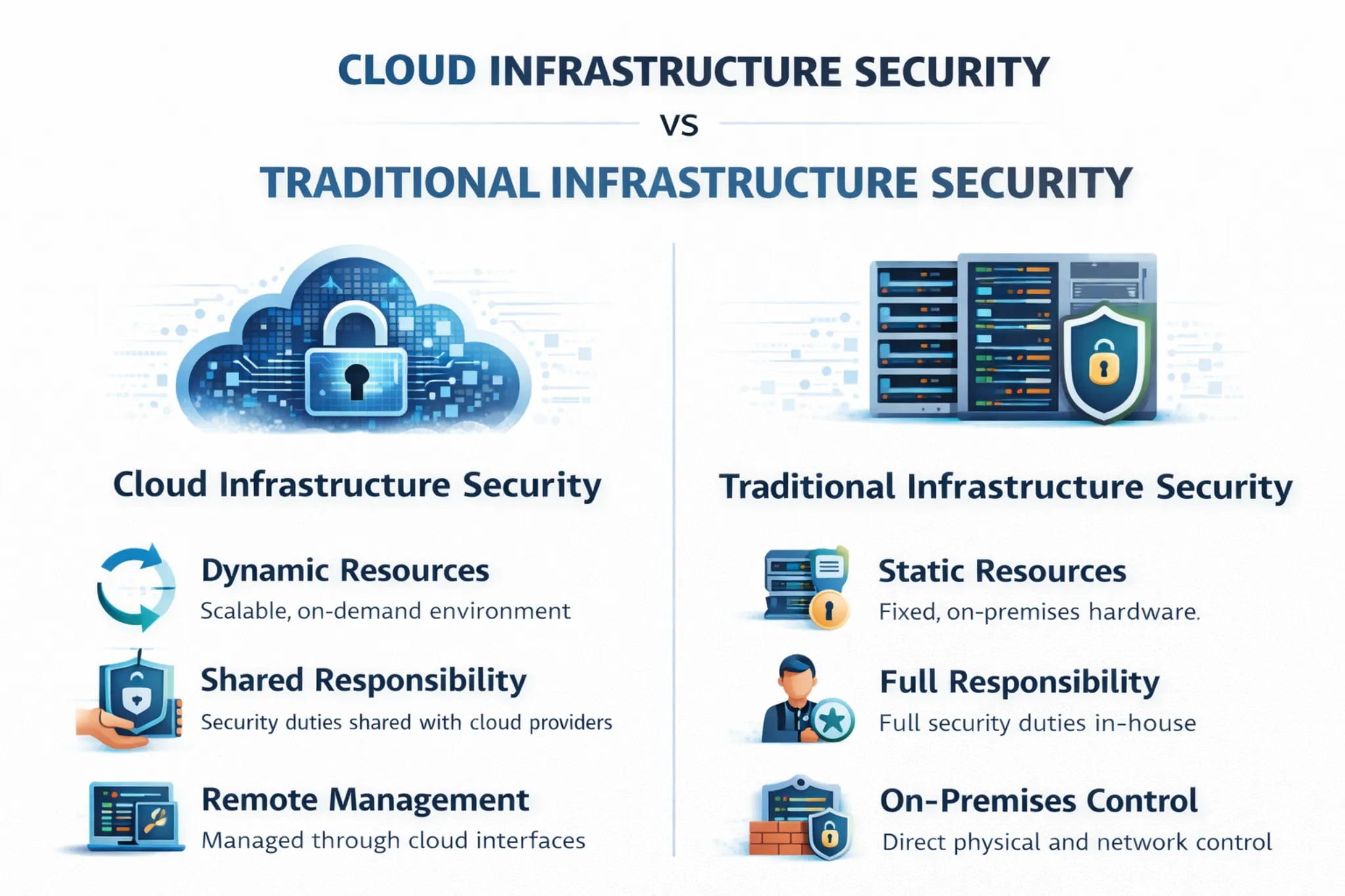
At some point, you’ll compare cloud infrastructure security with traditional setups and wonder which one actually gives you better protection.
The answer isn’t as simple as “cloud is more secure.” It depends on how you manage it.
Cloud gives you more power, more flexibility, and more built-in services. But it also introduces new risks, especially around misconfiguration and access control.
To understand the difference clearly, you need to look at how both approaches handle security at a practical level.
Side-by-Side Comparison
Factor | Cloud Infrastructure Security | Traditional Infrastructure Security |
|---|---|---|
Deployment Speed | Fast and scalable | Slower, hardware-dependent |
Security Model | Shared responsibility | Full control by organization |
Access Control | Identity-driven (IAM) | Network and physical access |
Network Security | Software-defined, flexible | Hardware-based, fixed |
Monitoring | Built-in and automated | Often manual or limited |
Risk Type | Misconfiguration, access misuse | Physical breaches, network attacks |
Scalability | High | Limited |
Automation | Advanced and integrated | Minimal |
What This Means for You
Cloud infrastructure security gives you more control, but also more responsibility.
In traditional environments:
You control everything
Changes are slower
Risks are more predictable
In cloud environments:
You share responsibility with the provider
Changes happen fast
Misconfigurations become the biggest risk
This is why understanding infrastructure security in cloud computing is critical. You’re not just managing systems. You’re managing how those systems are configured and accessed.
Where Cloud Security Wins
Cloud environments have clear advantages when handled properly.
They offer:
Built-in security services
Real-time monitoring capabilities
Automation for faster response
Scalable protection as your system grows
These features align with modern cloud infrastructure security best practices and make it easier to maintain a strong security posture, especially in dynamic environments.
Where Cloud Security Fails
Cloud doesn’t fail because of weak technology. It fails because of how it’s used.
Common issues include:
Over-permissioned access
Poorly configured cloud infrastructure security network
Lack of visibility into activity
Skipping regular cloud infrastructure security assessment
These problems don’t usually exist in traditional setups at the same scale because systems are more static.
The Key Difference: Flexibility vs Forgiveness
Traditional infrastructure is less flexible but more predictable.
Cloud infrastructure is highly flexible but less forgiving.
That means:
Small mistakes can scale quickly
Misconfigurations can expose entire systems
Access issues can affect multiple services instantly
This is why cloud infrastructure security best practices 2025 focused on setup, while 2026 focuses on continuous control and monitoring.
A Practical Example
Imagine two setups:
Traditional Setup
Server in a data center
Access is restricted physically and via the network
Changes require manual intervention
Cloud Setup
Server deployed in minutes
Accessible network configurations
Permissions controlled digitally
In the cloud, speed increases. But so does the need for precise control.
The Takeaway
Cloud infrastructure security isn’t better by default. It’s better when managed correctly.
It gives you:
More visibility
More automation
More scalability
But it also demands:
Strong identity control
A well-structured cloud infrastructure security network
Continuous monitoring and assessment
If you apply the right practices, cloud security becomes a powerful advantage. If you don’t, it becomes a fast-moving risk.
Pros and Cons of Cloud Infrastructure Security
Pros
Scales with your business without added complexity
Built-in tools enhance security capabilities
Automation reduces human error
Real-time monitoring improves threat detection
Cons
Misconfigurations can create serious vulnerabilities
Shared responsibility can cause confusion
Requires ongoing management and expertise
Fast changes increase the risk of oversight
Quick Cloud Infrastructure Security Checklist (2026)
If you want a fast way to evaluate your setup, this checklist gives you a clear snapshot of your current cloud infrastructure security posture.
You don’t need to overcomplicate it. If you can confidently check most of these, your environment is in a strong position. If not, you’ve just identified where to focus.
Identity and Access Control
Only required users have access to your cloud environment
Permissions follow least privilege, not full admin by default
Multi-factor authentication is enabled for all critical accounts
Unused accounts and roles are regularly removed
Access reviews are performed consistently
These are foundational cloud infrastructure security best practices. If identity is weak, everything else becomes vulnerable.
Cloud Infrastructure Security Network
Critical resources (databases, internal services) are not publicly exposed
Only necessary ports are open
Security groups and firewall rules are tightly controlled
Your environment is segmented into isolated layers
Internal services are not freely accessible to each other
Your cloud infrastructure security network should limit both access and movement. This is where most real-world risks appear.
Data Protection
Data is encrypted at rest
Data is encrypted in transit
Access to sensitive data is restricted and monitored
Encryption keys are securely managed
Encryption is part of standard infrastructure security in cloud computing, but it only works when combined with proper access control.
Monitoring and Visibility
Logging is enabled across all critical services
Logs are centralized for easy analysis
Alerts are configured for suspicious activity
You can track user actions and access patterns
Security is enhanced by which services in the cloud infrastructure, which often depend on how well you’ve implemented monitoring. Without visibility, you’re reacting too late.
Workload and System Security
Systems and applications are regularly updated
Vulnerability scans are performed frequently
Dependencies are monitored for known risks
Runtime behavior is observed for anomalies
Your workloads are active targets. Keeping them updated is one of the simplest but most effective protections.
Automation and Continuous Control
Misconfigurations are detected automatically
Security policies are enforced without manual intervention
Critical issues trigger immediate remediation
Configuration drift is monitored and corrected
This reflects the shift from cloud infrastructure security best practices 2025 to 2026, where automation is no longer optional.
Cloud Infrastructure Security Assessment
You maintain an up-to-date inventory of all assets
Regular assessments are performed, not just one-time audits
High-risk exposures are prioritized and fixed quickly
Changes in infrastructure trigger reassessment
A consistent cloud infrastructure security assessment process ensures your environment stays secure as it evolves.
Quick Self-Evaluation
If you step back and look at your setup:
Do you know exactly who has access right now?
Can you clearly see how traffic flows across your cloud infrastructure security network?
Would you detect suspicious activity immediately?
If the answer to any of these is no, that’s your next priority.
Final Thoughts
Cloud infrastructure security in 2026 is no longer a secondary concern. It’s a core part of how you build, scale, and protect your systems.
You don’t need more tools. You need better control.
Control over:
Who can access your environment
How your cloud infrastructure security network is structured
What’s happening across your systems in real time
The biggest shift from cloud infrastructure security best practices 2025 to today is clear. Security is no longer about setting things up once. It’s about continuously monitoring, assessing, and improving your environment.
Most failures still come down to simple gaps:
Too much access
Too much exposure
Not enough visibility
If you fix those, you eliminate the majority of real-world risks.
Cloud infrastructure security becomes manageable when you treat it as an ongoing process, not a one-time setup. Stay proactive, run regular cloud infrastructure security assessment checks, and apply best practices consistently.
That’s how you move from reactive defense to controlled, resilient infrastructure.
Frequently Asked Questions
What is cloud infrastructure security in simple terms?
Cloud infrastructure security is the process of protecting cloud-based systems, including servers, networks, and data, from unauthorized access and cyber threats.
Why is infrastructure security important in cloud computing?
It ensures your systems, data, and applications remain protected from breaches, misconfigurations, and unauthorized access.
What are the best cloud infrastructure security practices in 2026?
The most important practices include strong identity control, network segmentation, continuous monitoring, automation, and regular cloud infrastructure security assessment.
How do you perform a cloud infrastructure security assessment?
You evaluate your assets, identify exposure points, review access controls, scan for vulnerabilities, and monitor system activity to detect risks.
Which services improve cloud infrastructure security the most?
Identity management, network security services, monitoring tools, threat detection systems, and automation services all play key roles in strengthening security.