What Is The Goal Of An Insider Threat Program?
The goal of an insider threat program is to detect, prevent, and respond to risks caused by employees, contractors, or trusted users who may misuse access, intentionally or unintentionally, to protect sensitive data and maintain organizational security.
You trust your employees, contractors, and partners because your business depends on them. They need access to systems, files, and tools to get work done. But that same access creates a hidden risk that traditional security tools often miss.
An insider threat program exists to give you control over that risk.
The goal is not to treat everyone as suspicious. Instead, you build a system that understands behavior, identifies anomalies, and reacts before damage happens. You are not just protecting against malicious insiders. You are also reducing accidental mistakes, compromised accounts, and risky habits.
When you look at real-world breaches, many don’t start with external hackers breaking in. They start with someone already inside, using valid credentials. That is what makes insider threats so dangerous. They bypass firewalls, antivirus tools, and many traditional defenses.
An effective insider threat program shifts your mindset. Instead of assuming trust equals safety, you move toward verified trust. You monitor access, analyze patterns, and respond to deviations.
At its core, your program helps you:
- Understand how users interact with data
- Detect unusual behavior patterns
- Prevent sensitive information from being misused
- Respond quickly when something goes wrong
You are not eliminating trust. You are strengthening it with visibility and control.
Check out our latest blog on the Best Tor Search Engine for Privacy (2026)
Core Goals of an Insider Threat Program

Every insider threat program is built on clear, measurable goals. Without these, your efforts become reactive and inconsistent.
1. Detect Suspicious Behavior Early
Early detection is your biggest advantage.
You are not just looking for obvious threats. You are identifying subtle changes in behavior. For example, an employee accessing files they never used before, or logging in at unusual hours from a different location.
Behavioral monitoring allows you to:
- Establish normal activity baselines
- Detect deviations in real time
- Trigger alerts based on risk signals
The earlier you detect these changes, the easier it is to prevent escalation. Waiting until the data is already stolen means you are too late.
2. Prevent Data Loss and Exfiltration
Data loss is one of the most costly outcomes of insider threats.
Your program ensures that sensitive data is not just stored securely but also handled correctly. This includes monitoring how data is accessed, shared, and transferred.
You can:
- Restrict downloads of sensitive files
- Block unauthorized transfers
- Track data movement across systems
Prevention is always more effective than recovery. Once data leaves your environment, controlling its spread becomes nearly impossible.
3. Enforce Least Privilege Access
Access control is one of the simplest yet most powerful defenses.
Instead of giving broad access, you limit users to only what they need. This reduces the attack surface significantly.
You should:
- Regularly audit user permissions
- Remove unused or excessive access
- Implement role-based access control
When access is limited, even if an account is compromised, the damage remains contained.
4. Improve Incident Response
No system is perfect. Incidents will happen.
What matters is how quickly and effectively you respond. An insider threat program provides structured processes for identifying, analyzing, and containing threats.
You gain:
- Faster detection timelines
- Clear investigation workflows
- Coordinated response actions
This reduces downtime, financial loss, and reputational damage.
5. Build Security Awareness
Human behavior is unpredictable.
Many insider threats are not intentional. Employees may click phishing links, share files incorrectly, or ignore security policies.
Your program should include:
- Regular training sessions
- Awareness campaigns
- Clear reporting channels
When users understand risks, they become part of your defense system.
Key Components of an Insider Threat Program

An insider threat program is not a single tool. It is a combination of systems, policies, and processes working together.
User activity monitoring gives you visibility into how employees interact with systems. You can track logins, file access, and usage patterns. This data forms the foundation for detecting anomalies.
Data Loss Prevention (DLP) tools help you control how sensitive information moves. You can block unauthorized sharing, restrict downloads, and monitor external transfers.
User Behavior Analytics (UBA) adds intelligence. Instead of relying on static rules, it learns patterns and identifies unusual behavior automatically.
Access control systems ensure users only have the necessary permissions. Identity and Access Management (IAM) tools play a critical role here.
Finally, your incident response framework defines what happens when a threat is detected. Without this, alerts become noise instead of actionable insights.
Each component strengthens your overall defense. Missing even one creates gaps that attackers or insiders can exploit.
Types of Insider Threats You Must Address
Understanding insider threats requires you to look beyond just malicious intent.
Malicious insiders are the most obvious. These are individuals who intentionally misuse access. They may steal data, sabotage systems, or sell information.
Negligent insiders are far more common. These users do not intend harm, but their actions create risk. Weak passwords, careless file sharing, and ignoring security protocols fall into this category.
Compromised accounts blur the line between internal and external threats. Attackers use stolen credentials to act as legitimate users. From your system’s perspective, everything looks normal.
Each type requires a different response strategy. You cannot treat all insider threats the same. That is why behavioral analysis is critical. It helps you understand intent, not just actions.
Insider Threat Use Cases in Real Organizations
Real-world scenarios make insider threats easier to understand.
An employee preparing to leave may download sensitive files before resignation. This is a common data theft scenario.
An administrator might access confidential information without authorization. Privileged users pose higher risks because of their elevated access.
Employees may use unauthorized tools or cloud platforms, creating shadow IT risks. These tools often lack proper security controls.
Data exfiltration can happen through simple methods like USB drives or personal email accounts. These actions often go unnoticed without monitoring.
Each scenario highlights the importance of visibility. Without tracking behavior, these activities remain hidden until it is too late.
Technologies Powering Insider Threat Programs
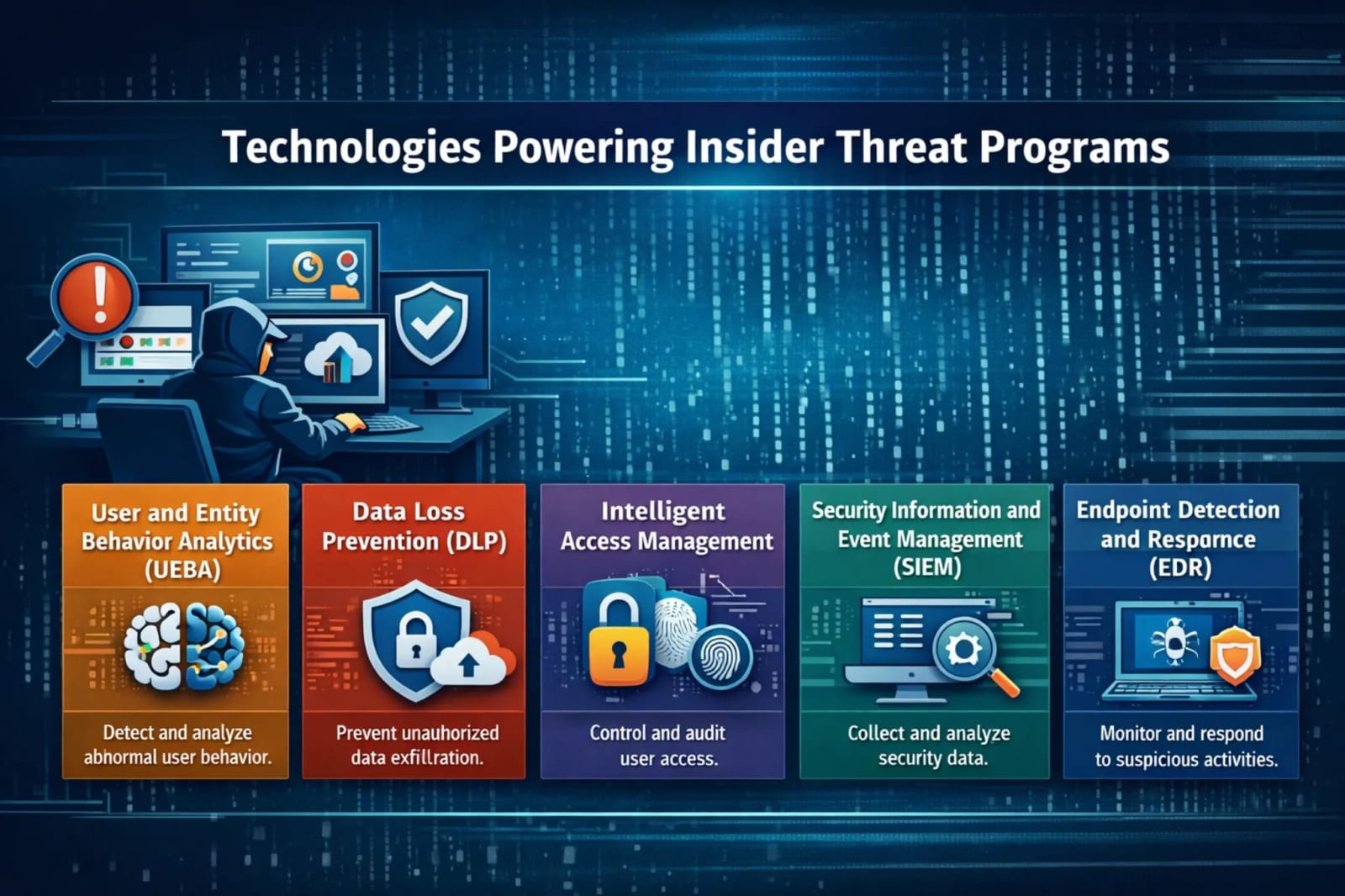
Technology enables your insider threat program to scale and operate effectively.
SIEM systems collect and analyze logs from multiple sources. They help you identify patterns and correlate events.
UEBA tools use machine learning to detect anomalies in user behavior. They reduce reliance on manual analysis.
EDR solutions monitor endpoint activity, giving you insight into what happens on individual devices.
IAM systems control access and enforce identity verification. They ensure only authorized users can access resources.
Cloud security tools extend protection to SaaS platforms and remote environments.
Together, these technologies create a comprehensive security ecosystem.
Insider Threat Program vs Traditional Security
Traditional security focuses on external threats. Firewalls, antivirus software, and intrusion detection systems are designed to keep attackers out.
Insider threat programs focus on what happens inside.
They analyze behavior instead of just signatures. They monitor users instead of just network traffic.
This shift is critical because many modern attacks originate from within. Relying solely on traditional security leaves a major gap.
Insider Threat Program vs Data Loss Prevention (DLP)
DLP is often misunderstood as a complete solution.
In reality, it is just one part of a larger strategy.
DLP focuses on data movement. It prevents sensitive information from being shared or transferred improperly.
An insider threat program goes further. It analyzes user intent, behavior, and context.
You need both. DLP protects data. The insider threat program protects your organization.
Insider Threat Lifecycle Explained
Every insider threat follows a pattern.
It starts with access. A user is granted permissions.
Then, behavior changes. This could be subtle or obvious.
Detection occurs when systems identify anomalies.
Investigation follows, where security teams analyze the situation.
Finally, response and mitigation contain the threat.
Understanding this lifecycle allows you to intervene early and reduce impact.
Best Practices for Insider Threat Management
Consistency is key.
You should enforce least privilege access across all systems. Monitor user behavior continuously instead of relying on periodic checks.
Automation helps reduce manual workload and improve detection speed.
Training employees regularly ensures they understand risks and follow best practices.
Policies should be updated frequently to reflect evolving threats.
A strong program is not static. It adapts and improves over time.
Challenges in Implementing Insider Threat Programs

Implementing an insider threat program is not without challenges.
Balancing security and privacy is a major concern. Employees may feel monitored if not handled transparently.
False positives can overwhelm security teams. Not every alert represents a real threat.
Integration with existing systems can be complex, especially in large organizations.
There may also be resistance from internal teams who see security measures as restrictive.
Addressing these challenges requires clear communication, proper tools, and strong leadership.
KPIs to Measure Success
You need measurable metrics to evaluate your program.
Tracking the number of detected threats helps you understand risk levels.
Time to detect (TTD) shows how quickly you identify issues.
Time to respond (TTR) measures your reaction speed.
False positive rates indicate the efficiency of your detection systems.
Monitoring data loss incidents helps you assess overall effectiveness.
These KPIs guide continuous improvement.
Benefits of an Insider Threat Program
The benefits go beyond just security.
You reduce the likelihood of costly data breaches. Detection becomes faster and more accurate.
Compliance requirements become easier to meet.
You gain better visibility into how your organization operates internally.
This leads to stronger trust with clients and stakeholders.
Pros and Cons
Pros
- Proactive detection
- Strong data protection
- Improved visibility
- Compliance support
Cons
- Requires investment
- Privacy concerns
- Ongoing management
How to Build an Insider Threat Program
Building a program requires a structured approach.
Start by identifying critical assets and high-risk areas. Deploy monitoring tools to gain visibility.
Define clear policies and procedures for handling threats.
Train employees to ensure awareness.
Continuously review and improve your program based on performance metrics.
This ensures long-term effectiveness.
Final Thoughts
Insider threats are not rare. They are inevitable.
The goal of an insider threat program is to give you control, visibility, and the ability to act before damage occurs.
You are not just protecting data. You are protecting your entire organization from within.
Frequently Asked Questions
What are the three main types of insider threats?
The three main types are malicious insiders who intentionally cause harm, negligent insiders who make mistakes, and compromised users whose accounts are taken over by attackers.
Why is an insider threat program important
An insider threat program is important because it helps organizations detect and prevent risks from trusted users who already have access to sensitive systems and data.
What is the difference between an insider threat and an external threat?
An insider threat comes from within the organization using legitimate access, while an external threat originates outside and attempts to gain unauthorized access.
How do companies detect insider threats?
Companies detect insider threats using tools like user behavior analytics, SIEM systems, and monitoring solutions that identify unusual activity patterns.
What is an example of an insider threat?
An example of an insider threat is an employee downloading confidential data before leaving the company or accidentally exposing sensitive information through phishing attacks.