Bomb Threat Checklist & Emergency Response Plan
A bomb threat checklist and emergency response plan in cybersecurity helps you respond to digital and physical threats, preserve evidence, protect systems, and coordinate a structured incident response that keeps people and operations secure.
You don’t experience a bomb threat in isolation anymore. It rarely shows up as a random phone call with no context. Today, it often arrives through email, messaging platforms, spoofed identities, or coordinated digital campaigns. That changes how you respond.
If you treat a bomb threat as purely a physical risk, you leave gaps. If you approach it with a cybersecurity and cyber defense mindset, you close those gaps before they turn into vulnerabilities.
A modern bomb threat checklist and emergency response plan isn’t just about evacuation. It’s about detection, containment, communication control, evidence preservation, and system protection. You’re managing an incident that can affect both people and infrastructure at the same time.
This guide walks you through a complete, rank-ready, real-world approach that aligns with modern cyber defense practices so you can act with clarity instead of reacting with uncertainty.
Why Bomb Threats Now Demand a Cybersecurity Response
You’re operating in a threat landscape where intent and execution are no longer separated. A bomb threat can be:
- A hoax designed to disrupt operations
- A phishing attempt to test vulnerabilities
- A distraction for a cyber attack
- A coordinated attempt to exploit both physical and digital access
You need to think beyond the message itself.
Ask yourself:
- Did this originate from a compromised account?
- Are multiple employees receiving similar threats?
- Is there unusual network activity right now?
- Could this be part of a broader attack chain?
Attackers don’t rely on a single method anymore. They layer tactics. While your team focuses on evacuation, they may attempt unauthorized access, data extraction, or lateral movement within your systems.
That’s why your response plan must integrate cyber defense from the very first step.
Phase 1: Threat Detection and Intake

You Start by Capturing, Not Reacting
The moment a threat reaches you, your instinct might be to act fast. That’s good, but your first responsibility is to capture accurate information while preserving evidence.
If the Threat Comes Through Email or Digital Channels
You should:
- Preserve the original message
- Avoid clicking links or downloading attachments
- Capture full email headers
- Take screenshots with timestamps
- Report the message internally without forwarding it broadly
You’re not just documenting. You’re protecting forensic evidence.
If the Threat Comes Through a Call
You should:
- Keep the caller engaged if possible
- Write down the exact wording
- Note tone, background noise, and pacing
- Identify signs of masking or VoIP usage
Cyber Defense Actions You Must Trigger
At this stage, you should:
- Notify your internal IT or security operations team
- Flag the message in your email security system
- Initiate log retention protocols
- Monitor for similar incoming threats
You’re setting the foundation for investigation and containment.
Phase 2: Threat Classification and Risk Assessment
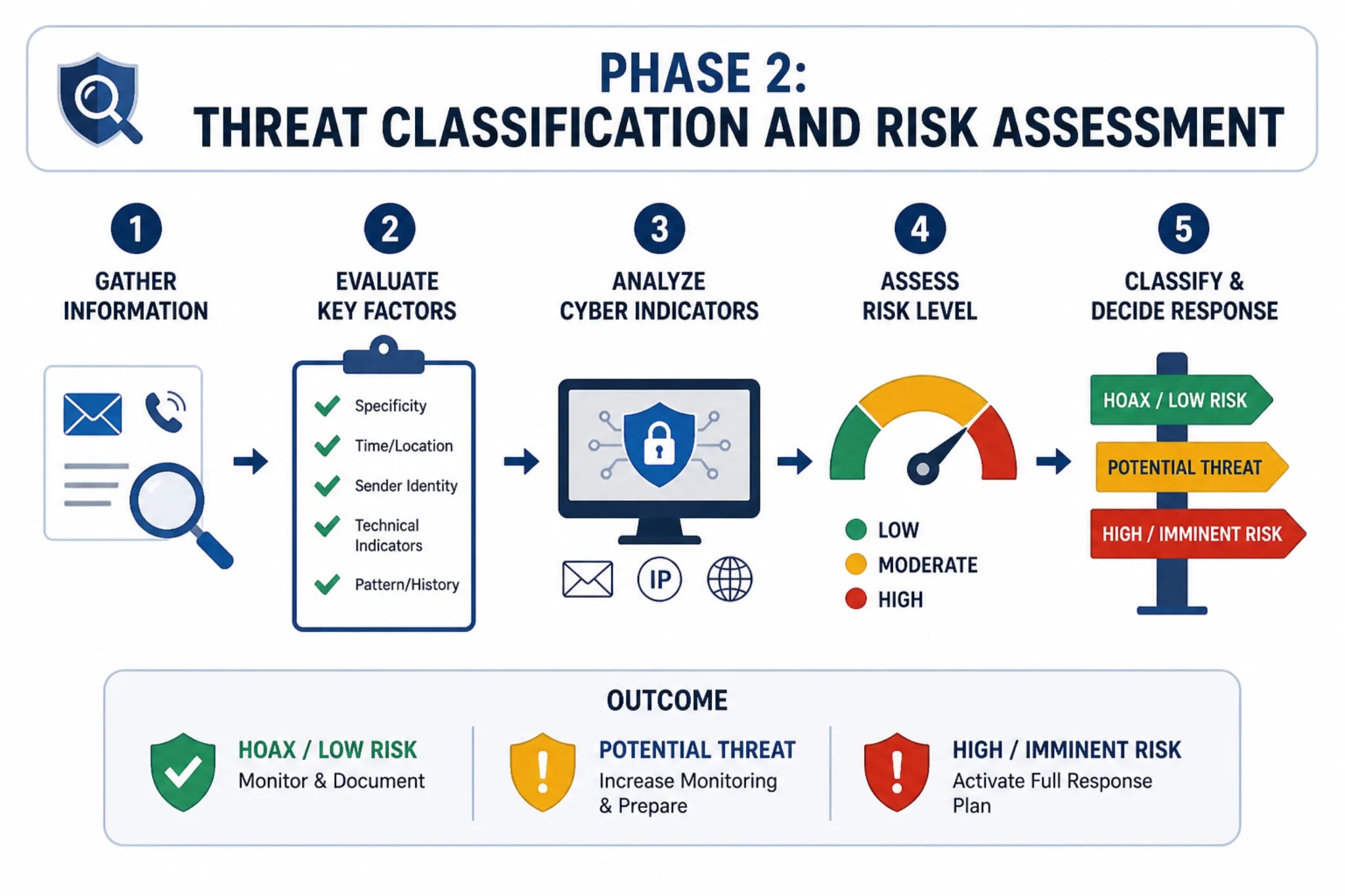
You Don’t Treat Every Threat the Same
Once the threat is documented, you move into classification. This step determines how serious the situation is and what level of response is required.
You Evaluate:
- Specificity of the threat
- Mentioned time or location
- Technical indicators in the message
- Sender identity and traceability
- Patterns across multiple users
Apply a Cybersecurity Lens
You should analyze:
- Whether the message resembles phishing campaigns
- If domains or IPs match known threat actors
- Whether internal systems show unusual behavior
Frameworks from organizations like NIST emphasize structured incident classification because misjudging severity leads to either overreaction or dangerous delays.
Your goal isn’t to guess. Your goal is to categorize risk accurately.
Phase 3: Containment and Parallel Response
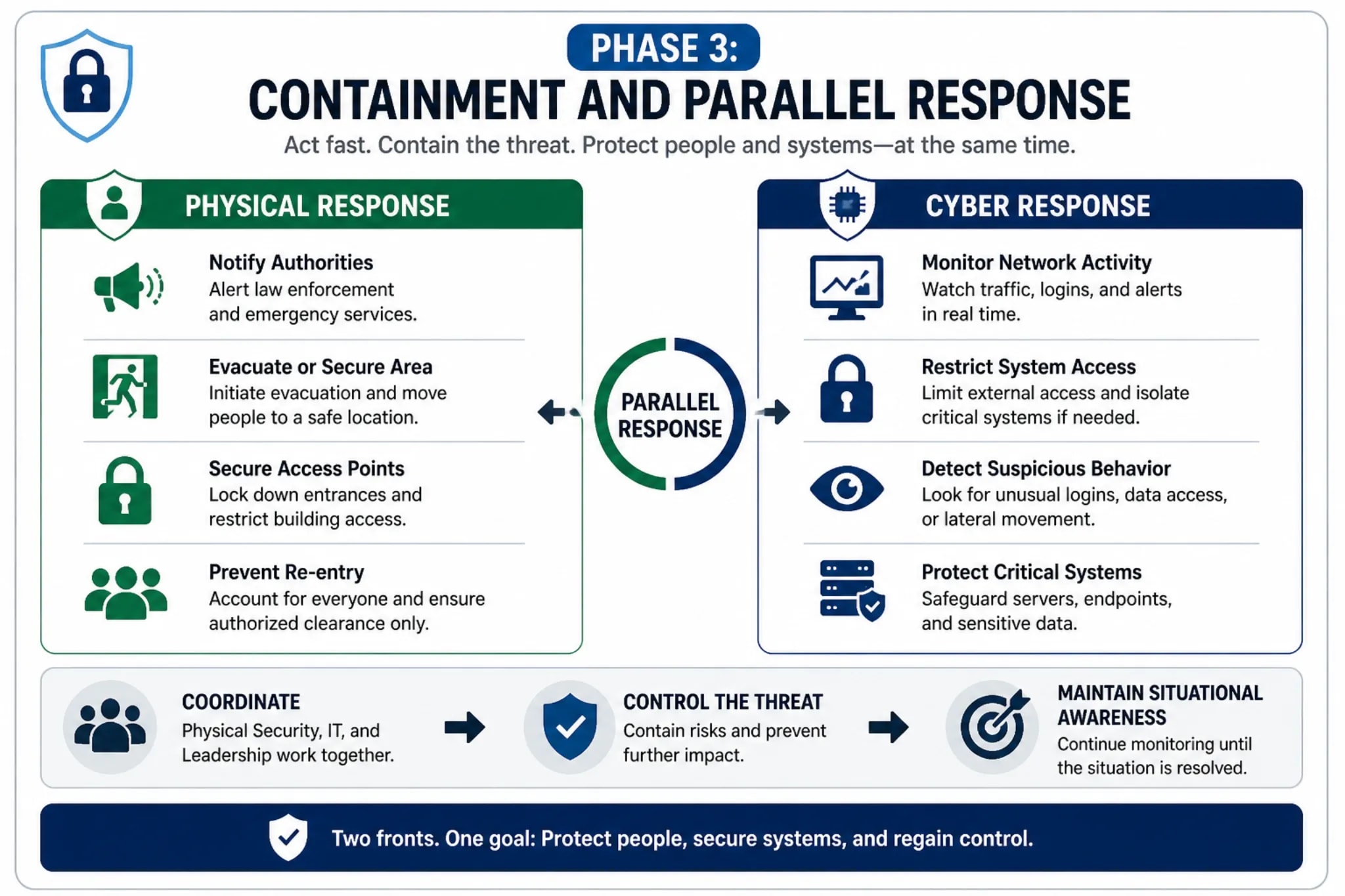
You Must Handle Physical and Digital Risks Together
This is where most organizations fail. They treat evacuation and cybersecurity as separate processes when they should run in parallel.
Physical Response Actions
You should:
- Notify emergency authorities immediately
- Initiate evacuation if required
- Secure entry and exit points
- Prevent unauthorized access
Cybersecurity Response Actions
At the same time, your IT team should:
- Monitor network traffic in real time
- Watch for unauthorized login attempts
- Restrict external access if needed
- Protect sensitive systems and databases
You’re preventing attackers from exploiting confusion.
Integrated Bomb Threat Checklist
You need a unified checklist that reflects both physical and cyber priorities.
| Stage | Action | Cyber Defense Layer | Priority |
|---|---|---|---|
| Threat Intake | Record exact details | Capture logs, metadata | Critical |
| Alert | Notify teams | Activate SOC monitoring | Critical |
| Classification | Assess threat credibility | Analyze indicators | High |
| Containment | Evacuate or secure site | Restrict system access | High |
| Investigation | Support authorities | Provide digital evidence | High |
| Communication | Control messaging | Use secure channels | High |
| Recovery | Resume operations | Validate system integrity | Critical |
This structure keeps your response aligned and efficient.
Phase 4: Communication Control and Information Security

You Control Panic by Controlling Information
Communication becomes a vulnerability if it’s not managed properly.
What You Should Do
- Use secure internal communication tools
- Provide clear, simple instructions
- Limit information to essential personnel
- Keep messaging consistent across teams
What You Should Avoid
- Sharing threat details publicly
- Speculating about outcomes
- Using unsecured apps for coordination
Cyber Risk You Must Consider
Attackers often monitor:
- Social media updates
- Internal leaks
- Public statements
They can use this information to adjust their tactics. You reduce that risk by controlling the narrative.
Phase 5: Investigation and Digital Forensics

You Move From Response to Understanding
Once immediate safety is addressed, your focus shifts to investigation.
What You Should Provide
You support authorities with:
- Email headers and logs
- Access records
- Communication history
- System activity reports
Internal Cyber Analysis
Your team should:
- Trace the origin of the message
- Identify malware indicators
- Review user activity
- Check for compromised accounts
Standards from ISO 27001 emphasize evidence integrity, which means you must avoid altering or deleting data during this phase.
You’re building a complete incident profile.
Phase 6: Recovery and System Hardening

You Don’t Just Return to Normal, You Improve
After the incident, you strengthen your defenses.
Immediate Recovery Actions
You should:
- Verify system integrity
- Reset credentials if needed
- Restore secure operations
- Validate access controls
Long-Term Improvements
You should:
- Enhance email filtering systems
- Implement multi-factor authentication
- Update incident response protocols
- Improve monitoring capabilities
Every incident becomes a learning opportunity.
How to Build a Cyber-Aware Bomb Threat Response Plan
You Design for Coordination, Not Silos
Your plan should integrate physical security and IT operations.
Essential Components
- Defined roles for security and IT teams
- Clear escalation procedures
- Digital evidence handling guidelines
- Secure communication protocols
- Integration with your SOC
Training Is What Makes It Work
You should:
- Conduct joint drills
- Simulate phishing-based threats
- Practice coordinated response scenarios
Preparation removes hesitation during real incidents.
Pros and Cons of a Cyber Defense Approach
Pros
- Stronger overall security posture
- Better incident visibility
- Reduced risk of secondary attacks
- Improved coordination across teams
- Faster detection of complex threats
Cons
- Requires skilled personnel
- More complex processes
- Needs continuous updates
- Higher initial setup effort
You’re trading simplicity for resilience, and that’s a worthwhile trade.
Common Mistakes You Should Avoid
You can have a plan and still fail if you overlook critical details.
Avoid:
- Ignoring digital threat indicators
- Delaying IT involvement
- Using unsecured communication tools
- Failing to preserve evidence
- Treating threats as isolated events
These mistakes create entry points that attackers can exploit.
Final Thoughts
You don’t rise to the level of the threat. You fall to the level of your preparation.
A bomb threat today isn’t just about a device. It’s about disruption, access, and exploitation. If you prepare only for evacuation, you’re solving half the problem.
When you integrate cybersecurity into your response plan, you protect your people, your systems, and your operations at the same time.
You don’t need complexity. You need structure, clarity, and practice.
Build your checklist. Train your teams. Align your defenses.
That’s how you stay in control when it matters most.
Frequently Asked Questions
Why should bomb threat response include cybersecurity measures?
Because many threats originate digitally and can be part of broader attacks like phishing, data breaches, or coordinated disruptions.
What is the first step in a bomb threat checklist?
You should document the threat accurately and preserve all related information, including digital evidence and communication logs.
How can a bomb threat be used in cyber attacks?
Attackers may use threats as distractions while attempting unauthorized access, data theft, or system compromise.
Should IT teams be involved immediately during a bomb threat?
Yes, early involvement helps monitor systems, preserve evidence, and detect parallel cyber activity.
How often should you update a bomb threat response plan?
You should review and update it regularly, especially after drills or real incidents, to improve effectiveness and adapt to evolving threats.