Managed Endpoint Detection and Response: Benefits & Tools
Cyberattacks increasingly target endpoints such as laptops, servers, employee devices, and remote workstations. Traditional antivirus software is no longer enough to stop modern threats like ransomware, fileless malware, credential theft, and lateral movement attacks.
Managed endpoint detection and response (EDR) helps businesses monitor, detect, investigate, and respond to endpoint threats in real time. Unlike legacy antivirus tools, managed EDR solutions combine behavioral analytics, continuous monitoring, threat intelligence, and SOC expertise to identify suspicious activity before it becomes a major security incident.
In 2026, organizations are adopting managed EDR platforms to improve endpoint visibility, reduce incident response times, and strengthen protection against increasingly advanced cyberattacks. This guide explains how managed endpoint detection and response works, its key benefits, common use cases, and the top EDR tools businesses use today.
What Is Managed Endpoint Detection and Response?
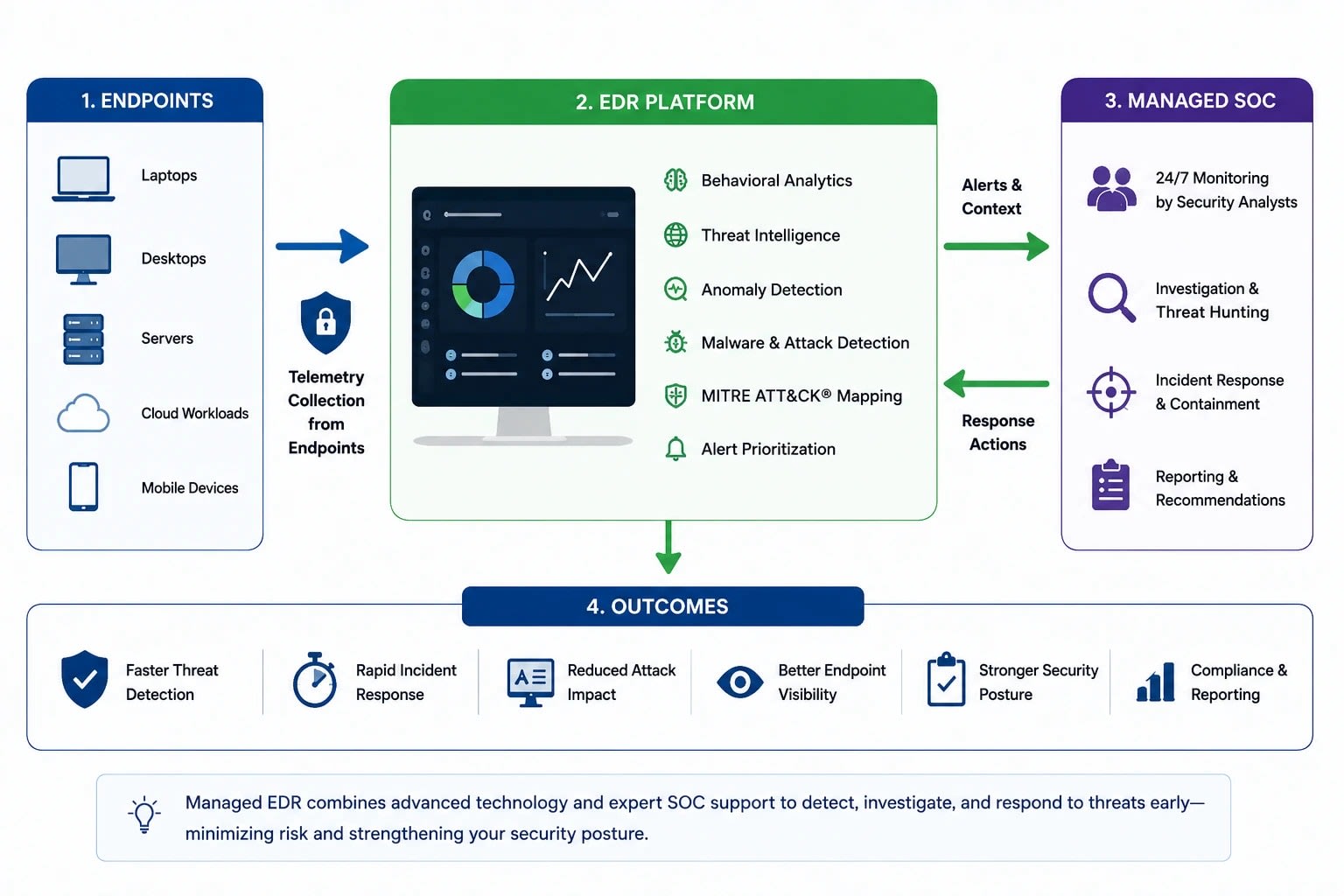
Managed endpoint detection and response is a cybersecurity service that combines endpoint security technology with managed threat monitoring and incident response support.
Unlike traditional antivirus solutions that mainly rely on known malware signatures, managed EDR platforms continuously collect and analyze endpoint telemetry to detect suspicious behavior, abnormal processes, and potential threats in real time.
A managed EDR solution typically includes:
- Continuous endpoint monitoring
- Behavioral threat detection
- Threat hunting
- Incident investigation
- Endpoint isolation
- Malware containment
- Security analyst support
- Automated remediation workflows
The “managed” component means organizations also receive support from a security operations team or MDR provider that actively monitors alerts, investigates incidents, and helps respond to threats around the clock.
This approach is especially valuable for businesses that lack a dedicated internal SOC team or advanced threat detection capabilities.
Check out our latest blog on Cybersecurity vs Data Analytics in 2026
Why Traditional Antivirus Is No Longer Enough

Traditional antivirus software was designed for a very different threat landscape.
Older antivirus tools primarily focused on detecting known malware signatures. While this worked against basic viruses and trojans, modern attacks have evolved far beyond static malware files.
Today’s attackers commonly use:
- Fileless malware
- PowerShell abuse
- Credential dumping
- Living-off-the-land techniques
- Ransomware-as-a-service
- Zero-day exploits
- Lateral movement tactics
These attacks often avoid traditional signature-based detection entirely.
Managed EDR addresses this gap by focusing on behavior rather than just known malicious files. Instead of asking whether a file matches a malware signature, EDR platforms analyze activity patterns such as:
- Unusual PowerShell execution
- Suspicious process spawning
- Privilege escalation attempts
- Registry persistence changes
- Remote execution activity
- Unauthorized lateral movement
This allows organizations to detect advanced threats earlier and respond before attackers gain full access to critical systems.
How Managed Endpoint Detection and Response Works

Managed EDR solutions operate by continuously collecting endpoint telemetry from devices across the organization.
This telemetry may include:
- Process activity
- User logins
- Command-line executions
- Network connections
- Registry modifications
- File activity
- Memory behavior
- USB device activity
The EDR platform then analyzes this data using:
- Behavioral analytics
- AI-driven detection models
- Threat intelligence feeds
- IOC matching
- MITRE ATT&CK mapping
- Machine learning detection logic
When suspicious activity is identified, alerts are generated for investigation.
In managed EDR environments, SOC analysts or MDR teams review these alerts to determine whether they represent real threats, false positives, or benign activity.
Depending on the severity, response actions may include:
- Killing malicious processes
- Isolating infected endpoints
- Blocking IP addresses
- Removing malicious files
- Resetting compromised credentials
- Launching deeper incident investigations
This combination of automation and human analysis helps reduce response times while improving detection accuracy.
Check out our latest post on GSOC Security: Global Security Operations Center
Key Benefits of Managed Endpoint Detection and Response
24/7 Threat Monitoring
Cyberattacks do not operate on business hours. Managed EDR solutions provide continuous endpoint visibility and monitoring, helping organizations identify threats at any time.
Faster Incident Response
Rapid detection and containment significantly reduce the impact of breaches. Managed EDR platforms can isolate compromised endpoints within minutes.
Improved Endpoint Visibility
Security teams gain deeper insight into endpoint activity, process execution, and user behavior across the environment.
Reduced SOC Workload
Managed services help reduce alert fatigue by filtering false positives and prioritizing high-risk incidents.
Better Protection Against Ransomware
Behavioral monitoring helps identify ransomware activity before encryption spreads across the network.
Threat Hunting Capabilities
Many managed EDR providers proactively search for indicators of compromise and hidden attacker activity.
Compliance and Reporting Support
Managed EDR solutions often include logging, reporting, and audit capabilities useful for compliance frameworks.
How Managed EDR Helps Prevent Ransomware
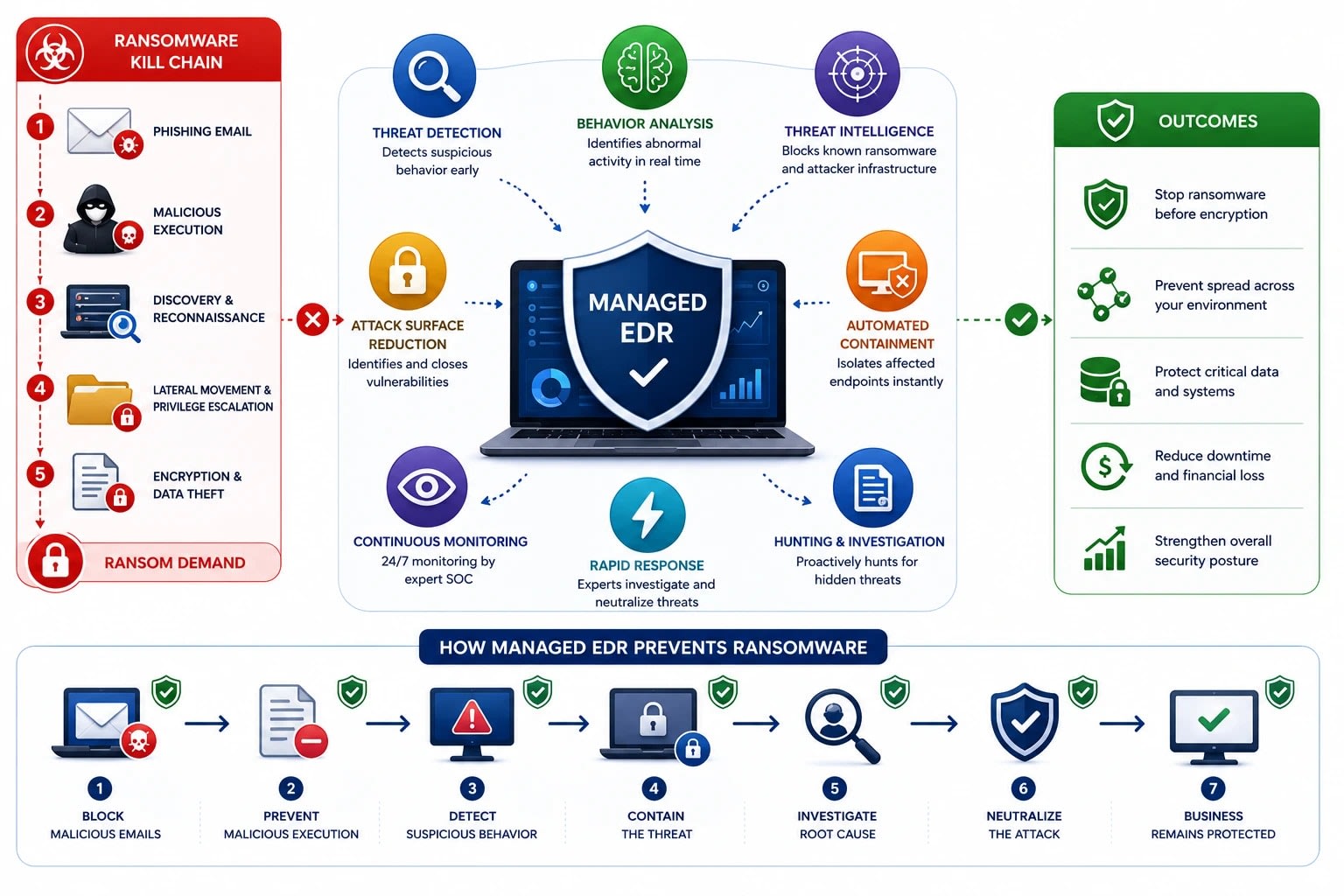
Ransomware remains one of the biggest cybersecurity threats facing businesses in 2026.
Managed EDR solutions help reduce ransomware risk through several mechanisms:
Behavioral Detection
Instead of relying on malware signatures alone, EDR tools identify suspicious encryption behavior, abnormal file access patterns, and privilege escalation attempts.
Endpoint Isolation
Compromised devices can be isolated from the network before ransomware spreads laterally.
Lateral Movement Detection
Managed EDR platforms monitor suspicious remote execution activity, credential abuse, and internal scanning behavior commonly used during ransomware campaigns.
Threat Hunting
Security analysts proactively search for ransomware indicators before attackers fully execute their payloads.
Automated Response Actions
EDR tools can automatically terminate malicious processes and block suspicious activity in real time.
This layered approach provides much stronger protection than traditional antivirus alone.
Common Threats Managed EDR Can Detect
Managed endpoint detection and response platforms are designed to identify a wide range of threats, including:
- Ransomware attacks
- Credential theft
- PowerShell abuse
- Insider threats
- Privilege escalation
- Malware-free attacks
- Lateral movement
- Persistence mechanisms
- Command-and-control communication
- Suspicious remote access activity
- Fileless malware
- Exploit attempts
Modern EDR platforms are especially valuable for detecting advanced threats that bypass legacy antivirus solutions.
Managed EDR vs Traditional Antivirus
| Feature | Traditional Antivirus | Managed EDR |
|---|---|---|
| Signature-based detection | Yes | Yes |
| Behavioral analytics | Limited | Advanced |
| Threat hunting | No | Yes |
| Real-time monitoring | Basic | Continuous |
| SOC analyst support | No | Yes |
| Endpoint isolation | Rare | Common |
| Incident investigation | Minimal | Advanced |
| Ransomware protection | Limited | Strong |
Traditional antivirus remains useful for basic malware prevention, but managed EDR provides significantly deeper visibility and response capabilities.
Key Features to Look for in a Managed EDR Solution
Choosing the right managed EDR platform requires evaluating several important capabilities.
Key features to look for include:
- Behavioral threat detection
- Endpoint isolation
- Threat intelligence integration
- AI-driven analytics
- Threat hunting support
- MITRE ATT&CK mapping
- SIEM integration
- Cloud workload visibility
- Automated remediation
- USB and device control
- Forensic investigation tools
- Cross-platform endpoint support
Organizations should also evaluate the provider’s SOC maturity, response SLAs, and detection engineering capabilities.
Best Managed Endpoint Detection and Response Tools in 2026

Several EDR vendors continue to dominate the cybersecurity market in 2026.
CrowdStrike Falcon
Widely used in enterprise environments for advanced threat detection, threat hunting, and cloud-native endpoint protection.
SentinelOne
Known for strong AI-driven automation and autonomous endpoint response capabilities.
Microsoft Defender for Endpoint
Popular among organizations heavily invested in Microsoft ecosystems and cloud services.
Palo Alto Networks Cortex XDR
Combines endpoint visibility with network and cloud telemetry for broader threat detection.
Sophos Intercept X
Offers ransomware protection and managed detection services for SMBs and enterprises.
Trend Micro Vision One
Provides XDR-focused visibility with strong threat intelligence integration.
Each platform offers different strengths depending on organization size, infrastructure, and security maturity.
Managed EDR vs MDR vs XDR
These terms are often confused, but they serve different purposes.
| Technology | Primary Focus |
|---|---|
| EDR | Endpoint detection and response |
| MDR | Managed security monitoring and response services |
| XDR | Cross-layer detection across endpoints, networks, cloud, and email |
EDR focuses specifically on endpoints.
MDR adds human-led monitoring and response services.
XDR expands visibility across multiple security layers beyond endpoints.
Many modern security providers now combine these capabilities into integrated platforms.
Who Should Use Managed Endpoint Detection and Response?
Managed EDR solutions are valuable for organizations of all sizes, especially those facing growing endpoint security risks.
Industries that commonly benefit include:
- Healthcare
- Financial services
- SaaS companies
- Government agencies
- Educational institutions
- Remote-first organizations
- Small businesses without internal SOC teams
Any organization handling sensitive data or operating distributed environments should consider managed EDR as part of its cybersecurity strategy.
Real SOC Challenges With Endpoint Detection and Response
While EDR platforms provide significant visibility, real-world SOC operations still face several challenges.
Alert Fatigue
Large environments can generate thousands of alerts daily, many of which may be low priority or false positives.
Detection Tuning
Security teams often need to fine-tune detection rules to reduce noise while maintaining visibility.
Visibility Gaps
Unmanaged devices, shadow IT, and remote endpoints can create blind spots.
Complex Integrations
Integrating EDR with SIEM platforms, identity providers, and cloud tools can be operationally challenging.
Incident Prioritization
SOC analysts must quickly determine which alerts represent genuine threats requiring immediate action.
These operational realities highlight why managed services and experienced analysts remain critical alongside automated detection technology.
What Affects Managed EDR Pricing?
Managed EDR pricing varies depending on several factors.
Common pricing considerations include:
- Number of protected endpoints
- 24/7 monitoring requirements
- Data retention duration
- Cloud workload visibility
- Threat hunting capabilities
- Incident response SLAs
- Compliance requirements
- Integration complexity
Organizations should focus on overall security value rather than choosing solutions solely based on price.
Final Thoughts
Endpoints remain one of the most targeted attack surfaces in modern cybersecurity.
As ransomware, credential theft, and AI-driven cyberattacks continue evolving, businesses can no longer rely on traditional antivirus tools alone. Managed endpoint detection and response provides the visibility, monitoring, and response capabilities needed to identify threats earlier and contain incidents faster.
In 2026, managed EDR is no longer just an enterprise security upgrade. For many organizations, it has become a core requirement for maintaining cyber resilience in increasingly complex digital environments.
Frequently Asked Questions
What is managed endpoint detection and response?
Managed endpoint detection and response (EDR) is a security service that monitors endpoints, detects threats, and helps respond to cyberattacks in real time.
How does managed EDR work?
Managed EDR collects endpoint activity data and uses behavioral analysis, threat intelligence, and SOC monitoring to detect suspicious activity.
What is the difference between EDR and antivirus?
Antivirus mainly detects known malware, while EDR identifies advanced threats using behavioral monitoring and threat analysis.
Does managed EDR stop ransomware?
Yes. Managed EDR can detect ransomware activity early, isolate infected devices, and reduce the spread of attacks.
What threats can managed EDR detect?
Managed EDR can detect ransomware, credential theft, lateral movement, insider threats, and fileless malware attacks.
What is the difference between EDR and MDR?
EDR focuses on endpoint threat detection, while MDR includes managed monitoring and incident response services from security experts.
Does managed EDR provide 24/7 monitoring?
Yes. Most managed EDR providers offer continuous monitoring through dedicated SOC teams.