Cybersecurity high-speed internet for the US Navy means delivering low-latency, high-bandwidth connectivity across ships, bases and satellites while enforcing zero-trust access, encrypted transport, continuous monitoring and mission-grade resilience against cyber and electronic threats.
You’re on watch. The network can’t blink.
You’re responsible for a network that moves faster than most enterprises ever will. Ships rotate. Crews change. Missions shift without warning. And the data never stops.
If high-speed internet fails or leaks, lives and missions are on the line. That pressure is yours.
A recent defense brief noted that modern naval operations generate terabytes of data per day across ISR feeds, logistics, maintenance and command systems. Speed matters. Security decides whether that speed becomes an advantage or a liability.
This guide speaks to you, the buyer, the decision-maker, the operator. No fluff. No buzzwords. Clear choices you can defend.
Check out our latest blog on : Google Gmail Data Breach: What’s Actually Happening (2026)
What “high-speed” means in a naval context
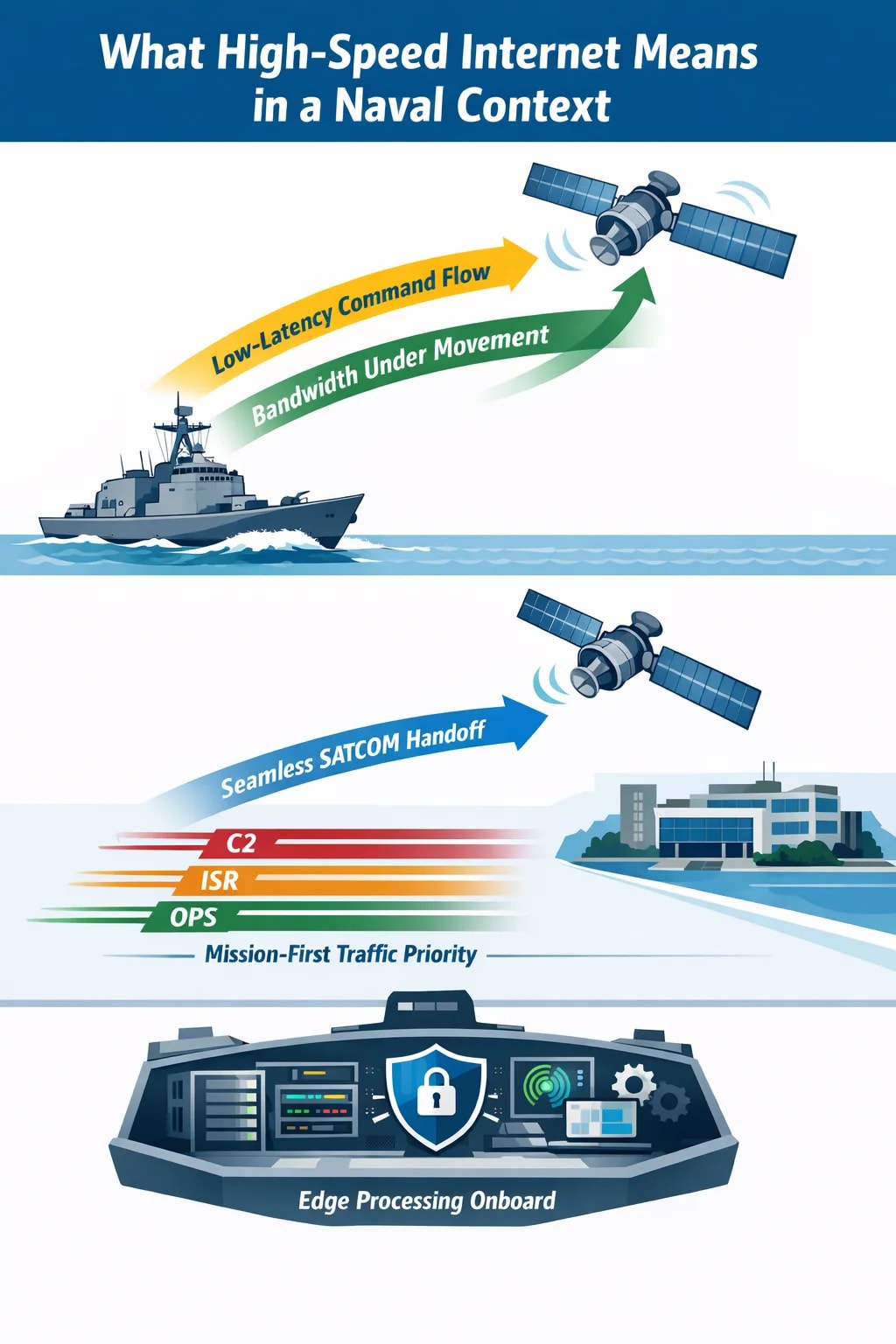
When you evaluate high-speed internet for naval operations, you aren’t thinking in megabits on a sales sheet. You’re thinking about how fast decisions move when conditions change. In a naval environment, “high-speed” has operational meaning tied directly to mission success.
Here’s what it means for you in practice:
- Low-latency command and control
Speed means orders, acknowledgments and sensor updates move without delay between ships, aircraft and command centers. Even small latency spikes can disrupt coordination during joint or time-sensitive operations. - Sustained bandwidth under movement
Your network must maintain throughput while ships maneuver, change satellites, or shift between shore and sea links. High-speed doesn’t collapse when the platform moves or the link handoff occurs. - Priority-driven traffic flow
Not all data is equal. High-speed means mission-critical traffic like C2, ISR and navigation data always outrun administrative or morale traffic, even during congestion or attack. - Edge processing close to the fight
Speed improves when data is processed onboard instead of being shipped back to shore. Local analytics, caching and decision engines reduce round-trip delays and keep operations responsive. - Rapid data ingestion from sensors
Modern naval platforms generate continuous feeds from radar, sonar, EW systems, drones and maintenance systems. High-speed connectivity ensures this data enters decision systems without backlog or loss. - Seamless satellite and terrestrial transitions
High-speed means your crews don’t notice when the network shifts between SATCOM, line-of-sight, or shore-based links. The transition stays smooth, encrypted and stable. - Resilience under degraded conditions
Speed isn’t peak performance in ideal conditions. It’s a consistent performance during jamming, interference, or partial outages, when the network must adapt instead of failing. - Security that doesn’t slow operations
High-speed in a naval context includes encryption, authentication and inspection that run at line rate. Security controls protect traffic without becoming bottlenecks.
For you, high-speed isn’t a number. It’s confidence that the network keeps pace with the mission, no matter where the ship sails or what the threat looks like.
Check out our latest blog on Data Leak Prevention: Complete Guide, Tools & Best Practices
Your real threat model (not the brochure version)

When vendors talk about threats, they show clean diagrams and generic attack paths. Your reality looks different.
You plan for adversaries who study naval networks, wait patiently and strike when the mission matters most. That threat model shapes every security decision you make.
Here’s what you’re defending against in the real world:
- State-sponsored cyber operations
You assume skilled, well-funded actors with time and intelligence on your architecture. These attackers probe during peacetime, map traffic patterns and move during operations when response windows shrink. - Electronic warfare combined with cyber intrusion
Jamming, interference and spoofing don’t happen alone. They arrive alongside cyber attempts designed to confuse routing, disrupt authentication, or force insecure failover paths. - Data interception during transit
Satellite links, line-of-sight radios and shore gateways all present interception risk. Your model assumes adversaries attempt to observe, replay, or manipulate traffic moving between platforms. - Insider risk from rotation and access churn
Crews rotate. Contractors come and go. Privileges change often. You plan for misuse, credential sharing and delayed revocation without assuming malicious intent every time. - Compromised hardware and firmware
Supply-chain threats don’t announce themselves. You assume some components arrive with hidden weaknesses and design segmentation so a single device never exposes the full network. - Bandwidth denial during critical windows
Attacks don’t aim to take everything down. They target peak moments, saturating links so priority traffic competes with noise unless controls enforce discipline. - Loss of reach-back to shore systems
You assume connectivity drops. The threat model includes operating securely while isolated, without cloud dependency or real-time SOC support.
This isn’t paranoia. It’s preparation.
Your real threat model accepts compromise as possible and focuses on limiting impact, preserving command authority and keeping the mission moving when conditions turn hostile.
Check out our latest blog on Digital Risk Protection Services for External Threats
The security stack that survives at sea

A naval security stack doesn’t get the luxury of perfect conditions. Saltwater, motion, signal loss, adversaries and time pressure shape every design choice. What survives at sea works autonomously, fast and under stress, without waiting for approvals or constant connectivity.
Here’s the stack you rely on when the mission tightens:
- Zero-trust access enforced at the edge
Every user, device and workload must continuously prove trust, even onboard. Access decisions happen locally, not after a round trip to shore. This limits the blast radius when credentials fail or devices are compromised. - Identity-first control for rotating crews
Sailors rotate. Roles change. The stack ties access to identity, role and mission context rather than static network locations. Privileges expire automatically, reducing risk from stale access. - End-to-end encryption across all links
Data stays encrypted from origin to destination across SATCOM, LOS radios and shore backhaul. Encryption persists during handoffs and degraded links, preventing interception or replay during transitions. - Mission-aware traffic prioritization
The stack understands which traffic keeps the mission alive. Command, control, navigation and ISR traffic always take precedence over non-essential flows, even during congestion or attack. - Edge-based threat detection and response
Ships can’t wait for SOC guidance. Local IDS, behavior analytics and automated containment operate independently, isolating threats when connectivity drops or latency spikes. - Segmentation is designed for damage control.
Systems, sensors and networks stay isolated by design. A compromised subsystem can’t cascade across the ship or fleet. Segmentation mirrors naval damage-control principles. - Resilient logging and delayed synchronization
Security events are logged locally and synchronized when links allow. You keep forensic visibility without assuming constant bandwidth or cloud access. - Fail-secure defaults, not fail-open shortcuts
When systems break, they fall into secure states. Authentication doesn’t bypass controls just to keep traffic flowing.
This stack survives because it assumes loss, pressure and hostility.
You’re not building for best-case scenarios. You’re building so the network holds when everything else shakes.
Many online threats today are linked to account takeover fraud, where attackers gain access to your account using stolen login details.
Speed vs security? You don’t have to choose.

You’ve heard this argument before. Push security too hard and the network slows. Push speed too hard and risk slips in. That trade-off exists only when systems are designed for offices, not operations at sea.
In a naval environment, speed and security rise together when architecture comes first.
Here’s how you avoid choosing one over the other:
- Move controls closer to the mission
When authentication, inspection and policy enforcement happen at the edge, traffic doesn’t bounce back to shore. Latency drops, decisions accelerate and security stays intact. - Encrypt once, move fast everywhere.
Modern encryption runs at line rate when implemented correctly. You avoid repeated re-encryption at every hop, which cuts delay and preserves bandwidth during satellite transitions. - Segment to reduce inspection overhead
Flat networks slow everything down because every packet gets over-checked. Segmentation limits inspection to where it matters, keeping high-priority traffic moving without exposure. - Prioritize traffic by mission impact.
Speed improves when critical flows never compete with non-essential traffic. Security policies enforce priority instead of blindly following. - Design for degraded connectivity
Systems built for constant reach-back slow down when links drop. Autonomous security keeps operations moving even when bandwidth shrinks.
Here’s the reality you can defend:
| If security is bolted on | If security is built in |
| Latency spikes | Predictable performance |
| Workarounds appear | Controls stay enforced |
| Operators bypass rules | Operators trust the system |
| Incidents spread | Impact stays contained |
A defense network architect said it best:
“Security doesn’t slow missions. Bad architecture does.”
When you design for speed and control from day one, you stop debating trade-offs. You deliver a network that moves as fast as the mission demands and stays secure when it matters most.
Where programs fail and how you avoid them
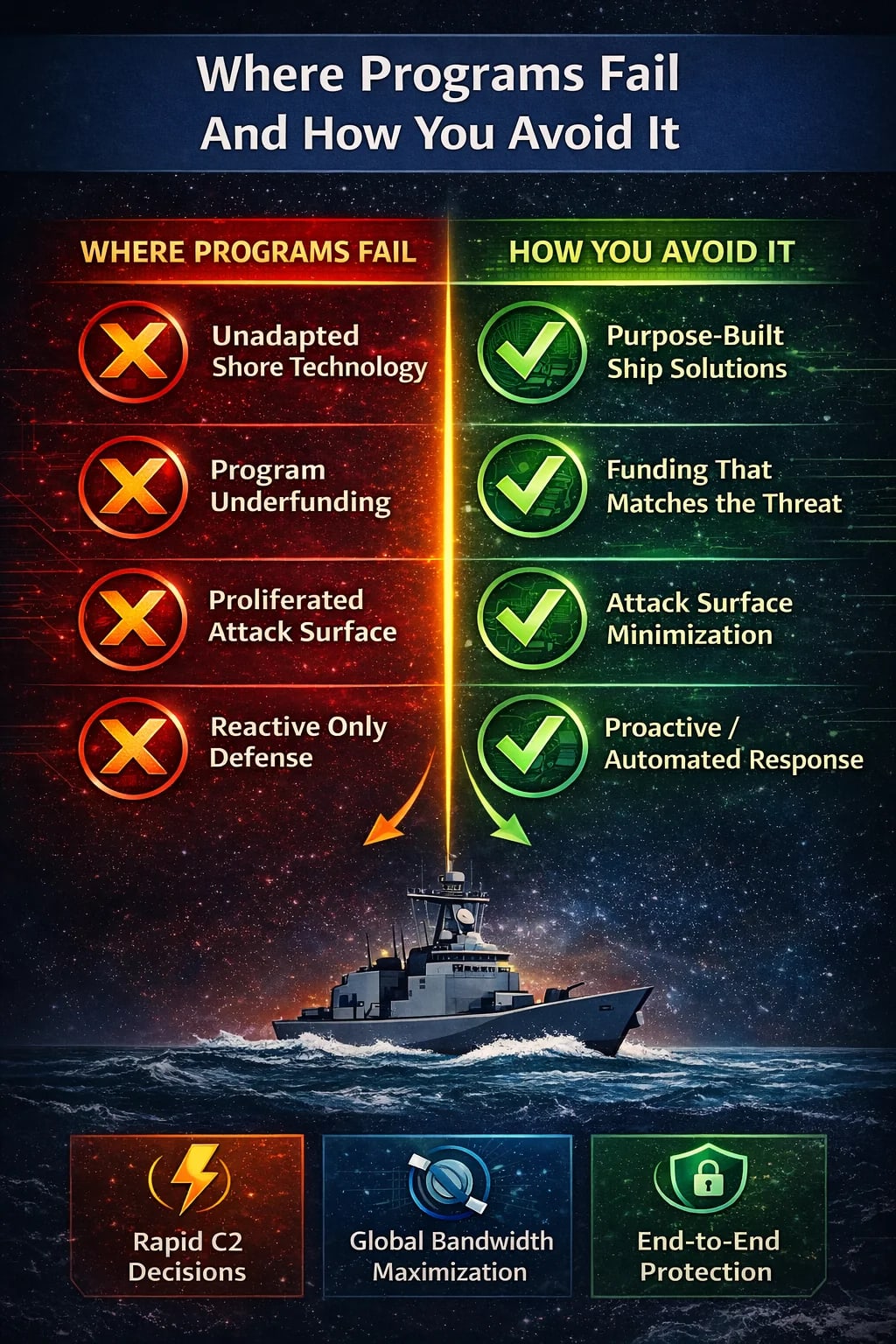
Most failures don’t come from weak tools. They come from wrong assumptions made early, then carried into production. You’ve seen these patterns before, even if they wear new labels.
Here’s where programs break down and how you stay ahead.
- Treating ships like branch offices
Programs fail when designers assume stable links, predictable users and constant reach-back. Ships operate in motion, under interference and often alone.
How you avoid it: Design ships as autonomous security zones with local authority, enforcement and response. - Centralizing decisions that need local action
When access control, detection, or response depends on shore approval, latency grows and threats spread.
How you avoid it: Push policy enforcement and automated response to the edge so crews can act immediately. - Assuming connectivity is always available
Many architectures collapse when satellite links degrade. Controls fail open. Logs vanish.
How you avoid it: Build for intermittent connectivity with local logging, delayed sync and fail-secure defaults. - Overloading networks with inspection overhead
Excessive inline inspection creates bottlenecks and forces operators to bypass controls during peak operations.
How you avoid it: Segment networks by mission role and inspect selectively, not universally. - Ignoring access churn from rotating crews
Stale accounts and over-privileged roles create silent exposure.
How you avoid it: Tie access to identity, role and mission context with automatic expiry. - Buying tools before defining the mission
Programs fail when procurement leads architecture instead of supporting it.
How you avoid it: Define mission flows, threat assumptions and response authority first. Tools follow the design.
A senior naval security lead once said:
“Most breaches start months before the incident report.”
You avoid failure by planning for reality, not diagrams. When your program assumes loss, pressure and change, it holds when others scramble.
Pros and cons you can defend to leadership

When you brief leadership, you’re not selling tools. You’re defending operational outcomes. Clear trade-offs earn trust and speed approvals. Here’s a balanced view you can stand behind.
Pros
- Faster command decisions under pressure
High-speed, secure connectivity shortens the time between sensing, deciding and acting. Leaders gain confidence that data arrives intact and on time. - Reduced operational risk
Zero-trust access, encryption and segmentation limit blast radius when incidents occur. One compromised system doesn’t jeopardize the mission. - Mission continuity during disruption
Edge enforcement and autonomous response keep ships operating even when links degrade or reach-back fails. - Scalable support for data-heavy missions
ISR feeds, AI-driven maintenance and logistics analytics scale without reopening security gaps. - Clear compliance and audit posture
Built-in controls simplify reporting against defense and cybersecurity mandates without retrofitting later.
Cons
- Higher upfront design effort
Architecture-first security requires more planning and coordination across operations, IT and security teams. - Specialized skill requirements
Crews and support teams need training to operate and tune mission-aware security controls. - Initial integration complexity
Legacy systems and mixed platforms require phased onboarding and careful segmentation. - Ongoing testing responsibility
Networks must be tested under degraded and contested conditions, not just during acceptance.
Here’s the leadership-ready summary:
| Leadership concern | Honest answer |
| Cost | Higher early, lower long-term risk |
| Speed | Improves with proper design |
| Reliability | Increases during disruption |
| Accountability | Clear ownership at the edge |
You’re not promising perfection. You’re committing to resilience, control and mission assurance. That’s a message leadership understands and supports.
Buying signals that matter
When procurement conversations start, noise creeps in fast. Feature lists grow. Promises sound similar. What cuts through is proof that a solution fits your operational reality, not a lab demo.
These are the buying signals that matter when you’re making a defensible choice:
- Edge enforcement without constant reach-back
Ask whether access control, policy enforcement and threat response still function when connectivity drops. If the answer depends on cloud approval, it’s a risk. - Mission-aware prioritization built in
You want controls that understand which traffic keeps command authority intact. If prioritization sits outside security, it won’t hold during an attack or congestion. - Encryption that survives link transitions
Solutions should maintain encrypted sessions across SATCOM handoffs and mixed transport paths. Re-keying delays signal operational friction. - Proven operation in contested environments
Look for evidence of performance under interference, jamming, or degraded bandwidth. Case studies matter more than benchmarks. - Identity-driven access for rotating crews
Access must adapt to role changes and expirations without manual cleanup. If identity management feels bolted on, exposure grows. - Autonomous response at the platform level
Buying signals include local containment, isolation and recovery actions that don’t wait for SOC approval. - Visibility that works offline
Logs, alerts and forensics must persist locally and sync later. Real security doesn’t disappear when bandwidth shrinks. - Clear ownership and accountability
You should know who controls policy, who responds onboard and who supports ashore. Ambiguity slows action during incidents.
A practical test you can use in reviews:
“Show me how this works when the ship is isolated, under load and under attack.”
If a solution answers that question clearly, it’s worth your time.
To better understand this threat in depth, explore our detailed guide on the golden ticket attack and how it impacts Active Directory security.
The escalation of the israel iran war has raised global cybersecurity concerns, as attacks linked to geopolitical tensions often spread beyond the original conflict zone.
Final thoughts
Cybersecurity high-speed internet for the US Navy isn’t a technology upgrade. It’s a mission decision. You’re designing how fast commanders see the truth, how securely data moves under pressure and how resilient operations remain when conditions turn hostile.
You don’t win by chasing peak bandwidth or stacking tools. You win by building architecture that assumes disruption, enforces trust at the edge and protects data in motion without slowing decisions. That’s what keeps speed useful instead of dangerous.
As a buyer, your leverage comes from clarity. When you define the threat model, push control closer to the mission and demand autonomy during isolation, vendors either rise to the challenge or fall away. That’s a good outcome.
The networks that endure aren’t the most complex. They’re the ones aligned with operational reality. If your design keeps command authority intact, limits blast radius and performs when reach-back disappears, you’ve made the right call.
Cybersecurity high-speed internet for the US Navy succeeds when speed and security reinforce each other. Build for that balance and your network becomes an advantage, not a risk.
Check out our latest blog on Why Phishing Is Not Often Responsible for PII Data Breaches
Frequently Asked Questions
How does the US Navy secure high-speed internet during active missions?
The United States Navy secures high-speed internet by combining encrypted SATCOM links, zero-trust access controls, traffic prioritization and edge-based threat detection that continues working even when connectivity to shore systems drops.
Why can’t the US Navy use commercial cybersecurity solutions for its networks?
Commercial tools assume stable connectivity and low threat intensity. Naval networks operate in contested environments, require offline enforcement, mission-aware prioritization and defenses built to withstand nation-state cyber and electronic warfare attacks.
What happens if high-speed naval internet is disrupted by a cyberattack?
Well-designed naval networks degrade gracefully. Mission-critical traffic stays prioritized, local security controls isolate threats at the edge and ships continue operating without waiting for central command intervention.
How does cybersecurity impact latency in naval high-speed networks?
Poorly designed security increases latency. Mission-grade cybersecurity reduces delay by enforcing controls at the edge, using optimized encryption and avoiding constant back-and-forth authentication with shore-based systems.
What should decision-makers prioritize when upgrading naval high-speed internet security?
You should prioritize zero-trust architecture, encrypted transport across SATCOM and terrestrial links, autonomous edge security and visibility that works during degraded or denied connectivity conditions.