
Data leak prevention is no longer a technical add-on. It is a business control. Companies manage growing volumes of sensitive data across cloud platforms, endpoints, SaaS tools and remote networks. A single exposed database or misdirected email can result in regulatory fines, contract losses and brand damage. This guide explains what data leak prevention means, how it works and how to implement it with measurable impact.
What Is Data Leak Prevention and Why Does It Matter
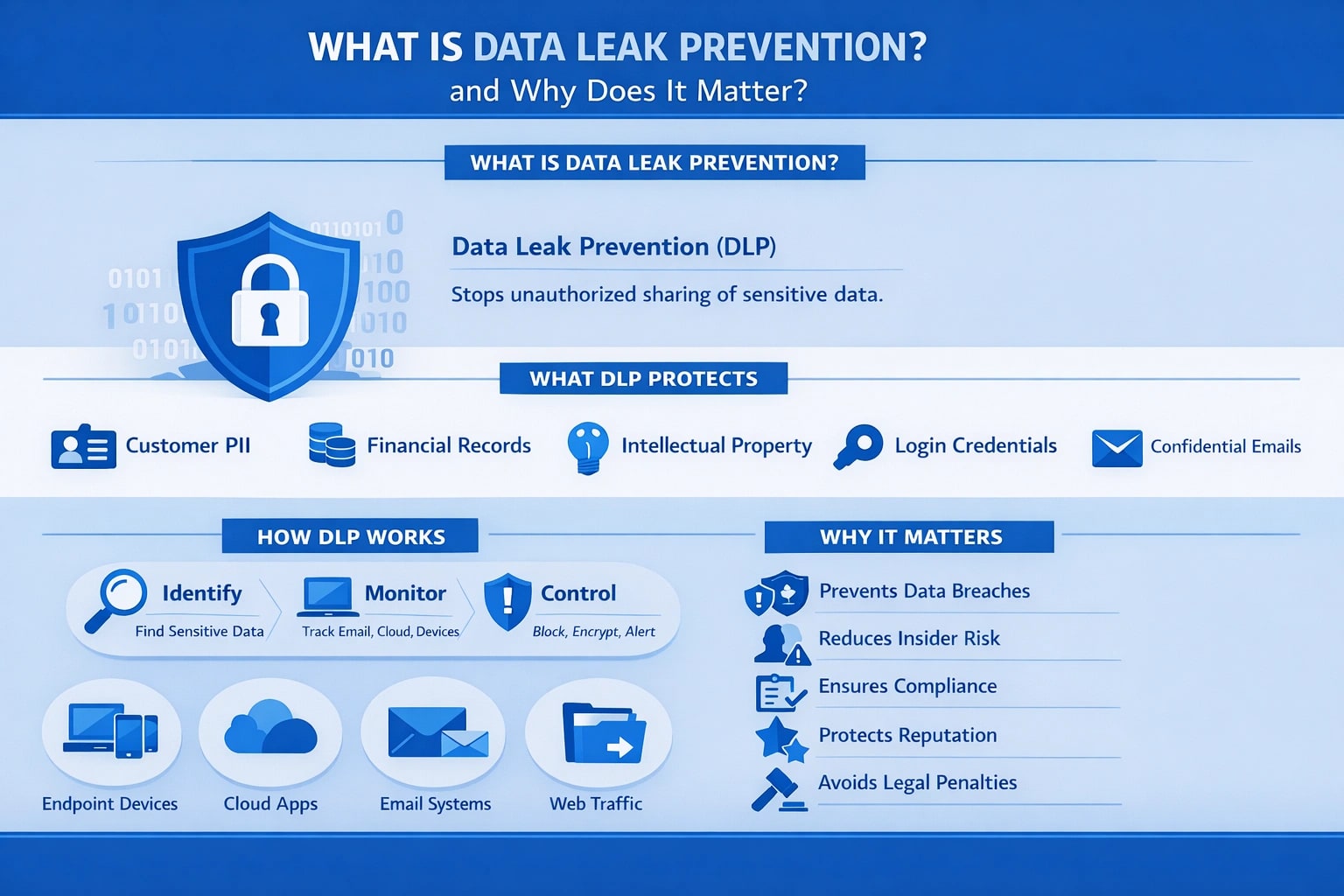
Data leak prevention refers to the policies, processes and technologies designed to stop sensitive information from leaving an organization without authorization. It focuses on preventing accidental exposure, insider misuse, and external exfiltration before it becomes a breach.
A data leak is different from a data breach. A breach usually implies confirmed unauthorized access by an external attacker. A leak may occur due to human error, misconfiguration, poor access control, or unsafe sharing practices. In many incidents, the leak happens first and the breach follows.
Organizations store multiple categories of sensitive data:
- Personally identifiable information
- Financial records
- Intellectual property
- Customer databases
- Source code
- Health records
The business impact of leaks extends beyond compliance penalties. It affects:
- Customer trust
- Investor confidence
- Competitive positioning
- Contract renewals
- Insurance premiums
Modern environments increase exposure. Cloud storage buckets, collaboration platforms APIs, and remote endpoints create multiple exit points for data. Traditional perimeter security cannot control how employees share files, upload spreadsheets, or connect third-party tools.
Many online threats today are linked to account takeover fraud, where attackers gain access to your account using stolen login details.
Data leak prevention addresses this gap through visibility, classification monitoring and enforcement. It answers three critical questions:
- What sensitive data exists
- Where it resides
- Who can access and transmit it
Without structured prevention controls, organizations operate reactively. Incident response becomes damage control instead of risk reduction.
Read More On: Data Risk Management Framework: Strategy (2026)
Common Causes of Data Leaks in Modern Environments
Understanding causes is essential before designing controls. Most data leaks are not advanced attacks. They are operational failures.
Check out our latest blog on Cybersecurity vs Data Analytics in 2026
Human Error
Employees may send confidential attachments to the wrong recipient, upload files to public drives, or copy data to personal devices. Lack of awareness and absence of validation checks contribute heavily.
Misconfiguration
Cloud storage containers left public or access permissions applied incorrectly remain one of the top leak sources. Security teams often discover exposed assets during routine audits rather than through attacks.
Insider Threats
Disgruntled employees or contractors may intentionally extract sensitive data before leaving. Without activity monitoring, this behavior remains undetected.
Stolen Credentials
Compromised accounts enable attackers to access internal systems legitimately. When access controls are weak, lateral movement becomes easy.
Third Party Exposure
Vendors with access to internal systems introduce additional risk. A partner compromise can cascade into your environment.
The table below summarizes primary causes and mitigation focus areas:
| Cause | Risk Type | Prevention Focus |
|---|---|---|
| Human error | Accidental | Training and policy enforcement |
| Misconfiguration | Accidental | Configuration audits and access reviews |
| Insider threat | Intentional | Monitoring and behavioral analytics |
| Credential theft | External attack | MFA and anomaly detection |
| Vendor exposure | Third party | Contract controls and access segmentation |
Organizations that treat these causes as technical problems alone miss governance and cultural dimensions. Prevention requires alignment across IT security, HR and leadership.
Check out our latest blog on What Is The Goal Of An Insider Threat Program?
Core Data Leak Prevention Strategies

An effective data leak prevention program combines policy, technical enforcement, and monitoring.
1. Data Classification
Identify and label sensitive data based on risk level. Categories may include confidential, internal restricted and public. Automated classification tools use pattern recognition to detect credit card numbers, health identifiers and proprietary keywords.
2. Access Control Enforcement
Role-based access ensures employees only access the data necessary for their role. Privileged accounts require additional authentication layers.
3. Encryption
Encrypt data at rest and in transit. Even if data is intercepted, it remains unreadable without keys.
4. Endpoint Controls
Prevent copying data to external drives, block unauthorized uploads and monitor file transfers.
5. Network Monitoring
Inspect outbound traffic for unusual file movement or large transfers.
6. Cloud Security Controls
Apply policies that detect public sharing links and misconfigured storage permissions.
Comparison of strategy focus areas:
| Strategy | Prevents Accidental Leak | Prevents Insider Misuse | Stops External Exfiltration |
|---|---|---|---|
| Classification | Yes | Yes | Indirect |
| Access control | Yes | Yes | Yes |
| Encryption | Limited | Limited | Yes |
| Endpoint DLP | Yes | Yes | Moderate |
| Network monitoring | No | Moderate | Yes |
| Cloud configuration audits | Yes | Moderate | Moderate |
The most resilient programs implement layered defenses rather than relying on one tool.
Data Leak Prevention Tools and Technologies
Data leak prevention tools fall into several categories. Selection depends on infrastructure scale, compliance requirements, and data flow complexity.
Network DLP
Monitors outbound traffic at the gateway level. Detects policy violations before data exits the organization.
Endpoint DLP
Installed on user devices to monitor file activity, clipboard usage and external storage transfers.
Cloud DLP
Protects SaaS platforms, cloud storage and collaboration environments.
Insider Risk Platforms
Use behavioral analytics to identify suspicious activity patterns.
Dark Web Monitoring
Detects leaked credentials and exposed datasets circulating online.
Tool comparison overview:
| Tool Type | Deployment Location | Best For | Limitation |
|---|---|---|---|
| Network DLP | Gateway | Central traffic control | Limited remote visibility |
| Endpoint DLP | User devices | Insider misuse prevention | Requires agent management |
| Cloud DLP | SaaS platforms | Cloud data governance | Integration complexity |
| Insider risk platform | Hybrid | Behavioral analysis | High tuning effort |
| Dark web monitoring | External | Exposure detection | Reactive visibility |
Tool selection should align with data flow mapping. Organizations operating fully in the cloud need strong SaaS level enforcement rather than perimeter-heavy solutions.
Implementation Framework and Governance

Technology alone does not prevent leaks. Governance defines accountability and sustainability.
Step 1: Conduct Data Inventory
Identify systems that store sensitive information. Map data movement between departments, tools and vendors.
Step 2: Define Policies
Document acceptable use, sharing restrictions and classification standards. Ensure alignment with regulatory requirements.
Step 3: Deploy Controls in Phases
Start with high-risk data categories such as financial records or customer PII. Expand gradually.
Step 4: Train Employees
Regular awareness sessions reduce accidental leaks. Real-world case studies improve retention.
Step 5: Monitor and Measure
Track incidents, policy violations, and remediation time.
Key Metrics
- Number of blocked policy violations
- Percentage of classified sensitive files
- Mean time to detect data exposure
- Reduction in public storage misconfigurations
Governance should include executive reporting. Security teams must communicate business impact, not only technical logs.
The escalation of the israel iran war has raised global cybersecurity concerns, as attacks linked to geopolitical tensions often spread beyond the original conflict zone.
Final Thoughts
Data leak prevention is a structured risk management discipline. It combines visibility, access control, monitoring and employee awareness. Organizations that treat prevention as a one-time tool deployment fail to adapt to evolving environments.
A mature program aligns classification governance, enforcement and monitoring under continuous review. Balanced controls reduce exposure without obstructing productivity. The objective is not to eliminate data movement. It is to ensure movement happens under policy and oversight.
Companies that invest early in structured data leak prevention reduce regulatory exposure, strengthen customer confidence, and maintain operational continuity.
To better understand this threat in depth, explore our detailed guide on the golden ticket attack and how it impacts Active Directory security.
If you are new to automation platforms, you should first learn what is n8n so you understand how workflows, credential storage, and integrations work before securing your environment.
Frequently Asked Questions
What is the difference between data leak prevention and data loss prevention?
Data leak prevention focuses on stopping unauthorized exposure of sensitive data, while data loss prevention often includes accidental deletion, corruption, or destruction scenarios.
Is data leak prevention only for large enterprises?
No. Small and mid-sized organizations face similar risks, especially with cloud services and remote teams. Scaled solutions exist for different budgets.
How do you measurethe effectiveness of data leak prevention?
Encryption protects data confidentiality but does not stop authorized users from sharing data improperly. It must be combined with monitoring and access control.
What industries need data leak prevention the most?
Healthcare, finance technology, and legal sectors manage highly sensitive information and face strict regulatory obligations, making prevention essential.