The 2025 St Paul cyberattack began on July 25, when hackers breached the city’s systems. The city shut down services to contain damage. The National Guard was deployed. The attackers published 43 GB of data.
Picture this.
You open your laptop on a quiet Monday morning to pay your water bill. The site doesn’t load. You refresh, still nothing.
Then you notice social feeds buzzing, “City websites down.”Within hours, every major service in St Paul grinds to a halt.
That’s how it started, a normal day turned upside down, Hollywood soundtrack, no flashing red lights, just confusion spreading faster than Wi-Fi.
If you’ve ever wondered how cyberattacks hit real people, not just big corporations, this story is for you. Because what happened in St Paul isn’t just about a city, it’s a mirror of what could happen to your town, your business, even your daily routine.
When the attack hit, the city was paralyzed. Payroll systems froze. Utility portals vanished. Internally, staff couldn’t even log into email. To outsiders, it appeared to be a glitch.
For those inside, it was chaotic scene.
I recall reading early reports, thinking, “Could they have seen it coming?”That’s what we’ll explore together, not just the timeline, but the emotions, the lessons, and the human choices behind every line of code.
By the end of this post, you’ll see how it unfolded, why it mattered, and what you can do to protect yourself from the same kind of digital ambush.
Read More On: Cyber Security Monitoring: Best Practices Guide 2026
The Setup: Before the Attack

Every cyberattack starts long before the first alert flashes. Somewhere, someone leaves a tiny digital door open, an outdated plugin, an unpatched server, a reused password.
That’s all it takes.
In St Paul’s case, the city had grown fast in digital terms. Online bill payments, public-works dashboards, and even internal HR tools were migrating to the cloud. Convenience was the goal; resilience wasn’t always top of mind.
If you’ve ever worked in a small IT team, you know the feeling: too many systems, too few hands. Budgets go to roads and parks, not to zero-day monitoring. The result? A patchwork network, parts modern, parts legacy, and plenty of blind spots.
Imagine being the city’s security manager that week. You’ve just finished another system update, you’re eyeing your coffee, and an alert pops up: “Unusual network activity detected.”
Do you drop everything? Maybe. But 90% of those alerts turn out to be false. That’s how breaches hide in plain sight.
Some early indicators hinted that something was brewing. Password-reset requests from odd IPs. Slowdowns in file-sharing servers. Nothing dramatic enough to raise alarms until it was too late.
Here’s the uncomfortable truth: cyber defense in most local governments is like trying to lock 200 doors with one key. You mean to get to them all, but one will stay open.
That one did.
Check out our latest blog on MGM Cyber Attack Las Vegas: Timeline, Losses (2026)
Breach Day: July 25, 2025, When the Lights Blinked
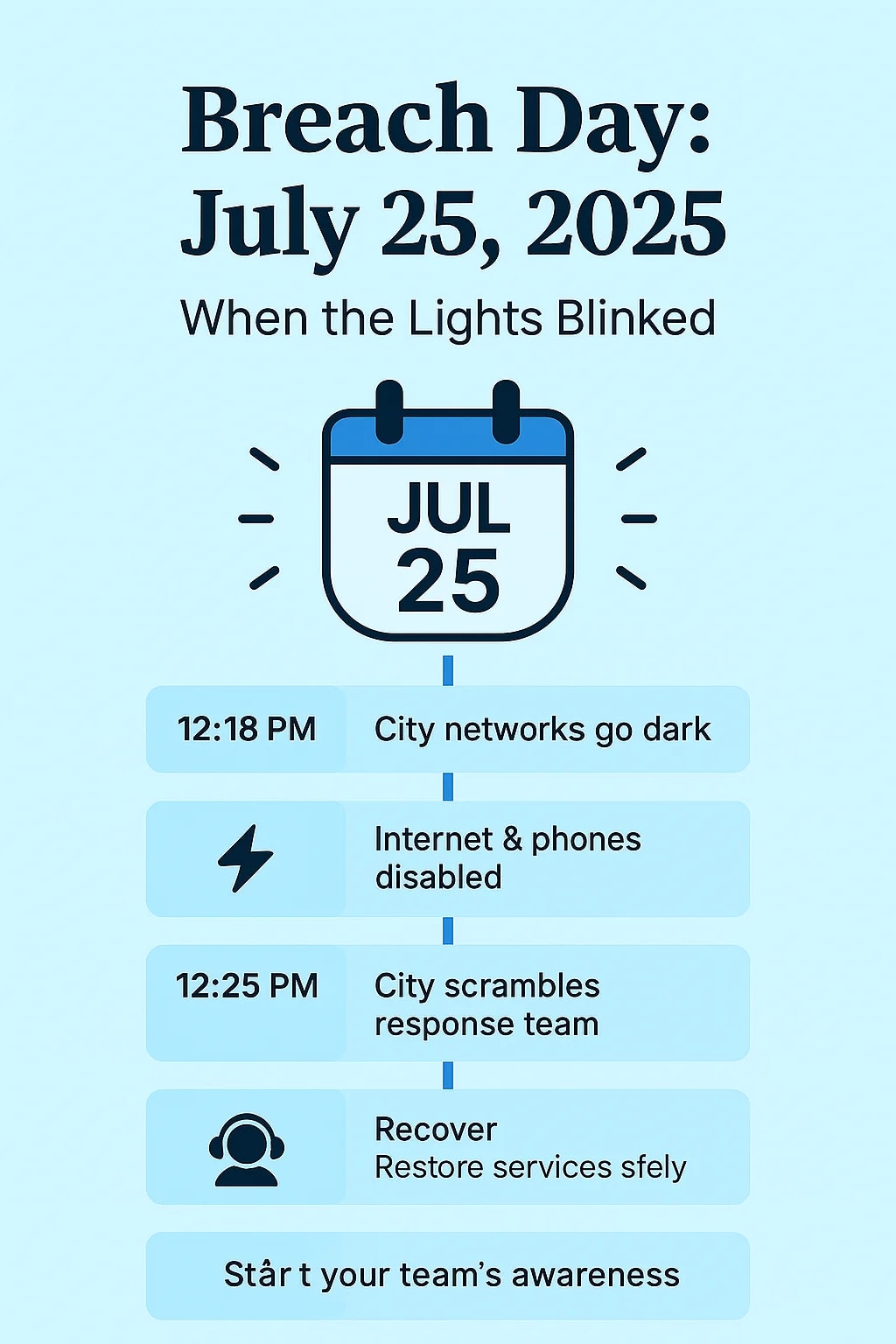
It started at dawn. A system monitor noticed irregular outbound traffic, large chunks of data moving to an unfamiliar domain. Within minutes, internal communication tools began to lag. Then crash.
The IT staff pulled the plug literally. They shut down every major network connection to contain the damage.
It was the digital version of cutting power to stop a fire from spreading.
City employees arriving that morning were greeted with blank screens and locked accounts. Phones rang nonstop.
Departments that depended on shared servers couldn’t access forms, permits, or payroll. Even police and emergency response systems faced disruptions.
By mid-morning, the mayor declared a city-wide systems emergency. For many residents, it was their first taste of what a municipal-level cyberattack feels like: slow responses, missing data, rising frustration.
Hackers had slipped ransomware into multiple core systems. Once triggered, it encrypted servers and demanded payment for the decryption key.
Officials never disclosed the ransom amount, but sources suggest it ran into six figures.
At that moment, the city faced the classic dilemma:
Do you pay the attackers to restore access, or do you risk losing everything?
If you’ve managed data before, you know how that question burns. You weigh ethics against survival. Pay, and you fund criminals. Don’t pay, and citizens suffer longer.
St Paul chose the hard path, no ransom.
Instead, they focused on isolation, cleanup, and restoration.
But the hackers didn’t sit quietly. Within days, they published 43 GB of stolen data on the dark web employee records, internal memos, and financial files. That move was designed to pressure the city and shame it publicly.
As the breach spread through headlines, citizens asked the same thing you might:
“If it can happen to them, can it happen to us?”
Transition: From Shock to Response
In the following days, local IT teams worked side by side with the Minnesota National Guard’s Cyber Protection Unit and the FBI.
Their mission was simple: stop the bleeding, identify the entry point, and rebuild the digital skeleton of the city from scratch.
That’s where the story shifts from panic to perseverance, a phase every organization dreads but must be ready for.
The Escalation & Response

When news broke that the entire city network was down, panic spread faster than the malware itself.
City hall was quiet, but not calm; you could feel the tension humming in the fluorescent light.
IT staff stared at dashboards that showed nothing but errors. Police officers filled out handwritten reports. Utility teams went analog, calling updates over radios. It looked like 1995 in the middle of 2025.
If you’ve ever been the person people look to for answers, you know that mix of adrenaline and dread. You try to project calm, but inside you’re counting every minute of downtime like it’s money burning.
The First 24 Hours
The first 24 hours were pure triage.
- Step 1: Isolate. Disconnect every compromised server.
- Step 2: Contain. Stop the ransomware from spreading.
- Step 3: Communicate without the usual tools.
Emails were out, so teams resorted to personal phones, group texts, and even paper memos. Some departments set up command posts in parking lots where wireless hotspots still worked.
By afternoon, the city’s emergency management director made the call: activate state-level assistance.
Minnesota’s National Guard Cyber Protection Unit rolled in that evening. Their role? Digital firefighters. They’d seen similar attacks in smaller counties, but this one hit a state capital.
Working shoulder to shoulder, local and federal experts began tracing the infection path of a single compromised credential reused across multiple internal systems. It’s a story as old as cybersecurity itself.
“One password, one mistake, that’s all it took,” one responder said later.
Behind the Scenes Decisions
Here’s what most headlines missed: during a live cyber crisis, you don’t have perfect information. You act on gut, pressure, and partial data.
Should they shut down every public website?
Should payroll be prioritized over police systems?
Would transparency cause more panic than calm?
Every choice felt like walking a tightrope over live wires.
I’ve been in rooms like that where someone has to say, “Pull the plug.” You feel the weight because you know shutting down systems saves data but stalls lives.
St Paul’s leadership held an emergency press conference that afternoon. The mayor stood behind a simple podium and said what every city fears saying:
“We’re experiencing a serious cybersecurity incident. Our priority is your data, your safety, and getting essential services back online.”
No fancy phrasing. Just honesty.
And that honesty mattered. It bought patience from citizens for a while.
The Hackers Raise the Stakes
Within 48 hours, the attackers, later linked to a ransomware-as-a-service group known as Medusa, upped the pressure.
They published proof of theft: city documents, staff directories, and HR files. Around 43 GB of data appeared on dark-web forums, free for anyone to download.
The message was clear: Pay us or we humiliate you.
That’s when the moral dilemma hit full force.
If you were in that chair, what would you do? Pay and risk becoming a future target? Or refuse and watch sensitive data spill into the wild?
St Paul chose refusal. Officials stuck to federal guidance: never pay ransom.
Instead, they doubled down on containment. That decision was expensive in time but priceless in principle.
Meanwhile, tech teams worked shifts around the clock, 12 hours on, 4 off, sleeping on cots near servers. Coffee became currency. No one complained. They just wanted the city back online.
Read More On: How Can Generative AI Be Used In Cybersecurity
Could Your Business Survive a Cyber Attack Like St. Paul?
Think you’re safe? So did they until everything went dark.
Public Reaction & Media Storm
By day three, frustration boiled over. Residents couldn’t pay utility bills. Permits stalled. Businesses waiting on clearances lost time and money.
News outlets ran headlines like “City Held Hostage by Hackers.”Twitter (or X) was merciless armchair experts debating firewalls, critics blaming leadership, and citizens posting memes of error screens.
If you’ve ever managed communications in a crisis, you know perception can hurt worse than the breach itself.
The city countered with daily updates: short, plain-language bulletins, no tech jargon.
“Our water system is safe. Your data is being reviewed. We’re working nonstop.”
It wasn’t flashy, but it was human, and that’s what people needed.
Digital Forensics in Action
While the public vented, digital detectives went hunting. Logs were combed line by line. IP traces led to Eastern Europe. Malware signatures matched earlier Medusa operations.
Their tools: packet sniffers, forensic images, and long nights.Their goal: understand the timeline, seal the entry, and secure recovery.
A pattern emerged: the attacker had lurked inside the network for weeks, mapping file shares and privileges. When they struck, they knew exactly where to hurt most.
That realization hit hard. The enemy wasn’t reckless; they were patient.
For you, as a reader, that’s the key takeaway: cyberattacks rarely start the day they explode. They start the day someone forgets to update a server or dismisses a weak password warning.
That’s the real enemy: complacency.
Collaborations & Support
The incident turned St Paul into a temporary command hub. The FBI, CISA, state IT services, and private cybersecurity firms joined forces.
You had veterans of big ransomware cases sitting beside local sysadmins who’d never dealt with a national headline before.
That mix worked. Each agency brought tools, forensics, malware sandboxes, and secure channels.
Each local worker brought context where the city kept backups, and which services mattered most to residents.
Together, they began Operation Secure St Paul, a coordinated plan to restore systems safely, layer by layer.
Read More On: The Role of ZTNA and VPN in Modern Cybersecurity Strategies
What the Rest of Us Can Learn
While the professionals battled malware, ordinary people watched from the sidelines.
But here’s where you come in.
If you manage any digital system, even your small business website, the St Paul story carries clear lessons:
- Backups aren’t optional. Keep at least one offline.
- Never reuse passwords; one weak link can ruin everything.
- Have a response plan. Even a simple checklist beats panic.
- Communicate fast, not perfectly. Silence breeds distrust.
- Train your team. Human error fuels most breaches.
You don’t need a million-dollar budget; you need awareness and discipline.
Because the next “city-level attack” could start with your login page.
Transition: From Chaos to Recovery
By week two, the smoke began to clear. Some websites flickered back online. Employees logged in under temporary credentials.
But recovery wasn’t instant; it was methodical, one server at a time. The biggest challenge ahead wasn’t just restoring files, it was restoring trust.
And that’s where the story turns next: rebuilding systems, reputations, and confidence brick by digital brick.
The Turning Point & Recovery
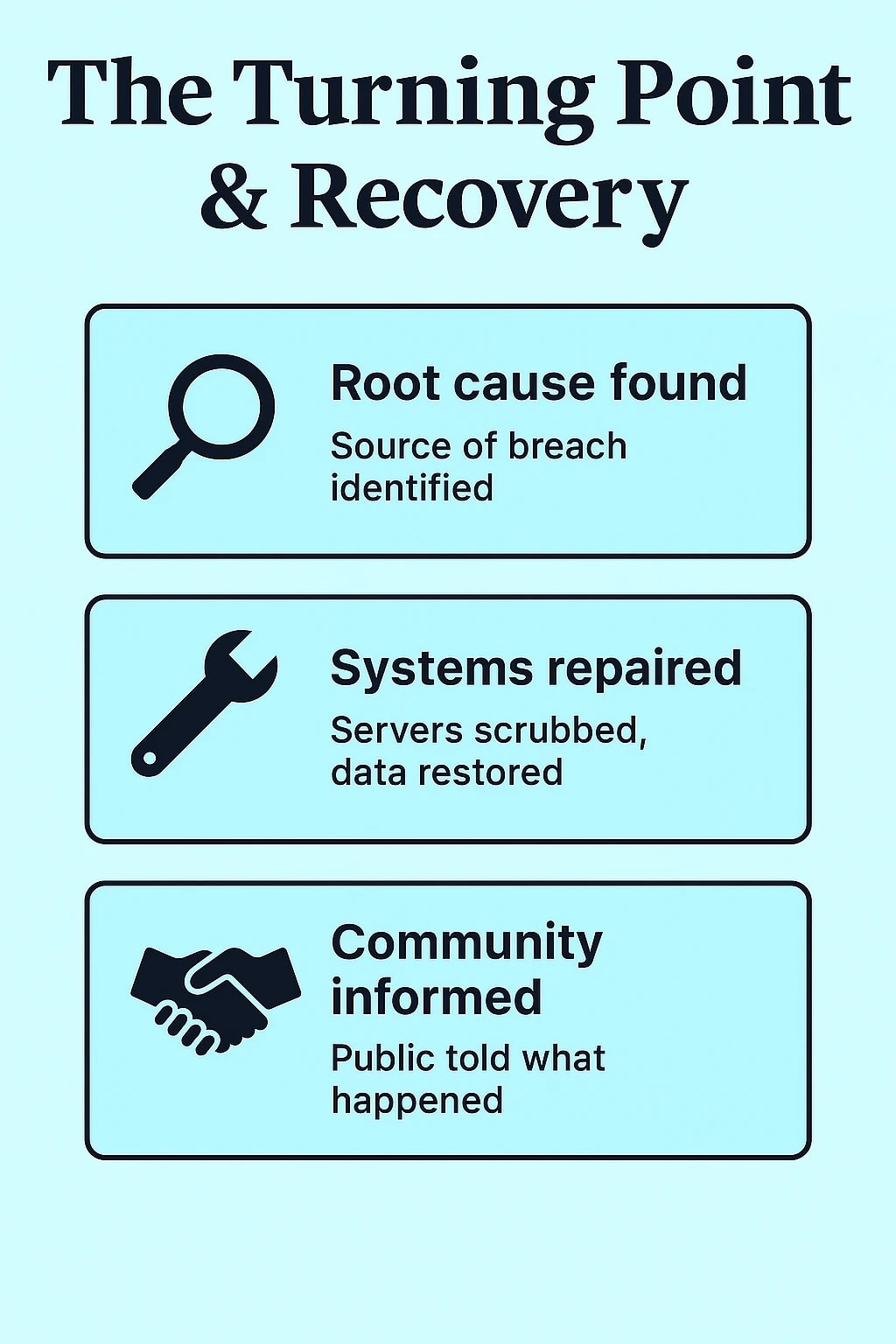
By the second week, St Paul felt like a patient slowly waking after surgery, weak but breathing.
You could sense hope replacing fear. Streetlights worked, payroll ran on backup servers, and small “system restored” emails began trickling in.
Inside the city’s temporary command center, that meant one thing: the triage phase was ending. Now came reconstruction.
If you’ve ever rebuilt a project after it fell apart, a failed site migration, or a corrupted database, you know recovery isn’t glamorous. It’s tedious, repetitive, and full of unknowns. But it’s also where you rediscover what truly matters.
Operation Secure St Paul
The recovery plan had a name, Operation Secure St Paul.
Each department received color-coded priorities:
- Red (critical): 911 dispatch, public safety networks, payroll
- Yellow (essential): water billing, permit systems, utilities
- Green (support): public websites, HR tools, staff portals
The rule was simple: restore only when clean, never rush.
Forensics teams verified every image before reconnecting to the live network.
Think of it as rebuilding a house, checking every beam for termites before painting the walls.
One IT engineer described it best:
“We weren’t just turning things back on. We were disinfecting history.”
The Human Factor
Technology can be replaced. People can’t. By week three, burnout became the real enemy. Teams slept on office floors, surviving on vending-machine snacks and energy drinks.
Still, they showed up because they knew what was at stake: hospitals, 911 calls, families depending on paychecks.
The city rotated shifts, brought in counselors, and even opened “quiet rooms.” Small gestures, but they kept morale from collapsing.
If you manage teams, remember this: in a cyber crisis, empathy is infrastructure. Your people need as much attention as your servers.
Public Trust: The Invisible System
While servers rebooted, another repair was underway to restore public trust. Citizens wanted answers. How much data was stolen? Who was responsible? Could it happen again?
The city’s communications office switched from reactive to transparent.
Daily bulletins turned into “What We’ve Learned” updates: short, honest summaries in plain language.
- “We found how the hackers got in.”
- “We’re resetting 50,000 passwords.”
- “Your water billing data was unaffected.”
No PR spin. No jargon. And it worked, slowly; people stopped panicking and started listening.
You can learn from that, too. Whether you run a city portal or an online store, transparency builds patience when systems fail.
The Technical Rebuild
Behind those press updates, a massive rebuild unfolded:
- Password resets: 10,000+ employee credentials replaced with multi-factor authentication.
- Network segmentation: critical systems are isolated, so one breach couldn’t topple all.
- Backup validation: every snapshot is scanned for dormant malware before reuse.
- Security drills: mock “ransom alerts” to train staff in recognizing phishing.
Each step turned chaos into structure.
This phase also revealed something encouraging: while the attack crippled digital tools, it couldn’t break human systems’ teamwork, improvisation, and collaboration.
That’s the paradox of cybersecurity: your greatest weakness is technology, but your greatest defense is people.
Read More On: Cyber Security Bootcamp: Top 10 Programs & Labs
Lessons Written in Real Time
During those long nights, the IT director started jotting down what worked and what didn’t, later shared as “Lessons from the St Paul Incident.”
A few stood out:
- Every minute counts. Early containment saved months of damage.
- Offline backups matter. Cloud copies were encrypted; physical drives saved operations.
- Clear roles prevent chaos. Defined decision-makers kept meetings short and actions fast.
- Don’t hide bad news. Transparency earned support from the state and citizens alike.
- Patch culture beats patch tools. No software can replace human vigilance.
As I read those notes, I realized how similar they sound to any business post-mortem. The stakes differ, but the truth stays constant: security is never a one-time project; it’s a mindset.
You Can Feel the Shift
By the fourth week, St Paul started to hum again. Water bills went through. City employees logged in without glitches.
The mayor announced:
“We’re not back to normal, we’re building better than before.”
That line stuck with me. Because it wasn’t about victory, it was about evolution.
If you’ve ever bounced back from a setback, a data loss, a hacked account, a failed deployment, you know the quiet pride of recovery. It’s not fireworks; it’s relief.
That’s what St Paul felt that day.
What This Means for You
Here’s where the story comes full circle.
You might not run a city, but your business, blog, or portfolio site holds something priceless.
A few takeaways you can act on today:
- Audit your logins. Change reused passwords now.
- Test your backups. Don’t wait for a crisis to discover they’re empty.
- Review your incident plan. Even a one-page checklist helps.
- Train your team. Simulate phishing; make learning routine.
- Monitor quietly. Most breaches start with small oddities; pay attention to them.
The St Paul attack isn’t a distant headline; it’s a preview. What happened to them can happen anywhere, and prevention begins with awareness.
Transition: From Recovery to Reflection
As systems blinked back to life, citizens slowly returned to normal routines.
But for those who lived through the breach, something fundamental changed: a new respect for the fragility of digital life.
You’ll feel it too when you think of your own setup: the invisible threads connecting passwords, backups, and people. Lose one, and the rest tremble.
That’s where we head next, the long-term aftermath and what it taught the world about resilience.
The Aftermath & Long-Term Effects
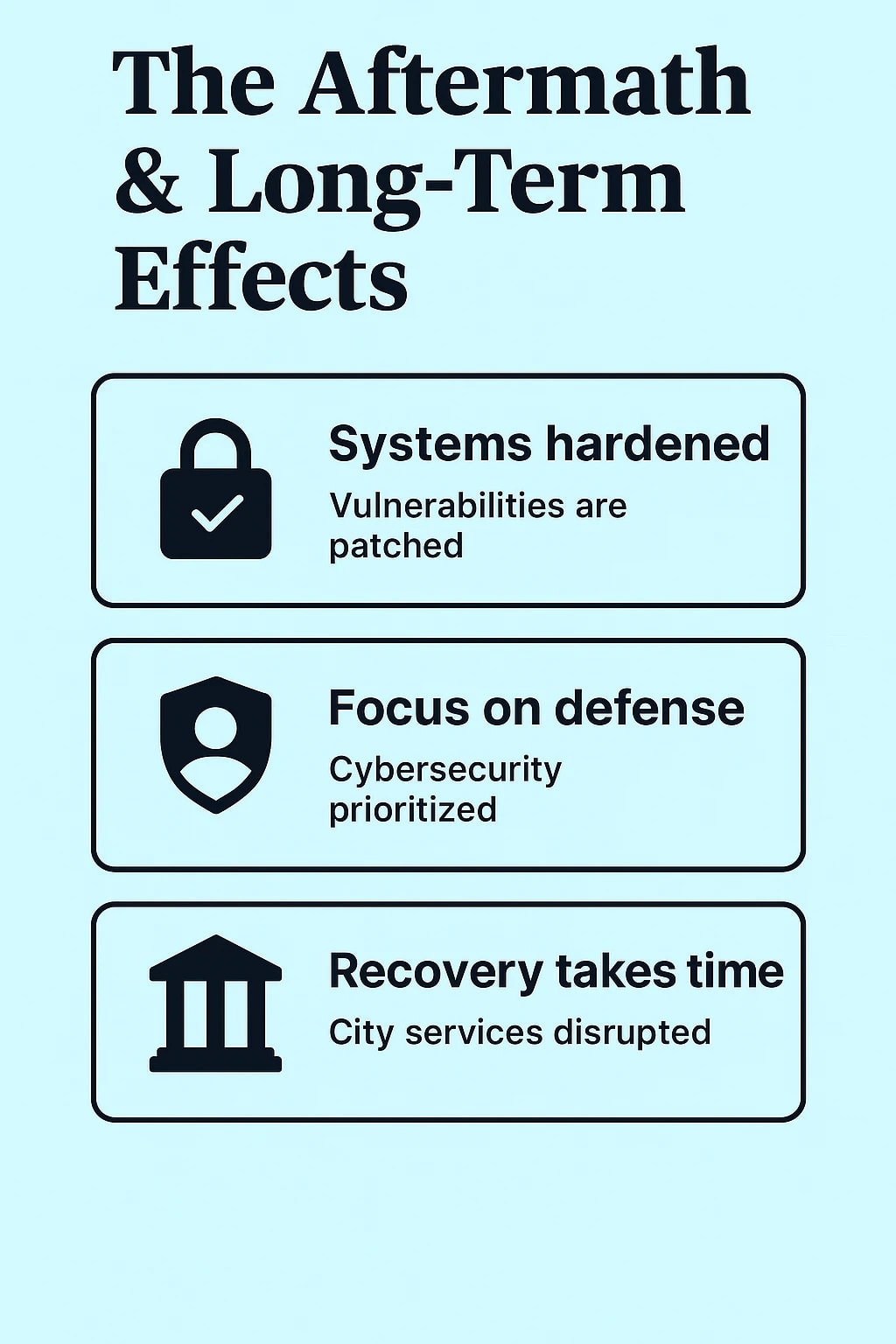
Weeks after the chaos faded, St Paul began counting the quiet costs, not in dollars, but in trust.
You could walk downtown and see life back to normal: buses running, permits printing, city Wi-Fi online again.
But beneath that surface, every department moved differently, cautiously, aware, changed.
If you’ve ever recovered from a data loss or a public failure, you know that feeling. The lights are on, but the memory of darkness never quite leaves.
The Real Cost of a Cyber Attack
Headlines love big numbers: millions lost, terabytes stolen. But the hidden price of the St Paul breach came in hours, stress, and confidence.
A post-incident report estimated:
- Three weeks of full operational disruption.
- Over $1.4 million in direct recovery costs.
- Thousands of work hours are diverted from public projects.
- Untold reputational loss.
Yet the intangible cost was bigger, citizens wondered if their government could really protect their data.
One resident put it simply:
“I trust them to fix potholes. Now I’m not sure I trust them with my personal info.”
If you run any digital service, that’s the wound you fear most: the silent erosion of confidence.
A Cultural Shift in City Hall
The city didn’t just rebuild servers; it rewired its mindset.
Daily cybersecurity briefings became standard. Every department, from parks to finance, had a “security champion.”
Passwords expire every 60 days. And yes, multi-factor authentication was no longer “optional.”
Meetings that once started with budgets now start with one question:
“Is this system secure?”
That cultural pivot may sound minor, but it’s massive.
Because cyber resilience isn’t only about tech; it’s about habit.
I’ve seen companies spend fortunes on tools but forget to train people. St Paul flipped that script. They realized people are the patch.
How the World Watched and Learned
St Paul’s ordeal didn’t stay local. Cities across the U.S. called their CIOs the next morning.
“Could this happen to us?”
The answer, of course, was yes.
Government agencies in Minnesota, Michigan, and Ohio requested briefings from St Paul’s cyber team. Their notes became a blueprint for crisis management:
- Declare early, don’t hide.
- Document everything.
- Communicate humanly, not technically.
- Coordinate state and federal support fast.
That open-source mindset, sharing lessons instead of hiding them, turned a disaster into a teaching moment.
If you’re reading this as a security professional, that’s the takeaway: your next incident report could save someone else’s city.
Read More On: How can you protect your home computer cyber awareness?
The Legal and Financial Ripples
Cyber insurance firms studied the case closely. Premiums for municipal policies spiked 15-20% statewide. Vendors were asked to prove security compliance before contracts were renewed.
The city also launched a review of third-party integrations, cloud billing, payment gateways, and HR systems. Every vendor had to show two things: encryption in transit and an incident response plan.
If you run a business, this is where the lesson gets personal.
Your security is no longer yours alone; it’s linked to every partner, plugin, and provider you use.
In the St Paul case, even a minor third-party link may have been a doorway.
And as threat actors get smarter, your defense is only as strong as your weakest collaborator.
From Response to Resilience
Six months later, the city launched the “Digital Resilience Initiative.” Its goal was simple: never face a surprise like July 25 again.
- 24/7 Monitoring: Managed Security Service Provider (MSSP) on watch every hour.
- Quarterly Drills: Simulated ransomware and phishing scenarios for staff.
- Data Segmentation: Critical records are split across isolated servers.
- Public Dashboard: A live transparency portal showing uptime and incidents.
That final step was bold. Few cities dare to show their vulnerabilities openly. But St Paul learned that transparency isn’t weakness; it’s trust.
For you, whether you manage a business or a blog, that’s a powerful lesson. Security isn’t a lock on your door. It’s a conversation with everyone who walks through it.
Human Stories That Stuck
Months after systems were restored, city employees still remember the moments that defined them.
One IT technician said she kept a sticky note on her monitor:
“Don’t assume. Verify.”
A finance clerk admitted she used to recycle passwords now she teaches her kids about passphrases.
And a mayor’s assistant who spent days printing forms by hand said:
“We got our city back one page at a time.”
These stories matter because they make cybersecurity real. They turn abstract risk into human memory.
If It Happened to Your City (or Business)
Let’s bring this home. If tomorrow you woke up and your systems were locked, what would you do?
Would you know who to call?
Where are your backups?
How to inform customers without panic?
St Paul didn’t have every answer, but they had courage and clarity. That combination saved them.
You can build the same resilience today by asking three questions:
- What are my critical assets?
- Who guards them?
- What happens if they fail?
Your answers don’t need to be perfect; they just need to exist. Because in a cyber crisis, hesitation hurts more than ignorance.
Long-Term Reflection
By year’s end, St Paul was stronger than before. Yet every employee carried a new instinct to pause before clicking, verify before trusting, and question before connecting.
That’s the true legacy of the attack. It didn’t just lock servers; it unlocked awareness.
Cyber experts often say, “Incidents are inevitable.”Maybe that’s true. But so is growth.
The difference is what you do after the breach. Do you rebuild quietly, or rebuild loudly, sharing lessons so others don’t repeat them?
St Paul chose the second path. That’s why their story still matters.
Quick Action Checklist (For You)
| Priority | Action | Outcome |
| High | Back up data offline weekly | Recover without paying ransom |
| High | Enable multi-factor authentication | Block most unauthorized logins |
| Medium | Run monthly phishing tests | Train staff to spot threats |
| Medium | Segment networks | Limit breach spread |
| Low | Review vendor contracts | Close third-party loopholes |
Closing Reflection
Every city has its wake-up call. For St Paul, it came as a cyber storm in the summer of 2025. For you, it might be an innocent email that wasn’t.
But if this story taught us anything, it’s that resilience is built before the attack in habits, not hardware.
So start today. Update that password. Test that backup. Talk to your team. Because the next headline shouldn’t be about what went wrong, it should be about how you stayed safe.
Read More On: What Is an Insider Threat Cyber Awareness?
What You Can Learn Turning Fear into Readiness

By now, you’ve walked through panic, recovery, and reflection. The truth? The St Paul cyber attack wasn’t unique; it was a mirror of what could happen to anyone running a digital system today.
You don’t need to be a government agency to feel vulnerable. Maybe you manage a small business website, a client database, or even a personal blog.
What St Paul faced in 2025 was a large-scale version of the same risks you face every day: outdated software, weak passwords, and unclear response plans.
The difference between devastation and defense comes down to one thing: preparedness.
And that’s something you can build now.
How to Turn Lessons into Action
If you want to translate St Paul’s hard-earned lessons into practical steps, here’s where to start:
1. Inventory Your Digital World
List every tool, plugin, platform, and cloud service you use. It’s tedious, yes, but you can’t protect what you don’t know exists.
Ask yourself:
- What holds customer data?
- What systems could stop my operations if compromised?
Once you know your weak points, you can start patching them.
2. Create a “When, Not If” Playbook
Cyberattacks aren’t hypothetical anymore.
Have a short, simple plan:
- Who do you call?
- What’s the first system to disconnect?
- How do you communicate if the email goes down?
Keep this one-pager printed and digital. When chaos hits, you won’t have time to Google it.
3. Backups: The Lifeline
St Paul’s biggest win wasn’t high-tech; it was offline backups.
Cloud copies were encrypted by the attackers, but physical drives saved operations.
That’s your sign: back up regularly and test those backups monthly.
4. Build a “Zero-Blame” Culture
In St Paul, it wasn’t a villain inside city hall; it was a simple human error that opened the door.
If you punish mistakes, employees hide them. If you teach through them, they report them early.
So foster transparency. Make cybersecurity a shared responsibility, not a fear tactic.
5. Communicate Like a Human
Remember how St Paul won back public trust? By talking plainly.
They dropped the jargon, kept people informed, and admitted when they didn’t have all the answers.
That’s powerful. Whether you manage a company or a community, honesty is your best defense against panic.
Counterfactuals: What If They Had Paid?
One of the most debated parts of the St Paul story was the city’s refusal to pay ransom.
Let’s imagine if they had.
If the city had transferred the money, data might’ve been restored faster, but at what cost?
Paying ransom is like handing a criminal a business card that says, “We’ll pay again.”It funds the next attack, not just on you, but on someone else.
By holding firm, St Paul suffered longer downtime but gained long-term strength. They proved resilience is built through patience, not panic.
The same rule applies to you. Quick fixes, shady “security” plugins, unverified cleanup tools, or ignoring alerts might seem easy now, but they invite the same danger later.
Sometimes, the hard choice is the right one.
Inside the Hacker Mind
Every attacker plays on psychology, not just software flaws. They count on human habits: reused passwords, curiosity clicks, and blind trust.
In this case, the group behind the St Paul breach (believed to be Medusa) likely studied the city’s network for weeks before acting. They understood how to trigger fear: lock systems, leak data, demand attention.
Here’s the unsettling part: they don’t need to know you personally; they just need your weak spot.
The best defense isn’t paranoia; it’s awareness.
Ask yourself:
- Do I reuse passwords?
- Could I spot a phishing email right now?
- Is my data backed up offline?
Cybersecurity isn’t about locking everything down. It’s about knowing what matters most and protecting that first.
Check out our other blogs:
NotEvil Search Engine: How It Works and What You Can Find
10 Online Best Dark Web Search Engines for Tor Browser
Your Action Plan: A Simple Framework
Here’s a practical roadmap based on everything St Paul taught us. Use it as your personal resilience blueprint:
| Step | Action | Outcome |
| 1 | Map your assets (data, tools, access) | Clear view of what needs protection |
| 2 | Identify single points of failure | Fewer surprises during incidents |
| 3 | Back up data to multiple locations | Faster recovery |
| 4 | Train everyone on phishing awareness | Reduce 90% of attack vectors |
| 5 | Simulate an outage quarterly | Test your true readiness |
| 6 | Monitor systems continuously | Catch issues before they grow |
| 7 | Communicate clearly and often | Build trust during a crisis |
This isn’t theory; it’s the checklist cities and businesses now use because of what happened in St Paul.
Don’t forget to follow us on LinkedIn.
Final Thoughts
When the final systems flickered online, one technician reportedly whispered,
“We’re back but different.”
That line captures the essence of resilience. You don’t return to the old normal; you build a smarter one.
The St Paul cyber attack wasn’t just a breach; it was a turning point in how we think about digital life.
Maybe your world isn’t as big as a city, but the principle stands: the smaller your system, the closer you are to your users and the faster you must react.
So, next time you log in, pause. Ask yourself: Is my world secure enough to survive a St Paul moment?
Because history won’t remember who got attacked. It’ll remember who learned and who helped others do the same.
Want expert help strengthening your security posture?
I’ve spent years studying real-world breaches like St Paul’s and turning them into actionable defense plans.
Get in touch with me here, and I’ll personally walk you through practical, affordable steps that work.
Check out our latest blog on Cyber Tanks: What It Teaches About Cyber Attacks
Frequently Asked Questions
How did the St Paul cyber attack start?
The St Paul cyber attack began when hackers gained access through a compromised city account. They used ransomware to encrypt key systems and demand payment.
What data was leaked in the St Paul cyber attack?
Hackers published around 43 GB of internal files, including staff records, city memos, and confidential administrative data. Sensitive citizen information was largely protected.
How did St Paul recover from the cyber attack?
The city worked with state and federal cyber units to isolate infected servers, rebuild clean backups, and reset thousands of passwords before restoring operations.
Could a similar cyber attack happen to other cities?
Yes. Most municipal systems face the same risks, outdated software, reused credentials, and limited monitoring. Without strong backups and training, any city is vulnerable.
What lessons can individuals learn from the St Paul cyber attack?
Keep your data backed up, use unique passwords, enable multi-factor authentication, and report suspicious activity early. Small actions can prevent large-scale breaches.