Cybersecurity is hard if you expect quick results without fundamentals. The field demands continuous learning, analytical thinking and hands-on practice. However, cybersecurity becomes manageable when you follow a structured path, build real skills and focus on one domain at a time instead of chasing everything at once.
Is Cyber Security Hard? A Realistic Introduction

Many people ask, “Is cyber security hard?” because they see high salaries, constant job openings and a shortage of skilled professionals.
What they do not see is the effort that goes into it behind the scenes. Cybersecurity does not reward shortcuts. It rewards discipline, curiosity and problem-solving.
Cybersecurity can feel hard when beginners jump straight into tools without understanding how systems work. Networking, operating systems and basic scripting form the foundation.
When you skip these, even simple security concepts feel overwhelming. When you build them properly, cybersecurity starts to make sense.
The field also feels hard because cyber threats evolve daily. Attackers change tactics. Defenders must adapt faster. You cannot rely on one certification or one tool for long. This reality intimidates many beginners. In practice, it means you must stay engaged, not stressed.
Cybersecurity does not require genius-level intelligence. It requires consistency. People who treat learning as a long-term process survive and grow. People who expect instant mastery burn out quickly.
So yes, cybersecurity is challenging. It tests patience. It tests logic. It tests attention to detail. But difficulty alone does not make something impossible. The right roadmap turns complexity into clarity.
Check out our latest blog on : Google Gmail Data Breach: What’s Actually Happening (2026)
Is Cyber Security Hard for Beginners With No IT Background?
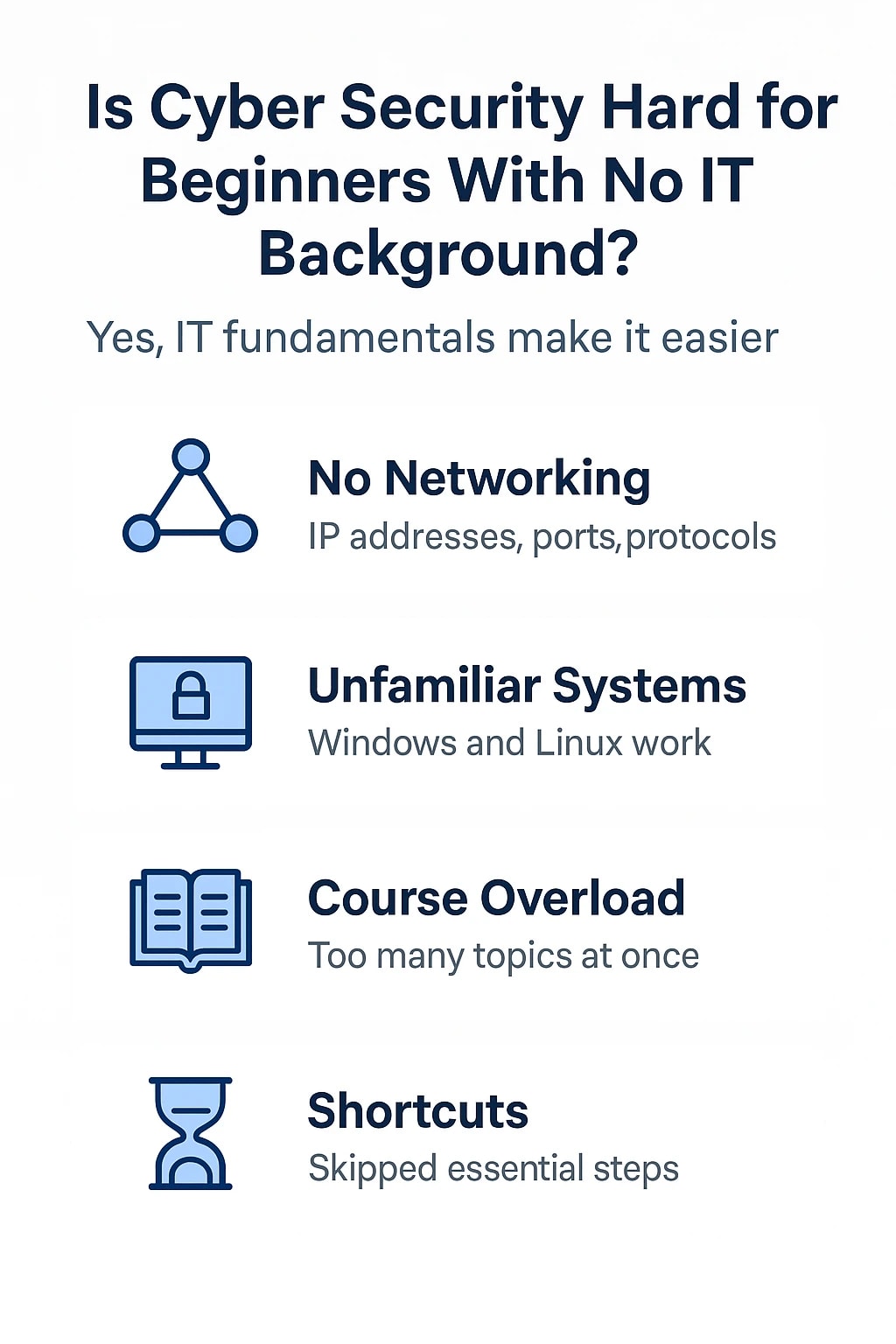
Cybersecurity feels hardest for beginners without an IT background. The difficulty does not come from security concepts. It comes from missing fundamentals.
Most cybersecurity topics assume prior knowledge. Networking, operating systems and basic system behavior form the base layer.
Beginners without this layer feel lost because terms appear without explanation. When you do not understand how data moves or how systems communicate, security explanations sound abstract.
This gap creates frustration. Many beginners assume cybersecurity is too complex. In reality, they started at the wrong level.
Cybersecurity becomes manageable when beginners rebuild the foundation first.
Check out our latest blog on Digital Risk Protection Services for External Threats
Why do beginners without an IT background struggle:
- Lack of networking basics
Concepts like IP addresses, DNS, ports and protocols appear everywhere. Without understanding them, logs and alerts make no sense. - No operating system familiarity
Security tools interact heavily with Windows and Linux. Beginners who have never explored system settings, processes, or permissions struggle. - Tool-first learning approach
Many courses jump straight into tools. Beginners memorize steps without understanding logic. This approach fails in real environments. - Overwhelming learning paths
Cybersecurity covers too many areas. Beginners try to learn everything at once and burn out. - Unrealistic expectations
Many expect to become job-ready in a few months. Cybersecurity requires time and repetition.
How beginners can reduce difficulty:
- Start with networking basics before security
- Learn Windows and Linux fundamentals.
- Choose one entry-level role and ignore the rest.
- Practice with labs instead of only watching videos
- Focus on understanding behavior, not memorizing commands.
Cybersecurity does not demand a computer science degree. It demands structured learning. Beginners who follow a step-by-step path progress faster than those who chase shortcuts.
Beginners with no IT background often succeed when they treat cybersecurity as a long-term skill, not a crash course. Progress feels slow initially. Confidence builds suddenly after repeated exposure.
Cybersecurity is hard for beginners without an IT background. It becomes achievable when they respect the learning curve and build fundamentals correctly.
Check out our latest blog on Data Leak Prevention: Complete Guide, Tools & Best Practices
Is Cyber Security Hard Compared to Other IT Careers?
Cybersecurity feels harder than many IT careers because it requires defensive thinking instead of just building systems. Developers create functionality. Security professionals assume failure and plan for abuse.
This mindset shift creates difficulty. You must think like an attacker while acting as a defender. You must understand how systems fail, not just how they succeed.
Cybersecurity also demands cross-disciplinary knowledge:
- Networking
- Operating systems
- Cloud platforms
- Identity systems
- Risk management
Most IT roles specialize early. Cybersecurity forces broad exposure before specialization. That early breadth overwhelms many learners.
Another reason cybersecurity feels harder is accountability. Security teams handle incidents, breaches and outages. Mistakes have consequences. This pressure does not exist at the same level in many other IT roles.
However, cybersecurity becomes easier over time. Experience compounds quickly. Once you understand attack patterns, tools start repeating the same logic. Logs follow predictable structures. Alerts reveal familiar behavior.
Compared to other IT careers, cybersecurity front-loads difficulty. The early phase feels steep. The mid-career phase feels stable. Senior roles focus more on strategy, architecture and risk rather than constant firefighting.
Cybersecurity is not harder forever. It is harder at the start.
Is Cyber Security Hard to Learn Without Coding?
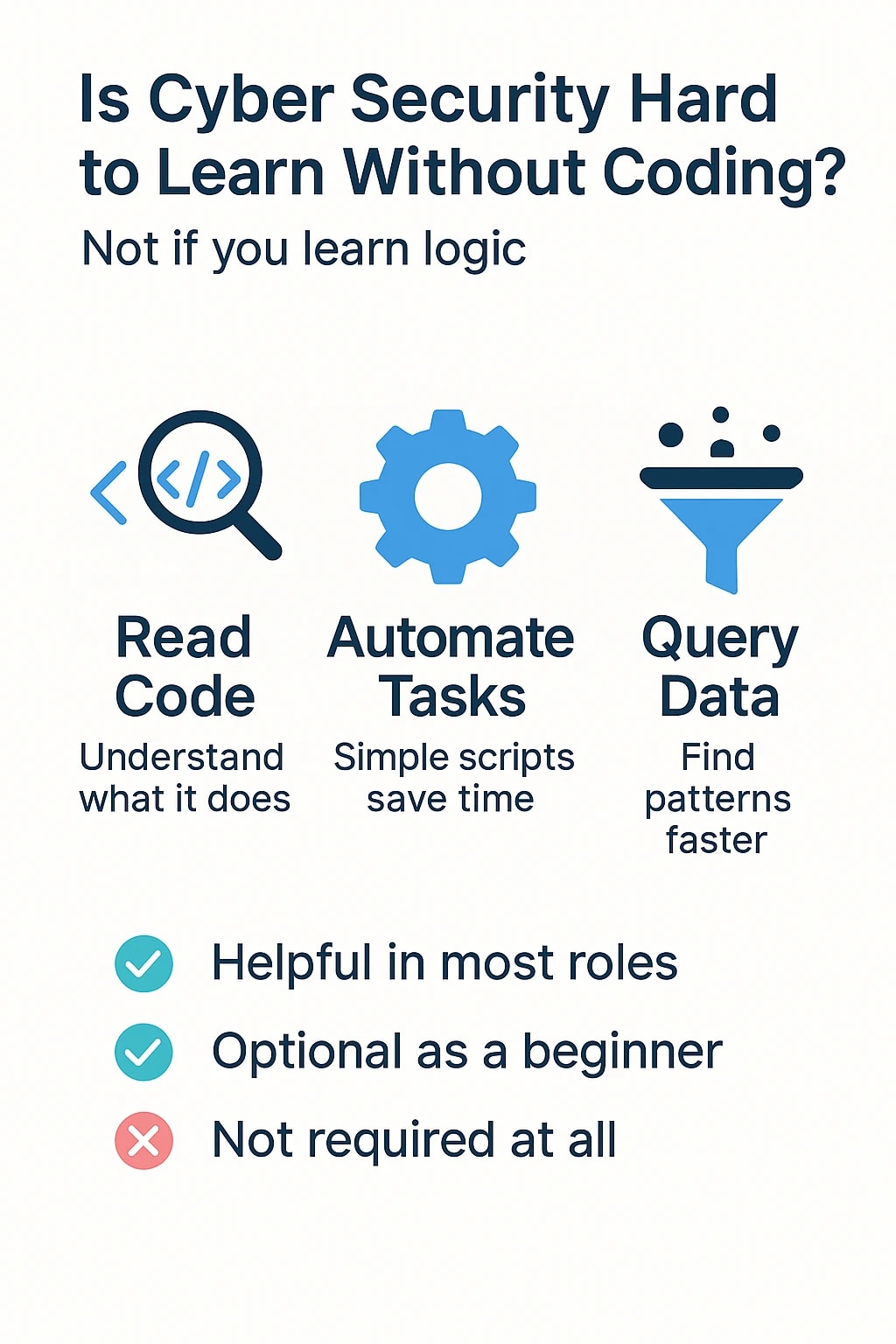
Cybersecurity does not require deep programming skills, but it does require technical thinking. Many beginners assume coding acts as a barrier.
In reality, the real challenge comes from understanding systems, not writing complex code.
Most entry-level cybersecurity roles do not involve building software. Analysts investigate alerts, review logs and identify abnormal behavior. These tasks rely more on logic than on programming.
Cybersecurity feels hard without coding when learners avoid scripting entirely. Manual analysis slows work and increases errors. Basic scripting simplifies investigations and improves efficiency.
What coding actually means in cybersecurity:
- Reading scripts written by others
- Modifying existing scripts
- Writing simple automation
- Understanding logic and flow
You do not need advanced algorithms. You need to understand what the script does and why it runs.
Areas where light coding helps:
- Log analysis using query languages
- Automation to reduce repetitive tasks
- Incident response scripts for containment
- Threat hunting queries and filters
Languages like Python, PowerShell and Bash dominate these tasks. You learn them gradually through usage, not formal programming study.
When cybersecurity feels harder without coding:
- You rely only on manual analysis
- You cannot automate routine tasks.
- You struggle to understand tool outputs.
- You avoid advanced investigations.
Professionals who resist coding limit their growth. They stay dependent on tools instead of controlling them.
Why coding reduces long-term difficulty:
- Scripts save time
- Automation reduces alert fatigue.
- Queries reveal patterns faster.r
- Custom logic improves detection quality.
Cybersecurity without coding is possible. Cybersecurity without technical literacy is not.
Beginners should not fear coding. They should treat it as a support skill. Learning basic scripting removes barriers instead of creating them.
Cybersecurity feels harder when learners believe coding is optional. It becomes easier when they use coding as a tool, not a requirement.
Is Cyber Security Hard Long Term or Just at the Start?
Cybersecurity feels hardest in the first two years. After that, patterns emerge.
Early learners face confusion because everything feels new. Logs feel noisy. Alerts feel meaningless. Tools feel complex. Over time, your brain filters signals from noise automatically.
Experience reduces cognitive load. You stop memorizing commands. You start recognizing behavior.
Long-term difficulty comes from stagnation, not complexity. Professionals who stop learning struggle. Professionals who evolve stay relevant.
Cybersecurity rewards curiosity. The field stays challenging, but not overwhelming. The challenge shifts from survival to optimization.
So is cybersecurity hard long-term? No. It becomes demanding, not impossible.
Is Cyber Security Hard Because of Job Pressure and Stress?

Cybersecurity feels hard because the job carries pressure. Security teams protect systems that must stay available at all times.
When something breaks, the business notices immediately. This pressure does not come from tools. It comes from responsibility.
Security incidents do not follow office hours. Alerts trigger at night, on weekends and during holidays.
SOC analysts rotate shifts. Incident responders stay on call. This reality surprises many newcomers who expected a standard IT schedule.
Stress increases when organizations underinvest in security. Small teams handle large environments.
Analysts monitor thousands of alerts with limited automation. In these environments, cybersecurity feels exhausting, not challenging.
However, stress depends heavily on role and company maturity.
Entry-level roles feel stressful because analysts lack confidence. Every alert feels urgent. Over time, experience changes perception. You learn which alerts matter and which ones do not. You learn escalation paths. You learn when to act and when to wait.
Senior roles experience less alert fatigue but more accountability. Architects and managers handle audits, risk decisions and executive pressure. The stress shifts from volume to impact.
Cybersecurity is hard in unhealthy environments. It becomes manageable in mature security programs with proper tooling, staffing and leadership support.
If you choose cybersecurity, evaluate the company as much as the role. Good teams reduce stress. Bad teams amplify it.
Is Cyber Security Hard to Get a Job In?
Cybersecurity jobs look abundant, but entry-level roles remain competitive. This mismatch creates confusion. Companies want “entry-level” candidates with hands-on experience. Beginners struggle to meet this expectation.
Cybersecurity feels hard to break into because hiring managers prioritize practical skills over theory. Certifications help, but they do not replace real exposure.
Candidates fail when they rely only on courses. Successful candidates:
- Build labs
- Practice log analysis
- Understand attack scenarios
- Explain detection logic
Hiring teams look for thinking, not tool memorization.
The job market also filters aggressively. Cybersecurity attracts career switchers, fresh graduates and experienced IT professionals. This volume increases competition.
However, cybersecurity jobs become easier to secure once you enter the field. Experience compounds fast. After one or two years, opportunities expand significantly.
Cybersecurity is hard to enter. It is easier to grow inside.
Who Should Avoid Cyber Security as a Career?
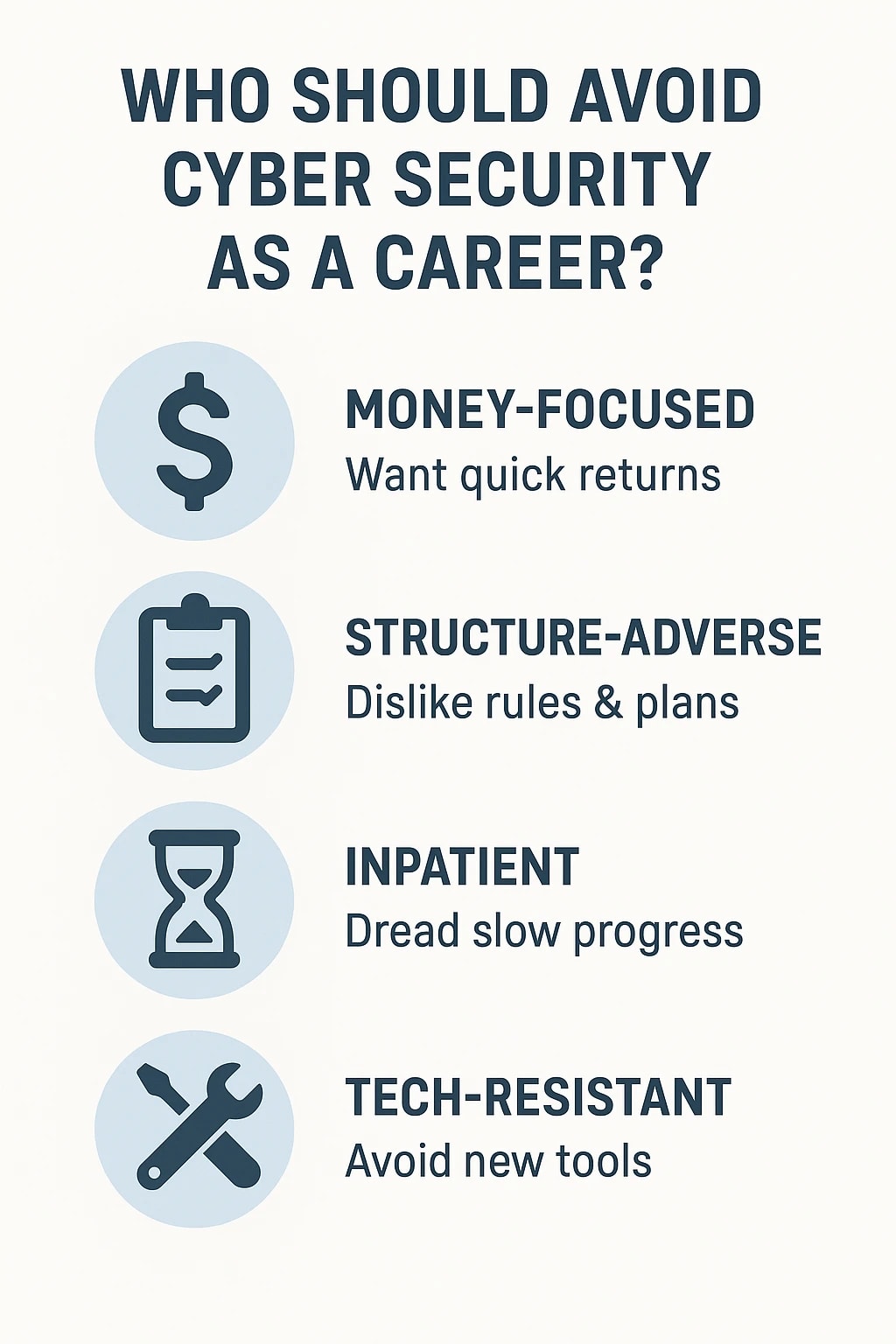
Cybersecurity offers strong career growth, but it does not suit everyone. Many people enter the field for salary or job security and leave within a few years. The problem is not intelligence. The problem is a mismatch.
You should avoid cybersecurity if you expect stability without effort. The field changes constantly. Threats evolve. Tools update. Attack techniques shift. If you dislike ongoing learning, cybersecurity will frustrate you.
CCybersecurityalso demands comfort with uncertainty. Analysts rarely get perfect data. Logs arrive incomplete.
Alerts lack context. Investigations require assumptions and judgment. People who need clear instructions struggle in this environment.
Check out our latest blog on Why Phishing Is Not Often Responsible for PII Data Breaches
Avoid cybersecurity if you relate to these traits:
- You dislike continuous learning
Cybersecurity requires constant upskilling. Skills lose relevance quickly. If you prefer mastering one tool and staying there, the field will exhaust you. - You avoid technical problem-solving
Security roles involve debugging, log analysis and system behavior analysis. You must enjoy breaking down problems logically. - You want predictable daily tasks.
Cybersecurity work changes daily. Incidents disrupt plans. Alerts interrupt schedules. People who need routine feel stressed. - You struggle under pressure.
Breaches, outages and investigations carry urgency. You must stay calm while others panic. - You expect fast results.
Cybersecurity careers grow slowly at first. The early phase feels heavy. People who expect quick success often quit. - You dislike accountability
Security decisions affect business risk. Mistakes have consequences. The role demands ownership.
Cybersecurity also challenges people who resist collaboration. Security teams work closely with IT, developers and leadership. Communication matters as much as technical skill. People who prefer isolation struggle.
That said, cybersecurity suits people who enjoy puzzles, pattern recognition and investigation. It rewards curiosity. It rewards persistence. It rewards those who accept that mastery takes time.
Avoid cybersecurity if you seek comfort and predictability. Choose it if you enjoy growth, complexity and responsibility.
This clarity saves time, money and frustration.
Check out our recent blog on Cybersecurity Stocks: Growth, Risks & Returns
Final Thoughts
So, is cybersecurity hard? Yes, but difficulty depends on how you approach it. Cybersecurity feels overwhelming when you rush, skip fundamentals, or chase tools without understanding systems.
It becomes manageable when you follow structure, build core knowledge and practice consistently.
Cybersecurity does not reward shortcuts. It rewards patience, curiosity and problem-solving. Beginners struggle early because everything feels new.
That struggle fades once patterns repeat and confidence builds. The field stays demanding, but it stops feeling chaotic.
Cybersecurity is not hard because of coding, math, or intelligence. It feels hard because it requires responsibility, accountability and continuous learning. People who accept this reality grow fast. People who resist it burn out.
If you treat cybersecurity as a long-term skill instead of a quick win, the difficulty turns into mastery.
Want to learn cybersecurity the right way?
Explore real-world guides, career breakdowns and hands-on learning paths on CyberLad. We focus on practical skills, not theory overload.
Visit CyberLad and start building security skills that actually translate into jobs.
Check out our latest blog on What Is PII? Definition, Examples & Security Risks
Frequently Asked Questions
Is cyber security hard without a computer science degree?
Cybersecurity does not require a computer science degree. Employers care more about system knowledge, problem-solving ability and hands-on experience than formal education.
Why do many people quit cybersecurity early?
Many people quit because they underestimate the learning curve and overestimate how fast they can become job-ready. Lack of fundamentals and unrealistic expectations cause early burnout.
Is cybersecurity harder in real jobs than in courses?
Yes. Real jobs involve noisy alerts, incomplete data and business pressure. Courses simplify scenarios, while real environments require judgment and prioritization.
Does cybersecurity get easier after the first job?
Yes. The first role feels overwhelming. Once you gain real-world exposure, patterns repeat and confidence increases, making the work far more manageable.
Is cybersecurity hard because of constant certifications?
CCybersecurityfeels harder when professionals chase certifications without applying knowledge. Certifications help, but hands-on practice reduces long-term difficulty more effectively.