Data Governance Frameworks: A Practical Guide
Data governance frameworks are structured systems of policies, roles, processes, and standards that organizations use to manage data responsibly. They define who owns data, who can access it, how quality is maintained, how sensitive information is protected, and how compliance is enforced.
Instead of leaving data decisions to individual teams, a framework sets clear rules for collecting, storing, using, sharing, and eventually deleting information. It typically covers five areas:
Data ownership: who is accountable for specific datasets.
Data quality: standards for accuracy, completeness, and consistency.
Data security: who can access sensitive information and how that access is managed.
Privacy and compliance: meeting regulatory and legal requirements.
Data management processes: repeatable procedures for classifying, storing, and monitoring data.
Governance is closely tied to data risk management strategies, because weak governance creates security, operational, financial, and compliance risk. It is also not just an IT function. Business leaders, security teams, compliance professionals, and employees all have a role.
Consider a company with customer data spread across a CRM, cloud storage, a marketing platform, and internal databases. A governance framework establishes which of that data is sensitive, who is responsible for it, who can access it, how long it is kept, and which controls protect it.
Key Components of a Data Governance Framework
A framework needs more than policies. It needs defined responsibilities, data standards, security controls, and processes people can follow consistently.
Data Ownership and Stewardship
Every important dataset needs an owner. The owner is accountable for how the data is managed, while stewards handle day-to-day work such as maintaining quality standards, resolving issues, and enforcing policy. Without clear ownership, problems fall between teams and nobody knows who should approve access or correct bad data.
Data Policies and Standards
Policies turn principles into rules. They typically cover classification, access, retention, sharing, privacy, and acceptable use. An organization might classify data as public, internal, confidential, or restricted, with different storage, access, and disposal requirements for each level.
Classification matters most for personal information. Knowing what PII is and the security risks it creates helps you decide which data needs stronger protection.
Data Quality Management
Governance also defines what "reliable" means. Set measurable standards for:
Accuracy: is the information correct?
Completeness: are required fields populated?
Consistency: does the data match across systems?
Timeliness: is it current enough for its purpose?
Validity: does it follow defined formats and rules?
Data Security and Privacy
Governance decides what needs protection and who should have access. Security controls such as encryption, authentication, monitoring, and least-privilege access enforce those decisions. Data leak prevention works best when it combines policy, technical controls, monitoring, and employee awareness rather than relying on one safeguard.
Governance Structure and Decision-Making
Finally, you need a structure for making and enforcing decisions. That usually means an executive sponsor, a data governance council, data owners and stewards, and security, privacy, and compliance teams. It should answer practical questions: who approves policies, who authorizes access to sensitive data, who resolves disputes, and who is responsible when quality falls below standard.
Popular Data Governance Frameworks
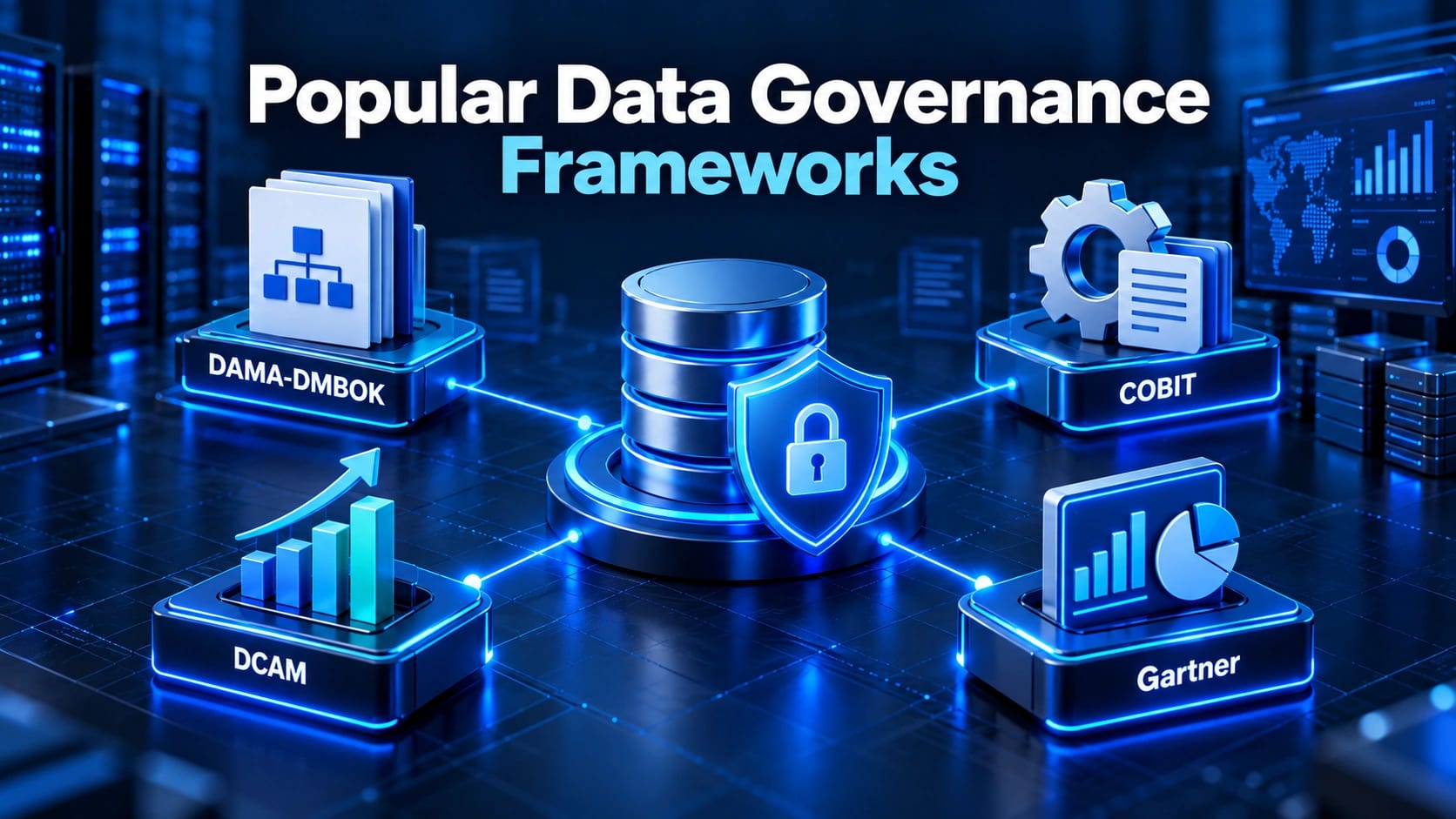
No single framework fits every organization. The most commonly referenced are DAMA-DMBOK, COBIT, DCAM, and Gartner's approach.
DAMA-DMBOK
The Data Management Body of Knowledge gives a broad foundation for managing data, covering governance, architecture, modeling, metadata, quality, security, and integration. It suits organizations building a comprehensive data management program, and it helps identify gaps between current practices and the capabilities needed.
COBIT
COBIT, developed by ISACA, is an IT governance and management framework. It is broader than data governance, but its focus on risk, controls, accountability, and compliance makes it useful when data governance needs to align with wider IT governance. It also links data to broader GRC practices instead of treating it as an isolated concern.
DCAM
The Data Management Capability Assessment Model evaluates and improves data management maturity across governance, quality, architecture, and technology. It is especially common in regulated, data-intensive sectors like financial services. Its strength is measurability: rather than asking whether you "have data governance," you assess how mature it actually is.
Gartner's Approach
Gartner treats governance as a business-driven discipline built on accountability, decision rights, and business outcomes. It works well when governance needs to support goals such as better analytics, lower risk, or regulatory compliance.
You don't have to adopt one model exactly as written. A business might use DAMA-DMBOK as its foundation, borrow COBIT controls, and use DCAM to assess maturity. The right mix depends on your size, industry, regulatory obligations, and data maturity.
How to Choose the Right Framework
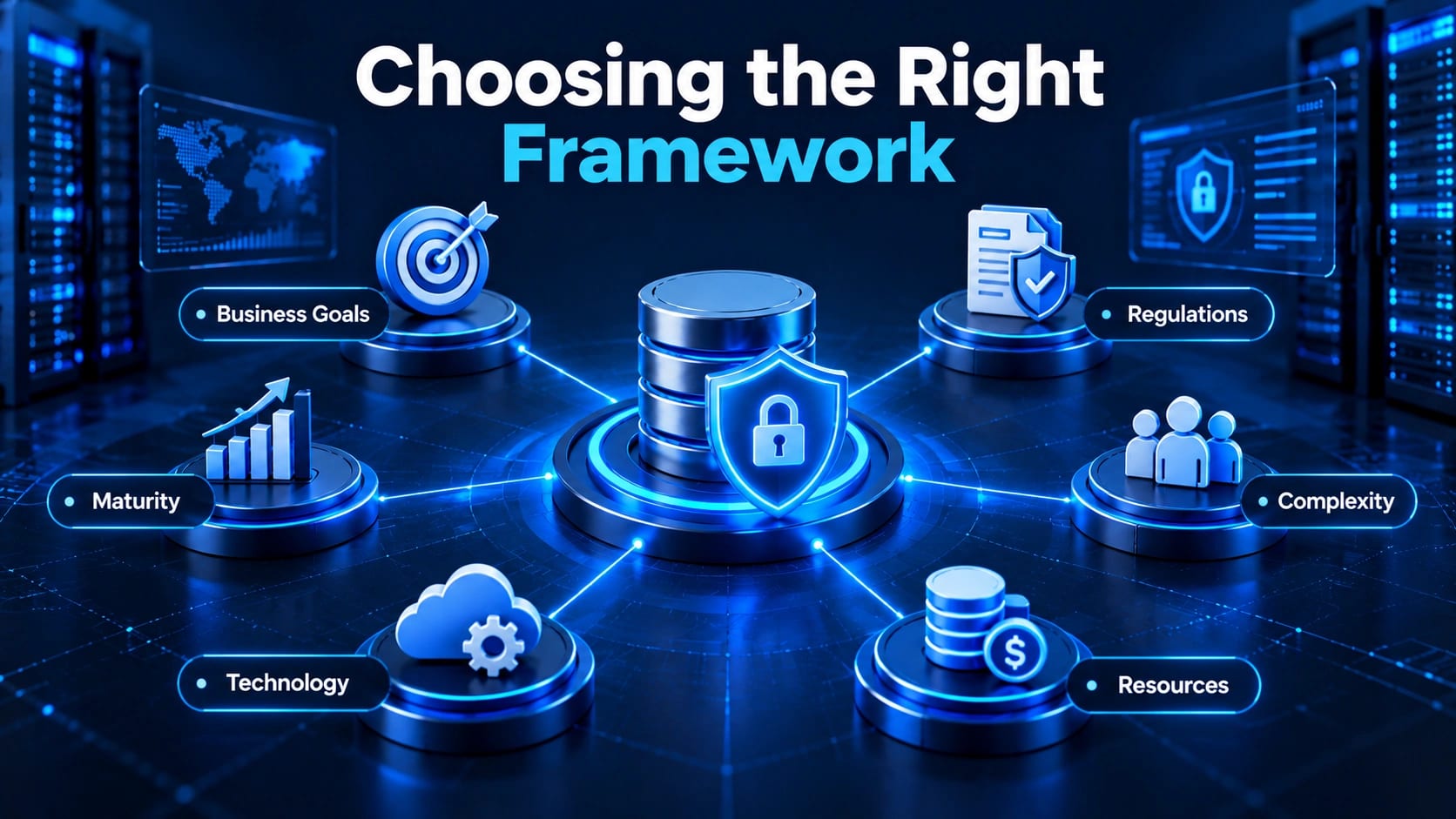
A framework that suits a large bank may be needlessly complex for a growing company. Weigh these factors:
Business goals: Are you improving data quality, strengthening security, meeting regulations, or clarifying ownership? The framework should serve the goal, not add processes with no practical value.
Regulatory requirements: Finance, healthcare, government, and companies handling large volumes of personal data face stricter rules on access, retention, privacy, and auditing. The framework should make compliance easier to demonstrate.
Data maturity: Organizations with informal processes should start with ownership, classification, and basic quality standards. Mature ones may need metadata management, lineage, and automated controls. An overly complicated framework creates resistance.
Size and complexity: Small teams can run governance with a handful of owners and stewards. Large enterprises may need formal councils and dedicated data offices.
Existing technology: Review your tools for data discovery, classification, access management, and monitoring. A recent cyber security assessment can reveal gaps in data protection and access controls that governance needs to address.
Resources: You need enough owners, stewards, and security and compliance staff to operate it.
The best framework isn't the most comprehensive one. It's the one you can implement, measure, and improve.
How to Implement a Data Governance Framework
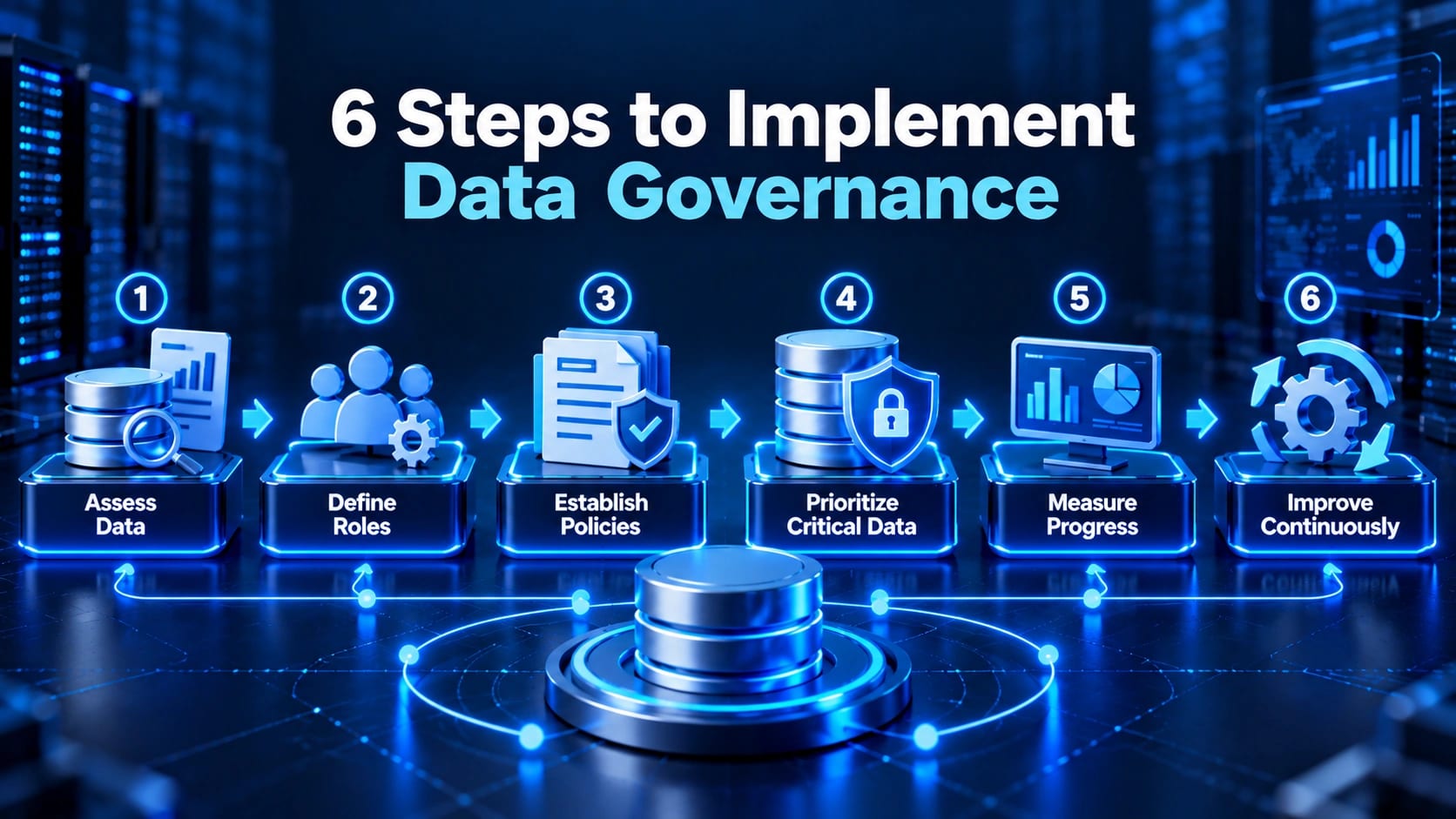
1. Assess Your Current Data Environment
Map what data you have, where it lives, who uses it, and what risks it carries. Identify critical assets, sensitive information, major data flows, and existing controls. The results become your baseline for measuring maturity later.
2. Define Roles and Responsibilities
Assign ownership before introducing new policies:
Executive sponsor: provides leadership support and resources.
Governance council: sets priorities and approves major decisions.
Data owners: are accountable for specific datasets or domains.
Data stewards: manage quality and governance day to day.
Security and privacy teams: define and enforce protection controls.
3. Establish Policies and Standards
Write practical policies on classification, access control, retention, privacy, quality, third-party sharing, and acceptable use. Connect them to your broader data risk management framework so risks are identified and addressed consistently.
4. Start With High-Value Data
Don't try to govern everything at once. Prioritize customer information, financial records, intellectual property, authentication data, and regulated data. For example, begin by classifying sensitive customer data, assigning owners, reviewing access privileges, and setting quality standards for the customer database. Early wins make the business case for expanding.
5. Monitor and Measure
Track metrics such as data quality scores, policy compliance rates, the percentage of critical datasets with owners, access review completion, unresolved data issues, and the share of sensitive data correctly classified. Continuous visibility, supported by solid cyber security monitoring, shows whether governance is working or just adding paperwork.
6. Review and Improve
Governance is not a one-time project. New applications, regulations, and threats change requirements. Revisit policies, update ownership, and reassess risks regularly, especially as you adopt more cloud services, automation, and AI.
Common Data Governance Challenges
Lack of executive support: Without sponsorship, governance gets treated as an optional IT initiative.
Unclear ownership: Teams disagree about who maintains data, approves access, or fixes quality issues.
Siloed data: Different departments use different definitions and formats for the same information.
Poor data quality: Quality is an ongoing responsibility, not something you fix once.
Resistance to change: Complicated policies feel like obstacles. Training and clear explanations of why a rule exists help adoption.
Excessive bureaucracy: Too many committees and approvals slow the business. Aim for enough structure to manage risk and accountability, and no more.
IT-only ownership: Business, legal, privacy, and compliance teams all bring knowledge IT lacks.
No measurement: Without metrics, you can't show progress.
The biggest challenge is making governance part of normal operations rather than a separate layer of paperwork.
Data Governance and Cybersecurity
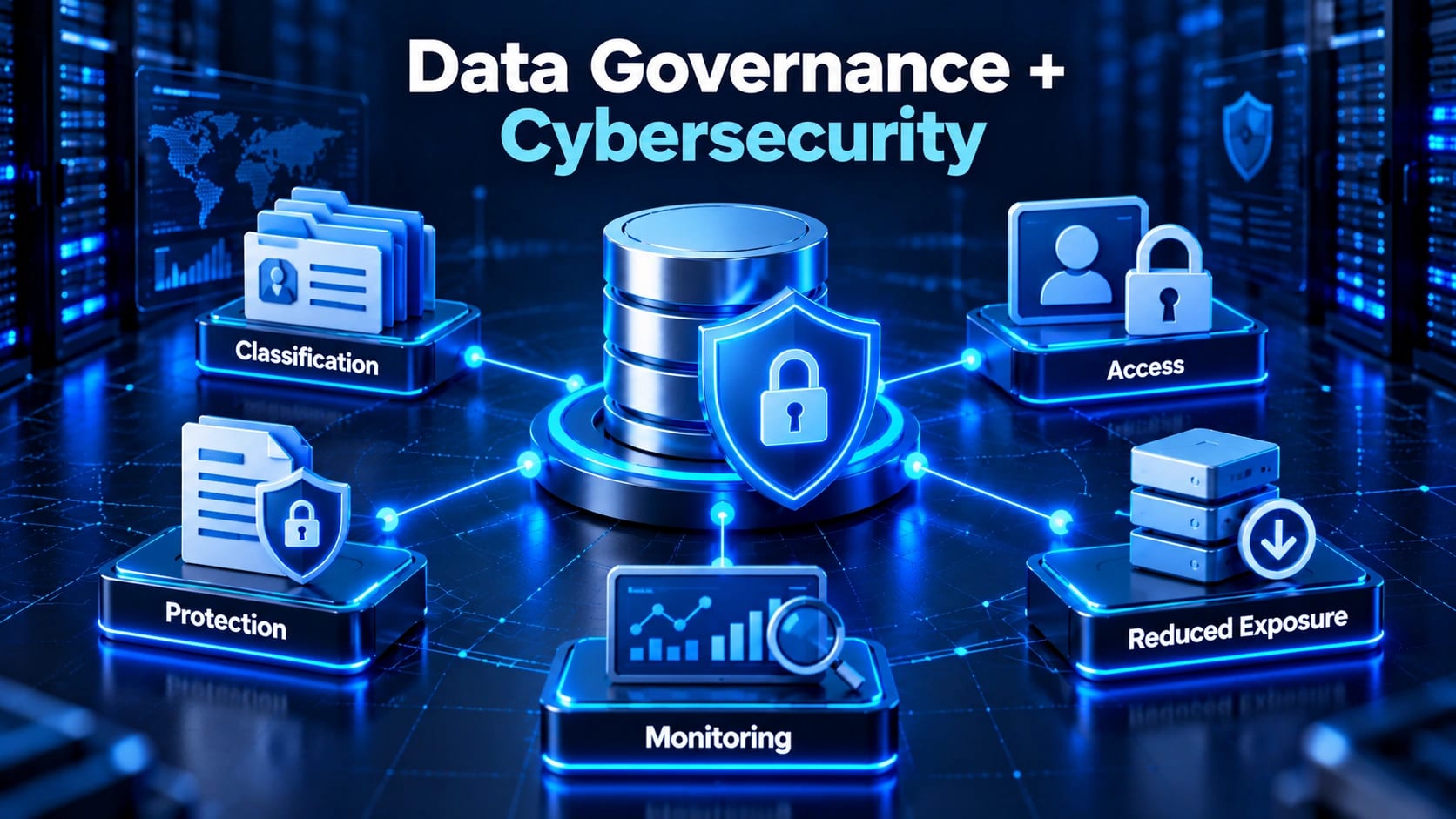
Governance establishes how data should be classified, accessed, and protected. Cybersecurity enforces those requirements. A strong framework reduces risk in several ways:
Classification: You can't protect data consistently if you don't know which information is sensitive.
Access control: Governance defines who should see what, and identity controls enforce it through least privilege. Weak access control is exactly what attackers exploit, whether through account takeover fraud or identity attacks like the golden ticket attack.
Data protection: Governance determines when encryption, masking, or retention controls are required. For personal data, effective PII security controls reduce the risk of exposure.
Monitoring and accountability: Logging, access reviews, and audits verify that policies are followed. For data in the cloud, strong cloud infrastructure security practices keep those controls enforceable.
Reduced exposure: The less unnecessary data you hold, and the more narrowly it's accessible, the smaller the impact of any incident. Retention limits and sharing rules help here. Third-party and external exposure matter too, which is where digital risk protection services come in.
How to Measure Success
The right metrics depend on your goals, but these are a good start:
Data quality: accuracy, completeness, and consistency of critical datasets before and after governance.
Ownership coverage: how many critical datasets have an assigned owner and steward.
Policy compliance: adherence to classification, retention, and handling rules.
Access review completion: whether reviews finish on schedule and unnecessary permissions are removed.
Issue resolution: the number of open data issues and how quickly they close.
Audit findings: fewer recurring data-related findings suggest controls are addressing root causes.
Governance maturity: periodic assessment across policies, ownership, quality, security, and technology.
The goal isn't a perfect score. It's identifying weaknesses, prioritizing fixes, and showing progress over time.
Final Takeaway
Data governance frameworks turn scattered data practices into a consistent, organization-wide process covering quality, ownership, security, privacy, and compliance. No universal framework exists, so adapt DAMA-DMBOK, COBIT, DCAM, or a blend to your objectives, regulations, maturity, and resources.
Start with critical data, assign clear owners, write practical policies, measure results, and keep improving. Done well, governance reduces unnecessary data exposure and strengthens accountability. It makes sure the right people can trust, protect, and use the right data at the right time.
Need help building or assessing your governance and risk program? Talk to the Cyber Lad team.
Frequently Asked Questions
1. What is a data governance framework?
A data governance framework is a structured set of policies, roles, processes, and standards that defines how an organization manages its data. It covers ownership, quality, security, privacy, and compliance across the full data lifecycle, from collection to deletion.
2. What are the main components of a data governance framework?
The core components are data ownership and stewardship, policies and standards, data quality management, security and privacy controls, and a governance structure for decision-making. Together, these ensure that someone is accountable for each dataset and that employees follow consistent rules.
3. What is the difference between data governance and data security?
Data governance decides what data exists, who owns it, and who should have access. Data security provides the technical controls, such as encryption, authentication, and monitoring, that enforce those decisions. Governance sets the rules, and security enforces them. Both feed into a broader data risk management framework.
4. Which data governance framework is best?
No single framework fits every organization. DAMA-DMBOK offers broad data management coverage, COBIT aligns governance with IT risk and controls, and DCAM assesses data management maturity. Many businesses combine elements of several, based on their size, industry, regulatory obligations, and data maturity.
5. How do you implement a data governance framework?
Start by assessing your current data environment, then define roles and responsibilities, and establish policies and standards. Begin with high-value data like customer or financial records, track metrics such as ownership coverage and data quality, and review the program regularly. Governance works best as an ongoing process, not a one-time project.
6. Can small businesses use a data governance framework?
Yes. Smaller organizations can scale governance down by assigning clear data owners, classifying sensitive information, and setting basic access and retention policies. A cyber security assessment is a good starting point for finding which data and gaps need attention first.
7. How do you measure the success of data governance?
Track data quality scores, the percentage of critical datasets with assigned owners, policy compliance rates, access review completion, and how quickly data issues are resolved. Fewer recurring audit findings are another sign the framework is working. The goal is steady, measurable improvement rather than a perfect score.