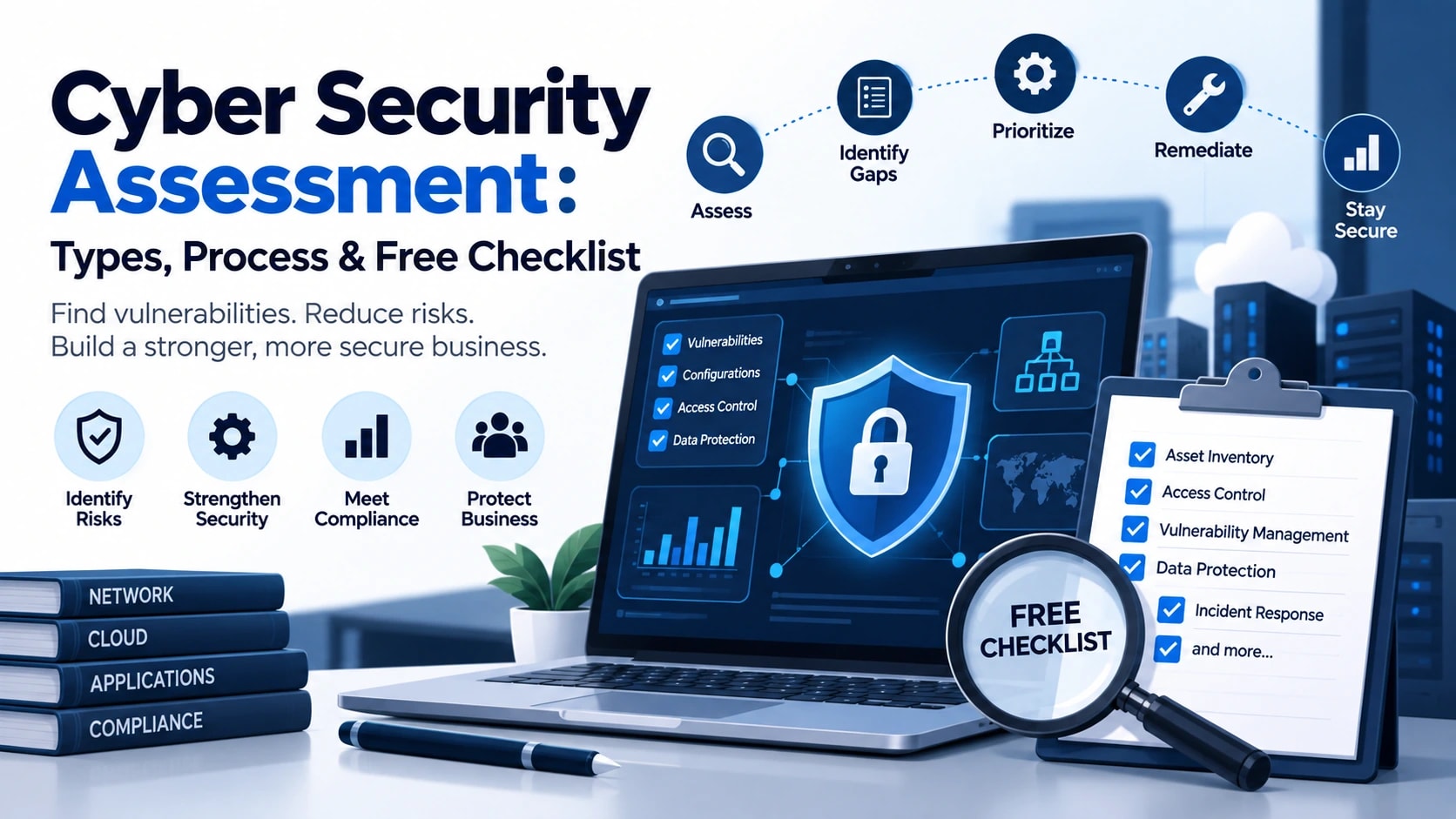
A cyber security assessment is a structured evaluation of an organization's systems, data, and controls designed to identify vulnerabilities before attackers do. It's the single most effective way to know where your actual risk sits, not where you assume it sits.
The stakes are real: the average data breach now costs $4.45M, and most organizations don't discover a breach for 204 days. A well-run assessment closes that gap by surfacing weaknesses while they're still cheap to fix.
In this guide, we'll break down the different types of cyber security assessments, walk through the process step by step, show you what a proper assessment report looks like, and give you a free checklist you can run through today. If you're weighing an assessment against a full penetration test, or wondering how it fits into a broader GRC program, we'll cover that too.
What Is a Cyber Security Assessment?
A cyber security assessment is a systematic review of an organization's IT environment to identify security weaknesses, understand potential threats, and evaluate whether existing security controls are strong enough to protect critical systems and data.
The assessment looks beyond individual vulnerabilities. It examines how different parts of the security environment work together, including networks, applications, endpoints, cloud infrastructure, user access, security policies, and data protection controls.
A typical assessment focuses on four core areas:
Assets: Systems, applications, devices, cloud resources, and sensitive data that need protection.
Threats: Potential events or attackers that could compromise those assets.
Vulnerabilities: Weaknesses that attackers could exploit, such as outdated software, misconfigurations, or excessive permissions.
Security controls: Measures already in place, including firewalls, MFA, endpoint protection, access controls, monitoring, and incident response procedures.
The goal is not simply to create a list of security problems. A good assessment helps an organization understand which risks matter most, what could happen if those risks are exploited, and which issues should be fixed first.
For example, an assessment might identify dozens of vulnerabilities across an environment. A missing patch on an isolated test server may present relatively little risk, while weak authentication on an internet-facing administrator account could require immediate attention.
This risk-based approach helps security teams prioritize resources instead of treating every finding as equally urgent.
Cyber Security Assessment vs Audit vs Penetration Test
These terms are often used interchangeably, but they serve different purposes.
Approach | Primary Purpose | What It Examines | Typical Outcome |
|---|---|---|---|
Cyber Security Assessment | Evaluate overall security posture and risk | Systems, vulnerabilities, threats, policies, controls, and processes | Prioritized findings and remediation plan |
Security Audit | Verify compliance with defined requirements | Policies, procedures, evidence, and security controls | Compliance findings and audit report |
Penetration Test | Determine whether vulnerabilities can be exploited | Selected networks, applications, systems, or infrastructure | Exploitable vulnerabilities and technical recommendations |
A cyber security assessment provides the broadest view. An audit focuses primarily on whether required controls and standards are being followed, while a penetration test actively tests whether weaknesses can be exploited.
Organizations often use all three as part of a mature security program rather than choosing only one approach. See our breakdown of Governance, Risk, and Compliance (GRC) in cybersecurity for how these efforts typically get coordinated.
Types of Cyber Security Assessments
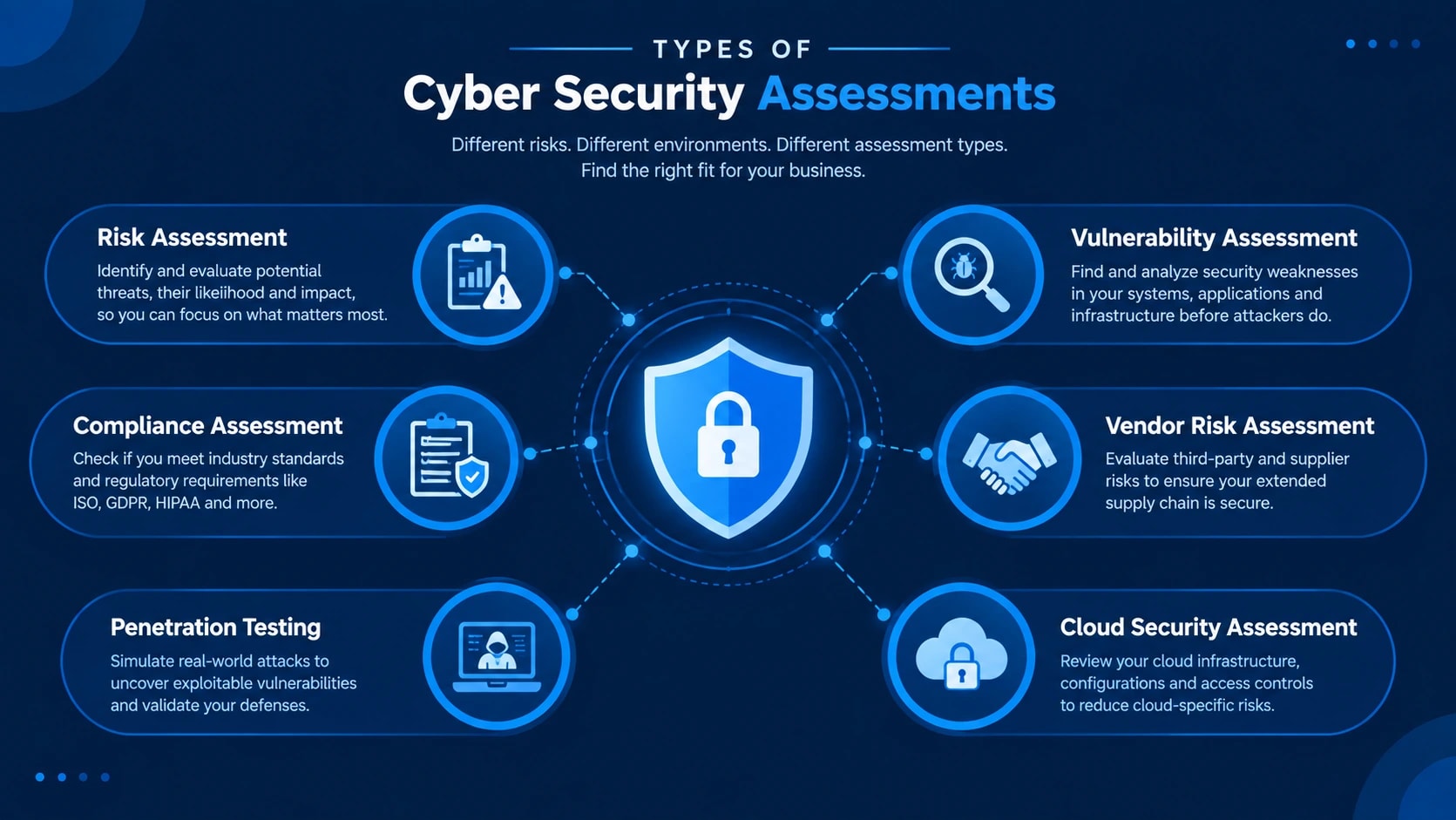
Not every organization faces the same security risks. The right assessment depends on your infrastructure, industry, regulatory requirements, and the type of data you handle.
Here are the most common types of cyber security assessments.
1. Cyber Security Risk Assessment
A cyber security risk assessment identifies threats to critical assets and evaluates the potential impact if those threats become real incidents.
Instead of focusing only on technical vulnerabilities, it considers the bigger picture. This includes the likelihood of an incident, the value of affected assets, existing security controls, and the potential financial or operational impact.
The findings are then prioritized by risk, helping organizations decide where security resources should be allocated first. If you want to put numbers behind that prioritization, our cybersecurity risk calculator is a useful starting point.
2. Vulnerability Assessment
A vulnerability assessment searches systems, applications, networks, and devices for known security weaknesses.
Security teams may use vulnerability scanning tools such as Nessus, Qualys, or Rapid7 to identify issues including:
Missing security patches
Outdated software
Open ports and unnecessary services
Weak configurations
Known software vulnerabilities
Exposed systems
Unlike penetration testing, a vulnerability assessment generally focuses on identifying weaknesses rather than actively exploiting them.
You can learn more about the difference in our guide to penetration testing and vulnerability assessment strategy.
3. Compliance Assessment
A compliance assessment evaluates whether an organization's security controls meet specific regulatory, industry, or contractual requirements.
Depending on the organization, this may involve frameworks and standards such as:
ISO 27001
NIST Cybersecurity Framework
SOC 2
GDPR
PCI DSS
The assessment can identify gaps between existing security practices and required controls, giving the organization a clear roadmap for improving compliance.
Compliance assessments are often part of a wider Governance, Risk, and Compliance (GRC) program. If you're in a regulated industry like financial services, frameworks such as APRA CPS 230 add another layer of operational-risk requirements on top of the standards above.
4. Third-Party and Vendor Risk Assessment
Organizations increasingly depend on cloud providers, SaaS platforms, contractors, payment processors, and other external vendors.
A third-party risk assessment evaluates whether those vendors introduce unacceptable security risks.
It may examine areas such as data handling, access controls, encryption, incident response procedures, security certifications, breach history, and subcontractor management.
These assessments are especially important when a vendor has access to sensitive data or critical business systems, and worth pairing with a look at the third-party risks your vulnerability scanner can't see, since scanning tools alone rarely catch vendor-side exposure.
5. Penetration Testing
Penetration testing takes a more adversarial approach.
Security professionals simulate real-world attacks against selected systems, applications, or networks to determine whether identified weaknesses can actually be exploited.
A penetration test can uncover attack paths that automated vulnerability scanners may miss, such as chained vulnerabilities, authentication weaknesses, business logic flaws, and privilege escalation opportunities.
Because penetration testing involves active exploitation, it is usually conducted within a clearly defined scope and with formal authorization. See our penetration testing and vulnerability assessment strategy guide for how the two disciplines fit together.
6. Cloud Security Assessment
A cloud security assessment evaluates the security configuration of cloud environments such as AWS, Microsoft Azure, or Google Cloud.
It typically examines:
Identity and access management
Publicly exposed resources
Storage permissions
Network configurations
Encryption
Logging and monitoring
Secrets and credential management
Security policies and misconfigurations
Cloud environments can change quickly, so these assessments are particularly useful after migrations, major architecture changes, or the deployment of new cloud services. A data risk management framework can help you decide what "critical" data actually needs the tightest controls once it's moved to the cloud.
Many organizations combine several of these assessments. For example, a business may conduct an annual cyber security risk assessment, run vulnerability assessments regularly, and perform penetration testing on critical applications before major releases.
Why Does Your Business Need a Cyber Security Assessment?
Cyber risks change constantly. New vulnerabilities are discovered, employees join or leave, applications are deployed, cloud environments expand, and attackers develop new techniques.
A cyber security assessment gives businesses a clear picture of where their security posture stands today. More importantly, it helps identify weaknesses before they become security incidents.
Regular assessments can help organizations:
Discover vulnerabilities and security misconfigurations
Identify excessive user privileges and weak access controls
Find outdated or unsupported systems
Evaluate whether existing security controls are working as intended
Prioritize security investments based on actual risk
Prepare for regulatory or compliance requirements
Reduce the likelihood and potential impact of a data breach
Improve incident response and recovery readiness
An assessment can also uncover security gaps that individual tools may not detect. A vulnerability scanner might identify an outdated server, for example, but a broader assessment can determine whether that server contains sensitive data, is exposed to the internet, and has adequate monitoring in place, which is really the job of ongoing cyber security monitoring once the assessment closes.
This context helps teams focus on vulnerabilities that present the greatest business risk.
How Often Should You Conduct a Cyber Security Assessment?
For many organizations, conducting a comprehensive assessment at least once a year provides a useful baseline. Higher-risk environments may require more frequent assessments depending on regulatory requirements, infrastructure changes, and the sensitivity of the data involved.
You should also consider conducting an assessment after significant events such as:
A data breach or security incident
Major infrastructure or network changes
Migration to a new cloud environment
Deployment of critical applications
A merger or acquisition
Introduction of new vendors with access to sensitive systems
Significant changes to regulatory requirements
Before an important compliance audit
Annual assessments should not replace continuous security monitoring, vulnerability management, patching, and other day-to-day security practices. Many organizations formalize this continuous layer through a Global Security Operations Center (GSOC) or managed endpoint detection and response (EDR).
Think of the assessment as a periodic health check for your security program. Continuous monitoring tells you what is happening across the environment, while an assessment takes a broader look at whether your defenses, processes, and priorities still match the risks your organization faces.
Cyber Security Assessment Process: 6 Steps
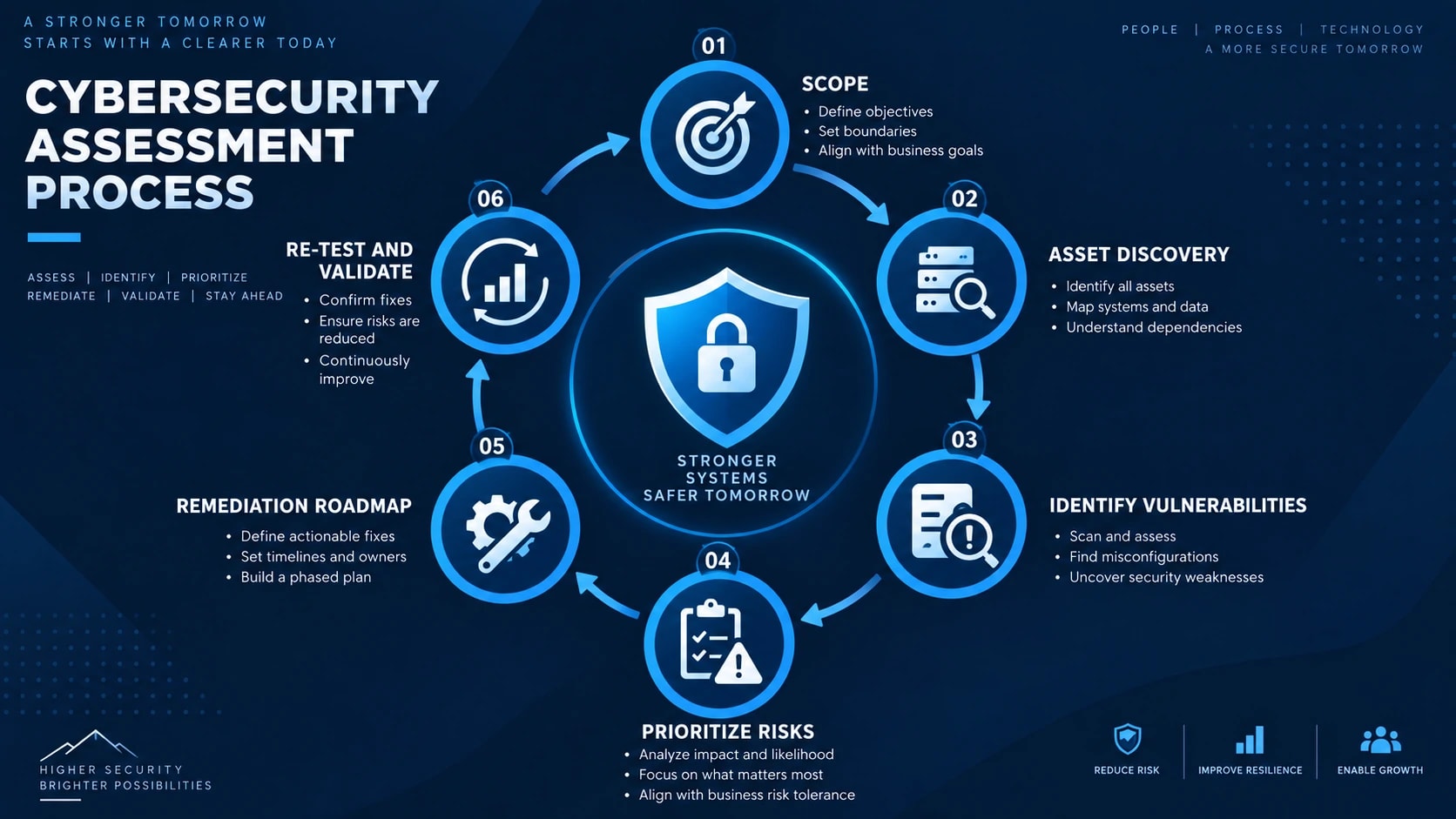
A successful cyber security assessment process follows a structured approach. The exact scope varies between organizations, but most assessments move through six core stages, from defining what needs to be assessed to validating that identified risks have been addressed.
1. Define the Scope
The first step is deciding exactly what the assessment will cover.
Depending on the organization, the scope may include:
Corporate networks
Servers and endpoints
Web applications
Cloud infrastructure
Databases
Remote access systems
Identity and access management
Sensitive business data
Third-party integrations
Security policies and procedures
Clearly defining what is in and out of scope prevents gaps and ensures everyone understands the purpose of the assessment.
The scope should also identify critical business processes and systems. An internet-facing customer portal, for example, may require more attention than an isolated development environment.
2. Discover Assets and Data
You cannot protect systems you do not know exist.
The next step is building an accurate inventory of hardware, software, cloud resources, applications, user accounts, and sensitive data.
Security teams should determine where critical information is stored, who has access to it, and how it moves between systems.
Asset discovery can also reveal forgotten servers, unmanaged devices, unused cloud resources, and shadow IT that may otherwise remain outside normal security monitoring.
3. Identify Vulnerabilities and Security Gaps
Once the environment is understood, the assessment looks for weaknesses attackers could exploit.
This can involve automated vulnerability scanners such as Nessus, Qualys, and Rapid7, combined with manual configuration reviews and security testing. Some teams go further with proactive cyber threat hunting to surface issues scanners alone won't catch.
Common findings include:
Missing security patches
Unsupported software
Weak passwords or authentication controls
Excessive user privileges
Exposed services
Cloud misconfigurations
Insecure network configurations
Missing endpoint protection
Inadequate logging and monitoring
Weak backup or recovery processes
Automated scanning is useful, but it should not be the entire assessment. Manual review provides context that scanning tools may miss.
4. Score and Prioritize Risks
Finding a vulnerability does not automatically make it a critical business risk.
Each finding should be evaluated based on factors such as exploitability, likelihood, asset importance, data sensitivity, existing controls, and potential business impact. Our cybersecurity risk calculator can help put a rough number on that impact when you're weighing findings against each other.
Teams can then classify findings using ratings such as:
Critical | High | Medium | Low
This prevents security teams from spending equal time on every vulnerability and helps them address the risks that could cause the greatest damage first.
5. Create the Report and Remediation Roadmap
The findings are documented in a cyber security assessment report.
A useful report does more than list vulnerabilities. It explains the associated risk, affected assets, recommended remediation, priority, and expected timeline for fixing the issue.
The remediation roadmap should separate immediate actions from longer-term improvements.
For example, disabling an exposed account may take minutes, while redesigning network segmentation could require several months of planning and implementation.
6. Re-Test and Validate
An assessment should not end when the report is delivered.
After remediation work is completed, security teams should verify that critical findings have been properly resolved and that the fixes have not introduced additional problems.
Re-testing may include vulnerability scans, configuration reviews, access-control checks, or targeted penetration testing.
The final result should be a cycle of assess, prioritize, remediate, validate, and reassess. This turns a one-time cyber security assessment into an ongoing process for improving the organization's security posture, one of the enterprise cyber security strategies that separates mature programs from reactive ones.
What Is Included in a Cyber Security Assessment Report?
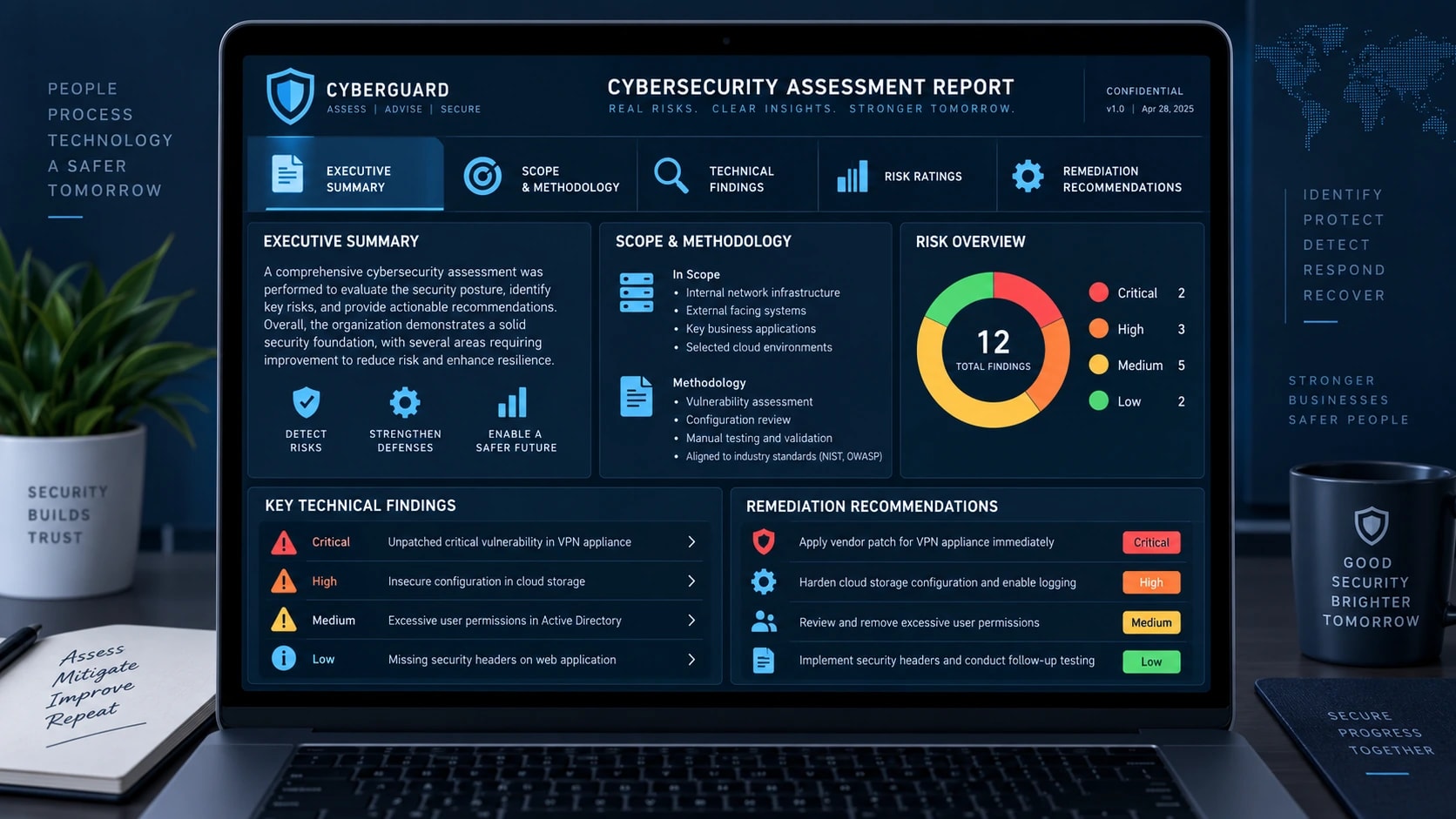
A cyber security assessment report turns technical findings into a clear action plan. It should help leadership understand overall business risk while giving security and IT teams enough technical detail to fix identified weaknesses.
A good report typically includes the following sections.
Executive Summary
The executive summary provides a high-level overview for senior management and other non-technical stakeholders.
It should explain the organization's overall security posture, the most significant risks discovered, and the actions that require immediate attention.
Instead of overwhelming leadership with technical details, this section should answer three questions:
What are our biggest cyber risks?
How could they affect the business?
What should we address first?
Scope and Methodology
The report should clearly document what was assessed and how the assessment was performed.
This may include networks, applications, cloud infrastructure, endpoints, identity systems, security policies, and other assets included within the scope.
Any exclusions or limitations should also be documented so readers understand what the assessment does and does not cover.
Technical Findings
This section contains detailed information about each security weakness discovered during the assessment.
A finding may include:
Vulnerability or security gap
Affected system or asset
Description of the issue
Potential impact
Evidence supporting the finding
Recommended remediation
Risk rating
Technical teams can use this information to reproduce, investigate, and resolve each issue.
Risk Ratings
Findings are commonly categorized as Critical, High, Medium, or Low based on their potential impact and likelihood of exploitation.
For example, an internet-facing vulnerability that could allow unauthorized access to sensitive customer data would generally receive greater priority than a low-impact configuration issue on an isolated system.
Risk ratings help organizations direct limited security resources toward the issues that matter most.
Remediation Recommendations
Every meaningful finding should include a practical recommendation.
Recommendations might involve applying patches, changing configurations, enforcing MFA, removing unnecessary privileges, improving network segmentation, strengthening monitoring, or updating security policies.
The report should also assign realistic remediation timelines based on risk.
Risk Level | Example Remediation Priority |
|---|---|
Critical | Immediate action |
High | As soon as possible |
Medium | Planned remediation |
Low | Address through normal improvement cycles |
These timelines should be adapted to the organization's risk tolerance, operational requirements, and regulatory obligations rather than treated as universal deadlines.
Remediation Roadmap
Finally, the assessment report should bring individual findings together into a prioritized roadmap.
Quick fixes can be addressed first, while larger security improvements can be planned over the following weeks or months.
This makes the cyber security assessment report more than a snapshot of vulnerabilities. It becomes a practical roadmap that leadership, IT teams, and security professionals can use to measure progress and steadily reduce risk.
Free Cyber Security Assessment Checklist
You do not need to wait for a formal audit to start identifying security gaps. Use this cyber security assessment checklist as a quick baseline review of your organization's current security posture.
1. Asset Inventory
Maintain an up-to-date inventory of servers, endpoints, applications, network devices, and cloud resources.
Identify where sensitive and business-critical data is stored.
Remove or secure unknown, unused, and unauthorized assets.
2. Identity and Access Management
Enable multi-factor authentication (MFA) for privileged and sensitive accounts.
Apply least-privilege access wherever possible.
Remove inactive and unnecessary user accounts.
Review administrator and privileged access regularly.
3. Patch and Vulnerability Management
Keep operating systems, applications, and network devices updated.
Run vulnerability scans regularly.
Prioritize critical and high-risk vulnerabilities for remediation.
Track identified vulnerabilities until they are resolved.
4. Endpoint and Network Security
Deploy endpoint protection or EDR across supported endpoints. See our guide to managed endpoint detection and response if you're weighing in-house vs. managed coverage.
Configure firewalls to allow only required traffic.
Review internet-facing ports and services.
Segment critical systems from lower-trust networks where appropriate.
5. Data Protection
Encrypt sensitive data in transit and at rest where required.
Restrict access to confidential and business-critical information.
Review how sensitive data is collected, stored, shared, and deleted, including PII, which carries its own handling and disclosure obligations.
Monitor for unauthorized access or unusual data transfers, and put data leak prevention controls in place for your most sensitive information.
6. Backups and Recovery
Back up critical systems and data regularly.
Keep protected backup copies that cannot be easily modified by compromised accounts.
Test backup restoration procedures.
Document recovery priorities for critical business services.
7. Logging and Monitoring
Enable security logging on critical systems and applications.
Centralize important logs where possible.
Monitor for suspicious authentication, privilege changes, malware, and unusual network activity.
Define a process for investigating security alerts. See our cyber security monitoring best practices for what a mature process looks like.
8. Incident Response
Maintain a documented incident response plan.
Define roles and responsibilities before an incident occurs.
Maintain escalation and communication procedures.
Test the incident response plan through exercises or simulations.
9. Third-Party Security
Identify vendors that can access sensitive data or critical systems.
Review their security practices before granting access.
Limit third-party permissions to what is necessary.
Remove vendor access when contracts or projects end. For a deeper look at where these relationships tend to fail, see the third-party risks your vulnerability scanner can't see.
10. Security Awareness
Provide employees with regular cyber security awareness training.
Train users to recognize phishing and social engineering attempts.
Provide a simple method for reporting suspicious emails or activity.
Include security responsibilities in employee onboarding and offboarding, and don't overlook risks from within, covered in what is the goal of an insider threat program.
Quick Assessment
If you answered No to several items above, those gaps can provide a useful starting point for a more detailed cyber security assessment.
The checklist is designed as a baseline, not a substitute for a professional assessment. The next step is to prioritize gaps according to their likelihood, potential business impact, and the importance of the systems involved. Critical weaknesses such as exposed administrative access, missing MFA, unsupported internet-facing systems, or untested backups should receive attention first.
How CyberLad Can Help
Identifying security gaps is only useful if you know which ones to address first. CyberLad helps businesses evaluate their security posture, uncover potential weaknesses, and prioritize improvements based on actual risk.
Our approach focuses on practical findings rather than lengthy reports filled with issues that provide little business context. If you'd rather bring in outside expertise for a deeper review, here's what a cyber security consultant does and why you might need one.
You can start with a free 30-minute cyber security assessment to get an initial view of your current security posture. We will help identify three critical security vulnerabilities or gaps that may require your attention and explain the practical steps you can take to reduce the associated risk.
Depending on your environment, the assessment can consider areas such as:
Network and infrastructure security
Vulnerability management
Identity and access controls
Endpoint security
Cloud security
Security monitoring and incident response
Data protection and compliance readiness
Whether you are preparing for an audit, responding to a recent security concern, or simply want to understand where your biggest risks are, a focused assessment can give you a clearer starting point.
Conclusion
A cyber security assessment gives your organization a clear view of its vulnerabilities, security controls, and overall risk. Instead of waiting for an incident to expose weaknesses, regular assessments help you find and address them early.
The process should go beyond running vulnerability scans. A complete assessment looks at your assets, access controls, infrastructure, cloud environments, data protection, security processes, and incident readiness. Most importantly, it turns those findings into a prioritized remediation plan.
Use the cyber security assessment checklist above as a starting point to identify obvious gaps. For a deeper review, consider a comprehensive assessment that evaluates both technical weaknesses and their potential business impact.
Cyber security is not a one-time exercise. Assess, remediate, validate, and repeat as your systems and risks evolve.
If you are unsure where to start, CyberLad's free 30-minute security assessment can help identify three critical security gaps and give you practical next steps for improving your security posture.
Frequently Asked Questions
How much does a cyber security assessment cost?
The cost of a cyber security assessment depends on the size of the organization, number of systems, assessment scope, complexity of the environment, and level of testing required. A small business assessment may cost significantly less than an enterprise assessment covering multiple networks, cloud environments, applications, and locations.
How long does a cyber security assessment take?
A cyber security assessment can take anywhere from a few days to several weeks. A focused assessment of a small environment may be completed quickly, while a comprehensive enterprise assessment involving multiple systems, applications, cloud platforms, and business units can take several weeks.
Who should conduct a cyber security assessment?
A cyber security assessment can be performed by an internal security team, an independent cyber security consultant, or a specialized security provider. Internal teams understand the environment well, while an independent third party can provide an outside perspective and may identify risks that internal teams have overlooked.
Organizations may also use both approaches, with internal teams performing regular assessments and independent specialists conducting periodic reviews.
What is the difference between a cyber security assessment and an audit?
A cyber security assessment focuses on identifying vulnerabilities, threats, control weaknesses, and overall security risk. A security audit primarily evaluates whether an organization complies with defined policies, regulations, frameworks, or standards.
An assessment asks, "Where are our security risks?" An audit generally asks, "Are we meeting the required controls or standards?"
What is a cyber security risk assessment?
A cyber security risk assessment identifies important assets, relevant cyber threats, vulnerabilities, existing security controls, and the potential impact of a security incident. The findings are prioritized according to risk so organizations can focus resources on the security issues that could have the greatest business impact.