Security Observability: A Guide for Security Teams
Security teams are collecting more data than ever. Endpoint activity, authentication events, cloud logs, network traffic, application telemetry and security alerts can all provide clues about what is happening inside an environment.
The problem is that more data does not automatically mean better visibility.
When security telemetry is spread across different tools and platforms, analysts can struggle to connect individual events into a clear picture. A suspicious login may look harmless on its own. When it is connected to an unusual device, a privilege change and abnormal cloud activity, the risk becomes much clearer.
This is where security observability becomes useful.
Security observability focuses on connecting security-relevant telemetry so teams can understand what happened, why it happened and what may have happened next. It goes beyond collecting logs or generating alerts by giving analysts more context for detection, investigation and response.
This guide explains how security observability works, how it differs from security monitoring, where technologies such as SIEM and EDR fit, and how organizations can build a practical strategy without simply collecting more data.
What Is Security Observability?
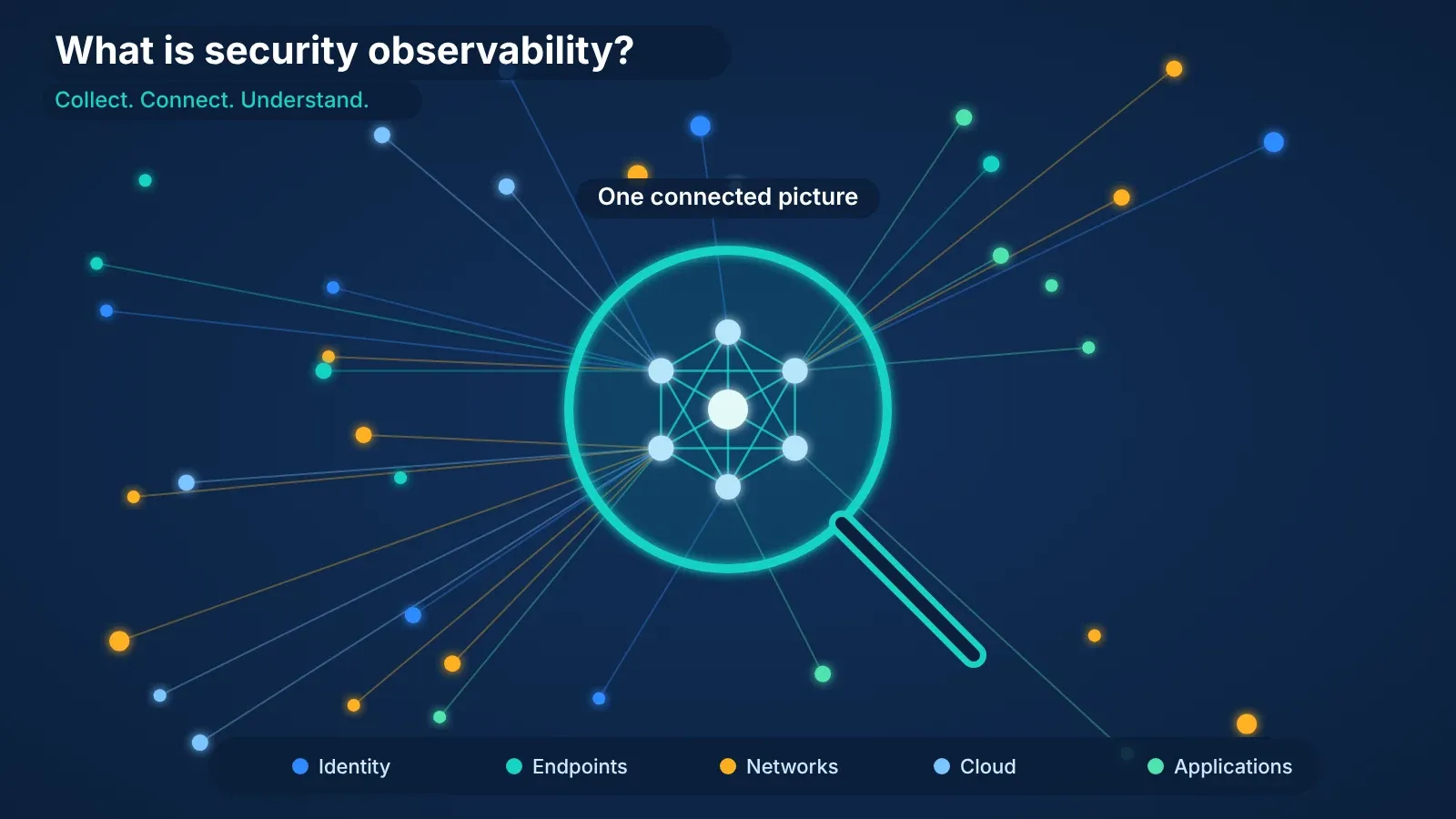
Security observability is the ability to understand what is happening across an environment by collecting, connecting and analyzing security-relevant telemetry.
The key idea is context.
A single security event rarely tells the whole story. An unusual login could be a legitimate employee working from a new location, or it could be the first step in an account compromise. Security observability helps analysts connect that login with other activity, such as device changes, privilege escalation, unusual application access or suspicious network behavior.
This requires visibility across several layers:
Identity: logins, authentication failures, privilege changes and account activity
Endpoints: processes, file activity, device behavior and security events
Networks: connections, DNS requests, traffic patterns and suspicious communications
Cloud environments: API calls, configuration changes, access activity and resource events
Applications: logs, API activity, errors and abnormal behavior
The objective is not to collect every possible event. It is to make important security signals available, connected and useful during detection and investigation.
Normalization, enrichment and correlation can then turn isolated events into a clearer picture of activity across the environment.
What Security Observability Is Not
Security observability is not simply another name for logging, monitoring or SIEM.
It is not just log collection. An organization can collect millions of events without being able to understand an attack effectively.
It is not a replacement for SIEM, EDR or XDR. These technologies can provide important collection, detection, correlation and investigation capabilities within a broader observability strategy.
It is not about collecting everything. The goal is meaningful visibility around critical assets, users and attack paths.
The useful question is not How much security data do we have? It is Can our security team connect the right data quickly enough to understand and respond to suspicious activity?
Security Observability vs. Security Monitoring
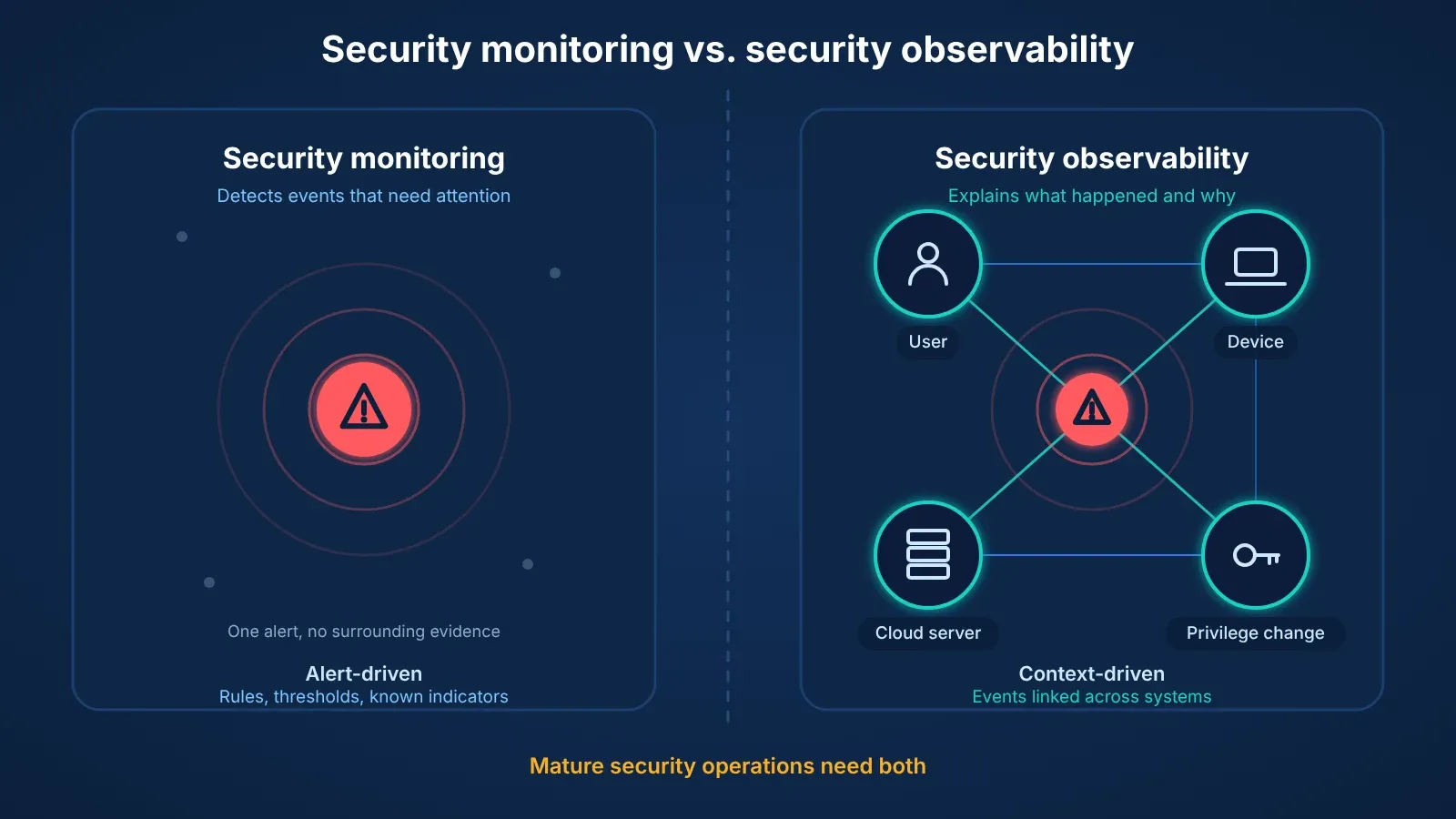
Security monitoring and security observability overlap, but they emphasize different parts of the security process.
Security monitoring focuses on detecting events that may indicate malicious or abnormal activity. It commonly relies on alerts, rules, thresholds and known indicators.
Security observability places greater emphasis on understanding relationships between events and investigating what is happening across the environment.
For example, a monitoring system might generate an alert for an unusual login. Observability adds context by connecting that login with the user's device, authentication history, privilege changes and activity in cloud or application systems.
Security monitoring | Security observability |
|---|---|
Focuses on detecting relevant events | Focuses on understanding activity and relationships |
Often alert-driven | Strongly focused on investigation context |
Uses rules and detection logic | Connects telemetry across systems |
Helps identify suspicious activity | Helps establish what happened and why |
Supports detection and response | Supports detection, investigation and response |
Observability does not replace monitoring. A mature security operation needs both. Monitoring helps teams identify activity that deserves attention, while observability can provide the broader context needed to investigate it.
CyberLad's cyber security monitoring guide covers the monitoring side in greater detail.
Why Security Observability Matters for a SOC
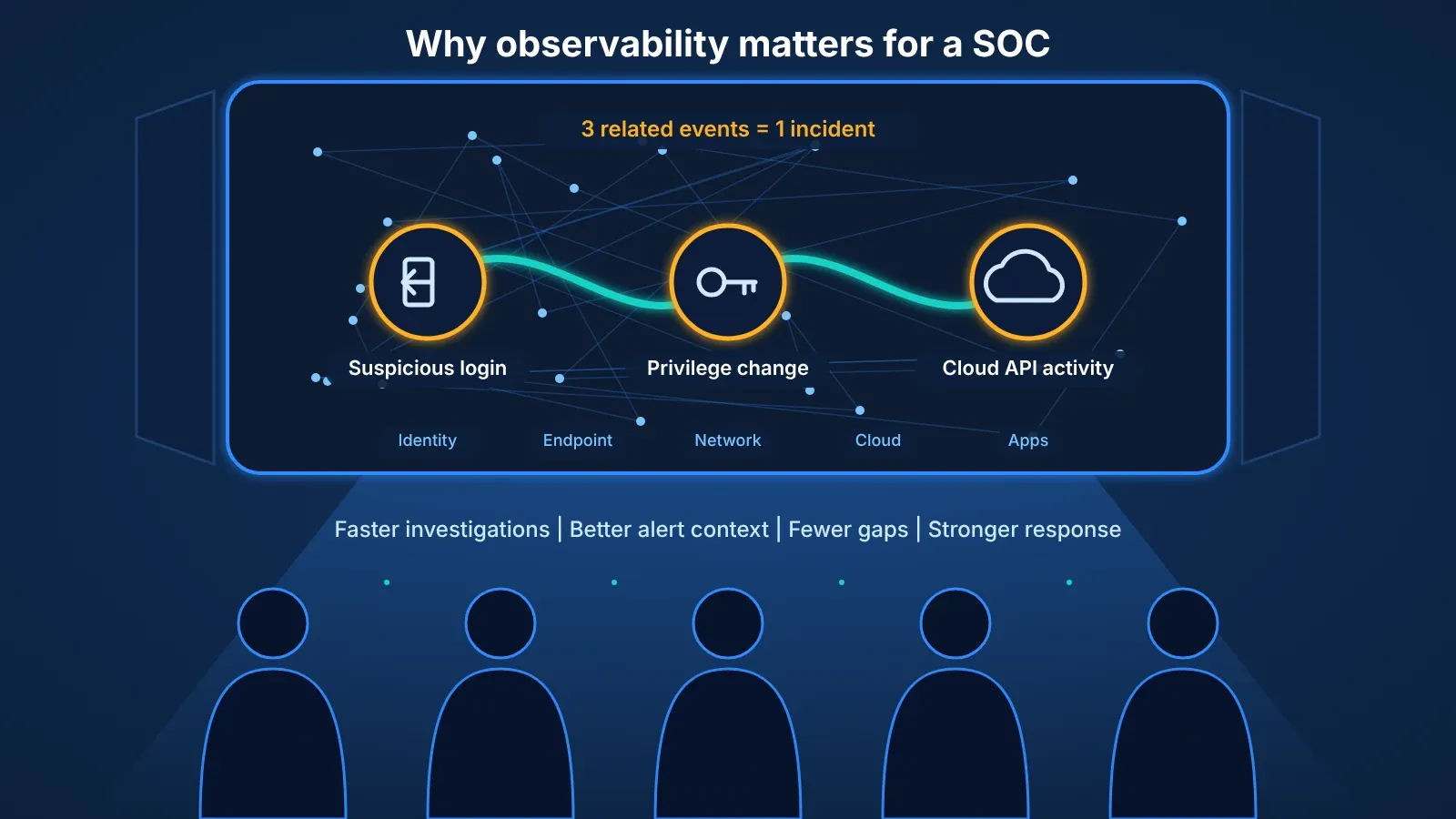
A security operations center can have strong detection tools and still struggle with investigations. The problem is often not the absence of alerts, but the lack of context around them.
Security observability helps SOC teams connect activity across different systems instead of investigating each signal in isolation.
Faster investigations
Analysts can follow related activity across identity, endpoint, network, cloud and application telemetry without manually piecing together information from disconnected systems.
Better alert context
An alert becomes more useful when analysts can see the activity surrounding it. A suspicious authentication event becomes more concerning when it is followed by privilege changes or unusual access to sensitive resources.
Fewer visibility gaps
Attackers often move across different parts of an environment. If security data remains separated between tools, important connections can be missed.
Stronger incident response
During an incident, teams need to establish what happened, when it happened and how far the activity spread. Correlated historical telemetry can help reconstruct the sequence and identify related systems or accounts.
The goal is not more dashboards. It is better evidence for making security decisions.
What Data Belongs in a Security Observability Strategy?
Security observability depends on having the right telemetry from the systems that matter most.
Identity and authentication
Authentication data can reveal unusual logins, repeated failures, privilege changes and suspicious access patterns.
Endpoint telemetry
Endpoint data provides visibility into processes, file activity, device behavior and other events that may indicate compromise.
Network telemetry
Network connections, DNS activity, traffic patterns and firewall events can help identify suspicious communication and lateral movement.
Cloud activity
Cloud environments generate security signals through API calls, identity activity, configuration changes, resource access and privilege modifications. CyberLad's guide to cloud infrastructure security provides additional context around protecting these environments.
Application and API telemetry
Application logs and API activity can expose abnormal requests, authentication issues and access to sensitive resources.
Threat intelligence
Threat intelligence can add external context to internal telemetry. Indicators such as suspicious domains, IP addresses and hashes can help analysts assess the significance of an event.
The important factor is correlation. A single event may be insignificant, but several related events can reveal a much clearer security story.
How Security Observability Works
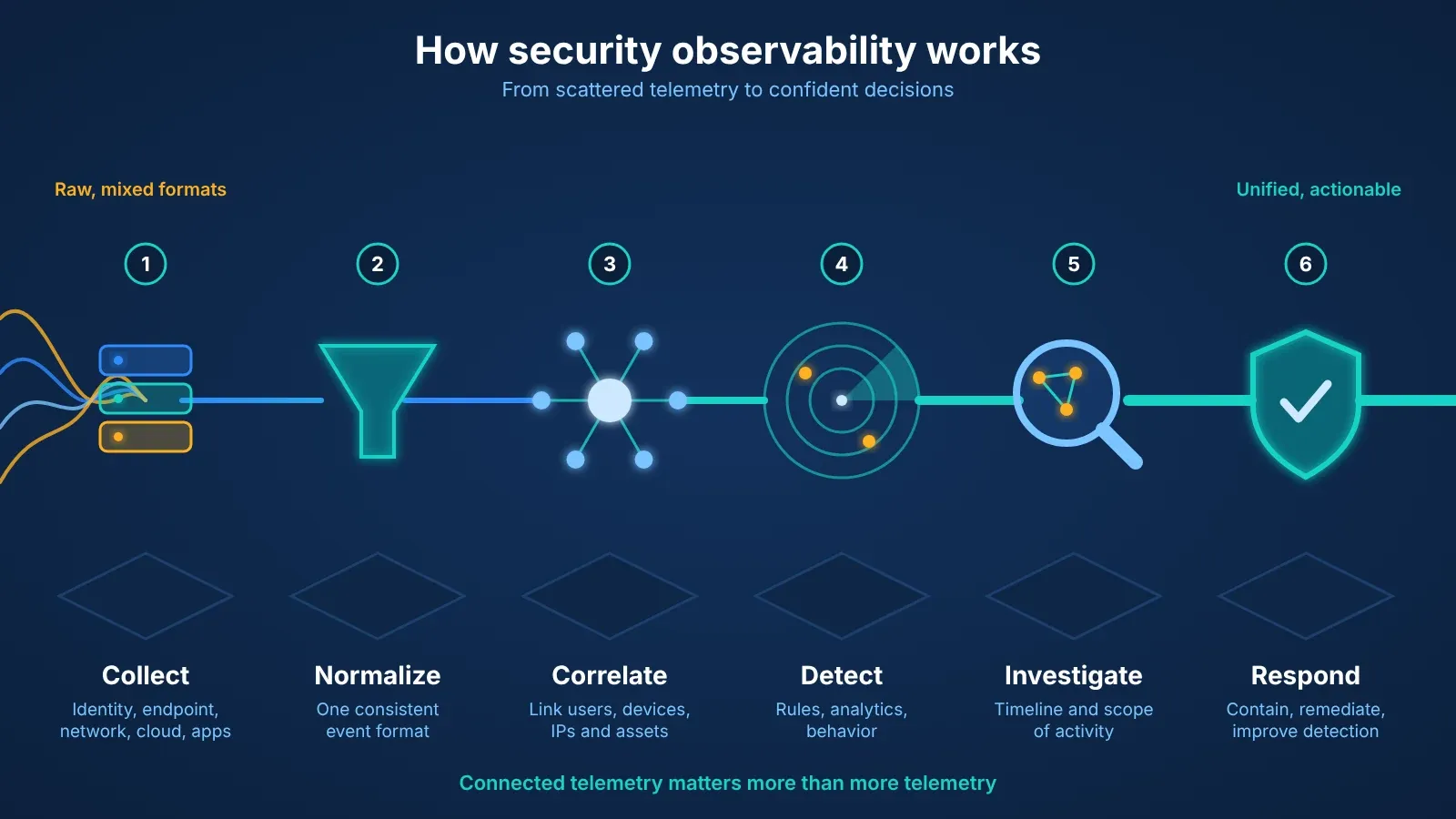
A practical security observability workflow looks like this:
Collect - Normalize - Correlate - Detect - Investigate - Respond
1. Collect
Telemetry is collected from identity systems, endpoints, networks, cloud platforms, applications and other relevant sources.
2. Normalize
Different systems produce data in different formats. Normalization provides a consistent way to interpret events from multiple sources.
3. Correlate
Related events are connected using factors such as users, devices, IP addresses, applications, timestamps and assets.
For example, an unusual login followed by a privilege change and suspicious API activity may represent one security incident rather than three unrelated events.
4. Detect
Detection rules, analytics and behavioral techniques identify activity that may require investigation.
5. Investigate
Analysts use the available context to reconstruct activity, establish timelines and determine whether an alert represents a genuine threat.
6. Respond
Once the activity is understood, the security team can contain the threat, remediate affected systems and improve future detection.
Better telemetry is useful, but connected and actionable telemetry is what helps security teams make better decisions.
Security Observability Use Cases
The value of security observability becomes clearer during real investigations.
Account compromise
A user authenticates from an unfamiliar device. Minutes later, the same account adds an authentication method, accesses a privileged application and makes an unusual cloud API request.
Looking at these events together provides stronger evidence than investigating each event separately.
Ransomware investigation
During a ransomware incident, endpoint telemetry can be combined with network activity, process execution, file changes and authentication events.
This can help analysts reconstruct how the attack moved through the environment and identify affected systems.
Cloud compromise
Cloud attacks can involve legitimate credentials and APIs rather than obvious malware. Observability can connect suspicious authentication with API calls, privilege changes, configuration modifications and access to cloud resources.
Threat hunting
Threat hunters can use historical telemetry to investigate specific hypotheses, such as unusual administrative activity followed by lateral movement or suspicious external communication.
CyberLad's cyber threat hunting guide covers this proactive investigation process in more detail.
Insider threat investigation
Investigating potential misuse may require correlating identity activity, endpoint behavior, file access and application usage.
The objective is not simply to flag unusual behavior. It is to establish enough context to determine whether further investigation is warranted.
Common Security Observability Mistakes
Security observability becomes less effective when organizations focus on collecting more data instead of improving how security teams use it.
Collecting everything
Excessive telemetry can increase storage costs, create noise and make investigations harder. Teams should prioritize sources that support important assets, attack paths and security use cases.
Treating observability as another dashboard
Adding another dashboard does not solve fragmented visibility. The objective is to connect related events and give analysts useful investigation context.
Ignoring data quality
Missing fields, inconsistent timestamps, duplicate events and unreliable telemetry can undermine investigations. Security teams need to know whether their data is complete and trustworthy.
Creating too many alerts
If every unusual event generates an alert, analysts can quickly become overwhelmed. Detection should prioritize meaningful combinations of signals rather than turning every anomaly into an incident.
Measuring data volume instead of outcomes
The amount of telemetry collected is a poor measure of security effectiveness. More useful measures include investigation time, detection coverage, false-positive rates and telemetry availability.
Buying tools before fixing visibility gaps
A new security platform cannot compensate for poorly defined use cases or missing telemetry. Organizations should identify visibility requirements first, then determine which technologies address those gaps.
The goal is better security decisions, not simply more security data.
How to Build a Security Observability Strategy
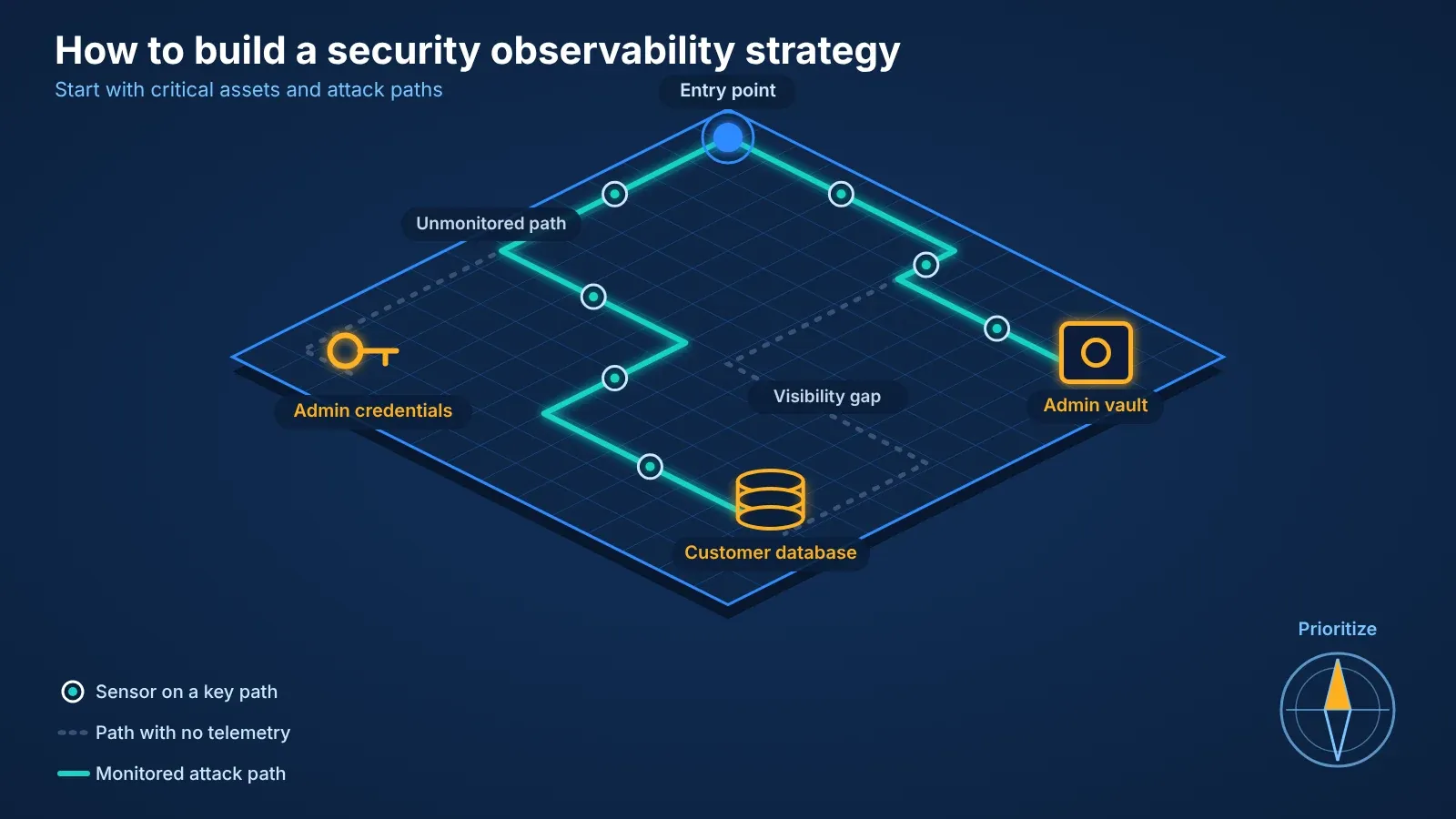
A security observability strategy should start with security priorities, not technology.
1. Identify critical assets and attack paths
Start with the systems that would cause the greatest impact if compromised. Map how users, devices, applications, cloud resources and privileged accounts interact with them.
2. Map existing telemetry
Document which security events are already available and where they are stored. Look for gaps across identity, endpoint, network, cloud and application environments.
3. Prioritize visibility gaps
Focus first on gaps affecting critical assets, common attack paths or high-impact detection and investigation scenarios.
4. Improve data quality
Standardize timestamps, fields and naming where possible. Remove unnecessary duplication and retain important telemetry for an appropriate period.
5. Build correlation around real use cases
Start with questions analysts need to answer. For example:
Can we trace suspicious activity from an initial login through privilege escalation and access to sensitive resources?
Build detection and correlation around those questions rather than around a particular tool.
6. Measure and improve
Track investigation time, detection coverage, false positives and telemetry availability. Use the results to identify where additional data, better correlation or process changes would improve outcomes.
A practical strategy should evolve as new cloud services, applications and attack techniques create new visibility requirements.
Where SIEM, EDR, XDR and SOAR Fit
Security observability is not a single product. Different technologies provide different parts of the visibility and investigation process.
SIEM
A SIEM centralizes and analyzes security events from multiple sources. It can provide correlation, detection rules, search and investigation capabilities across large volumes of telemetry.
EDR and XDR
EDR provides detailed visibility into endpoint activity. XDR can extend correlation across multiple security domains, depending on the platform and available data sources.
CyberLad's managed endpoint detection and response guide provides further context on the role of EDR in security operations.
SOAR
SOAR platforms can automate actions based on security alerts and investigation workflows, particularly repetitive response tasks.
Observability platforms
General observability technologies can provide logs, metrics and traces across applications and infrastructure. Combined with security telemetry, they can help teams understand relationships between application behavior and security events.
The distinction is important: these tools provide capabilities, while security observability is the broader practice of connecting those capabilities around meaningful security use cases.
Security Observability Metrics
Security observability should be measured by security outcomes, not data volume.
Useful metrics include:
Mean time to detect (MTTD): How quickly potential incidents are identified.
Mean time to investigate: How long analysts need to establish what happened and determine scope.
Mean time to respond (MTTR): How quickly teams act after confirming an incident.
Telemetry coverage: Whether critical systems and attack paths generate the required data.
False-positive rate: How often alerts require investigation but do not represent meaningful threats.
Data availability: Whether critical telemetry is consistently available when needed.
The strongest measure is not how much data an organization collects, but how effectively its security team can turn that data into useful decisions.
Conclusion
Security observability is ultimately about making security data useful.
Organizations can collect enormous amounts of telemetry and still have visibility gaps if that data remains fragmented. By connecting identity, endpoint, network, cloud and application signals, security teams can build better context around alerts and investigations.
The goal is not another dashboard or simply more data. It is the ability to understand what happened, determine the scope of suspicious activity and make better-informed security decisions.
A practical strategy should begin with critical assets and real investigation requirements. From there, teams can identify telemetry gaps, improve data quality, build meaningful correlations and measure whether those improvements actually strengthen detection and response.
Frequently Asked Questions
What is security observability?
Security observability is the practice of collecting, connecting and analyzing security telemetry so teams can understand activity across their environment.
Is security observability the same as SIEM?
No. A SIEM is a technology for collecting, analyzing and correlating security events. Security observability is a broader approach to gaining visibility and context across security-relevant systems.
What is the difference between security monitoring and security observability?
Security monitoring focuses primarily on detecting suspicious events and generating alerts. Security observability places greater emphasis on connecting telemetry and understanding the relationships between events during investigation.
Can small businesses use security observability?
Yes. Smaller organizations do not need to collect everything. They can start with critical accounts, endpoints, applications and cloud services, then expand visibility as their environment and security requirements grow.