What Does A Cyber Threat Intelligence Analyst Do?
A cyber threat intelligence analyst collects and analyzes information about cyber threats, attackers, and vulnerabilities so organizations can prevent cyber attacks before they happen. You research hacker activity, monitor risks, write reports, and help security teams stop threats before damage occurs.
You see headlines about ransomware, data breaches, and nation-state hacking, and you start wondering who figures out these threats before they hit. That’s where you come in as a cyber threat intelligence analyst.
In this role, you don’t just respond to incidents. You study attackers, track vulnerabilities, and give security teams the information they need to stay ahead. If you enjoy research, problem-solving, and understanding how hackers think, this career fits you better than roles that only focus on alerts.
Many people confuse threat intelligence with SOC work or penetration testing, but the focus here is different. You work on the strategy side of cybersecurity.
You connect clues from reports, logs, dark web chatter, and vulnerability databases to understand what could happen next. Companies rely on your analysis to decide what to patch, what to monitor, and what risks matter most.
- You work proactively instead of reacting to attacks
- You analyze threats instead of only fixing them
- You help the whole security team make decisions
- You focus on research, patterns, and risk
This guide explains what you actually do day to day, what skills you need, what tools you use, and whether this career path is right for you.
Check out our latest blog on How to Fix Kernel Security Check Failure and Check for Malware
Your core role as a cyber threat intelligence analyst

As a cyber threat intelligence analyst, your main job is to understand cyber threats before they become real incidents. You collect information from many sources, study attacker behavior, and turn technical data into intelligence that security teams can use.
Instead of waiting for an alert, you ask what attackers are doing right now, who they target, and how your organization could be affected.
Your day often starts by checking threat feeds, vendor reports, and vulnerability advisories. You look for new malware campaigns, ransomware activity, phishing trends, and zero-day vulnerabilities. Then you compare that information with your company’s environment to see if the threat matters.
Typical activities include:
- Checking threat intelligence feeds
- Reading security advisories
- Reviewing vulnerability reports
- Monitoring attacker activity
- Comparing threats with the company systems
You also track threat actors. These may include ransomware groups, cybercriminal gangs, hacktivists, or nation-state attackers. Each group has patterns. Some target finance, some target healthcare, and some target government networks. When you learn these patterns, you can predict future attacks.
Report writing is another big part of your role. You must explain threats clearly so both technical teams and managers understand the risk.
Your reports usually answer:
- What is the threat
- How likely is it to affect us
- What we should do about it
You also support other security roles.
- SOC teams use your intelligence to tune alerts
- Incident responders use it during investigations
- Engineers use it to improve defenses
- Managers use it for risk decisions
In simple terms, your job is to turn scattered threat data into useful action.
Check out our latest blog on What Is The Goal Of An Insider Threat Program?
Main responsibilities you handle every day

Your responsibilities can change depending on the company, but the core tasks stay similar. Most of your time goes into collecting intelligence, analyzing threats, and helping the organization prepare.
One major responsibility is intelligence collection. You gather information from open-source intelligence, vendor reports, internal logs, vulnerability databases, and sometimes dark web monitoring.
Sources you may use:
- Security blogs
- CVE databases
- Threat intelligence platforms
- OSINT tools
- Internal SIEM logs
- Government advisories
Another responsibility is threat analysis. You study how attacks work, what tools are used, and what systems are targeted. This includes reading malware reports, reviewing indicators of compromise, and mapping activity to frameworks like MITRE ATT&CK.
You also track threat actors over time.
Examples of threat actors:
- Ransomware groups
- Phishing campaigns
- Nation-state hackers
- Insider threats
- Botnet operators
Tracking them helps you understand patterns such as:
- Targets
- Tools
- Timing
- Attack methods
Report writing is one of the most important parts of the job. You create threat briefings, summaries, and technical reports.
Your reports may go to:
- SOC team
- Security engineers
- IT admins
- CISO
- Executives
A good report explains the risk and tells the team what action to take.
You also help prevent attacks by recommending changes.
Common recommendations:
- Patch systems
- Block IP addresses
- Update detection rules
- Increase monitoring
- Disable vulnerable services
This makes the role proactive instead of reactive.
Check out our latest blog on MGM Cyber Attack Las Vegas: Timeline, Losses (2026)
Skills and tools you need to succeed
To become a cyber threat intelligence analyst, you need technical knowledge, research ability, and good communication skills. This role is not only about tools. You must understand how attacks work and how to explain risk clearly.
Important technical skills include networking knowledge. Most attacks use networks, so you need to understand IP addresses, ports, DNS, and traffic behavior.
You also need operating system knowledge.
- Windows basics
- Linux basics
- Logs and processes
- User permissions
Basic scripting helps a lot. Many analysts use Python or simple scripts to automate tasks.
Useful skills:
- Python scripting
- Log parsing
- Data analysis
- Automation
- Regex basics
OSINT skills are also important. You must know how to find useful information from public sources and ignore noise.
Examples of OSINT sources:
- Security reports
- Forums
- Research blogs
- CVE listings
- Threat feeds
You should also understand common attack techniques.
- Phishing
- Ransomware
- Exploits
- Privilege escalation
- Lateral movement
- Data exfiltration
Framework knowledge helps too, especially MITRE ATT&CK.
Writing skills are very important in this role. You must explain technical threats in simple language so others can make decisions.
Common tools used by threat intelligence analysts:
- SIEM platforms
- Threat intelligence platforms
- Virus scanning tools
- Packet analyzers
- OSINT tools
- Sandbox environments
- Log analysis tools
You don’t always hack systems.
You study attackers and risks.
Read More On What Is Cyber Threat Hunting? Complete Guide for Security Teams (2026)
Tools used by cyber threat intelligence analysts
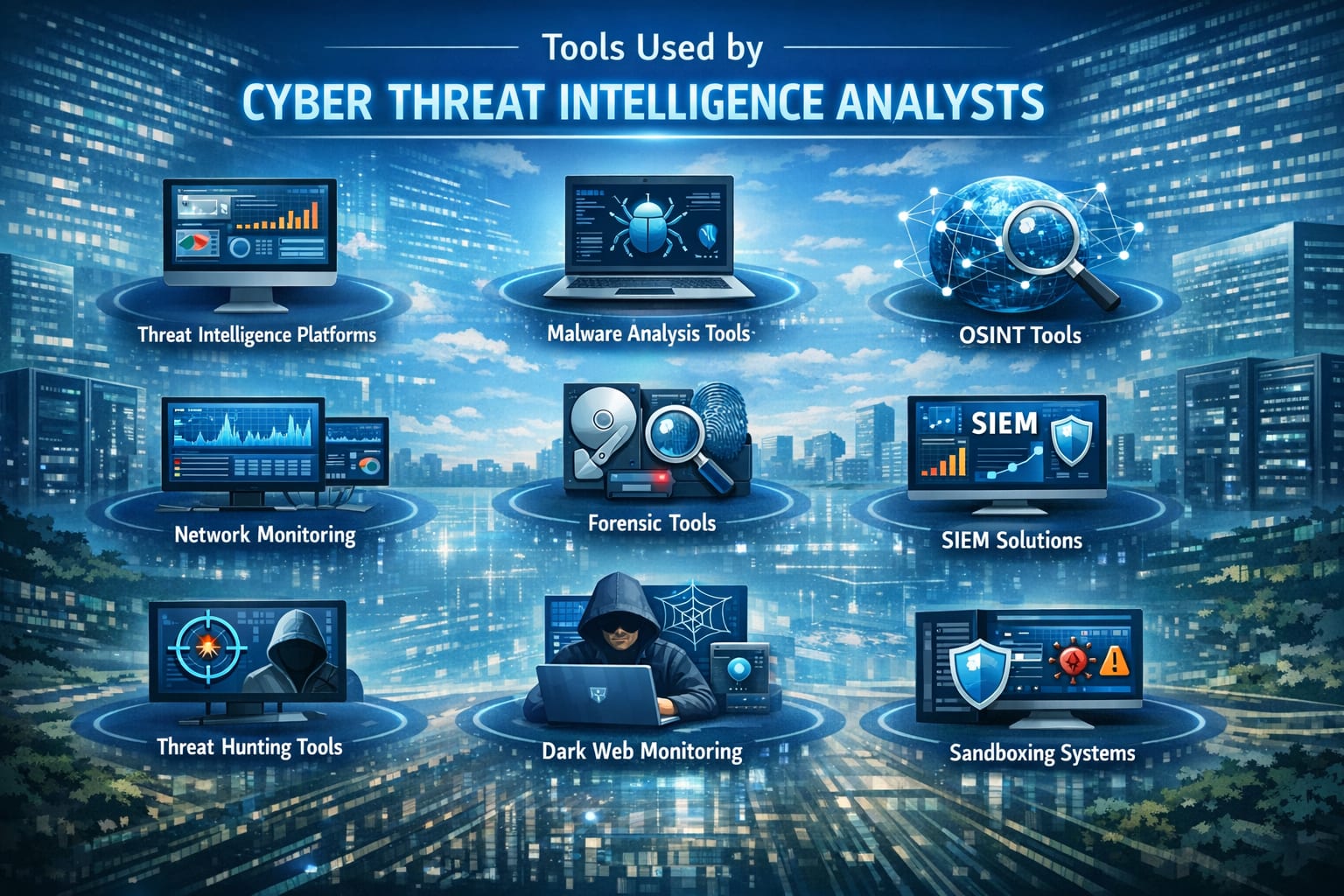
You don’t rely on one tool. You use many platforms to collect and analyze threat data.
Common tools include:
- SIEM platforms
- Threat intelligence platforms
- Virus scanning tools
- Packet analyzers
- OSINT tools
- Sandbox environments
- Log analysis tools
- Vulnerability scanners
Examples of work you may do:
- Review SIEM alerts
- Analyze malware reports
- Check threat feeds
- Monitor dark web activity
- Study attack patterns
- Write intelligence summaries
Your job is to understand threats, not just detect them.
Cyber threat intelligence analyst salary
Salary depends on experience, location, and company size, but this role is usually well paid.
| Level | Average salary |
|---|---|
| Entry level | 60k – 80k USD |
| Mid level | 80k – 110k |
| Senior | 110k – 150k+ |
| Government / intel | varies |
Threat intelligence roles often pay more than basic SOC roles because they require deeper knowledge.
How to become a cyber threat intelligence analyst
Most people do not start directly in threat intelligence. You usually gain experience in other cybersecurity roles first.
Common path:
- Learn networking and operating systems
- Study cybersecurity basics
- Work in a SOC or security analyst role
- Learn threat intelligence tools
- Study MITRE ATT&CK and malware behavior
- Move into a threat intelligence role
Helpful certifications:
- Security+
- CySA+
- CEH
- GCTI
- CISSP
- GIAC certifications
Experience matters more than certificates, but certifications help.
Pros and cons of becoming a cyber threat intelligence analyst
Pros
- High demand for cybersecurity
- Good salary potential
- Strategic and interesting work
- Less shift work than SOC
- Remote-friendly role
- Works with many teams
Cons
- Hard to enter without experience
- Requires strong knowledge
- Lots of reading and research
- Heavy report writing
- Needs constant learning
- Not very hands-on hacking
This role is best for people who enjoy analysis, research, and understanding how attacks work.
Final thoughts
When you become a cyber threat intelligence analyst, you move from reacting to attacks to predicting them. You study hackers, track vulnerabilities, analyze reports, and help your organization prepare before damage happens. Your work guides SOC teams, engineers, and managers, which makes this one of the most strategic roles in cybersecurity.
If you enjoy research, problem-solving, and understanding how threats evolve, this career can be more rewarding than roles that only focus on alerts. It takes time to build the knowledge, but once you do, you become the person everyone depends on to understand what threats are coming next.
Frequently Asked Questions
What does a threat intelligence analyst do in cybersecurity?
You collect and analyze information about cyber threats, attacker activity, and vulnerabilities to help organizations prevent attacks before they happen.
Is cyber threat intelligence a good career?
Yes, it is a high-demand cybersecurity role with strong salary potential and opportunities in many industries.
Do you need coding for threat intelligence?
Coding is not always required, but basic scripting, like Python, helps automate analysis and improves your efficiency.
Is threat intelligence the same as a SOC analyst?
No. A SOC analyst monitors alerts and responds to incidents, while a threat intelligence analyst researches threats and helps prevent attacks.
How do you become a cyber threat intelligence analyst?
Most people start in SOC, networking, or security analysis, then move into threat intelligence after gaining experience with security tools, logs, and attack methods.