The best cybersecurity projects are hands-on labs that prove you can detect threats, analyze logs, secure systems, investigate alerts, automate tasks, and explain your findings. Strong projects include SOC labs, SIEM detections, cloud security monitoring, malware analysis, Python automation, and home lab builds.
Cybersecurity projects help you move from “I’m learning cybersecurity” to “Here’s proof I can do the work.”
That matters because hiring managers don’t just want to see courses, certificates, or buzzwords on your resume. They want evidence. They want to know you can open a log file, spot suspicious behavior, write a detection rule, explain an attack path, secure a misconfigured system, or document an investigation like a real analyst.
If you’re a student, beginner, SOC analyst, IT professional, or job seeker, the right cybersecurity projects can become your strongest career asset.
They help you build technical confidence, create portfolio proof, and speak better in interviews. They also help you figure out which cybersecurity path fits you: SOC, cloud security, web application security, network security, malware analysis, threat detection, or automation.
The cybersecurity job market rewards practical skill. The U.S. Bureau of Labor Statistics projects that employment of information security analysts will grow 29 percent from 2024 to 2034, much faster than the average for all occupations. That demand helps, but entry-level roles still feel competitive because employers want candidates who can show hands-on ability, not just interest.
This guide gives you practical cybersecurity projects for beginners, intermediate learners, and advanced professionals. You’ll get project names, difficulty levels, tools, skills learned, and career value. You’ll also learn how to choose the right project and show your work on your resume, GitHub, and LinkedIn.
Why Cybersecurity Projects Matter More Than Passive Learning
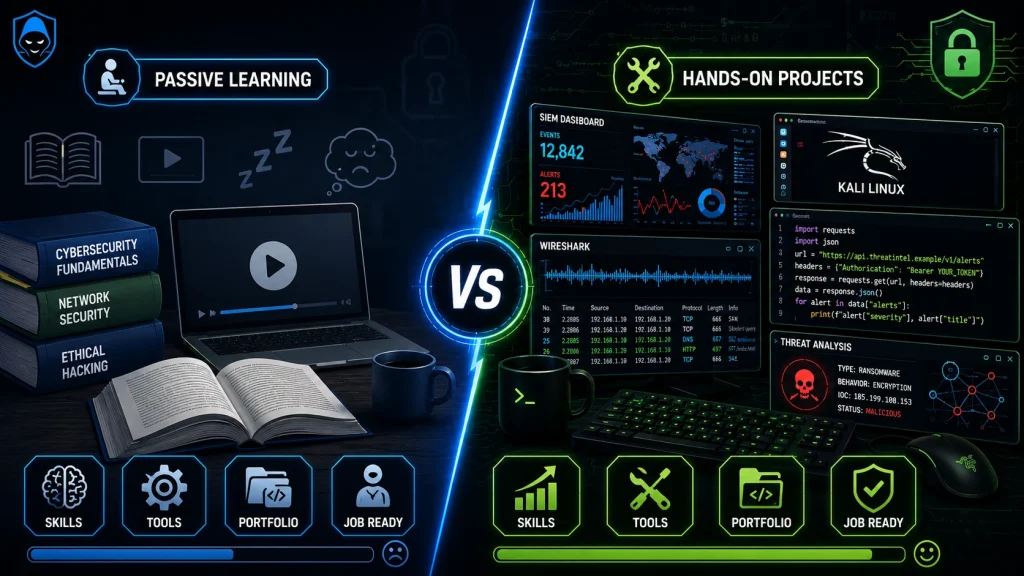
Cybersecurity is not a spectator skill. You can watch hours of videos about attacks, tools, frameworks, and incident response. Still, you won’t build real confidence until you touch systems, break things safely, investigate evidence, and write down what happened.
That’s where cybersecurity projects make the difference.
A good project forces you to connect theory with practice. For example, you might understand what brute-force attacks are, but building a detection rule for failed login attempts teaches you how those attacks appear in logs.
You might know that phishing is common, but analyzing email headers teaches you how attackers spoof senders, abuse domains, and hide malicious links. You might know cloud misconfigurations are risky, but building a cloud monitoring project teaches you how public storage, weak IAM permissions, and missing alerts expose real environments.
Projects also help you create proof. Anyone can list “Wireshark, Splunk, Python, Linux, AWS, vulnerability management” under skills. Fewer candidates can link to a GitHub repository that includes screenshots, sample logs, detection logic, scripts, diagrams, findings, and a clean write-up.
This is the difference between claiming and demonstrating.
Cybersecurity projects also map well to workforce expectations. The NICE Framework from NIST gives organizations a shared language for cybersecurity work, including the knowledge and skills needed for different roles.
When your project shows investigation, monitoring, scripting, documentation, and risk analysis, you’re showing skills that align with real cybersecurity work, not random lab activity.
You don’t need expensive tools to start. Many strong cybersecurity portfolio projects use free tools, open-source platforms, trial environments, intentionally vulnerable machines, sample logs, and home lab setups. What matters most is your process:
You define a problem.
You build or simulate an environment.
You collect evidence.
You analyze what happened.
You document your work.
You explain why it matters.
That final step is where many beginners fail. They build a lab, run a scan, or install a tool, then stop. A stronger project tells a story. It shows what you were trying to learn, what steps you took, what you found, what you fixed, and what you’d improve next.
For CyberLad.io readers, this is the mindset shift: don’t build cybersecurity projects just to say you built them. Build them to prove you can think and work like a cybersecurity professional.
Check out our latest post on GSOC Security: Global Security Operations Center
Beginner vs Intermediate vs Advanced Cybersecurity Projects
Before choosing from a long list of cybersecurity project ideas, you need to understand the skill levels. A beginner project should help you learn core concepts without drowning you in tool complexity.
An intermediate project should combine multiple skills, such as logging, detection, scripting, and reporting. An advanced project should look closer to real-world security operations, with attack simulation, detection engineering, cloud monitoring, malware behavior analysis, or incident response automation.
| Level | Best For | Typical Tools | Main Skills Built | Portfolio Value |
|---|---|---|---|---|
| Beginner | Students, career changers, IT beginners | Wireshark, VirtualBox, Linux, Nmap, TryHackMe, Windows Event Viewer | Networking, Linux basics, scanning, log reading, basic analysis | Shows initiative and foundation skills |
| Intermediate | SOC learners, junior analysts, IT professionals | Splunk, Wazuh, Security Onion, Zeek, Suricata, Python, Burp Suite | Detection, investigation, scripting, SIEM queries, reporting | Shows job-ready analyst ability |
| Advanced | Experienced learners, aspiring detection engineers, and loud security learners | AWS, Azure, Sigma, YARA, Velociraptor, Atomic Red Team, malware sandboxes | Threat detection, cloud defense, malware analysis, automation, and attack mapping | Shows specialized security capability |
A beginner project might answer: “Can you use basic tools and explain what you found?”
An intermediate project might answer: “Can you investigate an alert, write a detection, and document evidence?”
An advanced project might answer: “Can you simulate realistic attacker behavior, build detections, automate response, and map activity to MITRE ATT&CK?”
MITRE ATT&CK is valuable for advanced security projects because it organizes adversary tactics and techniques based on real-world observations.
Its Enterprise Matrix covers platforms such as Windows, Linux, macOS, SaaS, IaaS, identity providers, network devices, and more, which makes it useful for detection engineering and threat hunting projects.
The right level depends on your goal. If you’re applying for your first SOC role, don’t start with an advanced malware reverse engineering project that you can’t explain. A clean SIEM investigation project with screenshots, log samples, queries, findings, and lessons learned may help you more.
Read More on How to Get Into Cyber Security With No Experience
Cybersecurity Projects for Beginners
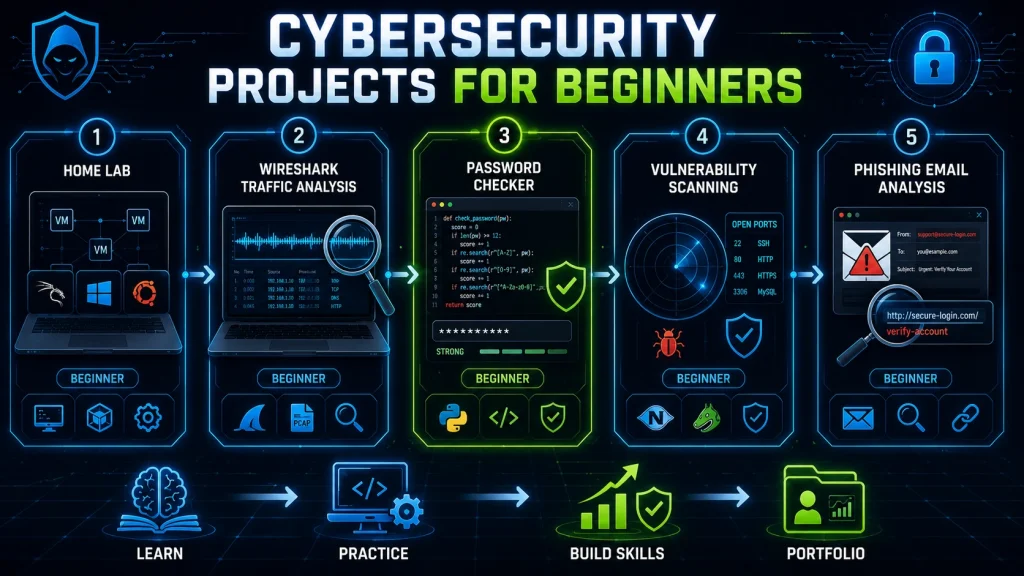
Beginner cybersecurity projects should teach you how systems communicate, how logs capture activity, how vulnerabilities appear, and how basic attacks look in a safe lab. These projects are ideal for students, cybersecurity learners, and job seekers building their first portfolio.
1. Build a Cybersecurity Home Lab
Difficulty level: Beginner
Tools needed: VirtualBox or VMware Workstation Player, Kali Linux, Ubuntu, Windows Evaluation VM, pfSense optional
Skills learned: Virtualization, networking basics, Linux commands, system setup, and safe lab isolation.
Why it helps your cybersecurity career: A home lab becomes the foundation for future cybersecurity projects, SOC analyst projects, malware analysis labs, and SIEM testing.
A cybersecurity home lab is one of the best cybersecurity projects for beginners because it gives you a safe place to practice. You can create virtual machines, test tools, capture network traffic, run scans, analyze logs, and simulate attacks without touching real production systems.
Start simple. Create one attacker machine, one Linux target, and one Windows target. Put them on an isolated virtual network. Document your architecture with a basic diagram. Write down IP addresses, operating systems, credentials used for lab-only accounts, and the purpose of each machine.
Your GitHub write-up should include:
- Lab diagram
- Tools installed
- Network setup
- Screenshots
- Problems you solved
- What do you plan to add next
This project helps your career because it shows you can create a controlled technical environment. That skill matters in cybersecurity because analysts and engineers often need to reproduce issues, test detections, validate patches, and investigate suspicious behavior safely.
2. Analyze Network Traffic with Wireshark
Difficulty level: Beginner
Tools needed: Wireshark, sample PCAP files, TryHackMe or Malware-Traffic-Analysis.net samples
Skills learned: Packet analysis, TCP/IP basics, DNS, HTTP, TLS, and suspicious traffic patterns.
Why it helps your cybersecurity career: Network visibility is core to SOC analysis, incident response, threat hunting, and network security.
Wireshark helps you see what’s happening on the network. For this project, download safe sample packet capture files and analyze them. Focus on questions like:
- What IP addresses are communicating?
- What protocols appear?
- Are there strange DNS requests?
- Is any host connecting to suspicious domains?
- Can you identify file downloads or login attempts?
Your goal isn’t to become a packet wizard overnight. Your goal is to learn how to investigate traffic and explain what you found. A strong beginner write-up might include screenshots of DNS queries, HTTP requests, TCP streams, and a short timeline of activity.
This project supports SOC analyst projects and network security projects because analysts often need to understand whether an alert represents normal traffic or suspicious behavior.
3. Create a Password Strength Checker
Difficulty level: Beginner
Tools needed: Python, regex, optional Have I Been Pwned API for safe breached-password check.s
Skills learned: Python basics, input validation, password policy logic, security awareness.
Why it helps your cybersecurity career: It shows you can write simple security-focused code and explain password risk.
This is a good Python cybersecurity automation project for beginners. Build a script that checks password length, complexity, common patterns, repeated characters, dictionary words, and known weak passwords. Don’t store user passwords. Don’t log sensitive input. Keep the project ethical and privacy-safe.
Add clear output, such as:
- Weak: too short
- Medium: missing special characters
- Strong: meets length and complexity requirements
- Warning: contains common password pattern
This project helps you learn secure coding basics. It also gives you a simple GitHub repository with readable code, a README, examples, and improvement ideas.
4. Perform Basic Vulnerability Scanning
Difficulty level: Beginner
Tools needed: Nmap, OpenVAS or Greenbone Community Edition, an intentionally vulnerable VM such as Metasploitable
Skills learned: Port scanning, service discovery, vulnerability identification, and basic reporting.
Why it helps your cybersecurity career: Vulnerability management is a common entry point into cybersecurity and helps you understand risk.
Set up a vulnerable virtual machine in your lab and scan it. Use Nmap to identify open ports and services. Then use a vulnerability scanner to find known issues. Your job is not to exploit everything. Your job is to document what exists, what’s risky, and how to fix it.
Your report should include:
- Target scope
- Scan method
- Open ports
- High-level findings
- Remediation recommendations
- Limitations
This project teaches you how to think like a defender. You learn that vulnerability scanning is not just button-clicking. It requires scoping, validation, prioritization, and communication.
5. Build a Phishing Email Analysis Lab
Difficulty level: Beginner
Tools needed: Email header analyzer, VirusTotal, URLScan.io, CyberChef, sample phishing emails
Skills learned: Email headers, sender spoofing, link analysis, indicators of compromise, reporting
Why it helps your cybersecurity career: Phishing investigation is a common SOC task, especially for entry-level analysts.
Use safe sample phishing emails. Analyze headers, sender domains, reply-to addresses, URLs, attachments, and message intent. Extract indicators of compromise, also called IOCs, such as domains, IP addresses, hashes, and suspicious URLs.
Your final deliverable should look like a SOC ticket:
- Summary
- Email sender
- Subject
- Indicators found
- Verdict
- Recommended action
- User guidance
This project is practical because phishing analysis appears often in SOC work. It also helps you build communication skills, which matter as much as tool knowledge.
Intermediate Cybersecurity Projects
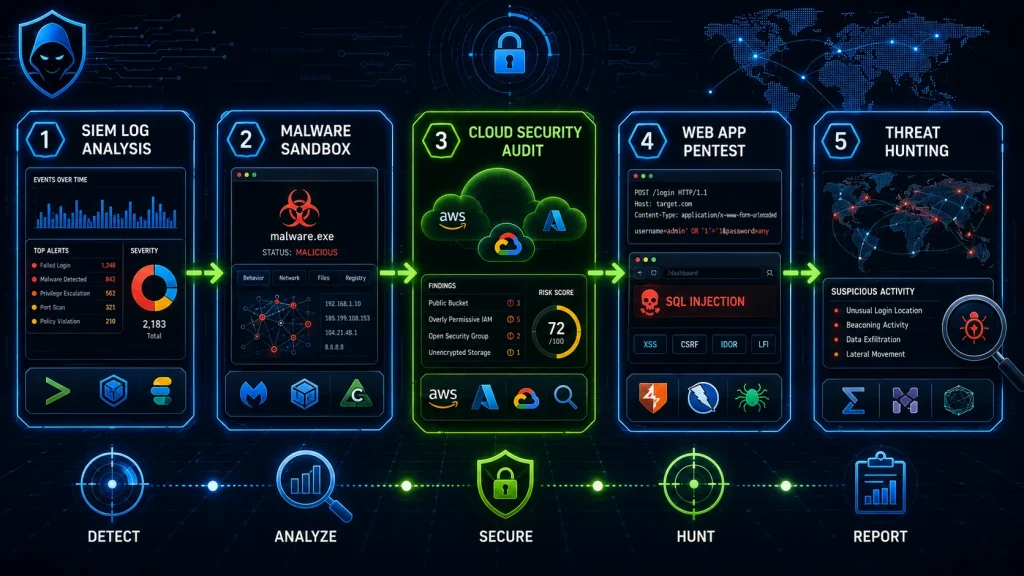
Intermediate cybersecurity projects should combine tools, analysis, and documentation. At this stage, you’re not just learning commands. You’re building workflows that look closer to real job tasks.
6. Build a SOC Analyst Investigation Lab
Difficulty level: Intermediate
Tools needed: Wazuh or Splunk Free, Windows VM, Sysmon, Ubuntu, and Atomic Red Team, optional
Skills learned: Endpoint logging, alert triage, event correlation, and investigation workflow.w
Why it helps your cybersecurity career: This is one of the strongest SOC analyst projects for your resume because it mirrors alert investigation.
Set up a Windows endpoint with Sysmon, forward logs to Wazuh or Splunk, then generate suspicious activity in a controlled lab. For example, create failed login events, PowerShell execution events, new process creation events, or suspicious file writes.
Your task is to investigate what happened. Build a timeline. Identify the host, user, process, parent process, command line, and event IDs. Then write a final analyst report.
This project helps you learn the heart of SOC work: collect, triage, investigate, escalate, and document.
A strong portfolio version should include:
- Lab architecture
- Log source configuration
- Example alerts
- Investigation screenshots
- Timeline
- Analyst conclusion
- Lessons learned
7. Create SIEM Detection Rules
Difficulty level: Intermediate
Tools needed: Splunk, Wazuh, Elastic Stack, Sigma rules, sample logs
Skills learned: SIEM searching, detection logic, alert tuning, false positive reduction
Why it helps your cybersecurity career: SIEM and log analysis skills are highly relevant for SOC, threat detection, and detection engineering roles.
For this project, choose a behavior to detect. Examples include:
- Multiple failed logins
- Suspicious PowerShell command
- New local admin user
- Unusual outbound DNS activity
- Possible brute-force attempt
Write a SIEM query to detect it. Then test the rule using sample logs or lab-generated events. Tune it to reduce noise. Document what the rule detects, what it misses, and how an analyst should respond.
To make the project stronger, map your detection to MITRE ATT&CK tactics and techniques where appropriate. MITRE describes techniques as how an adversary achieves a tactical goal, which makes it useful when explaining why a detection matters.
This project is better than a generic “I used Splunk” claim because it shows detection thinking.
8. Build a Python Log Analyzer
Difficulty level: Intermediate
Tools needed: Python, sample Apache logs, Windows event logs, Linux auth logs
Skills learned: File parsing, regex, anomaly detection basics, reporting, automation.on
Why it helps your cybersecurity career: Python automation helps analysts save time and handle repetitive security tasks.
Create a Python script that reads log files and identifies suspicious patterns. Start with simple use cases:
- Too many failed SSH logins from one IP
- Suspicious HTTP status codes
- Repeated requests to admin paths
- Login attempts outside business hours
- Rare user agents
Your script should produce a clean summary, such as:
- Top source IPs
- Failed login counts
- Suspicious paths requested
- Events requiring review
This project works well as a cybersecurity project for resume use because it proves you can automate analysis instead of manually reading every line.
Add a README that explains the problem, sample input, output, and future improvements.
9. Harden a Linux Server
Difficulty level: Intermediate
Tools needed: Ubuntu Server, SSH, UFW, Lynis, auditd, fail2ban
Skills learned: System hardening, access control, firewall rules, auditing, secure configuration
Why it helps your cybersecurity career: Hardening skills matter for blue team, system administration, cloud security, and DevSecOps roles.
Build a Linux server and secure it. Disable root SSH login, enforce key-based authentication, configure firewall rules, install fail2ban, enable automatic updates, review open services, and run a hardening audit with Lynis.
Your final write-up should include before-and-after findings. Show the initial risk, the control you applied, and the result. Don’t just say “I hardened Linux.” Prove it with commands, screenshots, config snippets, and explanations.
This project is useful for IT professionals moving into cybersecurity because it builds on system administration experience and turns it into a security value.
10. Build a Web Application Security Testing Lab
Difficulty level: Intermediate
Tools needed: OWASP Juice Shop, Burp Suite Community, Docker, browser developer tools
Skills learned: Web vulnerabilities, proxying traffic, authentication testing, input validation, and reporting.
Why it helps your cybersecurity career: Web application security projects help you understand how attackers find and exploit weaknesses in apps.
Run OWASP Juice Shop locally and test it with Burp Suite. Focus on legal, lab-only testing. Learn how requests and responses work. Look for common issues such as broken access control, injection flaws, weak authentication, and exposed data.
Your portfolio should not look like a brag sheet of exploited bugs. It should look like a professional security assessment:
- Scope
- Methodology
- Findings
- Evidence
- Risk rating
- Remediation advice
This project helps if you’re interested in application security, penetration testing, secure coding, or bug bounty learning.
Advanced Cybersecurity Projects
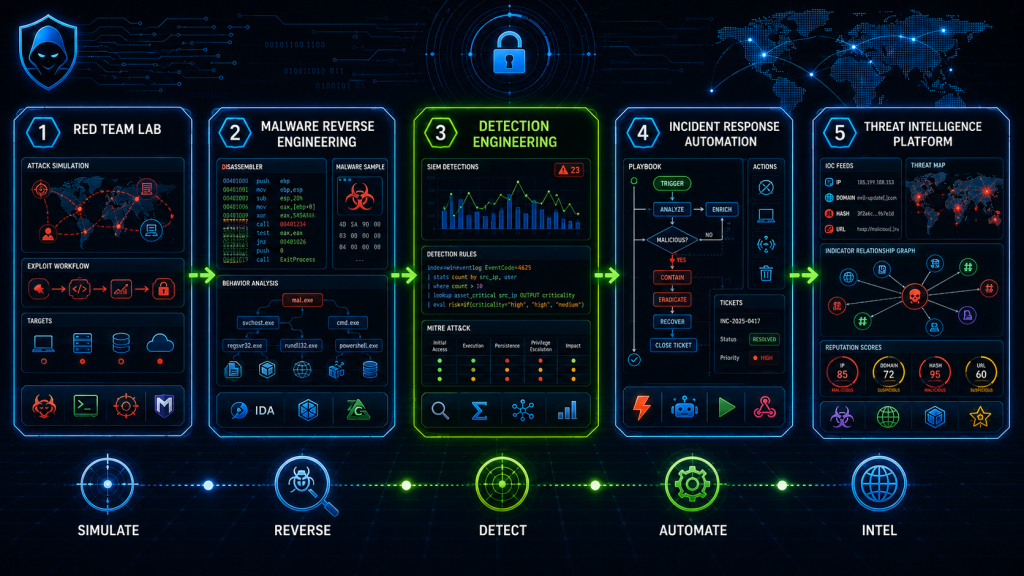
Advanced cybersecurity projects should show greater skill. These projects are best for learners who already understand basic networking, Linux, logging, and security tools.
11. Malware Analysis Sandbox
Difficulty level: Advanced
Tools needed: FLARE VM, REMnux, Windows VM, INetSim, Wireshark, Procmon, safe malware samples from controlled training sources
Skills learned: Static analysis, dynamic analysis, behavior monitoring, IOC extraction, malware reporting.
Why it helps your cybersecurity career: Malware analysis projects show you can investigate suspicious files and turn technical behavior into useful intelligence.
Build an isolated malware analysis lab. Use host-only networking. Never analyze malware on your main machine. Never connect unknown malware to the open internet.
Start with safe training samples or educational malware labs. Analyze file properties, strings, imports, process behavior, registry changes, file changes, and network connections. Extract IOCs and write a malware analysis report.
A strong report includes:
- File hash
- File type
- Execution behavior
- Network indicators
- Persistence attempts
- Detection opportunities
- Recommended containment steps
This project helps you stand out because malware analysis requires discipline, safety, patience, and clear documentation.
12. Threat Detection Engineering Lab
Difficulty level: Advanced
Tools needed: Elastic, Splunk, Wazuh, Sigma, Sysmon, Atomic Red Team, MITRE ATT&CK
Skills learned: Detection engineering, adversary emulation, rule writing, alert validation, ATT&CK mapping.
Why it helps your cybersecurity career: Detection engineering is valuable for SOC maturity, threat hunting, and blue team roles.
Pick a specific attacker behavior, such as credential dumping simulation, suspicious PowerShell usage, scheduled task creation, or registry run key persistence. Generate test telemetry in a lab. Write a detection rule. Validate the alert. Tune it. Document false positives.
The project should answer:
- What behavior are you detecting?
- What logs are required?
- What query or rule did you write?
- How did you test it?
- What false positives could happen?
- How should an analyst respond?
This is one of the best cybersecurity portfolio projects for learners who want to move beyond basic SOC work.
13. Cloud Security Monitoring Project
Difficulty level: Advanced
Tools needed: AWS Free Tier or Azure, CloudTrail or Azure Activity Logs, IAM, GuardDuty or Microsoft Defender for Cloud, Terraform optional
Skills learned: Cloud logging, IAM review, alerting, misconfiguration detection, cloud incident response basics
Why it helps your cybersecurity career: Cloud security skills are in demand because many organizations run workloads in AWS, Azure, and Google Cloud.
Build a small cloud environment with a storage bucket, IAM users, logging, and monitoring. Then create safe misconfiguration scenarios, such as overly permissive access or missing logging. Your job is to detect and fix the issue.
Document:
- Cloud architecture
- Logging setup
- Misconfiguration
- Detection method
- Remediation
- Lessons learned
This project helps you show cloud security awareness without claiming to be a cloud architect. It also proves you understand that cloud security is not only about tools. It’s about identity, visibility, least privilege, and response.
14. Active Directory Attack and Defense Lab
Difficulty level: Advanced
Tools needed: Windows Server Evaluation, Windows client VM, Splunk or Wazuh, Sysmon, BloodHound Community Edition, safe lab scripts
Skills learned: Active Directory basics, identity security, attack paths, Windows logging, defensive monitoring.g
Why it helps your cybersecurity career: Many enterprise environments depend on Active Directory, so AD defense skills are valuable for SOC, incident response, and security engineering.
Build a small domain in your lab. Create users, groups, and basic policies. Thesafely study common misconfigurations. Use BloodHound to understand relationships and possible attack paths.
Focus on defense. Your project should show how to identify risky permissions, monitor suspicious authentication, detect privilege changes, and improve configurations.
A strong portfolio write-up might include:
- Domain diagram
- User and group structure
- Risky configuration found
- Detection logic
- Remediation steps
- Security lessons
15. Incident Response Automation Project
Difficulty level: Advanced
Tools needed: Python, Shuffle SOAR or Tines Community Edition, Wazuh or Splunk, VirusTotal API, Slack or email integration
Skills learned: SOAR concepts, API usage, enrichment, alert workflow, response automation.
Why it helps your cybersecurity career: Automation projects show you can reduce analyst workload and improve response speed.
Build a workflow that takes an alert, extracts an IP address or file hash, enriches it with threat intelligence, assigns a severity score, and sends a notification. Keep the workflow safe. Don’t automate destructive actions. Start with enrichment and reporting.
Your write-up should include:
- Workflow diagram
- Alert input
- Enrichment steps
- Output example
- Safety controls
- Future improvements
This project is excellent for SOC analysts who want to grow toward detection engineering, security automation, or incident response engineering.
Cybersecurity Project Ideas by Career Path
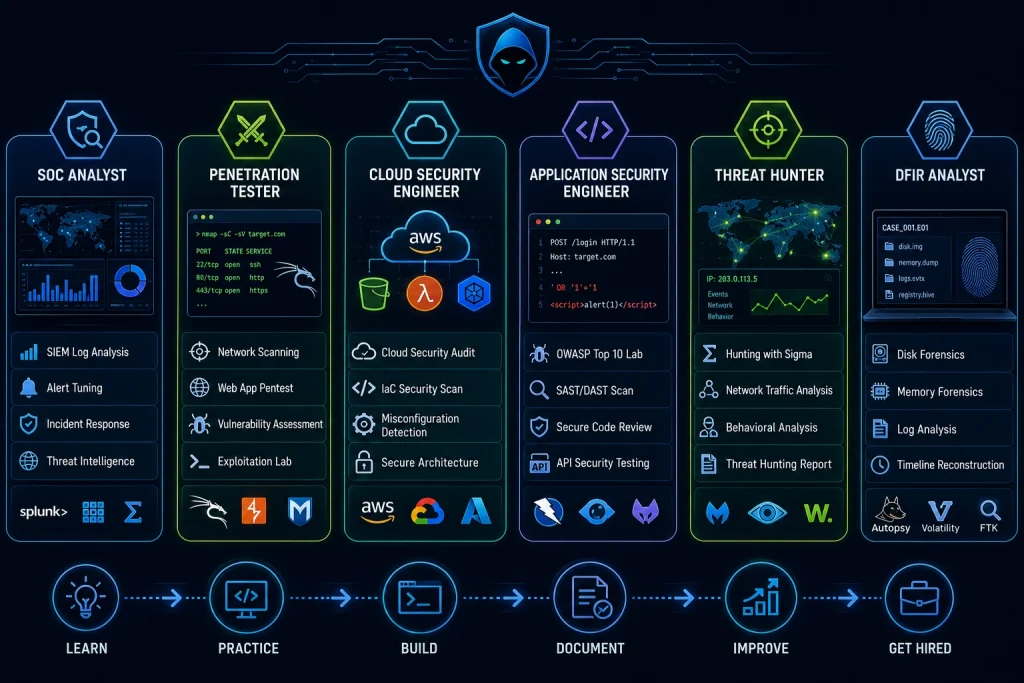
The best cybersecurity projects depend on the role you want. A future SOC analyst should not build the same portfolio as someone aiming for cloud security or web application security.
SOC Analyst Projects
SOC analyst projects should show alert triage, investigation, log analysis, and reporting.
Project name: SOC Alert Triage Lab
Difficulty level: Intermediate
Tools needed: Wazuh or Splunk, Sysmon, Windows VM, sample alerts
Skills learned: Alert investigation, event correlation, timeline building, escalation writing
Career value: Shows you can handle real SOC-style work and explain evidence.
Project name: Phishing Investigation Case File
Difficulty level: Beginner to intermediate
Tools needed: Email header tools, URLScan.io, VirusTotal, CyberChef
Skills learned: Email analysis, IOC extraction, user impact assessment
Career value: Gives you a practical project that maps closely to entry-level SOC tasks.
Project name: Brute-Force Detection Rule
Difficulty level: Intermediate
Tools needed: SIEM, Windows or Linux logs, Sigma optional
Skills learned: Detection logic, failed login analysis, alert tuning
Career value: Shows you can build and test detections, not just respond to alerts.
Network Security Projects
Network security projects should show traffic visibility, segmentation, firewall logic, and threat detection.
Project name: Network Traffic Baseline
Difficulty level: Beginner
Tools needed: Wireshark, Zeek, Security Onion optional
Skills learned: Protocol analysis, DNS review, baseline creation
Career value: Helps you explain normal versus suspicious traffic.
Project name: pfSense Firewall Lab
Difficulty level: Intermediate
Tools needed: pfSense, VirtualBox, Linux, and Windows VMs
Skills learned: Firewall rules, NAT, segmentation, logging
Career value: Shows practical understanding of network defense.
Project name: IDS Alert Analysis
Difficulty level: Intermediate
Tools needed: Suricata or Snort, sample PCAPs, Security Onion
Skills learned: IDS alerts, packet evidence, rule interpretation
Career value: Helps with SOC, network security, and threat detection roles.
Cloud Security Projects
Cloud security projects should show IAM, logging, monitoring, and secure configuration.
Project name: AWS CloudTrail Monitoring Lab
Difficulty level: Intermediate to advanced
Tools needed: AWS Free Tier, CloudTrail, IAM, GuardDuty
Skills learned: Cloud activity logging, identity monitoring, alert review
Career value: Shows you understand cloud visibility and security monitoring.
Project name: Public Bucket Risk Assessment
Difficulty level: Beginner to intermediate
Tools needed: AWS S3 or equivalent lab setup, IAM, cloud policy simulator
Skills learned: Storage permissions, least privilege, remediation
Career value: Shows you can identify and fix common cloud misconfigurations.
Project name: Terraform Security Review
Difficulty level: Advanced
Tools needed: Terraform, Checkov, tfsec
Skills learned: Infrastructure as code scanning, policy review, and DevSecOps basics.s
Career value: Useful for cloud security and security engineering roles.
Web Application Security Projects
Web application security projects should show ethical testing, vulnerability reporting, and remediation thinking.
Project name: OWASP Juice Shop Assessment
Difficulty level: Intermediate
Tools needed: Juice Shop, Burp Suite, Docker
Skills learned: Web testing, request analysis, vulnerability documentation
Career value: Shows AppSec awareness and structured reporting.
Project name: Secure Login Review
Difficulty level: Intermediate
Tools needed: Simple test app, Burp Suite, browser tools
Skills learned: Authentication testing, session review, password policy checks
Career value: Shows you understand common app security weaknesses.
Project name: API Security Testing Lab
Difficulty level: Advanced
Tools needed: Postman, Burp Suite, intentionally vulnerable API
Skills learned: API auth, broken object-level authorization, rate limits
Career value: Strong project for AppSec, API security, and pentest learning.
Threat Detection Projects
Threat detection projects should show behavior-based thinking.
Project name: Suspicious PowerShell Detection
Difficulty level: Intermediate
Tools needed: Sysmon, Splunk or Elastic, Sigma
Skills learned: Windows logging, command-line analysis, detection writing
Career value: Shows you can detect common attacker behavior.
Project name: MITRE ATT&CK Detection Map
Difficulty level: Advanced
Tools needed: ATT&CK Navigator, SIEM rules, lab telemetry
Skills learned: Detection coverage mapping, gap analysis
Career value: Shows strategic thinking beyond single alerts.
Project name: DNS Tunneling Hunt
Difficulty level: Advanced
Tools needed: Zeek, Security Onion, DNS logs
Skills learned: Threat hunting, anomaly analysis, DNS behavior review
Career value: Strong for detection engineering and threat hunting portfolios.
Malware Analysis Projects
Malware analysis projects should focus on safe handling, behavior, and reporting.
Project name: Static Malware Triage
Difficulty level: Intermediate
Tools needed: REMnux, strings, PEStudio, Detect It Easy
Skills learned: File metadata, strings, imports, suspicious indicators
Career value: Shows malware triage ability without unsafe execution.
Project name: Dynamic Behavior Report
Difficulty level: Advanced
Tools needed: FLARE VM, Procmon, Wireshark, INetSim
Skills learned: Process behavior, network calls, persistence signs
Career value: Shows deeper investigative ability.
Project name: YARA Rule Writing
Difficulty level: Advanced
Tools needed: YARA, malware samples from safe training sources
Skills learned: Pattern matching, rule testing, malware family tracking
Career value: Strong for malware analysis, threat intel, and detection roles.
SIEM and Log Analysis Projects
SIEM and log analysis projects are some of the best cybersecurity projects for resume impact.
Project name: Windows Event Log Investigation
Difficulty level: Beginner to intermediate
Tools needed: Windows Event Viewer, Sysmon, Splunk, and Wazuh
Skills learned: Event IDs, login events, process creation, timeline analysis
Career value: Directly supports SOC analyst work.
Project name: Apache Log Attack Review
Difficulty level: Intermediate
Tools needed: Apache logs, Python, Splunk, or Elastic
Skills learned: Web log analysis, suspicious IPs, scanning patterns
Career value: Useful for SOC and web security roles.
Project name: SIEM Dashboard for Security Events
Difficulty level: Intermediate
Tools needed: Splunk, Elastic, Wazuh
Skills learned: Dashboards, metrics, failed logins, and alert visualization
Career value: Shows you can make security data useful for teams.
Python Cybersecurity Automation Projects
Python cybersecurity automation projects help you show scripting ability.
Project name: IOC Extractor
Difficulty level: Beginner to intermediate
Tools needed: Python, regex, sample threat reports
Skills learned: Extracting IPs, domains, hashes, URLs
Career value: Useful for SOC, threat intel, and incident response.
Project name: Log Parser and Alert Summarizer
Difficulty level: Intermediate
Tools needed: Python, CSV, or JSON logs
Skills learned: Parsing, counting, filtering, reporting
Career value: Shows you can automate repetitive analyst tasks.
Project name: Threat Intel Enrichment Script
Difficulty level: Advanced
Tools needed: Python, APIs, VirusTota,l or AbuseIPDB
Skills learned: API calls, enrichment, scoring, JSON handling
Career value: Strong for SOC automation and security engineering.
Cybersecurity Home Lab Projects
Home lab projects let you combine everything.
Project name: Mini Enterprise Security Lab
Difficulty level: Intermediate to advanced
Tools needed: Windows Server, Windows client, Ubuntu, Wazuh, or Splunk
Skills learned: Identity, endpoint logging, SIEM ingestion, investigation
Career value: Shows broad blue team ability.
Project name: Security Onion Network Monitoring Lab
Difficulty level: Intermediate
Tools needed: Security Onion, Zeek, Suricata, sample PCAPs
Skills learned: IDS alerts, network visibility, threat hunting
Career value: Strong for SOC and network security portfolios.
Project name: Home Lab Incident Response Scenario
Difficulty level: Advanced
Tools needed: SIEM, Sysmon, Velociraptor optional, sample attack simulation
Skills learned: Triage, containment planning, evidence collection, and reporting
Career value: Shows mature incident response thinking.
How to Choose the Right Cybersecurity Project
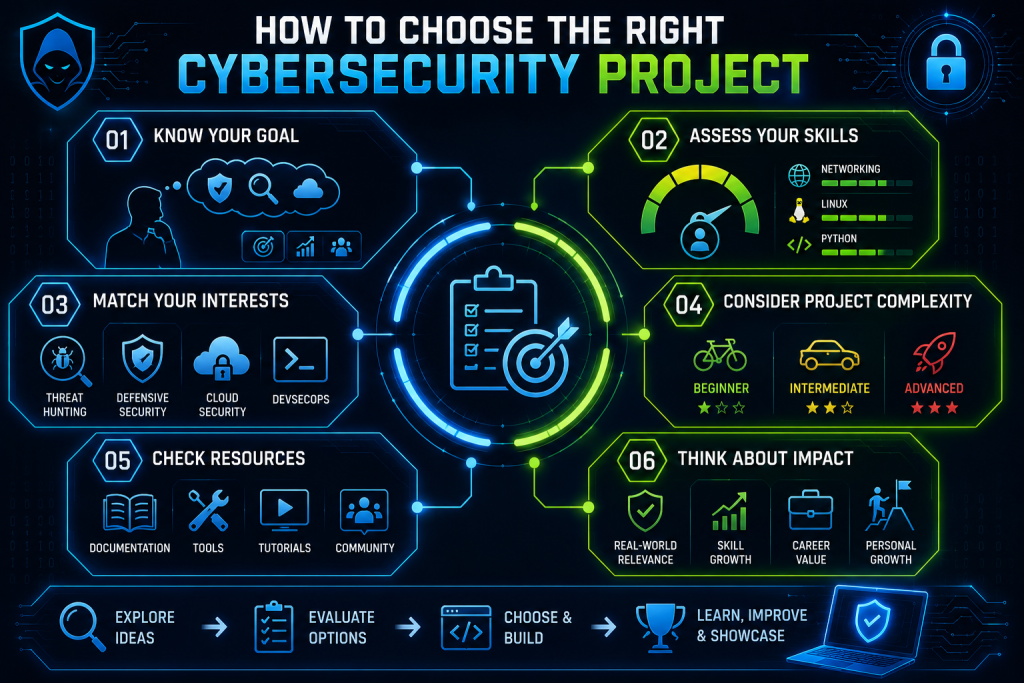
Don’t choose a cybersecurity project just because it sounds impressive. Choose one that matches your target role, current skill level, available time, and ability to explain the work.
Start with your career goal.
If you want a SOC analyst job, prioritize SIEM, log analysis, phishing analysis, alert triage, Windows events, and basic threat detection. A hiring manager for a SOC role will care more about your ability to investigate alerts than your ability to build a complex cloud architecture.
If you want cloud security, build projects around IAM, logging, monitoring, storage permissions, infrastructure as code scanning, and incident response in AWS or Azure.
If you want web application security, use OWASP Juice Shop, Burp Suite, API labs, secure coding reviews, and professional-style vulnerability reports.
If you want malware analysis, focus on safe lab setup, static analysis, dynamic behavior, YARA rules, and IOC extraction.
Next, choose a project you can finish. A completed beginner project beats an abandoned advanced project. Your first project doesn’t need to impress every expert. It needs to prove that you can learn, build, test, document, and communicate.
Use this decision filter:
- Can you explain the project in two minutes?
- Can you show screenshots or code?
- Can you describe what problem it solves?
- Can you list the tools used and why you used them?
- Can you explain what you’d improve next?
- Does it connect to the role you want?
Your project should also create an artifact. That artifact might be a GitHub repository, PDF report, SIEM dashboard, detection rule, Python script, architecture diagram, or LinkedIn case study.
Avoid projects that are too vague. “I built a home lab” is weak. “I built a Windows and Ubuntu home lab, forwarded Sysmon logs to Wazuh, generated failed login events, and wrote an investigation report” is stronger.
Also avoid unsafe or unethical projects. Don’t scan public systems without permission. Don’t test real websites unless you’re authorized. Don’t run malware on your main computer. Don’t publish sensitive keys, tokens, logs, or personal data.
The best cybersecurity projects help you build skills and trust at the same time.
How to Show Cybersecurity Projects on Your Resume, GitHub, and LinkedIn
A project only helps your career if people can understand it. You need to present your cybersecurity portfolio projects in a clear, professional way.
On Your Resume
Add a “Cybersecurity Projects” section if you don’t have much job experience. Keep each project short, specific, and outcome-driven.
Weak example:
“Built a SIEM lab.”
Strong example:
“Built a Wazuh SOC lab with Windows Sysmon logs, created detections for failed logins and suspicious PowerShell activity, and documented investigation steps with screenshots and remediation notes.”
Use this format:
Project name | Tools | Result
Example:
SOC Alert Triage Lab | Wazuh, Sysmon, Windows Event Logs
Investigated simulated brute-force activity, correlated authentication events, built an incident timeline, and wrote an analyst-style report with recommended response actions.
For cybersecurity projects, for a resume impact, include tools, actions, and outcomes. Don’t overload your resume with every command you ran. Save the details for GitHub.
On GitHub
GitHub should hold your proof. GitHub is widely used to store, manage, and share code and technical project files, which makes it a practical place to organize cybersecurity portfolio work.
Each project repository should include:
- Clear README
- Project goal
- Lab diagram
- Tools used
- Setup steps
- Screenshots
- Detection rules or scripts
- Findings
- Lessons learned
- Safe sample data where possible
Use a README structure like this:
Project Name
Objective
Explain what the project does and why you built it.
Tools Used
List tools and their purpose.
Lab Setup
Show architecture and configuration.
Steps Taken
Explain your process.
Findings
Summarize what you discovered.
Skills Learned
Connect the project to job skills.
Screenshots
Add visual proof.
Future Improvements
Show a growth mindset.
Never upload secrets, passwords, API keys, private logs, malware, or copyrighted training material you don’t have permission to share.
On LinkedIn
LinkedIn helps you turn your project into a professional story. Don’t just post “I completed a cybersecurity project.” Explain what you built and what you learned.
Use this simple format:
“I built a SOC alert triage lab using Wazuh, Sysmon, and Windows Event Logs. The goal was to practice investigating failed login activity and suspicious process creation. I configured log collection, generated test events, wrote detection logic, and documented my findings in an analyst-style report. Key skills practiced: SIEM analysis, Windows event review, alert triage, and incident documentation.”
Then link to your GitHub repo or portfolio page.
This turns your work into visible credibility.
Pros and Cons of Building Cybersecurity Portfolio Projects
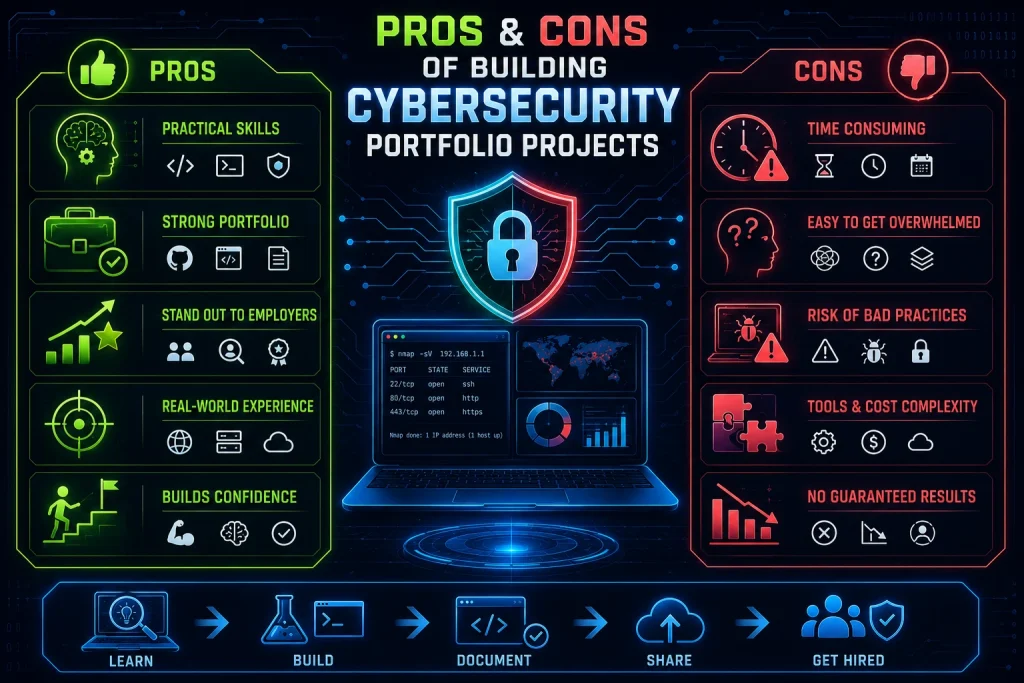
Cybersecurity projects can help your career, but you should understand both sides.
Pros
You build proof of skill. Projects show what you can do, not just what you studied.
You improve interview confidence. It’s easier to answer technical questions when you’ve built labs and investigated real examples.
You discover your preferred path. SOC, cloud, AppSec, malware, and automation feel different in practice.
You create a resume and LinkedIn content. Good projects give you specific achievements to share.
You learn by solving problems. Troubleshooting broken labs teaches patience and technical depth.
Cons
Projects take time. A strong write-up can take as much effort as the build itself.
Tool overload can distract you. Beginners sometimes chase too many tools instead of learning core concepts.
Poor documentation weakens the value. If you can’t explain the project, it won’t help much.
Unsafe testing can create risk. You must keep labs isolated and stay within legal boundaries.
Advanced projects can overwhelm beginners. Starting too hard can lead to frustration and abandoned work.
The solution is simple: start small, finish cleanly, document well, then level up.
Final Thoughts
The best cybersecurity projects don’t just teach tools. They teach you how to think.
You learn how to investigate, secure, detect, automate, explain, and improve. That’s what employers want to see. Not a random list of tools. Not a copied lab walkthrough. Not a half-finished repository with no context.
Start with one project that fits your target role. If you’re new, build a home lab, analyze network traffic, or complete a phishing investigation. If you’re aiming for SOC, build a SIEM lab and write detection rules. If you’re more advanced, create a malware analysis sandbox, cloud monitoring project, or threat detection engineering lab.
Your goal is not to look perfect. Your goal is to show progress, curiosity, discipline, and practical skill.
When you document your projects with clear screenshots, scripts, detections, findings, and lessons learned, you turn your learning into career evidence. That’s how cybersecurity projects become more than practice. They become your portfolio, your interview story, and your proof that you’re ready for real work.
Frequently Asked Questions
What are the best cybersecurity projects for beginners?
The best cybersecurity projects for beginners include building a home lab, analyzing Wireshark traffic, scanning vulnerable VMs, creating a password checker, and investigating phishing emails.
Which cybersecurity projects are best for a resume?
The best cybersecurity projects for resume impact are SOC labs, SIEM detection rules, log analysis scripts, phishing investigations, cloud security monitoring, and vulnerability assessment reports.
Do I need coding for cybersecurity projects?
You don’t need coding for every project, but Python helps. Start with log parsers, IOC extractors, password checkers, and simple automation scripts.
What are good SOC analyst projects?
Good SOC analyst projects include alert triage labs, phishing analysis, brute-force detection, Windows event log investigations, SIEM dashboards, and incident report writing.
How many cybersecurity projects should I have in my portfolio?
Three to five strong projects are enough for most beginners. Focus on quality, documentation, screenshots, clear findings, and role relevance instead of building many shallow projects.