Cybersecurity offers stronger long-term demand, higher urgency-driven salaries, and better resilience against AI automation than data analytics in 2026. Data analytics remains an excellent career for business-focused professionals, but cybersecurity currently provides broader specialization paths, stronger job security, and faster market growth.
If you’re trying to decide between and data analytics, you’re not alone.
Thousands of professionals entering tech in 2026 face the same question. Both fields offer high salaries, remote work opportunities, and strong career growth. Both are heavily tied to artificial intelligence, cloud computing, and enterprise transformation.
But once you move past surface-level career advice, you’ll realize these industries are fundamentally different.
Cybersecurity focuses on defending systems, detecting threats, securing infrastructure, and responding to attacks.
Data analytics focuses on extracting business insights from structured and unstructured data.
One career revolves around security operations, risk management, and threat intelligence.
The other revolves around dashboards, SQL queries, reporting, forecasting, and business optimization.
The challenge is that most comparison articles barely scratch the surface.
They tell you:
- Cybersecurity is growing
- Data analytics pays well
- Both need problem-solving skills
That information isn’t enough to make a career decision.
You need to understand:
- Which field has a stronger long-term demand
- Which is easier to learn
- Which pays more in the USA
- How AI impacts both industries
- What daily work actually looks like
- Which certifications matter
- What skills employers want in 2026
- How SOC operations compare to analytics workflows
- Whether cybersecurity data analyst roles are worth pursuing
This guide breaks down cybersecurity vs data analytics from a real operational perspective.
You’ll see practical examples, SIEM workflows, salary comparisons, MITRE ATT&CK mappings, and real-world use cases that most competitors completely ignore.
By the end, you’ll know which path fits your goals, personality, and long-term career strategy.
Check out our latest blog on How to Get Into Cyber Security With No Experience
What Is Cybersecurity?
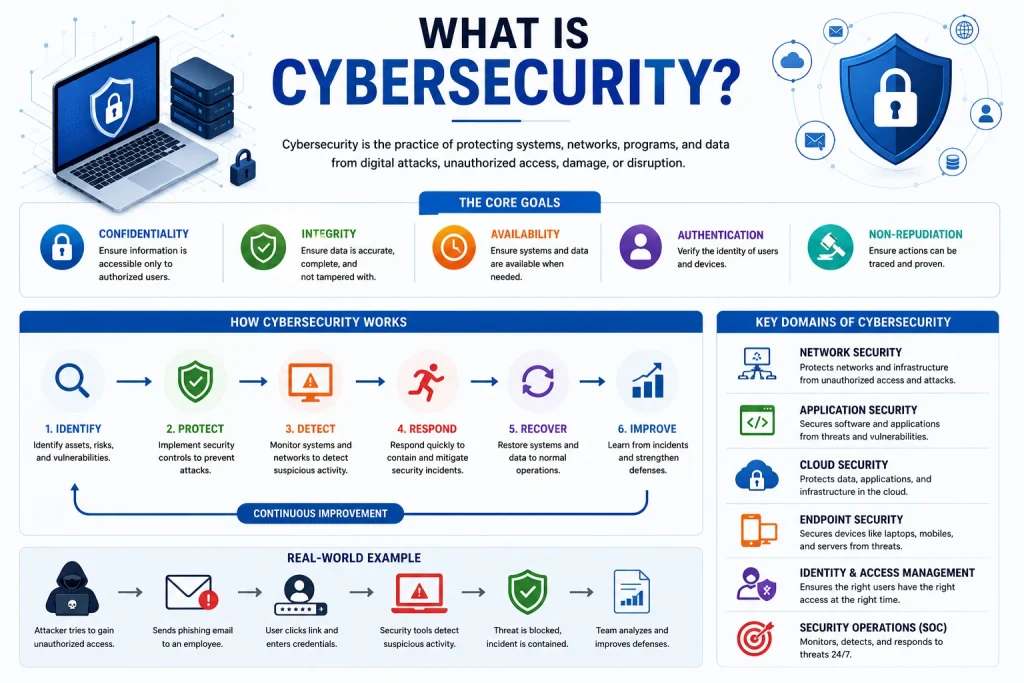
Cybersecurity is the practice of protecting systems, applications, networks, identities, and data from cyber threats.
Organizations now depend entirely on digital infrastructure. Banks process millions of online transactions daily. Hospitals store sensitive patient records. Manufacturers rely on connected industrial systems. Governments protect national infrastructure from state-sponsored attacks.
Every one of those systems is a target.
Cybersecurity professionals exist to reduce that risk.
Core Objectives of Cybersecurity
Cybersecurity teams focus on:
- Threat prevention
- Threat detection
- Incident response
- Vulnerability management
- Identity security
- Cloud security
- Compliance and governance
- Security monitoring
- Threat hunting
- Digital forensics
Unlike many technology fields, cybersecurity is highly adversarial.
You’re defending systems against attackers who continuously evolve their tactics.
That’s why cybersecurity changes rapidly.
A security analyst working in a Security Operations Center (SOC) may spend their day:
- Investigating phishing alerts
- Correlating SIEM logs
- Reviewing suspicious PowerShell activity
- Monitoring endpoint telemetry
- Responding to ransomware indicators
- Escalating incidents to responders
- Mapping attacker behavior to MITRE ATT&CK
Example: Real SOC Workflow
Imagine an employee receives a phishing email.
The attacker steals credentials and attempts lateral movement across the network.
A SOC analyst using Splunk Enterprise Security or Splunk Enterprise Security may detect:
- Excessive failed logins
- Abnormal geographic access
- Privilege escalation attempts
- Suspicious PowerShell execution
- Endpoint process anomalies
A simple Splunk query may look like:
index=windows EventCode=4625
| stats count by user, src_ip
| where count > 10
This query identifies repeated failed login attempts, often associated with brute-force attacks.
The analyst then maps the activity to:
| MITRE ATT&CK Technique | Description |
|---|---|
| T1110 | Brute Force |
| T1078 | Valid Accounts |
| T1021 | Remote Services |
This operational side of cybersecurity is what separates it from traditional data analytics.
You’re not just analyzing data.
You’re detecting active threats.
Check out our latest post on GSOC Security: Global Security Operations Center
Major Cybersecurity Career Paths
Cybersecurity is extremely broad.
You can specialize in:
| Role | Focus Area |
|---|---|
| SOC Analyst | Security monitoring and alert triage |
| Security Engineer | Infrastructure hardening |
| Threat Hunter | Proactive attacker detection |
| Penetration Tester | Ethical hacking |
| Cloud Security Engineer | AWS/Azure/GCP security |
| Incident Responder | Breach containment |
| Governance Risk and Compliance Analyst | Policy and regulation |
| Malware Analyst | Reverse engineering malware |
| Detection Engineer | SIEM rule creation |
| Security Architect | Enterprise security design |
That flexibility is one reason cybersecurity remains one of the fastest-growing technology industries.
What Is Data Analytics?
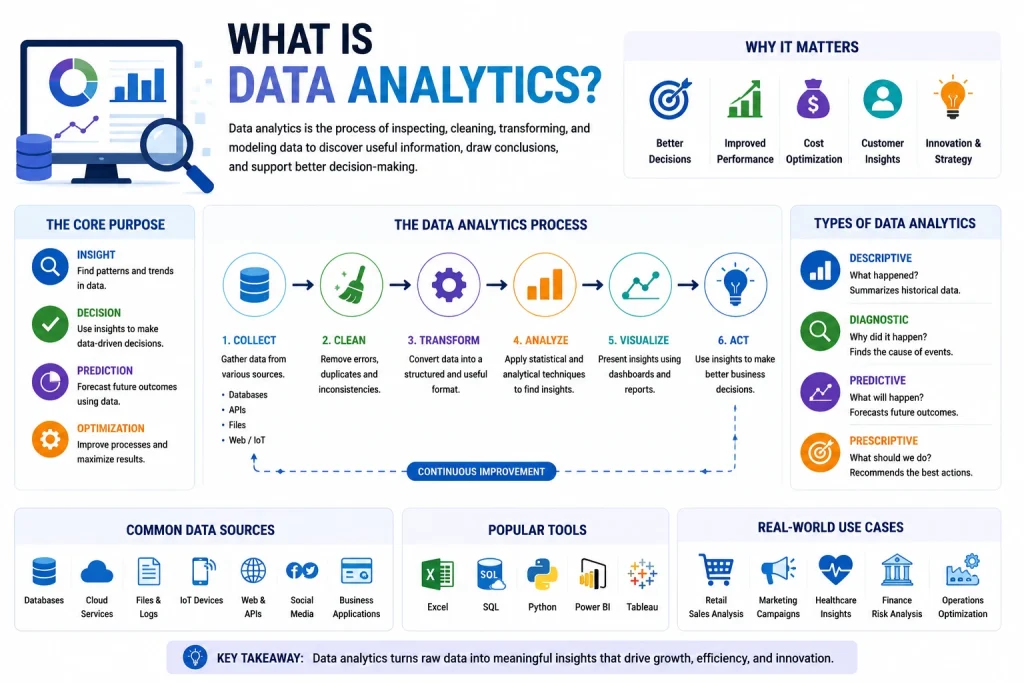
Data analytics focuses on extracting meaningful insights from data to improve business decisions.
Modern organizations generate enormous amounts of information every day:
- Website traffic
- Customer purchases
- Marketing performance
- Financial transactions
- Product usage
- Operational metrics
- Sales reports
- Customer behavior data
Businesses need professionals who can interpret that information.
That’s where data analysts come in.
Core Objectives of Data Analytics
Data analytics professionals help organizations:
- Understand trends
- Improve decision-making
- Forecast outcomes
- Optimize operations
- Increase revenue
- Improve customer experiences
- Reduce inefficiencies
A data analyst may spend their day:
- Writing SQL queries
- Cleaning datasets
- Building dashboards
- Creating visualizations
- Generating KPI reports
- Analyzing business performance
- Presenting findings to executives
Common Data Analytics Tools
Data analytics heavily relies on:
- SQL
- Excel
- Python
- Tableau
- Power BI
- BigQuery
- Snowflake
- Looker
Unlike cybersecurity, most data analytics environments are less reactive.
You’re typically working on business intelligence rather than active threat detection.
Example: Marketing Analytics Workflow
A marketing analyst may investigate:
- Which ad campaigns generate the highest conversions
- Which geographic regions produce the most revenue
- Which products underperform
- Which customer segments churn fastest
The analyst then creates dashboards and reports to guide executive decisions.
This business-oriented workflow makes data analytics attractive for professionals who enjoy structured analysis and strategic thinking.
Cybersecurity vs Data Analytics: The Core Differences
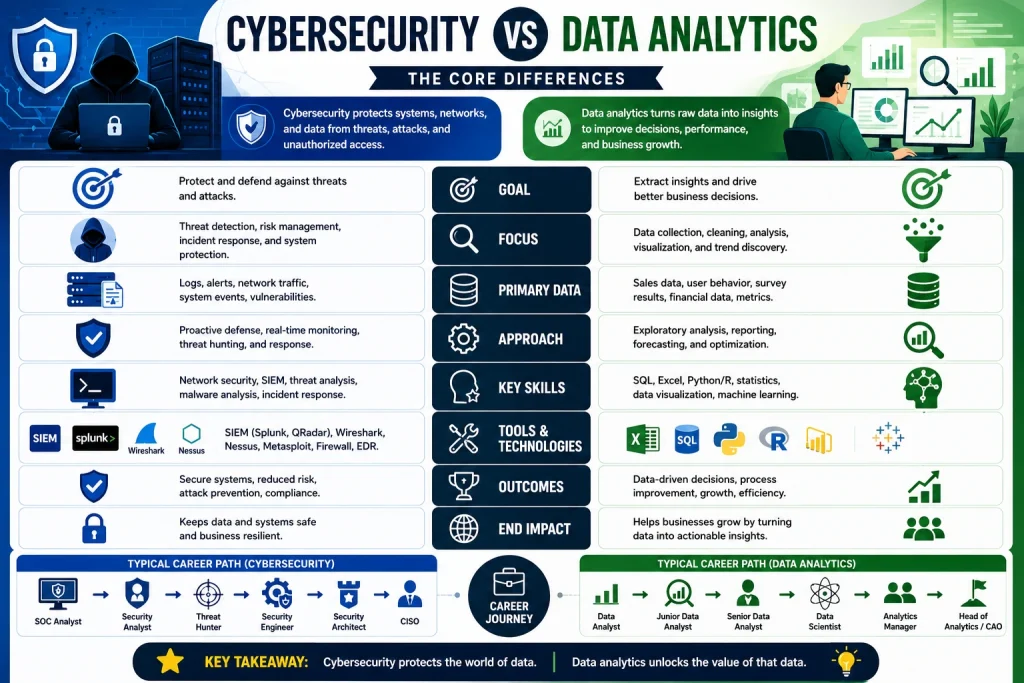
At a surface level, both careers involve technology and analysis.
But the operational mindset behind each role is completely different.
Primary Goal
Cybersecurity exists to protect systems.
Data analytics exists to improve decisions.
That single distinction changes everything.
Cybersecurity asks:
- Is this activity malicious?
- How do we reduce risk?
- How do we stop attackers?
- What vulnerabilities exist?
Data analytics asks:
- Why did revenue drop?
- What trends exist?
- Which campaign performed best?
- How can operations improve?
Work Environment Comparison
| Factor | Cybersecurity | Data Analytics |
|---|---|---|
| Main Objective | Threat defense | Business insights |
| Work Style | Reactive and proactive | Structured and strategic |
| Stress Level | Higher | Moderate |
| Technical Depth | Very high | Moderate to high |
| Communication Requirement | Medium | High |
| AI Automation Risk | Lower | Higher |
| Compliance Pressure | High | Medium |
| Operational Urgency | Critical | Business-driven |
Personality Fit
Cybersecurity often fits professionals who:
- Enjoy investigations
- Prefer fast-moving environments
- Like troubleshooting systems
- Enjoy technical problem-solving
- Stay calm under pressure
Data analytics often fits professionals who:
- Enjoy business strategy
- Like data storytelling
- Prefer structured workflows
- Enjoy presentations and reporting
- Like finding patterns in numbers
Cybersecurity vs Data Analytics Salary in the USA
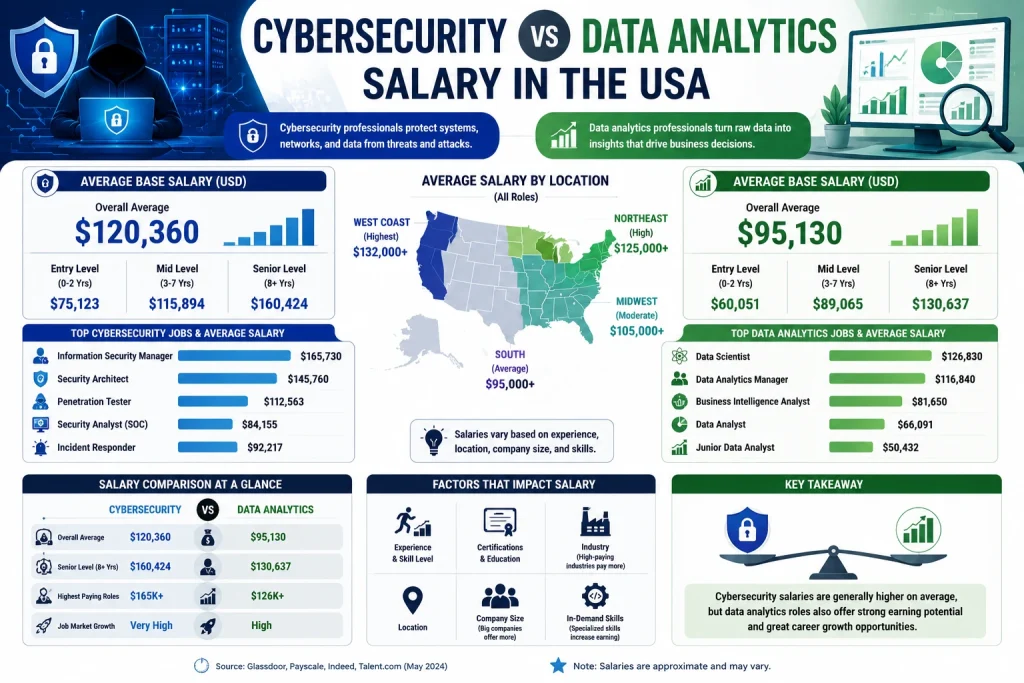
Salary is one of the biggest reasons professionals compare these careers.
Both fields pay well.
But cybersecurity currently holds a stronger long-term salary advantage due to the global talent shortage.
Entry-Level Salary Comparison
| Role | Average USA Salary |
|---|---|
| Junior SOC Analyst | $72,000 to $95,000 |
| Security Analyst | $80,000 to $110,000 |
| Junior Data Analyst | $60,000 to $85,000 |
| Business Intelligence Analyst | $75,000 to $100,000 |
Mid-Level Salary Comparison
| Role | Average USA Salary |
|---|---|
| Cloud Security Engineer | $140,000+ |
| Threat Hunter | $130,000+ |
| Detection Engineer | $145,000+ |
| Senior Data Analyst | $110,000+ |
| BI Engineer | $120,000+ |
| Analytics Manager | $130,000+ |
Why Cybersecurity Salaries Continue Rising
Organizations cannot afford breaches.
Ransomware incidents now cost millions in downtime, legal exposure, and reputational damage.
This creates urgency-driven hiring.
Companies willingly pay premium salaries for professionals who can:
- Reduce attack surfaces
- Improve detection capabilities
- Secure cloud infrastructure
- Respond to incidents quickly
That urgency creates stronger salary acceleration than many analytics roles.
Data Analyst vs Cyber Security Job Demand
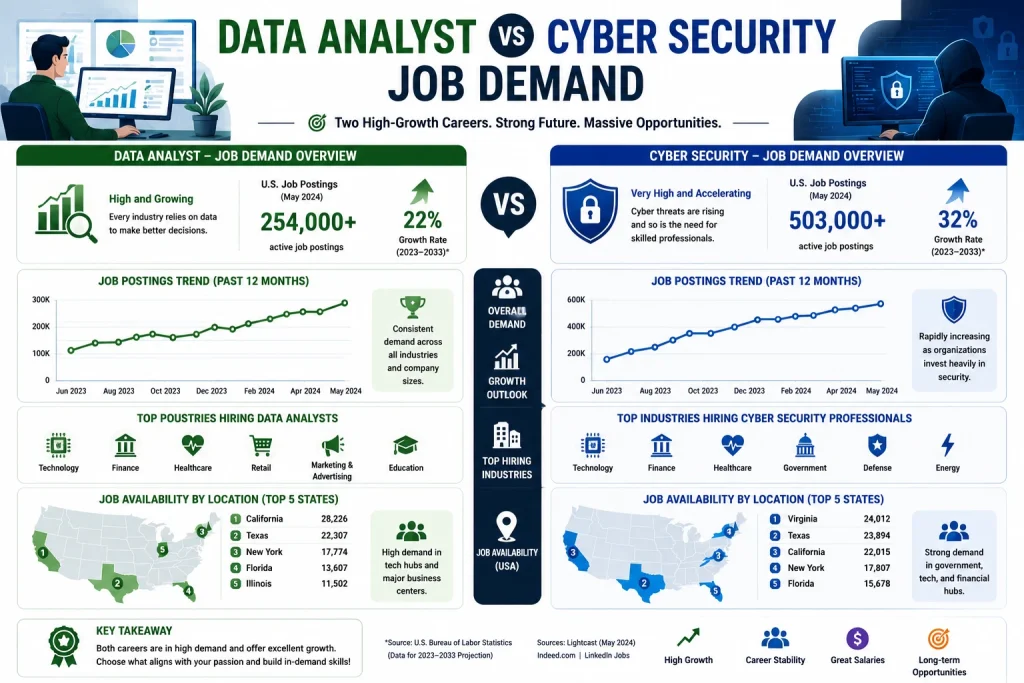
Both industries continue growing in 2026.
But cybersecurity demand is expanding at a much faster operational pace.
Why Cybersecurity Demand Is Exploding
Several factors drive cybersecurity growth:
- AI-powered attacks
- Cloud adoption
- Ransomware operations
- Nation-state threats
- Supply chain attacks
- Remote workforce security
- Compliance requirements
- Critical infrastructure protection
Organizations across every industry now require cybersecurity teams.
This includes:
- Healthcare
- Finance
- Retail
- Government
- Manufacturing
- Aviation
- Energy
- SaaS companies
According to industry estimates, the cybersecurity workforce gap remains in the millions globally.
Data Analytics Demand Remains Strong
Data analytics also continues growing because businesses rely heavily on:
- Forecasting
- KPI tracking
- Operational optimization
- Customer insights
- Predictive modeling
However, AI tools increasingly automate basic analytics tasks.
Modern platforms can already:
- Generate dashboards automatically
- Create visualizations
- Summarize datasets
- Produce natural language insights
That doesn’t eliminate data analysts.
But it does shift the role toward:
- Strategic thinking
- Advanced analytics
- Business interpretation
- AI oversight
Which Career Has Better Future Scope?
If your goal is maximum long-term resilience against automation, cybersecurity currently has the advantage.
Threat actors evolve unpredictably.
Human defenders remain critical.
That makes cybersecurity one of the strongest long-term technology career paths.
Cyber Security or Data Analytics: Which Is Easier to Learn?
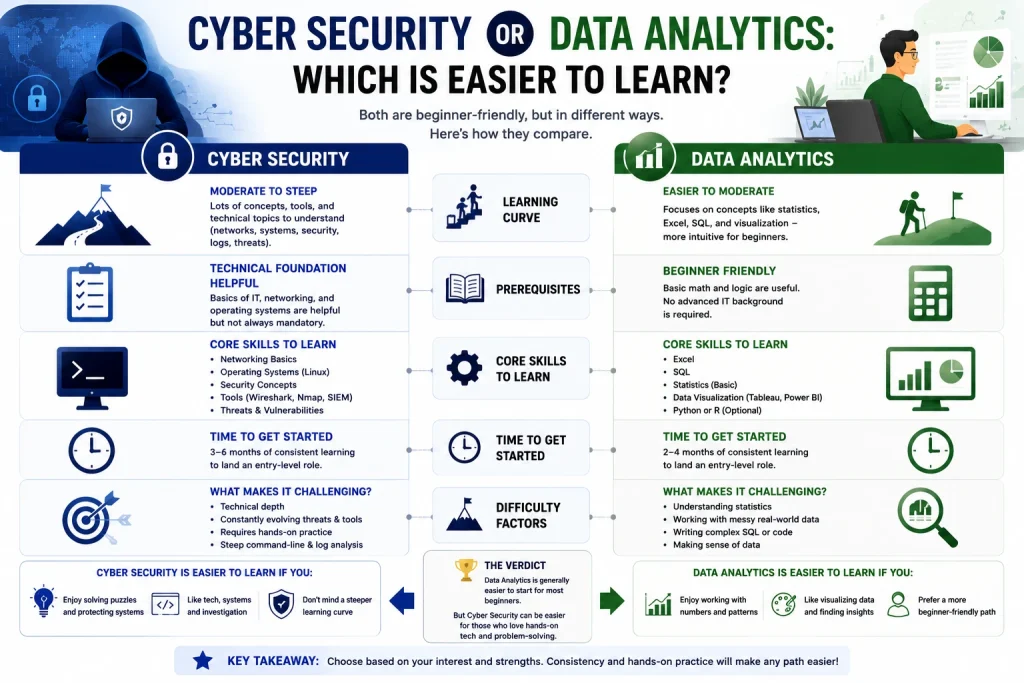
This is one of the most searched comparison questions online.
The answer depends on your technical background and learning style.
Why Cybersecurity Feels Harder
Cybersecurity requires broad infrastructure knowledge.
To understand attacks, you must first understand:
- Networking
- Linux
- Windows systems
- Identity management
- Cloud architecture
- Security protocols
- Logging systems
- Detection engineering
Beginners often feel overwhelmed because cybersecurity spans many technical domains.
Why Data Analytics Feels More Accessible
Data analytics usually provides a smoother entry path.
You can start with:
- Excel
- SQL
- Dashboards
- Visualization tools
You can build portfolio projects relatively quickly.
For example:
- Sales dashboards
- Marketing analysis reports
- Customer segmentation studies
- Revenue trend visualizations
This faster feedback loop makes analytics more beginner-friendly.
But Easier Doesn’t Mean Better
Because data analytics appears accessible, competition is intense.
Thousands of people complete entry-level analytics bootcamps every month.
Cybersecurity has a steeper learning curve, but employers still struggle to find qualified professionals.
That creates a stronger opportunity for skilled candidates.
The Rise of the Cybersecurity Data Analyst
One of the most important 2026 career trends is the rise of hybrid security analytics roles.
A cybersecurity data analyst combines:
- Threat analysis
- SIEM investigation
- Data correlation
- Log analysis
- Security telemetry interpretation
- Behavioral analytics
These professionals bridge the gap between traditional analytics and cybersecurity operations.
What Cybersecurity Data Analysts Actually Do
Security data analysts may:
- Analyze firewall logs
- Investigate endpoint telemetry
- Correlate SIEM alerts
- Detect insider threats
- Identify abnormal user behavior
- Create detection dashboards
- Build anomaly detection models
This role is increasingly important in:
- SOC environments
- Managed Security Service Providers (MSSPs)
- Enterprise security teams
- Threat intelligence operations
Example: Security Analytics Detection
A cybersecurity data analyst may create a query that identifies suspicious PowerShell execution.
Example:
index=windows EventCode=4104
| search powershell
| stats count by user, host
| where count > 20
This type of behavioral analytics helps security teams identify potential malicious scripting activity.
AI Impact on Cybersecurity vs Data Analytics
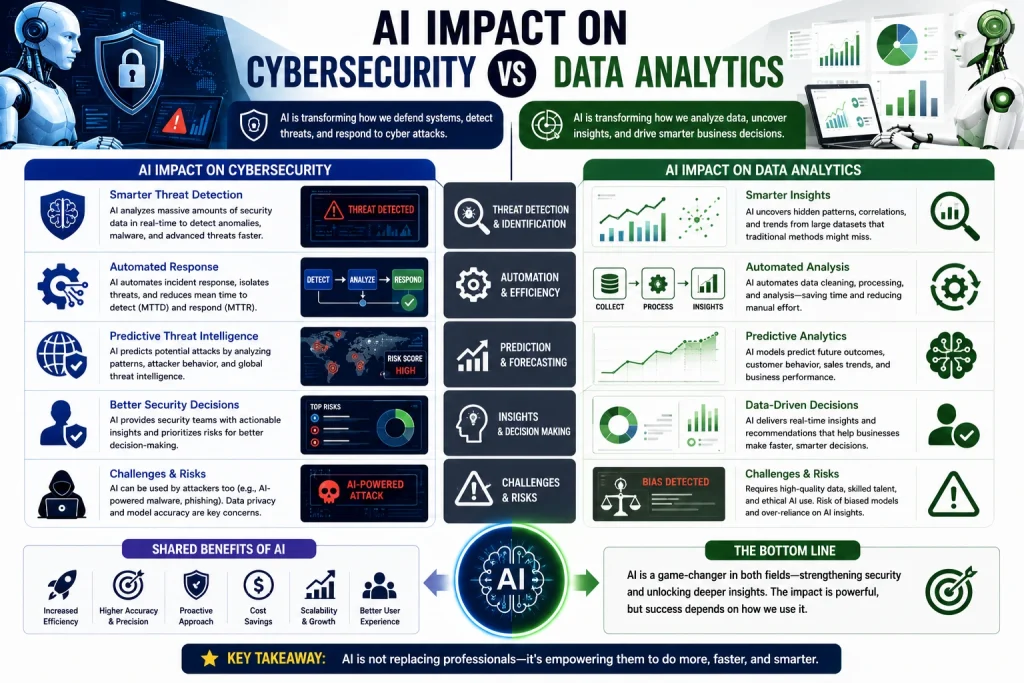
Artificial intelligence is transforming both industries.
But not equally.
AI in Data Analytics
AI now automates many analytics tasks:
- Dashboard generation
- Data summarization
- Visualization recommendations
- SQL generation
- Predictive forecasting
This means analysts increasingly focus on:
- Strategic interpretation
- Business communication
- Advanced analytical modeling
AI in Cybersecurity
Cybersecurity uses AI differently.
AI assists with:
- Threat detection
- Log correlation
- Behavioral analytics
- Malware classification
- Incident prioritization
However, attackers also use AI.
This creates a constant adversarial cycle.
Human analysts remain essential because:
- False positives require validation
- Threat actors evolve rapidly
- Security incidents involve contextual judgment
- Detection logic needs tuning
The Rise of AI-Powered SOCs
Modern SOCs increasingly rely on:
- XDR platforms
- AI-assisted detections
- User and Entity Behavior Analytics (UEBA)
- Threat intelligence enrichment
- Automated incident triage
Professionals who understand both cybersecurity and analytics gain major advantages in this environment.
Best Certifications for Cybersecurity vs Data Analytics
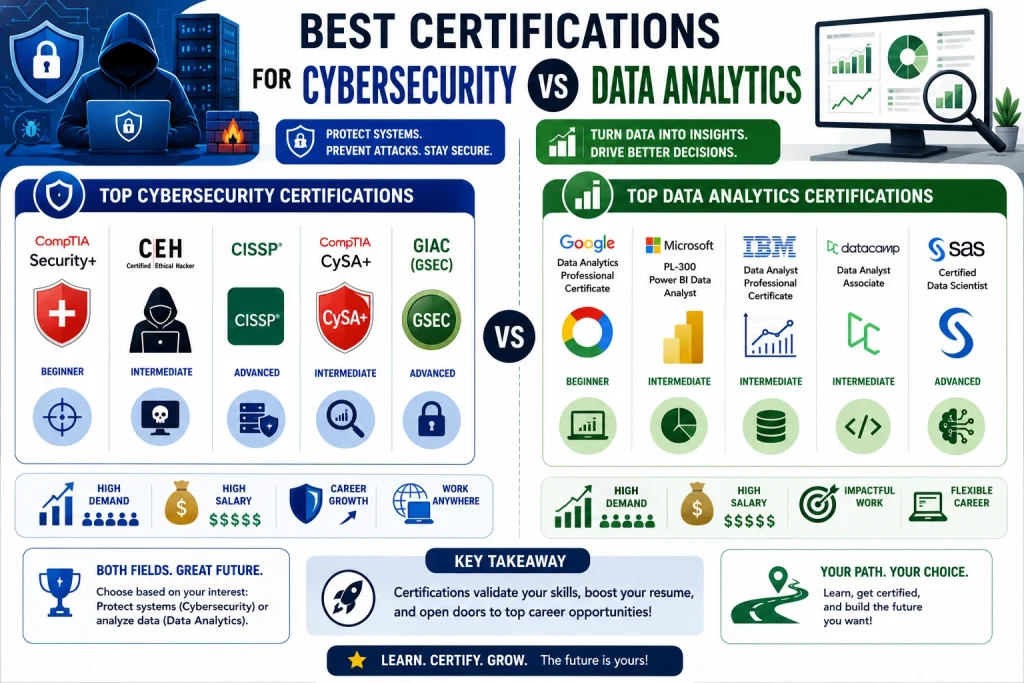
Best Cybersecurity Certifications
Beginner Certifications
- CompTIA Security+
- CompTIA Network+
- Google Cybersecurity Certificate
- Cisco CCNA
Intermediate Certifications
- CySA+
- GSEC
- CEH
- AWS Security Specialty
Advanced Certifications
- CISSP
- OSCP
- GIAC certifications
Best Data Analytics Certifications
- Google Data Analytics Certificate
- Microsoft PL-300
- Tableau Desktop Specialist
- IBM Data Analyst Certificate
Cybersecurity hiring managers often prioritize hands-on skills.
Analytics hiring managers often prioritize portfolios and communication.
Best Learning Roadmap for Cybersecurity
Step 1: Learn Networking Fundamentals
Understand:
- TCP/IP
- DNS
- HTTP/HTTPS
- Firewalls
- VPNs
- Routing
Step 2: Learn Linux and Windows Administration
SOC analysts constantly investigate operating system activity.
Step 3: Learn SIEM Platforms
Focus on:
- Splunk
- Microsoft Sentinel
- QRadar
- Elastic Security
Step 4: Study MITRE ATT&CK
Learn how attackers operate and map their techniques to detection strategies using the MITRE ATT&CK framework.
Step 5: Build a Home Lab
Use:
- Kali Linux
- Windows VMs
- Sysmon
- Splunk Free
- Security Onion
Step 6: Practice Detection Engineering
Create:
- SIEM alerts
- Correlation rules
- Behavioral detections
- Threat hunting queries
Best Learning Roadmap for Data Analytics
Step 1: Learn Excel
Master:
- Pivot tables
- Lookup functions
- Basic visualization
Step 2: Learn SQL
SQL remains the core skill for analytics professionals.
Step 3: Learn Visualization Tools
Focus on:
- Power BI
- Tableau
- Looker
Step 4: Learn Python
Use Python for:
- Data cleaning
- Automation
- Analysis
- Visualization
Step 5: Build Portfolio Projects
Examples include:
- Sales dashboards
- Financial trend analysis
- Marketing performance reports
- Customer segmentation studies
Pros and Cons of Cybersecurity
Pros
- Exceptional job demand
- Strong salaries
- Multiple specialization paths
- High long-term relevance
- Lower automation risk
- Remote work opportunities
- Fast career growth
Cons
- Steep learning curve
- Operational stress
- Constant learning required
- Incident-response pressure
- Technical complexity
Pros and Cons of Data Analytics
Pros
- Easier beginner entry path
- Strong business relevance
- Lower operational stress
- Valuable across industries
- Excellent remote opportunities
Cons
- Entry-level competition is intense
- AI automation risk is higher
- Some reporting tasks become repetitive
- Salary ceilings can be lower than those of advanced cybersecurity roles
Which Career Should You Choose?
Choose cybersecurity if:
- You enjoy troubleshooting systems
- You like fast-moving environments
- You enjoy investigations
- You want strong long-term demand
- You enjoy technical depth
Choose data analytics if:
- You enjoy business insights
- You like structured workflows
- You enjoy storytelling with data
- You prefer less operational stress
- You enjoy visualization and reporting
Best Choice for Long-Term Career Growth
In 2026, cybersecurity currently offers a stronger long-term opportunity.
The combination of:
- AI-driven attacks
- Cloud adoption
- Global talent shortages
- Expanding compliance requirements
- Security automation demand
creates massive hiring pressure.
That pressure continues pushing salaries and demand upward.
Final Verdict
Cybersecurity and data analytics are both valuable career paths.
But they serve different types of professionals.
Data analytics is ideal if you enjoy business intelligence, reporting, SQL, dashboards, and strategic decision-making.
Cybersecurity is ideal if you enjoy defending systems, investigating threats, building detections, and working in operational environments.
For long-term resilience, higher urgency-driven salaries, and stronger market demand, cybersecurity currently has the edge.
However, the most valuable professionals increasingly combine both skill sets.
Security analytics, SIEM engineering, detection engineering, and threat intelligence all rely heavily on data analysis.
That intersection between analytics and cybersecurity may become one of the most powerful career paths of the decade.
Frequently Asked Questions
Is cybersecurity better than data analytics?
Cybersecurity currently offers stronger job demand, higher long-term salary potential, and better resilience against automation than data analytics.
Which is easier to learn, cybersecurity or data analytics?
Data analytics is generally easier for beginners because it requires less infrastructure and systems knowledge.
Can a data analyst transition into cybersecurity?
Yes. Many analysts transition into security analytics, SIEM operations, and threat intelligence roles.
What is a cybersecurity data analyst?
A cybersecurity data analyst analyzes security telemetry, SIEM logs, endpoint data, and behavioral patterns to identify threats.
Which career has better future scope in 2026?
Cybersecurity currently has stronger long-term growth due to increasing cyber threats, AI-powered attacks, and global talent shortages.