




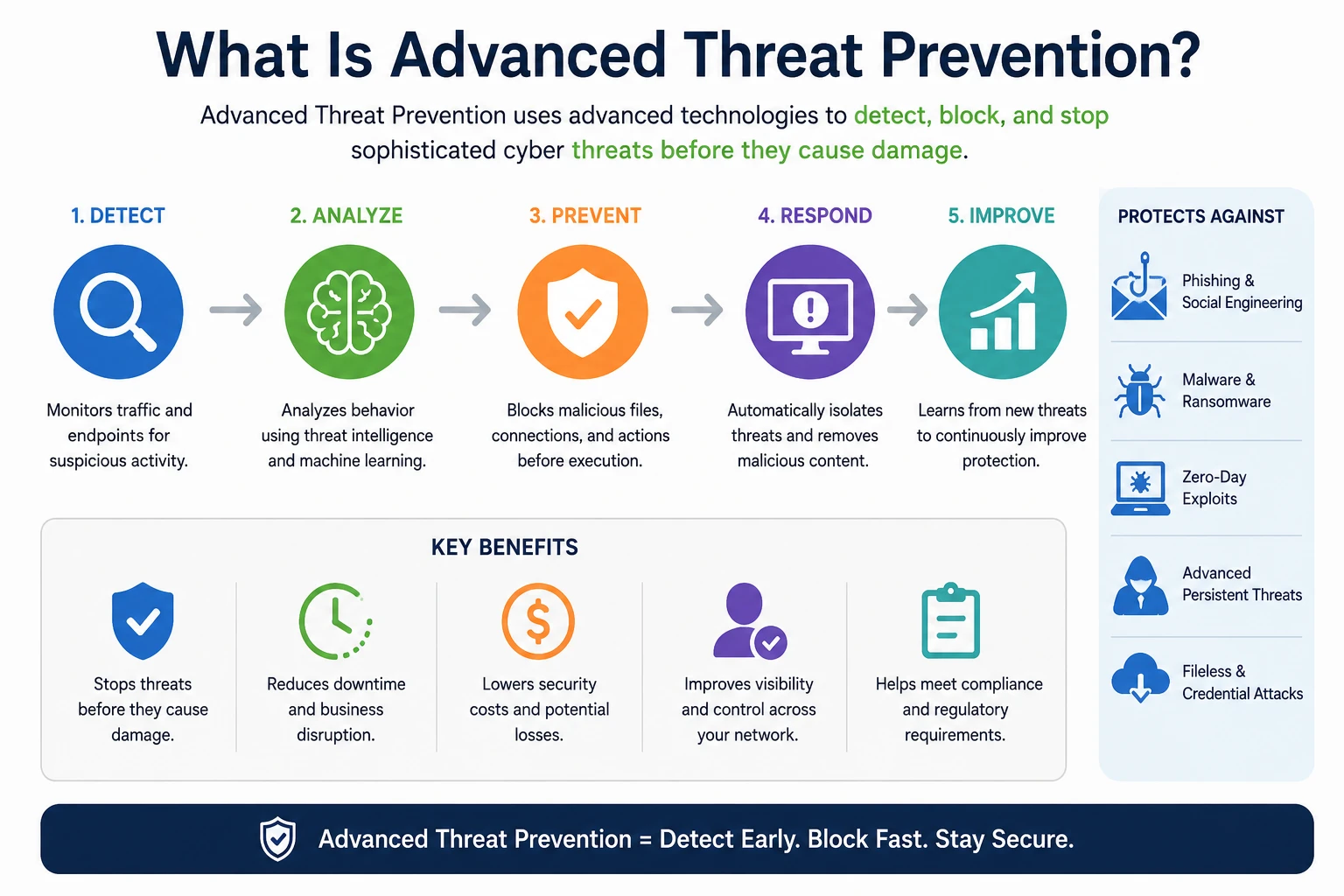
Advanced Threat Prevention (ATP) is a cybersecurity strategy that uses AI, behavioral analysis, threat intelligence, and real-time monitoring to detect and stop sophisticated cyberattacks before they compromise systems, networks, or sensitive data.
What Is Advanced Threat Prevention?
Cyberattacks have become faster, smarter, and harder to detect.
A few years ago, basic antivirus software and a firewall were often enough to protect your systems. Today, cybercriminals use ransomware, AI-generated phishing emails, fileless malware, zero-day exploits, and stealth techniques designed to bypass traditional security tools.
That’s why advanced threat prevention has become a critical part of modern cybersecurity.
Advanced Threat Prevention, often shortened to ATP, is a layered cybersecurity approach that identifies, blocks, analyzes, and responds to sophisticated threats before they can damage your business.
Instead of relying only on known malware signatures, ATP platforms use:
- Artificial intelligence
- Machine learning
- Behavioral analytics
- Real-time threat intelligence
- Sandboxing
- Endpoint monitoring
- Automated response systems
This allows ATP solutions to detect both known and unknown threats.
If your business handles customer data, cloud infrastructure, financial information, healthcare records, or remote employees, advanced threat prevention is no longer optional.
It’s one of the most important defenses against modern cybercrime.
In this guide, you’ll learn:
- What advanced threat prevention means
- How ATP works
- The technologies behind it
- The threats ATP stops
- Benefits and limitations
- How businesses implement ATP solutions
- How to choose the best advanced threat prevention software
Understanding Advanced Threat Prevention
Advanced threat prevention is a cybersecurity framework designed to stop sophisticated attacks before they infiltrate networks, endpoints, cloud systems, or user accounts.
Unlike traditional antivirus software, ATP focuses on proactive threat prevention rather than reactive malware detection.
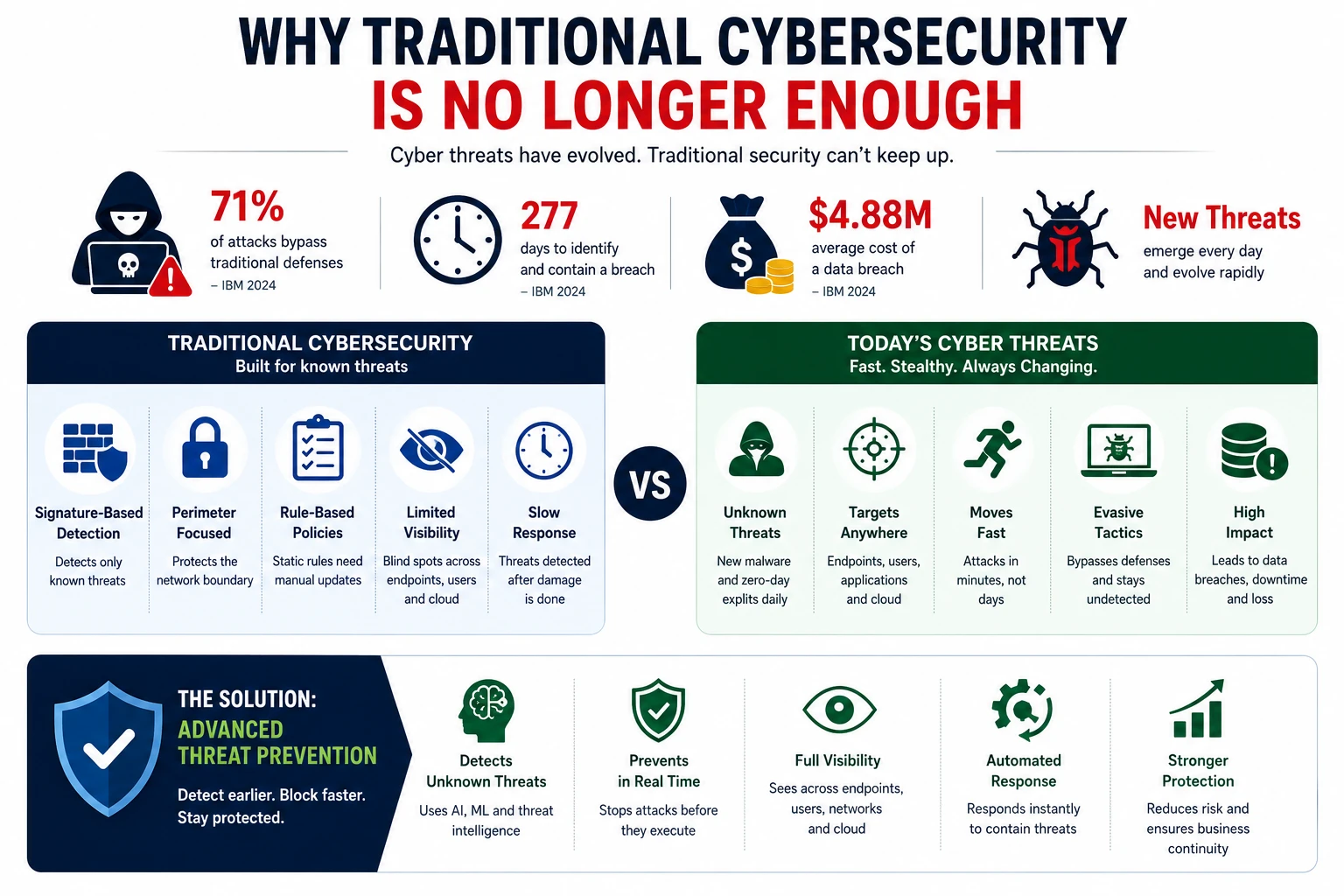
Traditional security tools mainly rely on signature-based detection.
That means they compare files against databases of known malware.
The problem is simple.
Modern cyberattacks evolve constantly.
Hackers modify malware code, encrypt payloads, use legitimate system tools, and exploit vulnerabilities that haven’t been patched yet.
Many attacks no longer leave obvious signatures behind.
Advanced threat prevention solves this problem through intelligent analysis.
Instead of only asking:
“Is this file known malware?”
ATP systems ask:
- Is this behavior suspicious?
- Is this application acting abnormally?
- Is this user behaving unusually?
- Is this network activity dangerous?
- Does this resemble an active attack pattern?
That behavioral approach dramatically improves threat detection.
For example, imagine one of your employees receives an email attachment that appears harmless.
A traditional antivirus solution might miss it because the malware variant is new.
An ATP platform analyzes the file inside a secure sandbox environment.
If the attachment attempts to:
- Download malicious payloads
- Encrypt files
- Contact suspicious servers
- Escalate system privileges
- Modify security settings
The ATP system blocks it immediately.
That proactive defense helps prevent data breaches, ransomware infections, and operational downtime.
Check out our latest blog on Cybersecurity vs Data Analytics in 2026
Why Traditional Cybersecurity Is No Longer Enough
Cybercrime has become a multi-billion-dollar industry.
Attackers now operate like professional organizations.
Many ransomware gangs run affiliate programs, customer support operations, and automated attack systems.
According to multiple cybersecurity industry reports, ransomware and phishing attacks continue increasing every year, while breach costs keep rising for businesses worldwide.
Traditional security tools struggle because modern attacks use:
- Zero-day exploits
- AI-generated phishing emails
- Fileless malware
- Credential theft
- Supply chain attacks
- Cloud-native exploits
- Living-off-the-land techniques
- Advanced persistent threats
Traditional antivirus software works best against known malware.
Advanced threat prevention works against evolving threats.
That difference matters.
| Traditional Security | Advanced Threat Prevention |
|---|---|
| Signature-based detection | AI and behavioral analysis |
| Reactive protection | Proactive prevention |
| Limited visibility | Full environment visibility |
| Detects known threats | Detects known and unknown threats |
| Minimal automation | Automated threat response |
| Endpoint-focused | Endpoint, cloud, network, and email protection |
| Static rules | Adaptive threat intelligence |
This shift from reactive defense to proactive cybersecurity is the reason ATP solutions have become essential for modern organizations.
How Advanced Threat Prevention Works
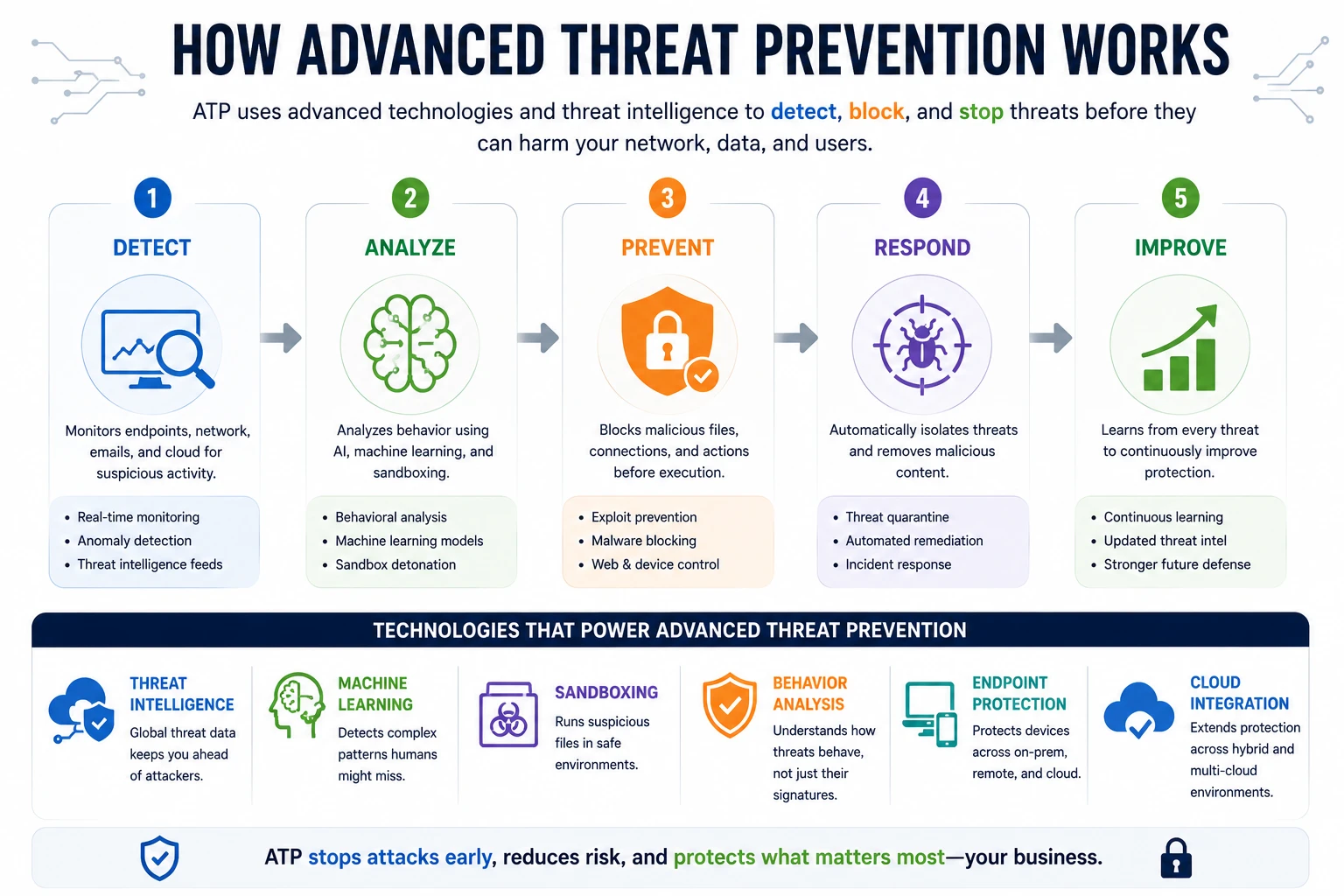
Advanced threat prevention works by combining multiple cybersecurity technologies into a layered defense system.
Instead of relying on one security tool, ATP platforms create overlapping protection across endpoints, cloud systems, networks, email platforms, and user identities.
Each layer identifies different indicators of compromise.
Together, these layers improve detection accuracy and reduce the likelihood of successful attacks.
Threat Intelligence
Threat intelligence is one of the most important parts of advanced threat prevention.
ATP systems continuously collect information from:
- Global threat databases
- Security researchers
- Malware analysis labs
- Government cybersecurity agencies
- Dark web monitoring
- Real-time attack telemetry
This intelligence helps ATP platforms recognize:
- Malicious IP addresses
- Known ransomware infrastructure
- Phishing domains
- Botnet traffic
- Emerging malware campaigns
- Exploit kits
If a device inside your network attempts communication with a dangerous server, the ATP platform can instantly block the connection.
That rapid response reduces the risk of malware spreading.
Behavioral Analysis
Behavioral analysis focuses on suspicious actions rather than malware signatures.
The ATP platform monitors:
- User activity
- Application behavior
- Network communication
- File execution patterns
- Endpoint processes
- Authentication attempts
If something behaves abnormally, the system flags or blocks it.
For example:
- An employee suddenly downloads huge amounts of data
- A trusted application launches PowerShell unexpectedly
- A workstation scans internal systems aggressively
- A process begins encrypting hundreds of files
These actions may indicate ransomware, insider threats, or compromised accounts.
Behavioral analysis is one of the strongest defenses against zero-day attacks and fileless malware.
Sandboxing
Sandboxing isolates suspicious files or applications inside a controlled virtual environment.
The ATP system safely observes what the file attempts to do.
If malicious behavior appears, the platform blocks the threat before it reaches production systems.
Sandboxing is especially effective against:
- Unknown malware
- Malicious email attachments
- Polymorphic malware
- Zero-day threats
- Script-based attacks
This technology helps businesses stop attacks before users interact with dangerous content.
Artificial Intelligence and Machine Learning
AI-driven cybersecurity has become a major part of advanced threat prevention.
Machine learning helps ATP systems:
- Detect anomalies faster
- Reduce false positives
- Identify hidden attack patterns
- Predict malicious behavior
- Analyze large security datasets
As ATP platforms process more attack data, they improve detection accuracy over time.
This adaptive capability is essential because cybercriminals constantly change attack methods.
Endpoint Detection and Response
Endpoint Detection and Response, also called EDR, monitors endpoint devices continuously.
These devices include:
- Laptops
- Servers
- Mobile devices
- Workstations
- Cloud endpoints
If suspicious behavior appears, the ATP platform can:
- Isolate infected devices
- Kill malicious processes
- Remove malware
- Block dangerous connections
- Alert administrators
- Trigger automated remediation
This rapid containment prevents attacks from spreading across networks.
Types of Threats: Advanced Threat Prevention Stops
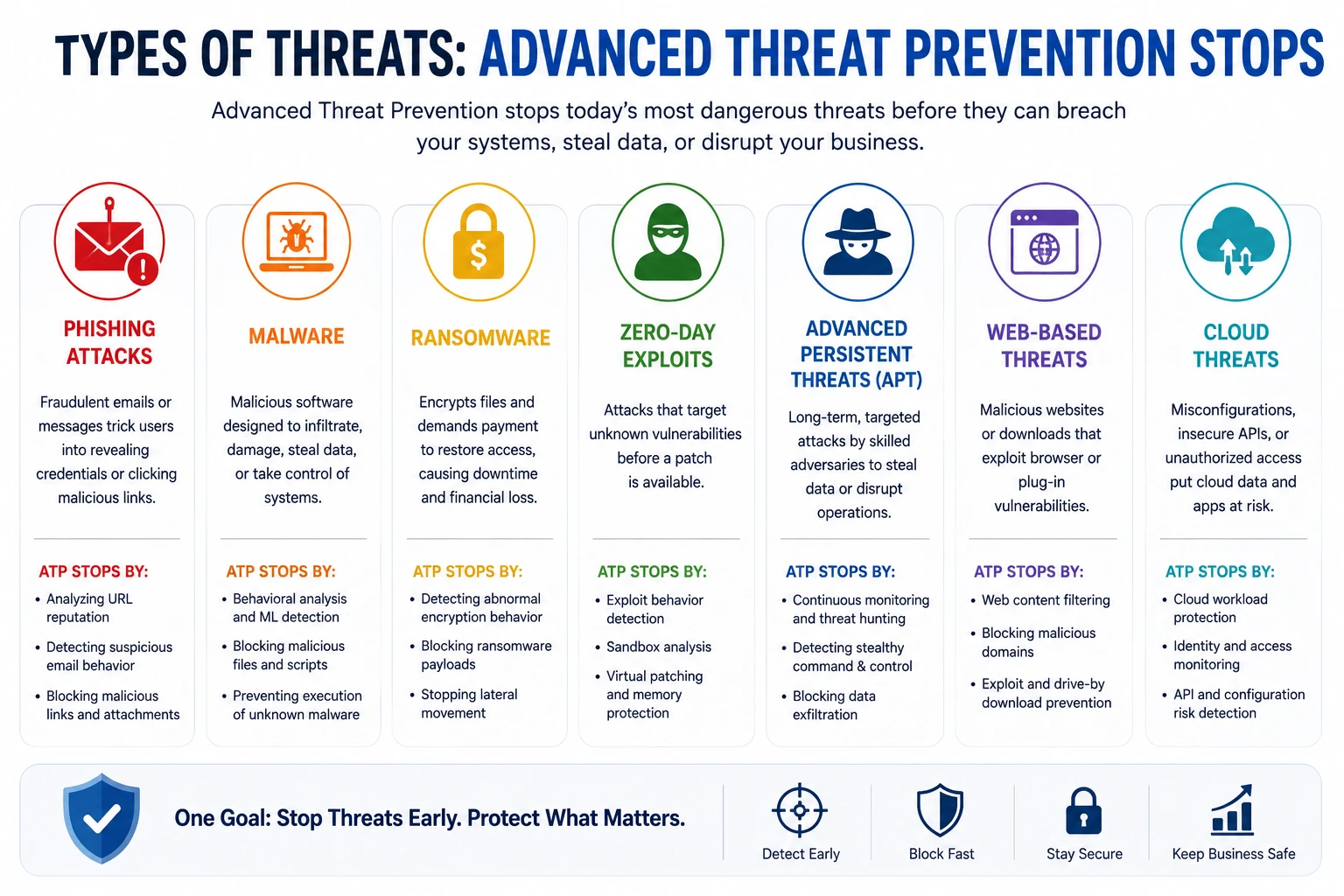
Advanced threat prevention solutions are designed to stop sophisticated attacks that traditional cybersecurity tools often miss.
Ransomware Attacks
Ransomware remains one of the most damaging cyber threats for businesses.
Attackers encrypt files and demand payment to restore access.
Modern ransomware groups often target:
- Healthcare providers
- Financial institutions
- Government agencies
- Manufacturing companies
- Small businesses
- Cloud infrastructure
ATP systems help stop ransomware through:
- Behavioral monitoring
- Suspicious encryption detection
- Network segmentation
- Threat intelligence
- Device isolation
- Automated incident response
Early detection can prevent widespread operational disruption.
Zero-Day Exploits
Zero-day attacks exploit vulnerabilities before software vendors release security patches.
Because these vulnerabilities are unknown initially, traditional antivirus software often fails to detect them.
ATP platforms use:
- Behavioral analytics
- AI-based monitoring
- Sandboxing
- Threat intelligence feeds
This allows ATP systems to identify suspicious behavior even without known signatures.
Phishing and Social Engineering
Phishing attacks have become significantly more advanced.
Cybercriminals now use:
- AI-generated emails
- Fake login portals
- Business impersonation
- Voice cloning
- Deepfake technology
Advanced threat prevention platforms analyze:
- Sender reputation
- Embedded URLs
- Email behavior
- Attachment activity
- User interaction patterns
This reduces the risk of credential theft and malware delivery.
Fileless Malware
Fileless malware operates directly in memory instead of installing malicious files.
That makes traditional malware scanning much less effective.
ATP solutions monitor:
- PowerShell execution
- Memory activity
- Registry changes
- Script behavior
- System command usage
Behavioral analysis becomes critical against these attacks.
Advanced Persistent Threats
Advanced Persistent Threats, commonly called APTs, are long-term targeted attacks.
These attacks often involve nation-state groups or highly organized cybercriminals.
Attackers quietly maintain access to systems for weeks or months while stealing data.
ATP platforms help detect:
- Lateral movement
- Credential abuse
- Unusual traffic patterns
- Data exfiltration
- Persistence techniques
This visibility helps security teams stop attacks before major damage occurs.
Key Components of an Advanced Threat Prevention System
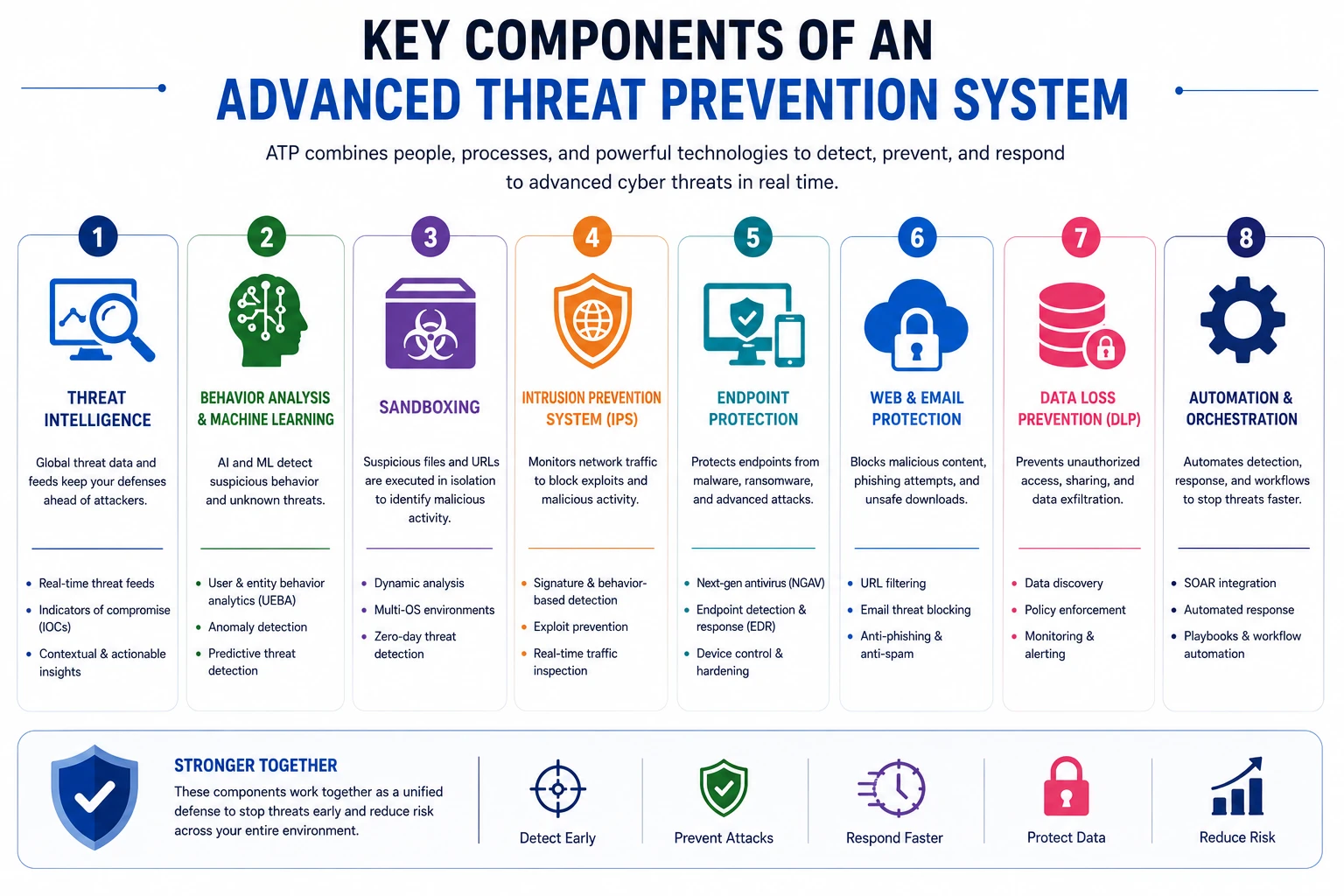
Strong ATP platforms combine multiple security technologies into one integrated ecosystem.
Network Threat Prevention
Network-level ATP tools continuously inspect incoming and outgoing traffic.
They detect:
- Malicious payloads
- Unauthorized access attempts
- Exploit activity
- Botnet communication
- Suspicious data transfers
This layer protects your organization’s infrastructure perimeter.
Email Threat Protection
Email remains the most common attack entry point.
Advanced email security scans:
- Attachments
- Embedded links
- Sender domains
- Scripts
- Email patterns
Many ATP solutions automatically rewrite suspicious URLs and quarantine dangerous files.
Cloud Security Protection
Modern businesses rely heavily on cloud platforms.
That creates additional attack surfaces.
Cloud-focused ATP systems secure:
- SaaS applications
- Cloud workloads
- Remote access environments
- Cloud storage
- Hybrid infrastructure
Cloud-native ATP has become essential for remote and hybrid workforces.
Identity and Access Security
Compromised credentials are involved in many data breaches.
ATP solutions strengthen identity security through:
- Multi-factor authentication
- Identity analytics
- Risk-based authentication
- Privileged access monitoring
- Session monitoring
This reduces unauthorized access risks significantly.
SIEM and XDR Integration
Modern ATP platforms increasingly integrate with:
- SIEM systems
- XDR platforms
- Security orchestration tools
- Zero Trust architectures
This integration improves:
- Threat visibility
- Cross-platform monitoring
- Automated response
- Security analytics
Organizations gain stronger control across complex IT environments.
Benefits of Advanced Threat Prevention
Businesses invest in ATP solutions because the benefits extend far beyond malware detection.
Stronger Cybersecurity Protection
ATP platforms detect:
- Unknown malware
- Zero-day exploits
- Advanced ransomware
- Insider threats
- Fileless attacks
- Sophisticated phishing campaigns
This layered defense significantly lowers breach risk.
Faster Threat Detection and Response
Modern cyberattacks spread rapidly.
The longer attackers remain undetected, the greater the damage.
ATP systems provide:
- Real-time monitoring
- Automated alerts
- Continuous threat visibility
- Rapid incident response
Faster containment minimizes operational disruption.
Reduced Financial Losses
Cyberattacks can create enormous costs.
Businesses may face:
- Downtime
- Data recovery expenses
- Legal costs
- Compliance fines
- Lost revenue
- Reputation damage
- Cyber insurance impacts
Preventing attacks early often saves organizations millions.
Improved Compliance and Reporting
Many industries require strict cybersecurity controls.
ATP solutions help businesses support compliance frameworks such as:
- GDPR
- HIPAA
- PCI DSS
- ISO 27001
- NIST
- SOC 2
Comprehensive reporting simplifies audits and compliance reviews.
Better Visibility Across Systems
ATP platforms centralize security visibility.
Security teams can monitor:
- Endpoints
- Servers
- Cloud environments
- User activity
- Email systems
- Network traffic
This unified visibility improves security operations and decision-making.
Challenges and Limitations of Advanced Threat Prevention
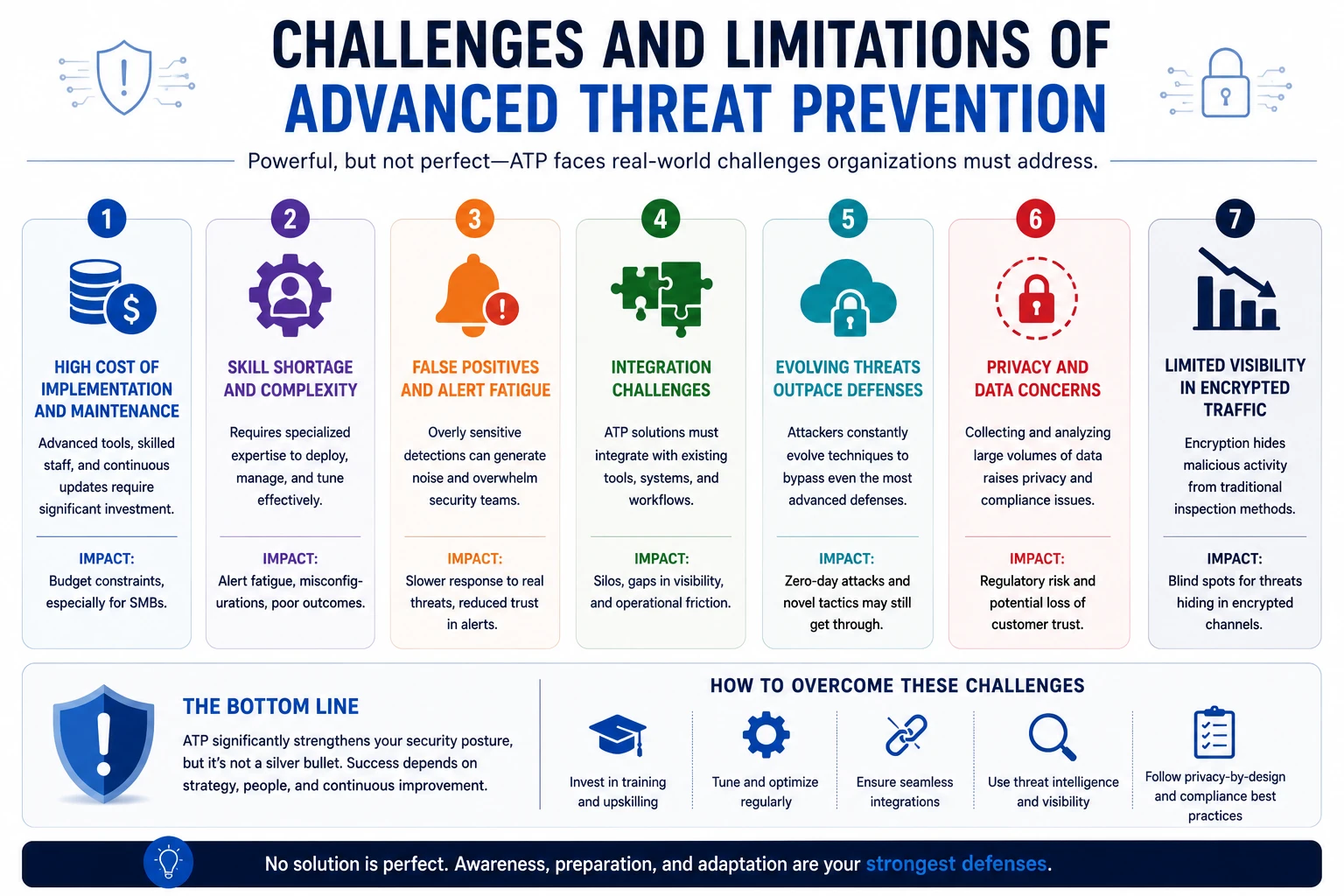
Although ATP solutions provide strong security advantages, they also come with challenges.
High Costs
Enterprise-grade ATP platforms can require significant investment.
Costs may include:
- Licensing
- Hardware
- Cloud subscriptions
- Security staffing
- Ongoing maintenance
- Employee training
However, the cost of a major breach is often far greater.
Deployment Complexity
Advanced cybersecurity platforms can become complex.
Organizations may need:
- Skilled analysts
- Security operations teams
- Integration expertise
- Incident response planning
Improper configuration reduces effectiveness.
False Positives
Behavioral analytics occasionally flags legitimate activity.
Too many alerts can overwhelm security teams.
Modern AI models continue improving accuracy, but false positives still occur.
Constantly Evolving Threats
Cybercriminals continue adapting quickly.
Attackers now use:
- AI-generated malware
- Deepfake phishing
- Encrypted attack channels
- Cloud-native exploits
ATP systems must evolve continuously to remain effective.
How Businesses Implement Advanced Threat Prevention
Implementing advanced threat prevention requires strategy, planning, and continuous management.
Assess Security Risks
Organizations begin by identifying vulnerabilities across:
- Networks
- Endpoints
- Cloud environments
- Third-party systems
- User access controls
- Sensitive data locations
A detailed risk assessment helps prioritize cybersecurity investments.
Choose the Right ATP Platform
Different businesses require different ATP capabilities.
Healthcare organizations may prioritize compliance and ransomware prevention.
Financial institutions may focus heavily on fraud detection and identity security.
When evaluating ATP software, businesses compare:
| Feature | Why It Matters |
| AI threat detection | Identifies unknown attacks |
| Endpoint protection | Secures employee devices |
| Threat intelligence | Improves real-time detection |
| Cloud security | Protects remote infrastructure |
| Automated response | Speeds threat containment |
| SIEM integration | Improves visibility |
| Reporting tools | Supports compliance |
| Scalability | Supports growth |
Popular advanced threat prevention vendors include:
- Microsoft Defender for Endpoint
- CrowdStrike Falcon
- Palo Alto Networks Cortex
- SentinelOne
- Cisco Secure
- Sophos Intercept X
- Fortinet FortiEDR
- Check Point Harmony
Train Employees
Human error remains one of the largest cybersecurity risks.
Employees should learn how to:
- Identify phishing emails
- Avoid suspicious downloads
- Use strong passwords
- Enable MFA
- Report unusual activity
- Follow security policies
Security awareness training strengthens ATP effectiveness.
Monitor and Improve Continuously
Cybersecurity requires ongoing improvement.
Businesses must:
- Update systems regularly
- Patch vulnerabilities
- Monitor security alerts
- Review incident response plans
- Test defenses continuously
Continuous optimization helps organizations stay ahead of emerging threats.
Advanced Threat Prevention vs Traditional Antivirus
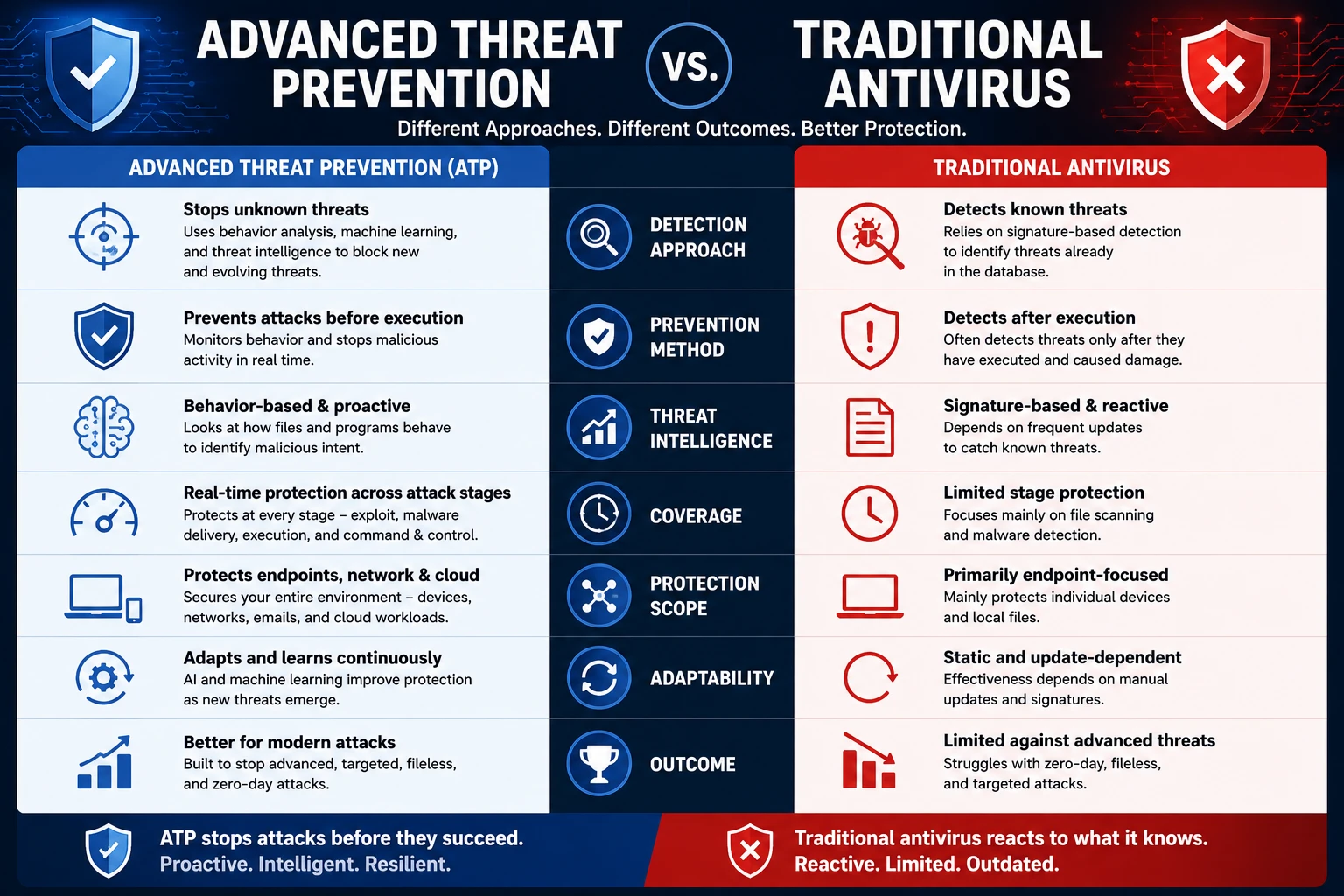
Many businesses mistakenly assume antivirus software alone provides enough cybersecurity protection.
It doesn’t.
Traditional antivirus primarily detects known malware signatures.
Advanced threat prevention protects against both known and unknown attacks through intelligent analysis and automated response.
Traditional Antivirus
Traditional antivirus software focuses on:
- Known malware signatures
- Basic file scanning
- Reactive protection
It works well against common malware but struggles against:
- Fileless attacks
- Zero-day exploits
- Sophisticated phishing
- Advanced ransomware
- Credential theft
Advanced Threat Prevention
ATP platforms combine:
- AI-driven analytics
- Behavioral monitoring
- Threat intelligence
- Real-time response
- Endpoint detection
- Cloud security
- Identity protection
This creates much broader cybersecurity coverage.
| Feature | Antivirus | Advanced Threat Prevention |
| Detection Method | Signature-based | Behavioral and AI-driven |
| Zero-Day Protection | Weak | Strong |
| Real-Time Monitoring | Basic | Advanced |
| Threat Intelligence | Limited | Continuous |
| Automated Response | Minimal | Extensive |
| Cloud Security | Limited | Integrated |
| Endpoint Visibility | Basic | Full visibility |
| Unknown Threat Detection | Poor | Strong |
For modern organizations, ATP has become a necessity rather than a luxury.
Industries That Need Advanced Threat Prevention Most
Every organization benefits from stronger cybersecurity, but some industries face especially high risks.
Healthcare
Healthcare providers store sensitive patient records and medical data.
Ransomware attacks on hospitals can disrupt patient care and create life-threatening situations.
Healthcare organizations also face strict compliance requirements under regulations such as HIPAA.
Financial Services
Banks and financial firms are major cybercrime targets.
Attackers seek:
- Customer credentials
- Payment systems
- Financial records
- Transaction data
ATP platforms help reduce fraud, account takeover, and breach risks.
Government Agencies
Governments face attacks from:
- Nation-state actors
- Cyber espionage groups
- Organized criminals
- Hacktivists
Advanced threat prevention helps secure classified information and critical infrastructure.
Manufacturing
Manufacturing companies increasingly rely on connected industrial systems.
Cyberattacks can disrupt:
- Production lines
- Supply chains
- Industrial control systems
- Logistics operations
ATP helps secure operational technology environments.
E-commerce Businesses
Online retailers process large volumes of customer data and payment information.
ATP systems help prevent:
- Credential theft
- Fraud
- Account takeovers
- Data breaches
Future Trends in Advanced Threat Prevention
Cybersecurity continues evolving rapidly.
Advanced threat prevention platforms are adapting to address new attack methods and modern IT environments.
AI-Powered Cyber Defense
Artificial intelligence will continue transforming cybersecurity.
Future ATP systems will:
- Predict attacks earlier
- Automate investigations
- Improve anomaly detection
- Accelerate response times
- Reduce false positives
AI-driven automation will become increasingly important.
Zero Trust Security
Zero Trust security assumes no user or device should be trusted automatically.
ATP platforms increasingly integrate with Zero Trust architectures.
This approach continuously validates:
- User identity
- Device health
- Access permissions
- Behavioral activity
Zero Trust reduces unauthorized access risks significantly.
Extended Detection and Response
Extended Detection and Response, known as XDR, expands ATP visibility across environments.
XDR combines:
- Endpoint telemetry
- Cloud monitoring
- Email security
- Identity analytics
- Network visibility
This improves cross-platform threat detection.
SASE and Cloud-Native Security
Secure Access Service Edge, or SASE, combines networking and cloud security into one framework.
As businesses adopt hybrid work models, ATP solutions increasingly integrate with SASE platforms.
Cloud-native security will continue becoming more important for:
- Remote workers
- SaaS applications
- Multi-cloud environments
- Distributed infrastructure
Pros and Cons of Advanced Threat Prevention
Pros
- Detects sophisticated cyber threats
- Protects against zero-day attacks
- Uses AI-driven behavioral analysis
- Improves ransomware protection
- Supports cloud security
- Provides real-time monitoring
- Accelerates incident response
- Enhances compliance efforts
- Improves network visibility
- Automates many security tasks
Cons
- Can be expensive for small businesses
- Requires skilled security management
- Complex deployments may take time
- False positives still occur
- Ongoing monitoring is necessary
- No cybersecurity system guarantees 100% protection
How to Choose the Best Advanced Threat Prevention Solution
Choosing the right ATP platform depends on your infrastructure, business size, compliance needs, and cybersecurity goals.
Evaluate Security Coverage
Look for ATP solutions that protect:
- Endpoints
- Networks
- Cloud systems
- Email platforms
- Mobile devices
- Remote employees
Comprehensive protection creates stronger defense layers.
Prioritize Detection Accuracy
A strong ATP platform should:
- Detect unknown threats
- Minimize false positives
- Provide behavioral analytics
- Use AI-powered detection
Independent cybersecurity testing reports can help evaluate vendors.
Consider Ease of Management
Complex tools slow security teams down.
Look for:
- Centralized dashboards
- Automated workflows
- Clear reporting
- Easy integrations
- Simplified policy management
Usability affects long-term success.
Ensure Scalability
Your ATP solution should grow alongside your business.
Scalable platforms support:
- Remote workforces
- Cloud expansion
- Hybrid environments
- Additional locations
- Increased endpoint counts
Review Vendor Support
Strong support becomes critical during security incidents.
Evaluate:
- Customer service quality
- Response times
- Threat research capabilities
- Training resources
- Technical documentation
Reliable vendor support improves operational resilience.
Final Thoughts
Advanced threat prevention has become one of the most important cybersecurity investments for modern businesses.
Traditional antivirus software alone can’t keep up with sophisticated attacks such as ransomware, fileless malware, phishing campaigns, and zero-day exploits.
Modern ATP platforms provide proactive protection through:
- AI-driven analytics
- Behavioral monitoring
- Threat intelligence
- Automated response
- Endpoint visibility
- Cloud security integration
Instead of waiting for malware signatures, ATP systems identify suspicious behavior before attacks spread.
That proactive approach helps organizations reduce downtime, protect sensitive data, strengthen compliance, and improve long-term cybersecurity resilience.
If your organization handles sensitive customer information, cloud infrastructure, remote employees, or critical operations, investing in advanced threat prevention is no longer optional.
It’s a critical requirement for surviving today’s cyber threat landscape.
Frequently Asked Questions
What does advanced threat prevention mean?
Advanced threat prevention refers to cybersecurity technologies and strategies that detect, block, analyze, and respond to sophisticated cyber threats before they compromise systems or data.
Is advanced threat prevention the same as antivirus?
No. Antivirus software mainly detects known malware using signatures, while advanced threat prevention uses AI, behavioral analysis, and threat intelligence to stop both known and unknown threats.
Why is advanced threat prevention important?
Advanced threat prevention helps organizations defend against ransomware, phishing, zero-day attacks, fileless malware, and other advanced cyber threats that traditional security tools often miss.
What industries need advanced threat prevention most?
Industries such as healthcare, finance, government, manufacturing, and e-commerce benefit heavily from ATP because they manage sensitive data and face high cyberattack risks.
Can advanced threat prevention stop ransomware?
Yes. ATP systems can detect suspicious encryption behavior, isolate infected devices, block malicious activity, and help prevent ransomware from spreading across networks.
