
Cybersecurity is one of the fastest-growing industries in the world. Organizations of every size need professionals who can protect networks, cloud environments, applications, and sensitive data from cyber threats. As attacks continue to increase, companies are investing heavily in security teams, creating thousands of opportunities for beginners looking to enter the field.
If you’ve searched for how to get into cyber security with no experience, you’ve probably seen the same advice repeated everywhere: earn a certification, learn networking, and start applying for jobs. While those suggestions are useful, they often leave out the practical steps that hiring managers actually value.
The good news is that you do not need years of IT experience or a computer science degree to begin a cybersecurity career. Many successful SOC analysts, security engineers, penetration testers, and incident responders started with little or no professional experience. What helped them stand out was a combination of foundational knowledge, hands-on projects, continuous learning, and the ability to demonstrate real skills.
The cybersecurity industry rewards curiosity and problem-solving. If you enjoy understanding how technology works, investigating issues, or learning new tools, you already have qualities that employers appreciate. Your challenge is not simply learning cybersecurity. It is proving that you can apply what you learn.
Can You Get Into Cyber Security With No Experience?

Yes, you can get into cyber security with no experience, but you should understand what “no experience” means from an employer’s perspective.
Many beginners assume companies expect years of professional security work before considering an applicant. In reality, most entry-level cybersecurity positions focus less on previous job titles and more on your ability to learn, solve problems, and demonstrate technical knowledge.
Experience does not only come from paid employment. Recruiters often consider home labs, certifications, personal projects, internships, Capture the Flag (CTF) competitions, open-source contributions, and volunteer work as valuable evidence of your skills.
For example, imagine two candidates applying for a junior SOC analyst position:
Candidate A
- CompTIA Security+
- No projects
- Generic resume
- No GitHub profile
- No practical labs
Candidate B
- ISC2 Certified in Cybersecurity (CC)
- Built an Active Directory lab
- Completed multiple TryHackMe learning paths
- Investigated Windows Event Logs
- Created Sigma detection rules
- Published incident response reports on GitHub
Even if Candidate B has never worked in cybersecurity, they have demonstrated initiative and practical ability. That often makes them the stronger candidate.
What Hiring Managers Actually Look For
After interviewing and working with security professionals across SOCs, consulting firms, healthcare, finance, telecom, and cloud environments, one pattern becomes clear: hiring managers rarely expect beginners to know everything.
Instead, they ask questions such as:
- Can this person learn quickly?
- Do they understand networking fundamentals?
- Have they worked with Linux or Windows?
- Can they explain how an attack works?
- Do they know how to investigate logs?
- Have they completed any practical labs?
- Can they communicate clearly?
- Are they genuinely interested in cybersecurity?
Technical knowledge matters, but attitude matters just as much. Employers want people who enjoy solving problems and continuously improving their skills because cybersecurity changes every day.
Skills Matter More Than Job Titles
Cybersecurity is one of the few technology fields where practical skills can outweigh formal experience.
Suppose you spend three months building a home lab where you:
- Install Windows Server
- Configure Active Directory
- Create user accounts
- Generate failed login events
- Forward logs into Microsoft Sentinel
- Write basic detection rules
- Investigate alerts
- Document your findings on GitHub
Although this is not commercial experience, it closely mirrors the type of work performed by junior security analysts. During an interview, you can confidently explain your setup, demonstrate your troubleshooting process, and discuss what you learned. That level of practical understanding often leaves a stronger impression than simply listing certifications.
Your Previous Career Can Be an Advantage
If you are switching careers, don’t assume your previous experience has no value. Many skills transfer directly into cybersecurity.
| Previous Background | Valuable Cybersecurity Skills |
|---|---|
| IT Support | Troubleshooting, Windows administration, and user management |
| Network Administration | Routing, switching, firewalls, TCP/IP |
| Software Development | Secure coding, debugging, scripting |
| System Administration | Server management, Active Directory, virtualization |
| Help Desk | Customer communication, ticket handling, problem-solving |
| Military | Risk management, discipline, and incident response |
| Finance | Compliance, fraud detection, risk analysis |
| Healthcare | Data privacy, regulatory awareness, and documentation |
Recruiters often value candidates who combine technical knowledge with experience in another industry because they bring different perspectives and understand business operations.
Do You Need a Computer Science Degree?
No.
Many cybersecurity professionals come from backgrounds such as electronics, mathematics, business, law, engineering, psychology, and even teaching.
A degree can certainly help, particularly for graduate roles or larger organizations, but it is no longer the only path into the industry.
Today, employers frequently evaluate candidates based on:
- Practical projects
- Industry certifications
- GitHub repositories
- Hands-on labs
- Communication skills
- Problem-solving ability
- Continuous learning
If you do have a degree outside of computer science, highlight transferable skills such as research, analytical thinking, teamwork, and documentation.
Is Cybersecurity Difficult?
Cybersecurity has a reputation for being difficult because it combines concepts from networking, operating systems, cloud computing, programming, and security.
The challenge is not that each topic is impossible. It is that there are many areas to learn.
The good news is that you do not need to master every cybersecurity domain before applying for your first role.
For example, an entry-level SOC analyst is not expected to reverse engineer malware, discover zero-day vulnerabilities, or design enterprise security architectures.
Instead, employers expect you to understand topics such as:
- Basic networking
- Common cyber threats
- Windows and Linux fundamentals
- Authentication concepts
- Security monitoring
- Log analysis
- Incident response basics
Focus on building strong fundamentals first. As your career progresses, you can specialize in cloud security, penetration testing, digital forensics, malware analysis, identity security, governance, or threat hunting.
What Entry-Level Cybersecurity Jobs Can You Apply For?
Your first cybersecurity position may not have the word “engineer” in the title, and that’s perfectly normal. Many professionals start in operational or support-focused security roles before moving into advanced positions.
Common entry-level roles include:
- SOC Analyst (Tier 1)
- Junior Security Analyst
- Information Security Analyst
- Cybersecurity Operations Analyst
- Vulnerability Management Analyst
- Identity and Access Management (IAM) Analyst
- Governance, Risk, and Compliance (GRC) Analyst
- Security Administrator
- Security Operations Coordinator
- Incident Response Associate
These roles provide exposure to real-world security tools, alerts, and processes, helping you build the experience needed for more advanced positions later.
A Realistic Timeline
Many online posts promise that you can become a cybersecurity expert in a few months. While intensive learning can help you build a strong foundation quickly, developing professional skills takes consistent effort.
A realistic path for someone studying part-time might look like this:
| Timeline | Milestone |
|---|---|
| Month 1 | Learn networking, Windows, Linux, and security fundamentals |
| Month 2 | Complete hands-on labs and earn an entry-level certification |
| Month 3 | Build a home lab, create GitHub projects, and start applying for jobs |
| Months 4–6 | Continue learning, improve your portfolio, attend interviews, and refine your skills based on feedback. |
The exact timeline varies depending on your background, study schedule, and local job market. The key is to stay consistent and focus on practical experience rather than collecting certifications alone.
Why Cybersecurity Is a Great Career
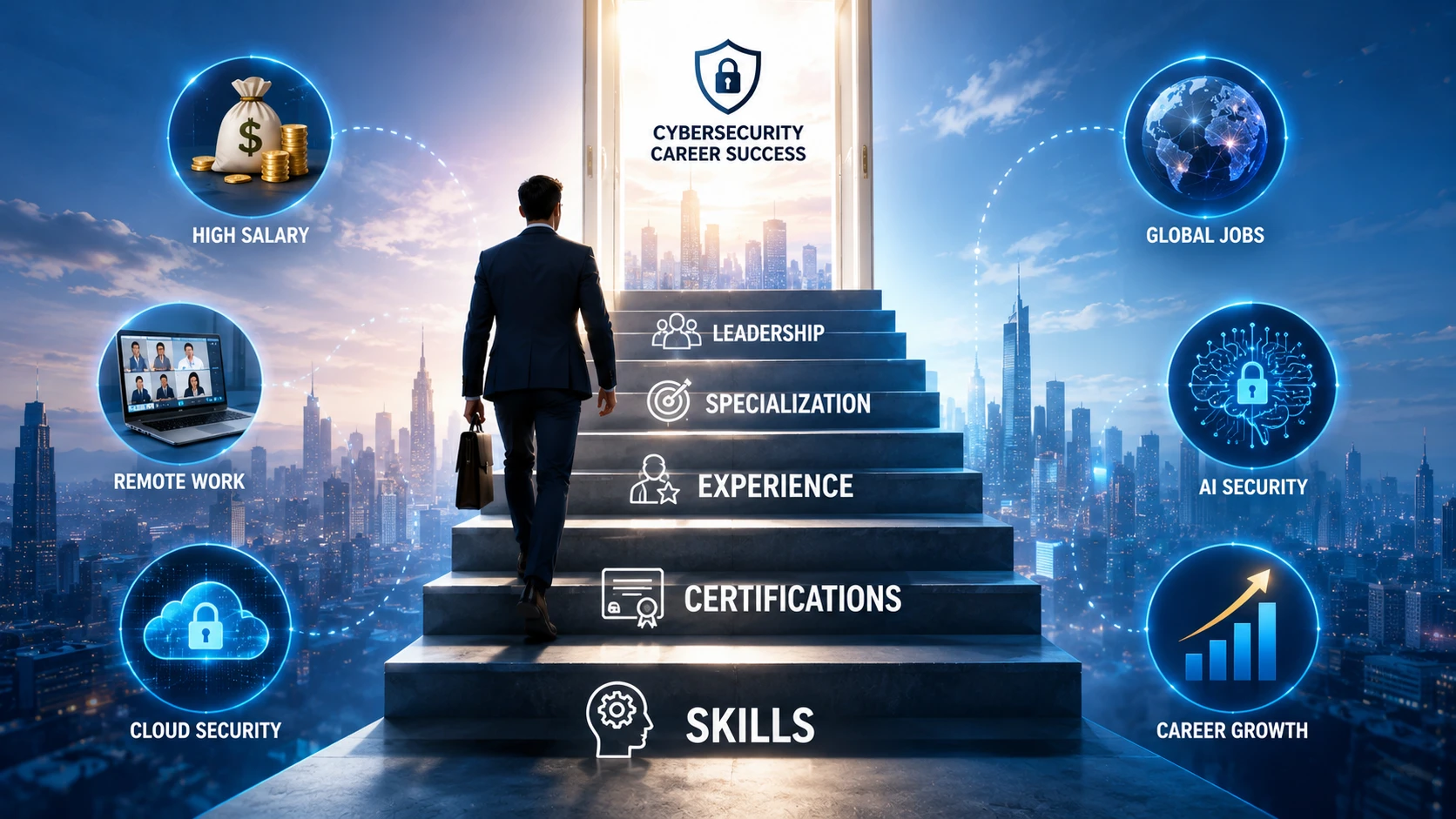
Cybersecurity is more than a high-paying technology field. It is a profession built on continuous learning, problem-solving, and protecting organizations from real-world threats. Every business that relies on computers, cloud services, or online transactions needs cybersecurity professionals. That demand continues to grow as ransomware, phishing, supply chain attacks, and cloud security risks become more sophisticated.
Unlike some technology careers where a single programming language or framework dominates, cybersecurity offers multiple career paths. You can specialize in cloud security, digital forensics, governance, security operations, penetration testing, malware analysis, identity management, or threat intelligence. If one area does not interest you, there are many others to explore.
One of the biggest advantages is career progression. Many professionals begin as SOC analysts or security analysts before advancing into engineering, consulting, architecture, management, or leadership roles. The skills you develop early in your career remain valuable because every advanced role relies on understanding security fundamentals.
Strong Global Demand
Governments, healthcare providers, financial institutions, manufacturers, retailers, and technology companies continue expanding their cybersecurity teams. Digital transformation, cloud adoption, artificial intelligence, and stricter compliance requirements have all increased the need for skilled security professionals.
You are not limited to one industry. A cybersecurity career can take you into banking, aviation, telecom, healthcare, education, government, energy, or consulting. The underlying security principles remain similar even though each industry faces different risks.
Salary Expectations
Cybersecurity salaries vary based on experience, certifications, company size, location, and specialization. The figures below are approximate annual salaries intended as a general guide.
| Country | Entry Level | Mid-Level | Senior |
|---|---|---|---|
| United States | $65,000 to $95,000 | $95,000 to $140,000 | $140,000 to $220,000+ |
| United Kingdom | £30,000 to £45,000 | £45,000 to £70,000 | £70,000 to £110,000+ |
| India | ₹4 LPA to ₹8 LPA | ₹8 LPA to ₹18 LPA | ₹18 LPA to ₹45 LPA+ |
| UAE | AED 120,000 to AED 220,000 | AED 220,000 to AED 400,000 | AED 400,000+ |
These numbers should not be viewed as guaranteed salaries. Your compensation depends on your technical skills, interview performance, certifications, industry, and the complexity of the role.
Remote Work Opportunities

Many cybersecurity jobs now support hybrid or remote work. Security teams frequently monitor cloud infrastructure, investigate alerts, manage identity platforms, or respond to incidents from anywhere with secure access.
Remote positions are common for roles such as:
- Security Analyst
- SOC Analyst
- GRC Analyst
- Cloud Security Engineer
- Threat Intelligence Analyst
- Vulnerability Management Analyst
Keep in mind that highly regulated industries or government organizations may require on-site work because of security policies.
A Career That Never Stops Evolving
Cybersecurity is one of the few professions where learning never truly ends. New attack techniques, cloud technologies, AI-powered threats, and defensive tools appear every year.
While this continuous change requires commitment, it also keeps the work interesting. You are constantly solving new problems rather than repeating the same tasks every day.
Cybersecurity Career Paths
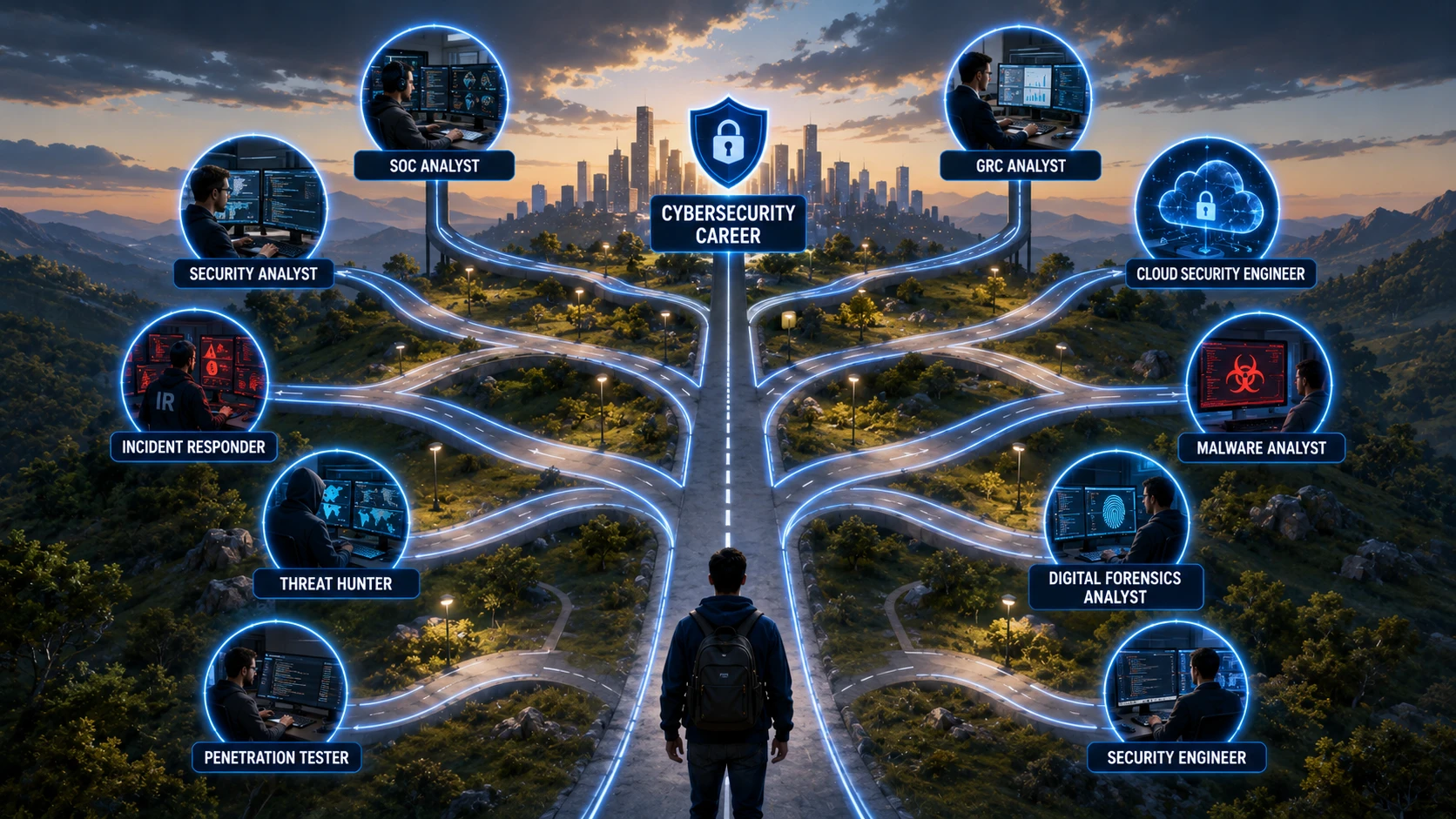
One mistake beginners make is assuming cybersecurity is a single job. In reality, it includes dozens of specializations. Choosing the right starting point depends on your interests and existing skills.
The table below compares some of the most common career paths.
| Role | Primary Responsibilities | Difficulty | Good First Role? | Approximate Salary | Key Skills |
|---|---|---|---|---|---|
| SOC Analyst | Monitor alerts, investigate incidents, triage threats | Beginner | Yes | $$ | SIEM, Windows, Networking |
| Security Analyst | Security monitoring, risk analysis, vulnerability management | Beginner | Yes | $$ | Security tools, compliance |
| Incident Responder | Investigate security incidents and coordinate containment | Intermediate | After SOC | $$$ | Forensics, Windows, Linux |
| Threat Hunter | Proactively search for hidden attackers | Advanced | No | $$$$ | SIEM, scripting, threat intelligence |
| Penetration Tester | Simulate attacks to identify vulnerabilities | Intermediate | Possible | $$$ | Networking, Linux, Web Security |
| GRC Analyst | Governance, compliance, policies, audits | Beginner | Yes | $$ | Risk management, documentation |
| Cloud Security Engineer | Secure AWS, Azure, or Google Cloud | Advanced | Later | $$$$ | Cloud platforms, IAM |
| Security Engineer | Build and manage security infrastructure | Intermediate | After experience | $$$ | Firewalls, EDR, IAM |
| Digital Forensics Analyst | Recover and analyze digital evidence | Advanced | Later | $$$ | File systems, memory analysis |
| Malware Analyst | Reverse engineer malicious software | Expert | No | $$$$ | Assembly, debugging, Windows internals |
For someone entering cybersecurity without experience, three roles consistently provide the best starting point:
- SOC Analyst
- Junior Security Analyst
- GRC Analyst
These positions expose you to real security operations while helping you develop the technical knowledge needed for more advanced roles.
Which Career Path Should You Choose?
Instead of chasing whichever role offers the highest salary, think about what type of work you enjoy.
SOC Analyst
If you enjoy investigating alerts, working with security tools, and solving incidents under pressure, the SOC is an excellent place to start.
A typical day may include:
- Reviewing SIEM alerts
- Investigating suspicious login attempts
- Analyzing phishing emails
- Escalating confirmed incidents
- Creating incident tickets
- Documenting findings
- Monitoring dashboards
Many security engineers, threat hunters, and incident responders started in a SOC because it provides exposure to real attacks.
Penetration Tester
If you enjoy understanding how attackers think and like solving technical challenges, penetration testing could be a good fit.
However, many beginners underestimate the knowledge required.
Successful penetration testers understand:
- Networking
- Linux
- Windows
- Web applications
- Active Directory
- Scripting
- Exploitation techniques
- Reporting
This is usually not the easiest first job unless you already have strong technical skills.
GRC Analyst
Not every cybersecurity role involves hacking.
Governance, Risk, and Compliance professionals help organizations manage security policies, audits, regulatory requirements, and risk assessments.
If you enjoy documentation, communication, and working with business stakeholders, GRC offers an excellent long-term career path.
Cloud Security Engineer
As companies migrate workloads to the cloud, cloud security continues to grow rapidly.
Cloud security engineers secure services such as:
- Microsoft Azure
- Amazon Web Services (AWS)
- Google Cloud Platform
These roles typically require previous experience in either cloud infrastructure or security operations.
Skills You Need Before Applying
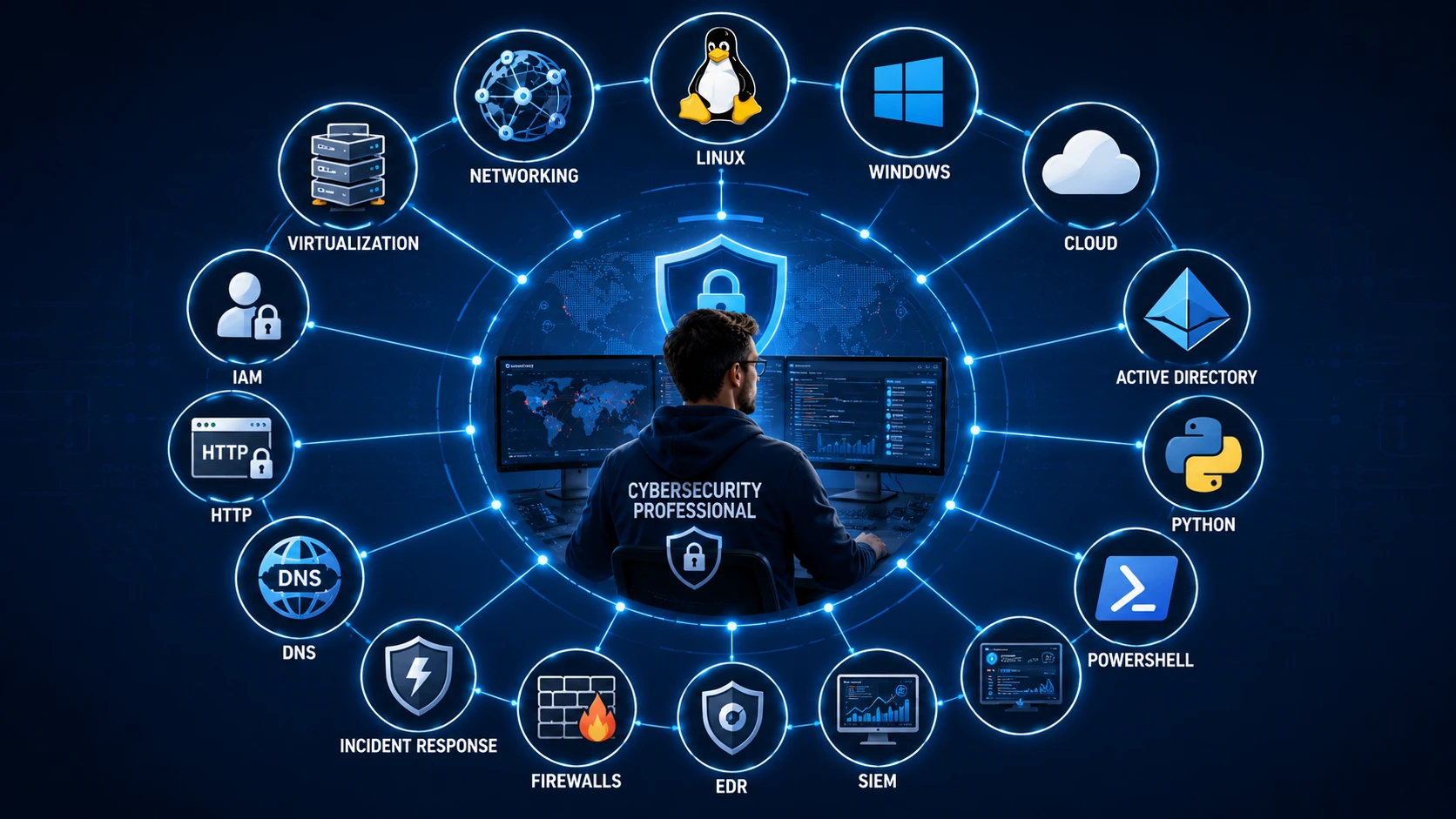
One of the biggest misconceptions about cybersecurity is that you need to learn hundreds of tools before applying for your first job.
You do not.
Instead, build strong fundamentals. Once you understand the basics, learning new security technologies becomes much easier.
Networking Fundamentals
Networking is the foundation of cybersecurity.
Attackers move across networks. Defenders monitor networks. Every security tool relies on networking concepts.
You should understand:
- IP addresses
- Subnets
- Routers
- Switches
- NAT
- DNS
- DHCP
- VPN
- TCP vs UDP
- Ports
- Firewalls
For example, if you investigate an alert showing outbound traffic to an unfamiliar IP address, you need to understand how that communication occurred before determining whether it is malicious.
Without networking knowledge, many security alerts become difficult to interpret.
Windows
Many enterprise environments still rely heavily on Windows.
You should become comfortable with:
- File systems
- Windows Services
- Event Viewer
- Local Users and Groups
- Registry basics
- Scheduled Tasks
- PowerShell
- User Account Control
- Windows Defender
One particularly important skill is reading Windows Event Logs because SOC analysts review them daily during investigations.
Linux
Linux powers web servers, cloud infrastructure, security tools, and many enterprise applications.
Learn:
- File permissions
- Basic commands
- SSH
- Process management
- Networking commands
- Package installation
- Log locations
- Bash basics
You do not need to become a Linux administrator, but you should feel comfortable navigating the command line.
TCP/IP
TCP/IP forms the backbone of Internet communication.
Understand:
- TCP handshake
- UDP communication
- Packet flow
- Ports
- Sessions
- Connection states
This knowledge becomes essential when investigating suspicious network activity.
DNS
Almost every cyberattack involves DNS at some stage.
You should understand:
- DNS resolution
- A records
- CNAME records
- MX records
- TXT records
- DNS tunneling basics
Malware often communicates through DNS before contacting command-and-control servers.
HTTP and HTTPS
Since many attacks target web applications, understanding HTTP is critical.
Learn:
- Request methods
- Response codes
- Headers
- Cookies
- Sessions
- Authentication
- TLS basics
Being able to inspect browser requests helps during phishing investigations and web security assessments.
Active Directory
If you want to work in a Security Operations Center (SOC), understanding Active Directory (AD) is one of the best investments you can make.
Active Directory is Microsoft’s directory service that manages users, computers, groups, permissions, and authentication in enterprise environments. Even as organizations adopt cloud services, many still rely on Active Directory or hybrid identity solutions.
As a beginner, you should understand:
- Organizational Units (OUs)
- Users and Groups
- Group Policy Objects (GPOs)
- Domain Controllers
- Authentication basics
- Password policies
- Privileged accounts
A common SOC alert might involve multiple failed logins against a privileged account. If you understand how Active Directory works, you’ll be able to determine whether it’s a user mistake, a password spray attack, or a brute force attempt.
Tip: Install Windows Server in a virtual machine and build your own Active Directory lab. Creating users, applying policies, and generating authentication events gives you valuable hands-on experience.
Identity and Access Management (IAM)
Identity has become one of the most important areas in cybersecurity. Instead of attacking firewalls directly, many attackers try to steal user credentials.
Identity and Access Management focuses on ensuring that the right people have the right level of access to systems and data.
Learn the basics of:
- Authentication vs authorization
- Multi-factor authentication (MFA)
- Single Sign-On (SSO)
- Role-Based Access Control (RBAC)
- Least privilege
- Privileged Access Management (PAM)
Understanding IAM also prepares you for cloud security because platforms like Microsoft Entra ID (formerly Azure AD) and AWS Identity and Access Management are used by organizations worldwide.
Cloud Fundamentals
Cloud skills are becoming essential, even for entry-level roles.
You don’t need to become an AWS or Azure expert before applying for your first job, but you should understand:
- What cloud computing is
- Infrastructure as a Service (IaaS)
- Platform as a Service (PaaS)
- Software as a Service (SaaS)
- Shared responsibility model
- Virtual machines
- Storage
- Virtual networks
- Security groups
- Identity management
Microsoft Azure is a great starting point because many organizations integrate Azure with Microsoft Defender and Microsoft Sentinel.
Virtualization
Virtualization allows you to run multiple operating systems on one computer. It is the foundation of nearly every home lab.
Popular tools include:
- Oracle VirtualBox
- VMware Workstation
- Hyper-V
- Proxmox VE
With virtualization, you can create an isolated environment where you safely experiment with malware, configure Windows domains, deploy Linux servers, and test security tools without affecting your primary computer.
Python
You do not need to become a software engineer, but basic Python knowledge will make your work much easier.
Python is widely used for:
- Automating repetitive tasks
- Parsing log files
- Threat intelligence scripts
- API integrations
- Security tooling
- File analysis
Start with:
- Variables
- Loops
- Functions
- Reading files
- JSON
- Working with APIs
Later, you can build simple scripts that search logs or extract indicators of compromise (IOCs).
PowerShell
PowerShell is the automation language for Windows.
Security analysts use it to:
- Collect system information
- Investigate incidents
- Query Windows logs
- Automate administrative tasks
- Manage Active Directory
Even basic PowerShell commands make investigations faster.
Bash
If you work with Linux servers, Bash becomes equally valuable.
Learn commands such as:
lspwdgrepfindchmodpsnetstatsscurl
Many security tools also rely on shell scripting.
SIEM Platforms
A Security Information and Event Management (SIEM) platform collects logs from multiple devices and helps analysts identify suspicious activity.
Popular SIEM platforms include:
- Microsoft Sentinel
- Splunk
- IBM QRadar
- Elastic Security
- Google Security Operations
As a beginner, you should understand:
- Log ingestion
- Dashboards
- Alerts
- Correlation rules
- Search queries
- Incident creation
You do not need years of SIEM experience. Building a small home lab with Microsoft Sentinel or Splunk Free is enough to demonstrate practical knowledge.
Endpoint Detection and Response (EDR)
Modern organizations rely on EDR solutions to detect suspicious activity on laptops, servers, and workstations.
Common platforms include:
- Microsoft Defender for Endpoint
- CrowdStrike Falcon
- SentinelOne
- VMware Carbon Black
- Cortex XDR
Understand concepts such as:
- Endpoint telemetry
- Process execution
- File reputation
- Threat detection
- Isolation
- Live response
Knowing how EDR works helps you understand how attackers are detected in real environments.
Log Analysis
Logs tell the story of what happened inside an environment.
A SOC analyst spends much of the day reviewing logs from:
- Windows Event Logs
- Linux syslog
- Firewalls
- VPN gateways
- Web proxies
- DNS servers
- Cloud platforms
- EDR tools
Instead of memorizing every log source, learn how to identify patterns.
Ask yourself:
- Who logged in?
- When?
- From where?
- What changed?
- Was the activity expected?
This investigative mindset is far more valuable than memorizing commands.
Incident Response
Incident response is the process of handling security incidents from detection to recovery.
A simplified workflow looks like this:
- Detect the alert
- Validate whether it is malicious
- Investigate affected systems
- Contain the threat
- Remove malicious activity
- Recover normal operations
- Document lessons learned
Even junior analysts participate in these stages by collecting evidence, escalating incidents, and documenting findings.
Best Cybersecurity Certifications for Beginners

Certifications can help you demonstrate commitment and foundational knowledge, but they should complement practical experience rather than replace it.
Below are some of the most valuable entry-level certifications.
| Certification | Approx. Cost | Difficulty | Best For | Hiring Value |
|---|---|---|---|---|
| ISC2 Certified in Cybersecurity (CC) | Free exam for eligible candidates or low cost | Beginner | Complete beginners | ★★★★★ |
| Google Cybersecurity Certificate | Subscription based | Beginner | Career changers | ★★★★☆ |
| CompTIA Security+ | Medium | Beginner to Intermediate | Security fundamentals | ★★★★★ |
| CompTIA Network+ | Medium | Beginner | Networking basics | ★★★★☆ |
| Microsoft SC-900 | Low | Beginner | Microsoft Security | ★★★★☆ |
| Microsoft AZ-900 | Low | Beginner | Azure fundamentals | ★★★★☆ |
| Cisco CyberOps Associate | Medium | Intermediate | SOC careers | ★★★★★ |
1. ISC2 Certified in Cybersecurity (CC)
If you are completely new to cybersecurity, this is one of the best places to start.
It introduces:
- Security principles
- Risk management
- Network security
- Access control
- Incident response
Many recruiters recognize ISC2 as a respected cybersecurity organization.
2. Google Cybersecurity Certificate
Designed for beginners, this certificate introduces practical cybersecurity concepts through guided labs and real-world scenarios.
Topics include:
- Linux
- SQL
- Security monitoring
- Python basics
- SIEM
- Incident response
It is particularly useful if you are changing careers.
3. CompTIA Security+
Security+ remains one of the most requested certifications for entry-level cybersecurity jobs.
It covers:
- Threats
- Identity
- Cryptography
- Risk management
- Network security
- Secure architecture
Many government and enterprise organizations recognize Security+ during hiring.
4. CompTIA Network+
Networking is the foundation of cybersecurity.
Network+ helps you understand:
- Routing
- Switching
- TCP/IP
- Wireless
- VPN
- Troubleshooting
A strong networking background makes every security topic easier to understand.
5. Microsoft SC-900
If you plan to work in Microsoft environments, SC-900 introduces:
- Microsoft Defender
- Microsoft Sentinel
- Identity
- Compliance
- Cloud security
Many organizations using Microsoft 365 value candidates with this knowledge.
6. Microsoft AZ-900
Cloud security starts with understanding cloud platforms.
AZ-900 teaches:
- Azure services
- Virtual machines
- Storage
- Networking
- Identity
- Pricing
It is not a security certification, but it provides an excellent cloud foundation.
7. Cisco CyberOps Associate
If your goal is to become a SOC analyst, a CyberOps Associate deserves serious consideration.
It focuses on:
- Security monitoring
- Threat analysis
- Network security
- Incident response
- Security operations
Its content aligns closely with the responsibilities of many Tier 1 SOC analysts.
Build Experience Without a Job
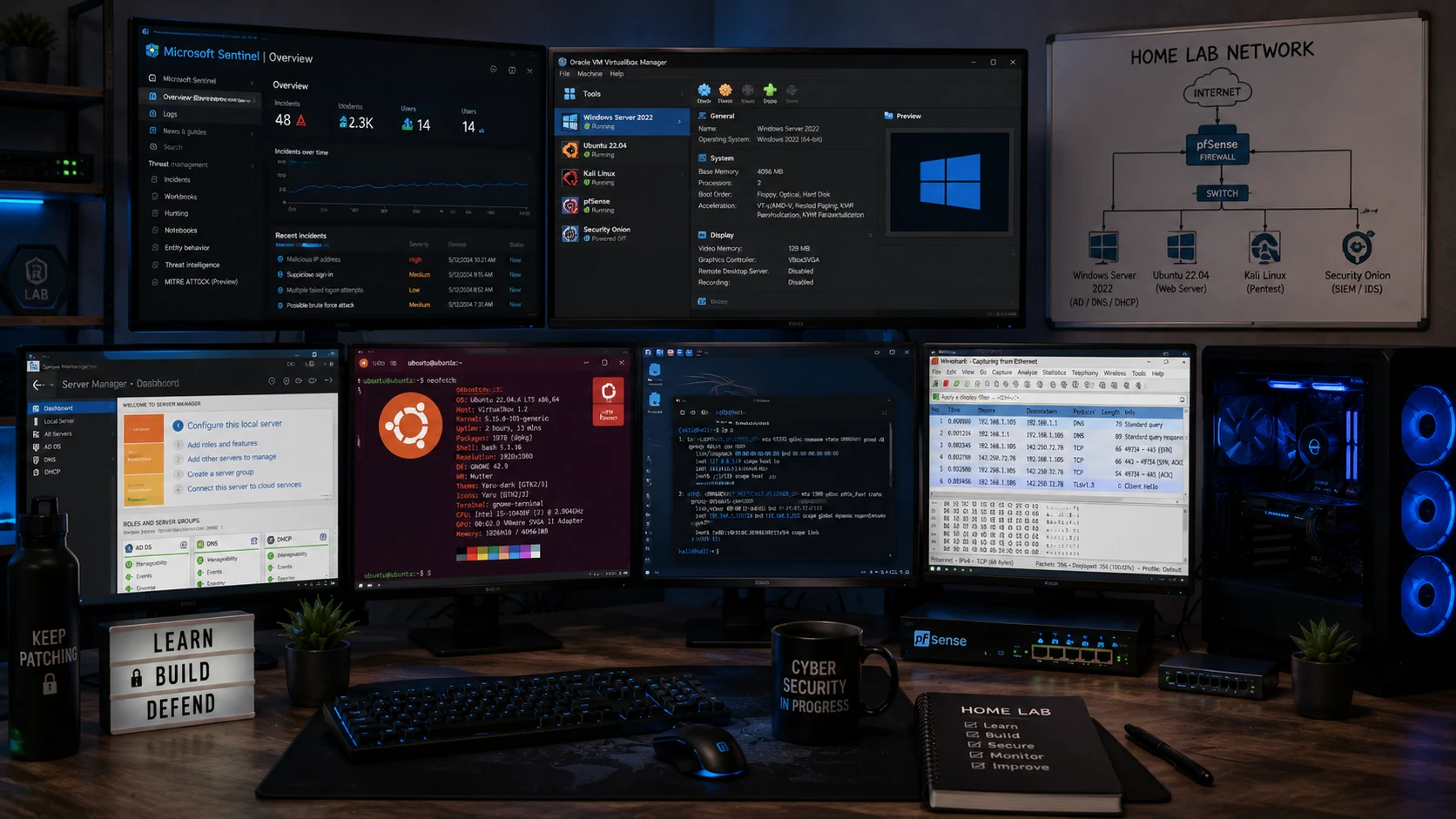
One of the biggest challenges for beginners is answering the question, “How can I get experience if no one hires me?”
The answer is simple: create your own experience.
Hiring managers are impressed by candidates who take the initiative to learn outside of a formal job.
Build a Home Lab
A home lab allows you to practice safely using real operating systems and security tools.
A beginner lab might include:
- Windows Server
- Windows 11
- Ubuntu Linux
- Kali Linux
- VirtualBox or VMware
- pfSense firewall
With this setup, you can simulate users, networks, attacks, and investigations from your own computer.
Deploy a SIEM
Install Microsoft Sentinel or Splunk Free and forward Windows logs into the platform.
Then practice:
- Searching logs
- Creating alerts
- Investigating incidents
- Building dashboards
This closely resembles the daily work of a SOC analyst.
Learn Packet Analysis
Install Wireshark and capture network traffic.
Practice identifying:
- DNS queries
- HTTP requests
- TLS handshakes
- ICMP traffic
- Suspicious connections
Packet analysis is a skill you’ll use throughout your cybersecurity career.
Practice With Real Projects
Instead of simply completing online courses, build projects that demonstrate your abilities.
Examples include:
- Investigate a brute force attack using Windows Event Logs.
- Create Sigma rules to detect suspicious PowerShell activity.
- Build a phishing investigation report.
- Analyze malicious network traffic in Wireshark.
- Deploy Microsoft Sentinel and create custom analytics rules.
- Configure Active Directory with multiple users and security groups.
- Write a Python script that extracts failed login attempts from a log file.
- Simulate ransomware detection using Sysmon logs.
Document each project in GitHub with screenshots, diagrams, objectives, and lessons learned.
A well-documented project often carries more weight than another certification because it shows recruiters that you can apply your knowledge to realistic scenarios.
Best Free Platforms to Learn Cybersecurity
You don’t need to spend thousands of dollars to build cybersecurity skills. Some of the best learning platforms are free or offer generous free content.
The key is choosing platforms that provide hands-on experience rather than just videos.
| Platform | Difficulty | Free Content | Best For | What You’ll Learn |
|---|---|---|---|---|
| TryHackMe | Beginner | Extensive | Complete beginners | Networking, Linux, Windows, SOC, Web Security |
| Hack The Box | Intermediate | Limited free labs | Offensive Security | Penetration testing, exploitation |
| CyberDefenders | Beginner to Intermediate | Yes | Blue Team | Log analysis, DFIR, malware investigations |
| Blue Team Labs Online | Beginner | Yes | SOC Analysts | Incident response, SIEM investigations |
| LetsDefend | Beginner | Yes | SOC Simulation | Realistic alert investigations |
| PortSwigger Web Security Academy | Beginner to Advanced | Completely Free | Web Security | OWASP Top 10, Burp Suite |
| Microsoft Learn | Beginner | Completely Free | Azure Security | Defender, Sentinel, Entra ID |
| Google Cloud Skills Boost | Beginner | Selected Free Labs | Cloud Security | Google Cloud fundamentals |
Start Simple
If you’re completely new, follow this sequence:
- Learn networking basics.
- Complete TryHackMe’s beginner learning paths.
- Build a Windows and Linux home lab.
- Practice SOC scenarios on LetsDefend.
- Solve Blue Team Labs challenges.
- Learn web security using PortSwigger.
- Explore Microsoft Learn for cloud security.
Avoid jumping between ten different platforms. Master one before moving to the next.
Create a Cybersecurity Portfolio
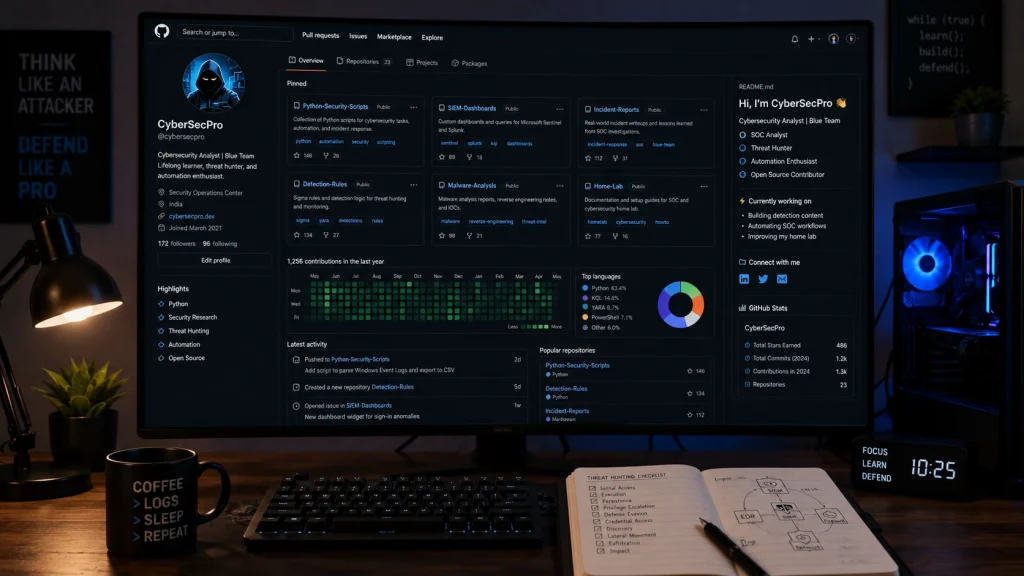
A portfolio proves you can apply what you’ve learned. It often makes a stronger impression than a long list of certifications.
Think of your GitHub profile as your cybersecurity resume.
What Should You Include?
Home Lab Documentation
Explain:
- Your virtual machines
- Network diagram
- Active Directory setup
- SIEM deployment
- Firewall configuration
Include screenshots and explain what each component does.
Detection Rules
Create Sigma or SIEM detection rules for scenarios like:
- PowerShell abuse
- Brute-force attacks
- Privilege escalation
- Suspicious account creation
- Ransomware indicators
Explain why each rule matters and what type of attack it detects.
Python Scripts
Even simple automation demonstrates initiative.
Examples include:
- IOC parser
- Log analyzer
- Hash checker
- VirusTotal API lookup
- Failed login detector
Document the purpose, input, and expected output.
Incident Reports
Pretend you’re working in a SOC.
Write reports covering:
- Executive summary
- Timeline
- Indicators of compromise
- Investigation steps
- Root cause
- Recommendations
Hiring managers appreciate candidates who can communicate technical findings clearly.
Threat Analysis
Choose a recent ransomware campaign or phishing attack and explain:
- Initial access
- Persistence
- Privilege escalation
- Defense evasion
- Impact
- Detection opportunities
Map techniques to the MITRE ATT&CK framework where appropriate.
SIEM Dashboards
If you build Microsoft Sentinel or Splunk dashboards, include screenshots showing:
- Authentication failures
- High-risk users
- Malware alerts
- Endpoint activity
- Network traffic
Explain what each dashboard helps analysts monitor.
Blog Articles
Publishing beginner-friendly cybersecurity articles shows communication skills and reinforces your knowledge.
Topics might include:
- How Active Directory works
- Windows Event IDs every SOC analyst should know
- Building a Microsoft Sentinel home lab
- Detecting brute-force attacks
- Wireshark basics
If you own a website or contribute to technical blogs, link those articles from your GitHub profile.
Build a Resume That Gets Interviews
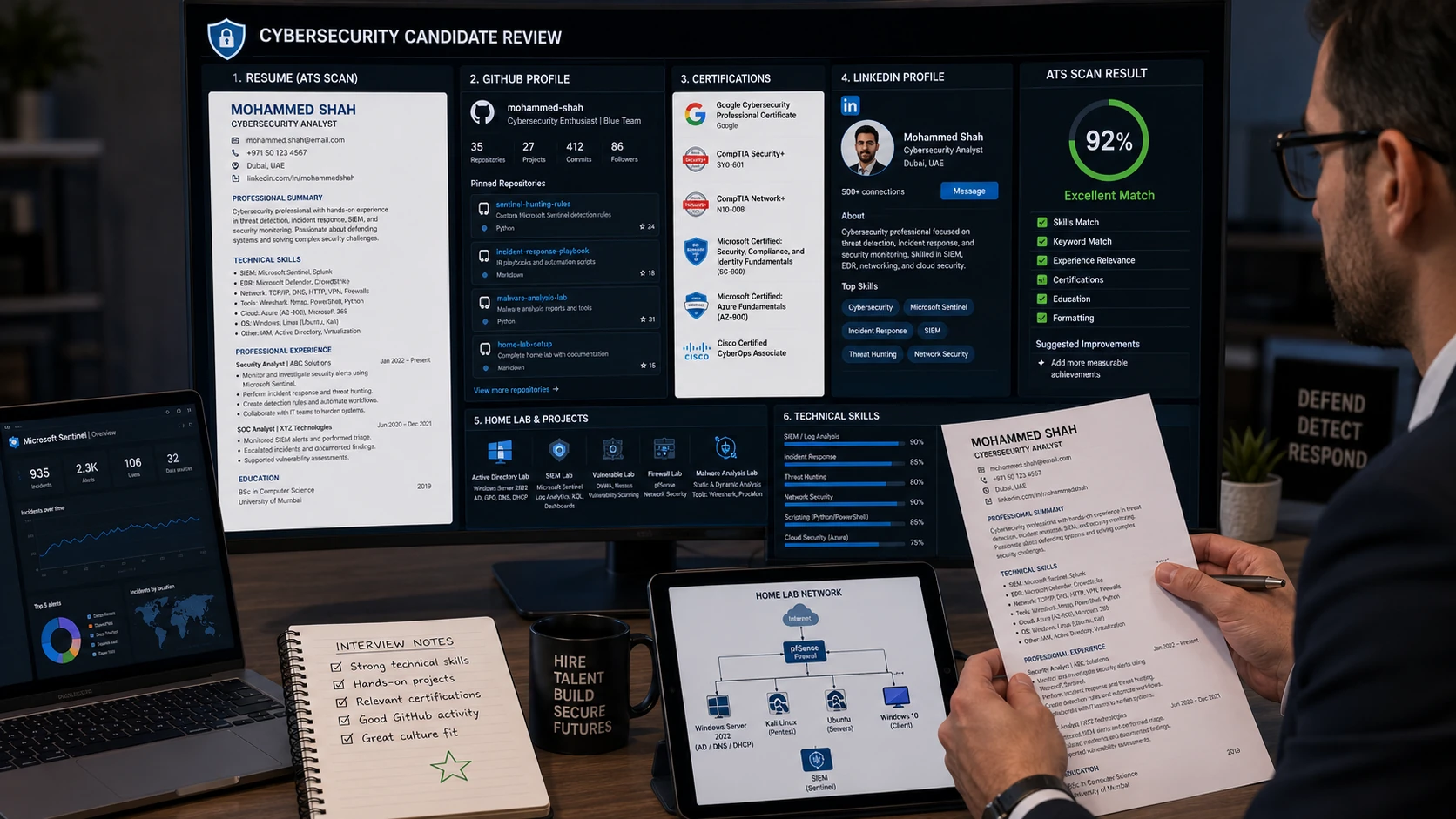
Many beginners focus almost entirely on certifications while ignoring the rest of their resume.
Recruiters usually spend less than a minute reviewing an application. Your resume should quickly answer one question:
Can this person perform the responsibilities of a junior cybersecurity role?
Include These Sections
- Professional Summary
- Technical Skills
- Certifications
- Home Lab Projects
- GitHub Portfolio
- Work Experience
- Education
- Volunteer Experience
Highlight Projects
Projects deserve almost as much attention as work experience.
Instead of writing:
Built Microsoft Sentinel lab.
Write:
Built a Microsoft Sentinel lab that collected Windows Security Logs from multiple virtual machines. Created custom analytics rules to detect brute-force attacks and suspicious PowerShell execution.
Specific accomplishments always carry more weight.
Optimize for Applicant Tracking Systems (ATS)
Many companies use ATS software before a recruiter sees your resume.
Include keywords naturally, such as:
- SIEM
- Microsoft Sentinel
- Splunk
- Incident Response
- Active Directory
- Windows Security
- Network Security
- IAM
- Threat Detection
- Vulnerability Management
- PowerShell
- Python
- Linux
Do not stuff keywords unnaturally. Make sure they reflect skills you actually have.
Common Resume Mistakes
Avoid:
- Listing 50 different tools you’ve never used.
- Including unrelated hobbies instead of projects.
- Using vague phrases like “hard-working” without evidence.
- Making your resume longer than two pages.
- Applying with the same resume for every role.
Tailor your resume to each job description.
Prepare for Cybersecurity Interviews
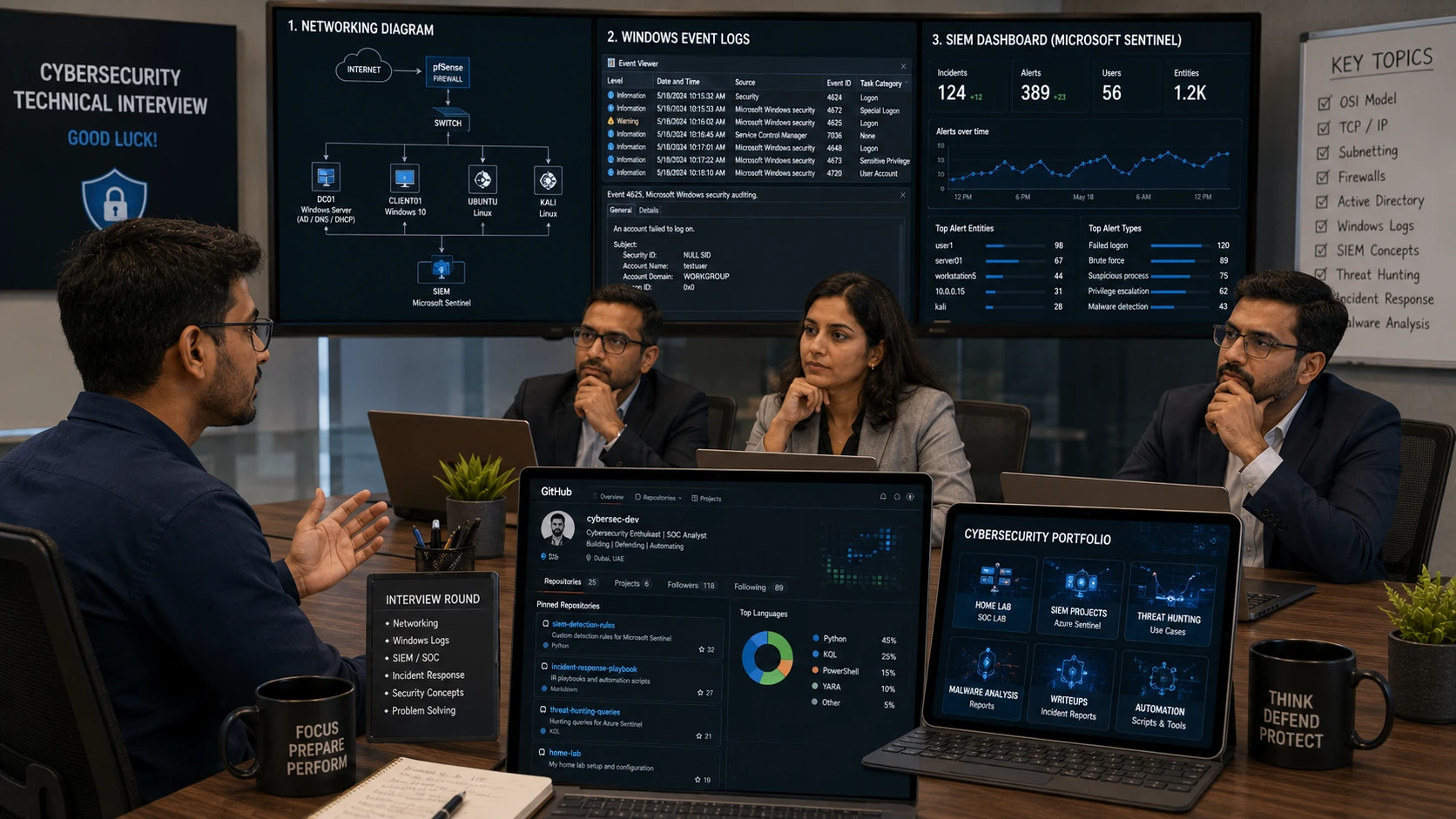
Interview preparation begins long before you receive an invitation.
Review your projects carefully because interviewers often ask about them first.
Common Technical Questions
What is the difference between TCP and UDP?
TCP provides reliable, connection-oriented communication. UDP is faster but does not guarantee delivery.
What happens when you type a website into your browser?
Explain:
- DNS lookup
- TCP handshake
- TLS negotiation
- HTTP request
- Server response
- Browser rendering
What is a SIEM?
A SIEM collects logs from multiple sources, correlates events, and helps analysts investigate security incidents.
What is phishing?
A phishing attack attempts to trick users into revealing credentials or downloading malicious files through deceptive emails, websites, or messages.
Explain the CIA Triad.
- Confidentiality
- Integrity
- Availability
Every cybersecurity professional should know this concept.
Windows Event IDs Worth Remembering
You don’t need to memorize hundreds of Event IDs, but these are commonly discussed in SOC interviews.
| Event ID | Meaning |
|---|---|
| 4624 | Successful logon |
| 4625 | Failed logon |
| 4634 | Logoff |
| 4672 | Special privileges assigned |
| 4688 | Process creation |
| 4720 | User account created |
| 4726 | User account deleted |
Knowing what these events represent demonstrates familiarity with Windows investigations.
Behavioral Questions
Expect questions like:
- Tell me about yourself.
- Describe a difficult technical problem you solved.
- How do you stay current with cybersecurity?
- Why do you want to work in cybersecurity?
- Describe a time you learned something quickly.
Use examples from your home lab, projects, or previous work experience.
Common Mistakes Beginners Make
Many aspiring professionals delay their careers by focusing on the wrong priorities.
Avoid these common mistakes.
Chasing Too Many Certifications
Certifications support your learning, but they do not replace practical experience.
Complete one certification, then apply what you’ve learned before moving to the next.
Ignoring Networking
Networking is the language of cybersecurity.
Without understanding IP addresses, DNS, ports, and routing, investigating alerts becomes much harder.
Skipping Hands-On Practice
Watching videos alone is not enough.
Install virtual machines.
Break things.
Fix them.
Document what you learned.
Not Building a Portfolio
If recruiters cannot see evidence of your work, they must rely only on your resume.
Projects help remove that uncertainty.
Expecting Immediate High Salaries
Focus on learning rather than chasing compensation during your first role.
Experience compounds quickly in cybersecurity.
Learning Without Consistency
Studying eight hours one weekend and then taking three weeks off rarely works.
A consistent schedule of one or two focused hours each day produces better long-term results.
90-Day Beginner Cybersecurity Roadmap
| Weeks | Focus |
|---|---|
| 1–2 | Networking, TCP/IP, DNS, HTTP, Linux basics |
| 3–4 | Windows, Active Directory, PowerShell, Virtual Machines |
| 5–6 | Security fundamentals, CompTIA Security+ or ISC2 CC study |
| 7–8 | Build a Microsoft Sentinel or Splunk lab, and investigate Windows logs |
| 9–10 | Complete TryHackMe and Let’s Defend SOC exercises |
| 11 | Create a GitHub portfolio, document projects, and update LinkedIn |
| 12 | Build a resume, practice interview questions, and begin applying for entry-level cybersecurity jobs. |
Stay consistent. Even one or two focused hours each day will produce meaningful progress over three months.
Final Thoughts
Starting a cybersecurity career without professional experience may seem challenging, but it is far from impossible. Every experienced security professional was once a beginner who had to learn networking, investigate their first security alert, and build confidence through practice.
Instead of trying to master every cybersecurity domain, focus on building strong fundamentals. Learn how networks communicate, become comfortable with Windows and Linux, understand common cyber threats, and practice using security tools in a home lab. Pair that technical knowledge with beginner-friendly certifications, documented projects, and a well-organized GitHub portfolio that showcases your abilities.
Remember that recruiters and hiring managers are not looking for someone who knows everything. They are looking for someone who demonstrates curiosity, consistency, and the ability to solve problems. Every lab you complete, every incident report you write, and every project you publish moves you one step closer to your first cybersecurity role.
The journey may take several months, but the investment is worthwhile. Stay consistent, keep learning, seek feedback, and continue applying your knowledge in practical ways. Your first cybersecurity opportunity is much more likely to come from demonstrated skills and persistence than from collecting certifications alone.
Frequently Asked Questions
Can I get into cybersecurity with no experience?
Yes. Employers often value practical projects, certifications, home labs, and problem-solving skills over previous cybersecurity job titles.
Do I need a computer science degree?
No. Many successful cybersecurity professionals come from engineering, business, mathematics, military, and IT support backgrounds.
Which certification should I earn first?
ISC2 Certified in Cybersecurity (CC) and CompTIA Security+ are excellent starting points for most beginners.
Most beginners can build a solid foundation within three to six months through consistent study and hands-on practice.
Is Python mandatory?
No, but learning basic Python makes automation, scripting, and security analysis much easier.
Which cybersecurity role is easiest to enter?
SOC Analyst, Junior Security Analyst, and GRC Analyst are among the most accessible entry-level positions.
Can I get hired without certifications?
Yes, especially if you have strong projects and practical skills. Certifications improve your chances, but are not the only path.
Is cybersecurity stressful?
It can be during active incidents, but the level of pressure depends on your role, employer, and responsibilities.
What should I learn first?
Start with networking, Windows, Linux, security fundamentals, and hands-on labs before moving to advanced topics.
