Cyber Security Health Check: What It Covers
A cyber security health check gives a business a practical view of how well its current security controls are working. It can uncover exposed systems, excessive access, missing patches, cloud misconfigurations, monitoring gaps, and weaknesses in backup or incident response before they become serious problems.
The review looks beyond individual vulnerabilities. It considers how technology, people, processes, and security controls work together, then helps the business decide which risks need attention first.
This guide explains what a cyber security health check covers, how it differs from a security assessment and vulnerability assessment, how the process works, and what businesses should do after the review.
What Is a Cyber Security Health Check?
A cyber security health check is a structured review of an organisation's security environment. It can examine networks, endpoints, identities, cloud infrastructure, applications, sensitive data, monitoring, backups, and incident response processes.
It is similar to a health check in the sense that it looks for weaknesses before they become serious problems.
A typical review may identify:
Unpatched or unsupported systems
Exposed services and unnecessary open ports
Weak authentication controls
Excessive administrator privileges
Unmanaged or unknown devices
Misconfigured cloud resources
Inadequate security logging
Weak backup and recovery controls
Gaps in incident response
Poor protection for sensitive data
A health check is broader than simply running a vulnerability scanner. A vulnerability assessment focuses primarily on known technical weaknesses, while a health check considers how different security controls work together.
For a deeper explanation of the broader assessment process, see Cyber Security Assessment: Types, Process & Free Checklist.
What Does a Cyber Security Health Check Cover?
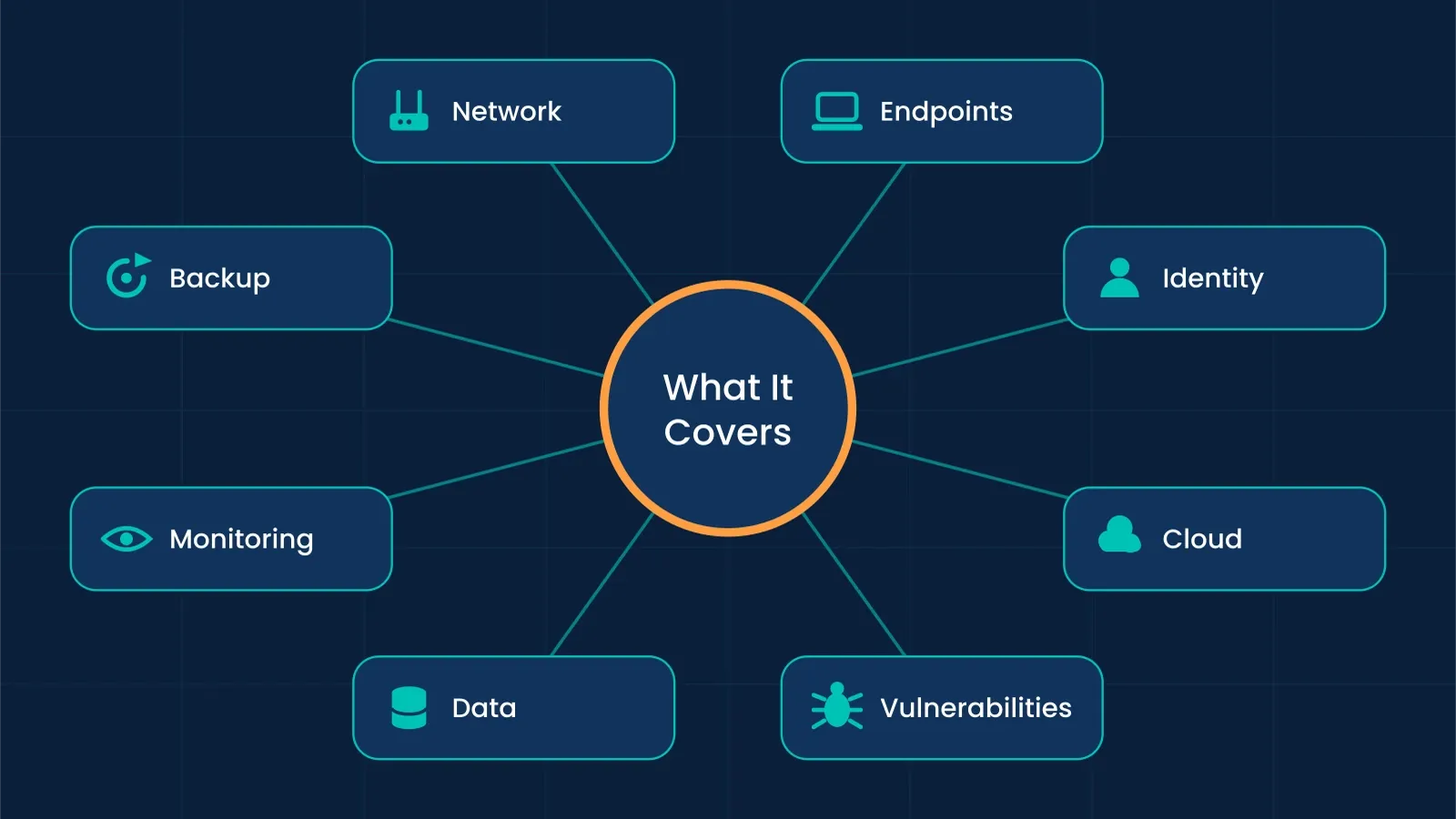
The exact scope depends on the organisation, but most health checks should examine several core areas.
1. Network and Infrastructure Security
The review should examine firewalls, routers, remote access systems, VPNs, exposed services, network segmentation, and internet-facing infrastructure.
The objective is to identify unnecessary exposure and determine whether critical systems are adequately separated from lower-trust environments.
Internet-facing systems deserve particular attention because attackers can discover and target them without needing access to the internal network first.
2. Endpoint and Device Security
Laptops, desktops, servers, and remote workstations are common attack targets.
A health check should determine whether endpoints are:
Properly patched
Protected by endpoint security tools
Centrally managed
Supported by current operating systems
Monitored for suspicious behaviour
Covered when employees work remotely
Organisations with limited internal security resources may benefit from managed endpoint detection and response. Managed Endpoint Detection and Response: Benefits & Tools explains how EDR combines endpoint telemetry, behavioural detection, monitoring, threat hunting, and response capabilities.
3. Identity and Access Management
Compromised credentials are a major security concern, making identity controls an important part of any health check.
The review should consider whether the organisation uses MFA for sensitive accounts, follows least-privilege principles, regularly reviews administrator access, and removes inactive accounts.
It should also examine service accounts, shared credentials, privileged accounts, and access belonging to former employees or contractors.
The question is simple: does every person and system have only the access it actually needs?
4. Cloud Security
Cloud environments can change quickly, and a single configuration mistake can expose sensitive resources.
A cloud-focused health check should examine:
Identity and access permissions
Publicly exposed resources
Storage permissions
Security groups
Encryption
Logging
Secrets and credentials
Network configuration
Backup controls
CyberLad's Cloud Infrastructure Security: The Complete Guide for 2026 provides additional context on protecting cloud environments and managing configuration risks.
5. Vulnerability Management
A health check should determine whether vulnerabilities are being identified, prioritised, remediated, and verified.
This includes checking for:
Missing security patches
Unsupported software
Critical CVEs
Exposed systems
Weak configurations
Unnecessary services
Vulnerabilities affecting internet-facing assets
Finding vulnerabilities is only the first step. Businesses also need ownership, remediation deadlines, and a process for confirming that important weaknesses have actually been fixed.
For a closer look at how vulnerability assessment differs from active security testing, see our Penetration Testing and Vulnerability Assessment Strategy.
6. Data Protection
The review should identify what sensitive information the organisation holds, where it is stored, who can access it, and how it moves between systems.
This may include customer information, financial records, credentials, intellectual property, employee records, and other confidential data.
Controls should cover appropriate access restrictions, encryption, secure transfer, retention, and monitoring for unauthorised data movement.
CyberLad's Data Leak Prevention: Complete Guide, Tools & Best Practices provides a deeper look at protecting sensitive information from unauthorised disclosure.
7. Security Monitoring and Logging
A health check should examine whether important systems generate useful security logs and whether those logs are actually monitored.
The review should consider:
Authentication events
Privilege changes
Endpoint activity
Network activity
Cloud events
Suspicious processes
Security alerts
Incident escalation
Log retention
Strong preventive controls do not guarantee that an organisation will detect an attack quickly. Monitoring provides the visibility needed to identify suspicious activity and respond to it.
For a deeper look at continuous security visibility, see our Cyber Security Monitoring: Best Practices Guide 2026.
8. Backup and Recovery
Backups are not useful if ransomware or another incident can destroy them along with production systems.
A health check should verify whether critical data is backed up, how frequently backups occur, where copies are stored, who controls them, and whether restoration has been tested.
Recovery procedures should also define which business services need to be restored first.
What Should a Cyber Security Health Check Report Include?
A health check should produce more than a list of vulnerabilities. The final report should give the business a clear view of its current security posture and what needs to happen next.
A useful report may include:
Executive summary: The most important security risks in plain business language
Scope and methodology: Systems, locations, technologies, and controls reviewed
Key findings: Security weaknesses, gaps, and misconfigurations identified
Risk ratings: A prioritised view of which findings require the most attention
Business impact: What a weakness could mean for operations, data, customers, or regulatory obligations
Remediation recommendations: Practical steps for addressing each important finding
Ownership and timelines: Who should address the issue and how quickly
Verification requirements: How the business can confirm that important findings have been properly resolved
This makes the health check useful to both technical teams and management. Security teams can use the findings to plan remediation, while business leaders can understand where security investment should be prioritised.
A good report should ultimately answer three questions: What is wrong? How serious is it? What should we do about it?
Cyber Security Health Check vs Security Assessment
These terms can overlap, and their exact scope depends on the provider. In practice, a health check usually refers to a practical review of an organisation's current security controls and weaknesses. A formal security assessment may use a defined framework, methodology, or compliance requirement and can involve a broader analysis of risk and control effectiveness.
Approach | Primary purpose |
|---|---|
Cyber security health check | Practical review of current security posture |
Cyber security assessment | Broader evaluation of risks, controls, vulnerabilities, and processes |
Vulnerability assessment | Identify known technical weaknesses |
Penetration test | Determine whether selected weaknesses can be exploited |
Security audit | Verify compliance with defined requirements |
A penetration test is different because it actively attempts to exploit weaknesses within an approved scope. A vulnerability assessment focuses primarily on identifying known technical weaknesses.
These approaches can complement each other. A business might use a health check to understand its overall security posture, vulnerability assessment to identify technical weaknesses, and penetration testing to validate whether selected weaknesses can actually be exploited.
How Does a Cyber Security Health Check Work?
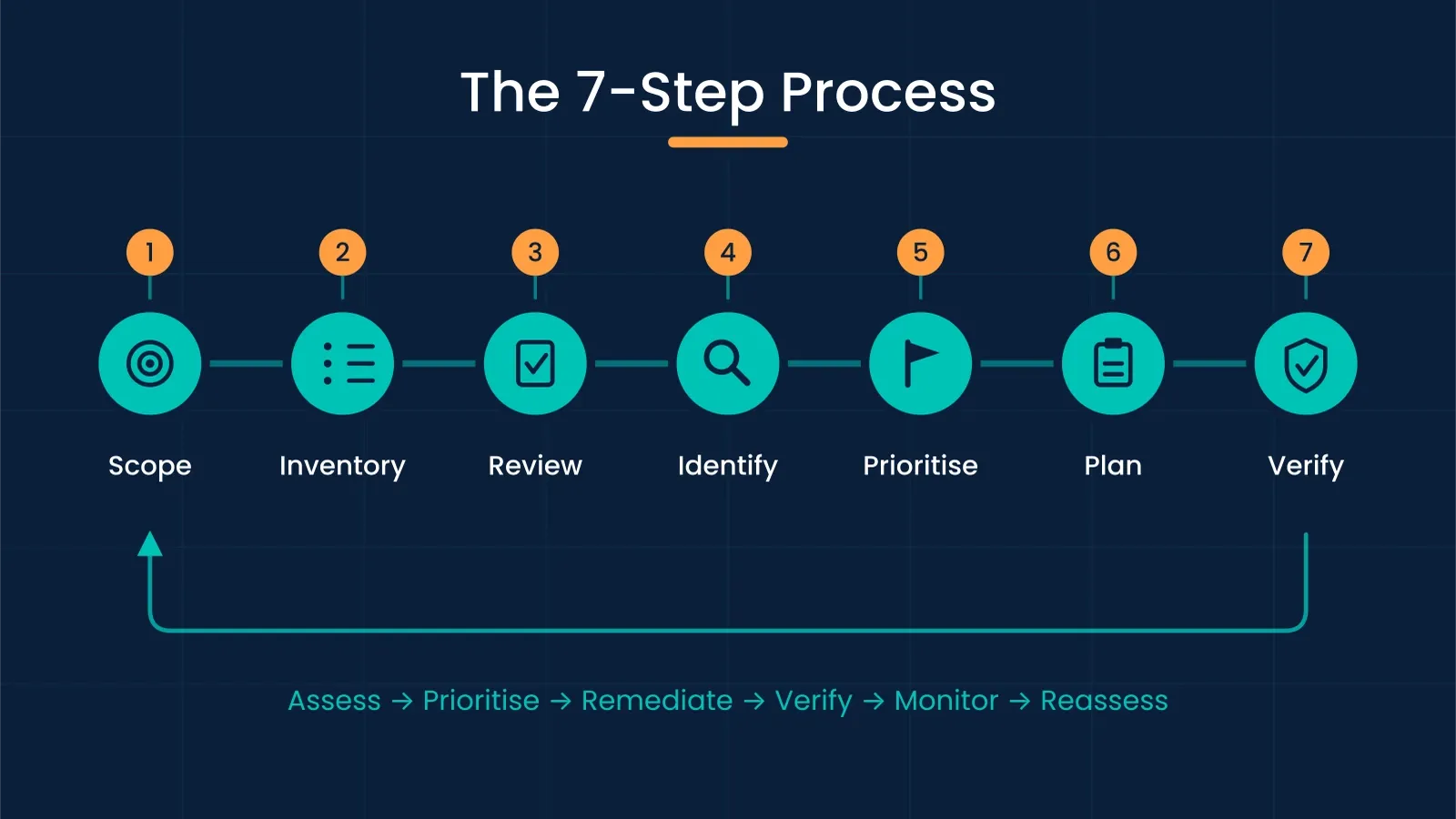
A useful health check follows a structured process.
1. Define the Scope
Start by deciding what will be reviewed.
This might include corporate networks, endpoints, applications, cloud infrastructure, remote access, identities, sensitive data, third-party connections, and security policies.
2. Build an Asset Inventory
You cannot protect assets you do not know exist.
The review should identify servers, endpoints, applications, cloud resources, user accounts, network devices, and important data.
Unknown or unmanaged assets can create security blind spots.
3. Review Existing Controls
Next, examine the controls already in place.
This includes firewalls, MFA, endpoint protection, access management, patching, monitoring, backups, security policies, and incident response procedures.
The objective is not simply to ask whether a control exists. It is to determine whether it is configured correctly and consistently managed.
4. Identify Security Gaps
Technical scanning, configuration reviews, interviews, documentation checks, and manual analysis can reveal weaknesses.
The strongest health checks combine automated tools with human review because scanners alone cannot understand every business context or attack path.
5. Prioritise Risk
Not every finding deserves the same response.
A critical vulnerability on an internet-facing system processing sensitive information may require immediate attention. A lower-risk issue on an isolated development system may not.
Risk should therefore be considered alongside exploitability, exposure, asset importance, data sensitivity, and potential business impact.
6. Create a Remediation Plan
Each significant finding should have an owner, recommended action, priority, and target timeline.
This turns the health check from a report into an actionable security programme.
7. Verify Remediation
After important weaknesses are fixed, they should be retested or otherwise verified.
The process should continue as:
Assess → Prioritise → Remediate → Verify → Monitor → Reassess
Common Problems a Health Check Can Uncover
A health check frequently exposes issues that have developed gradually rather than through one major mistake.
Common examples include:
Outdated operating systems and applications
Missing MFA on privileged accounts
Excessive administrative permissions
Poor network segmentation
Publicly exposed cloud resources
Incomplete endpoint coverage
Weak security logging
Untested backups
Unclear incident response responsibilities
Unknown or unmanaged assets
The important point is that these weaknesses can interact.
An attacker might compromise a poorly protected endpoint, steal credentials, gain excessive privileges, move through a poorly segmented network, and reach sensitive systems.
The individual weaknesses may appear manageable in isolation. Together, they can create a serious attack path.
Why Does a Cyber Security Health Check Matter to the Business?
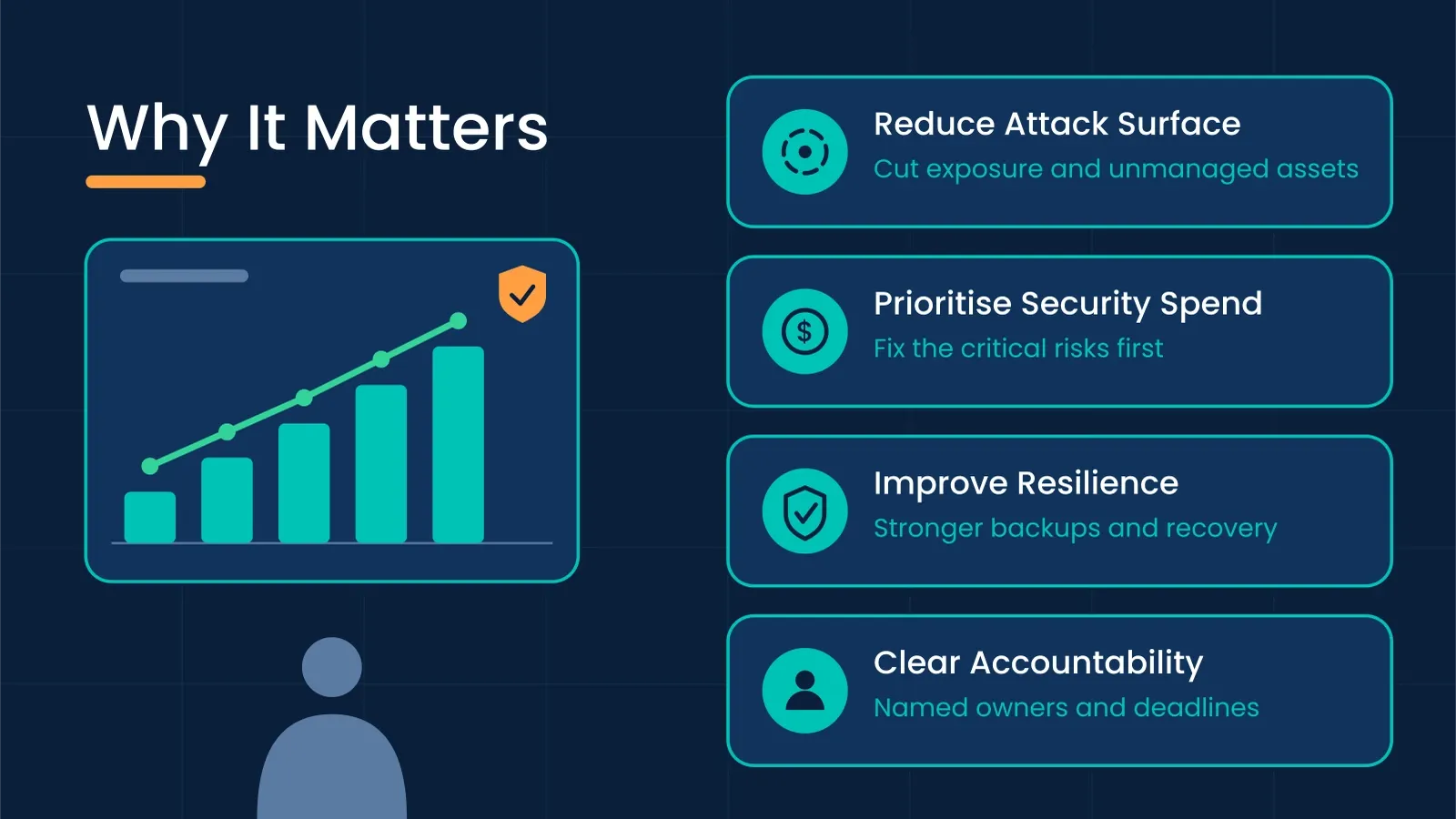
The value of a health check is not limited to finding technical vulnerabilities. It helps businesses make better decisions about security risk and investment.
A health check can help an organisation:
Reduce its attack surface by identifying unnecessary exposure and unmanaged assets
Prioritise security spending by separating critical risks from lower-priority issues
Improve resilience by identifying weaknesses in backups, recovery, and incident response
Reduce security blind spots by reviewing systems, identities, cloud resources, and third-party access
Support management decisions with a clearer picture of current security risks
Prepare for change by identifying weaknesses before major technology or business changes
Improve accountability by assigning findings to specific owners with remediation timelines
Security maturity is not measured by how many security tools a business owns. It is measured by whether those controls are configured correctly, monitored, maintained, and capable of reducing meaningful risk.
A health check helps identify where that security maturity is strong and where it needs improvement.
How Often Should a Business Conduct a Cyber Security Health Check?
For many organisations, a comprehensive review at least once a year is a reasonable baseline.
Higher-risk environments may require more frequent reviews of specific areas.
A new health check may also be appropriate after:
A major security incident
Cloud migration
Acquisition or merger
Major infrastructure changes
New third-party access
Deployment of critical applications
Significant regulatory changes
Major changes to remote working
Annual reviews should not replace continuous security practices. Vulnerability management, monitoring, patching, endpoint protection, and incident response need to operate throughout the year.
What Happens After a Cyber Security Health Check?
The report should lead directly into remediation.
First, prioritise the highest-risk findings. Then assign ownership and establish realistic deadlines.
Critical issues may require immediate action, while architectural improvements can become longer-term projects.
Once fixes are implemented, verify them. If the same problem keeps returning, investigate the underlying process rather than repeatedly fixing individual symptoms.
For example, repeated unpatched vulnerabilities may indicate a weak patch-management process rather than a series of unrelated technical failures.
The ultimate objective is continuous improvement, not a perfect score on a single assessment.
Cyber Security Health Check Checklist
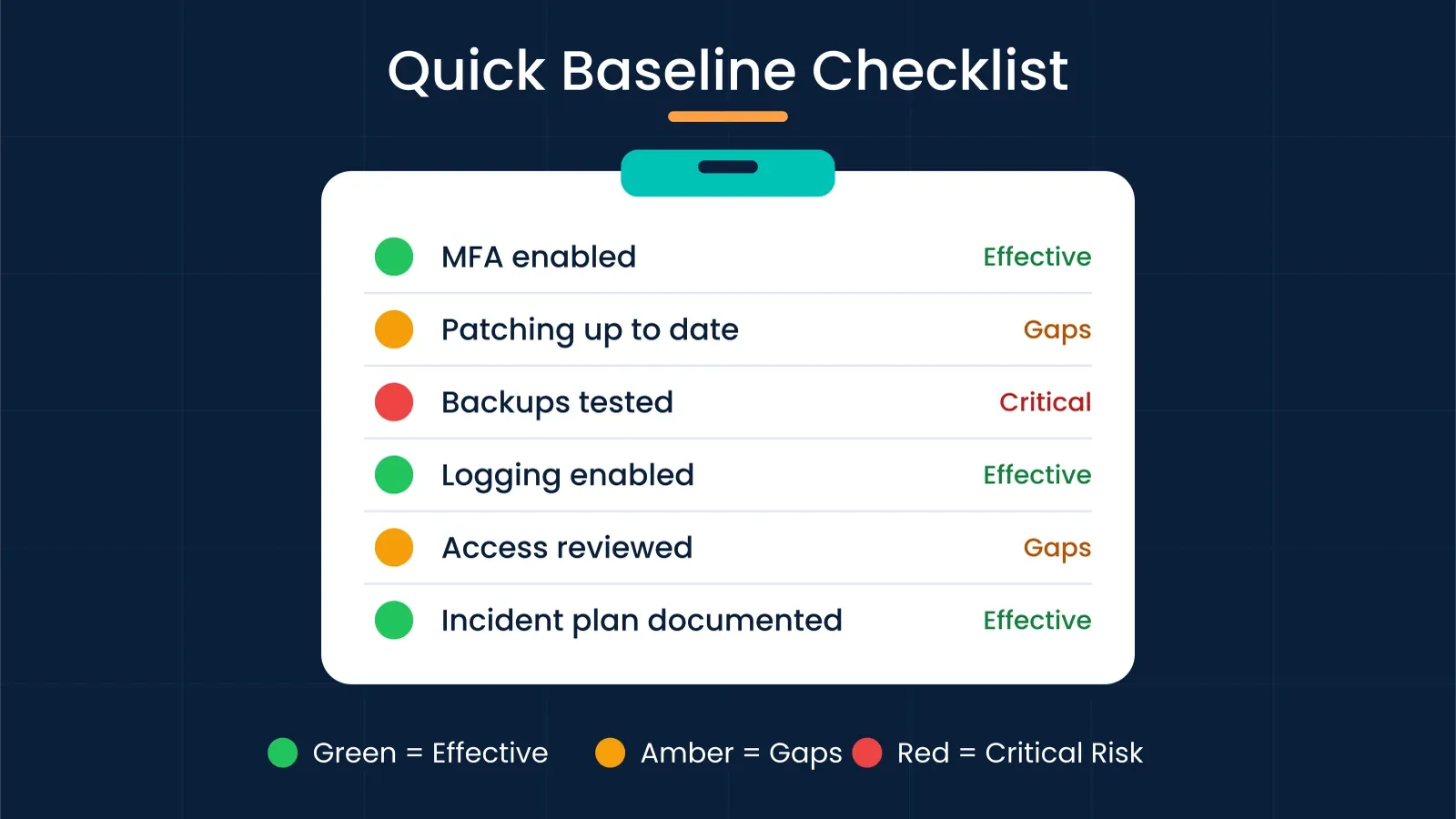
Use this checklist as a quick baseline review:
Maintain an accurate asset inventory
Enable MFA for privileged and sensitive accounts
Review administrator permissions
Remove inactive accounts
Patch operating systems and applications
Scan for vulnerabilities regularly
Review internet-facing systems
Protect endpoints with appropriate security controls
Review cloud permissions and exposed resources
Identify and protect sensitive data
Enable security logging on critical systems
Monitor important security events
Maintain tested backups
Document incident response procedures
Review third-party access
Test security controls periodically
A simple Green, Amber, or Red rating can make the checklist easier to use:
Rating | Meaning | Example |
|---|---|---|
Green | Control is implemented and operating effectively | MFA is enforced across privileged accounts |
Amber | Control exists but has gaps or inconsistent coverage | MFA is enabled for some sensitive users but not all |
Red | Control is missing, ineffective, or presents significant risk | Privileged accounts have no MFA |
The rating should reflect both the state of the control and the risk associated with the gap. A business should not automatically treat every Amber finding as equally important.
Use the ratings to create a prioritised remediation plan rather than simply counting how many areas are Green, Amber, or Red.
When Should You Get Professional Help?
Internal IT teams can handle many security checks, but external expertise can provide useful independence and specialist knowledge.
Professional support is particularly valuable when a business:
Has no dedicated cybersecurity team
Has a complex cloud environment
Has recently experienced an incident
Is undergoing rapid growth
Is preparing for compliance requirements
Has repeated security findings
Needs independent validation
Wants to improve security monitoring
An external consultant can also help connect technical findings to business risk.
Our Cyber Security Consultant: What They Do & Why You Need One explains how specialist consultants can support organisations with security assessment, risk identification, and security improvements.
The objective does not have to be outsourcing the entire security function. A focused assessment can identify the most important gaps while allowing the internal team to handle remediation.
Conclusion
A cyber security health check gives a business a practical view of its current security posture.
It can reveal vulnerabilities, excessive access, configuration problems, monitoring gaps, exposed assets, weak recovery processes, and other risks before attackers exploit them.
The real value comes from what happens afterward.
Businesses should use the findings to prioritise risk, assign ownership, fix weaknesses, verify remediation, and continuously monitor their environment.
Cybersecurity is not a one-time project. Systems change, employees change, vendors change, cloud environments change, and attackers change their techniques.
A regular cyber security health check helps ensure that the security strategy changes with them.
Frequently Asked Questions
1. What is a cyber security health check?
A cyber security health check is a structured review of an organisation's security controls, systems, users, devices, networks, cloud environments, and processes. It identifies weaknesses and helps prioritise security improvements.
2. What does a cyber security health check include?
It can include network security, endpoint protection, identity and access management, cloud security, vulnerability management, data protection, monitoring, backups, and incident response.
3. How often should a business conduct a cyber security health check?
Many businesses should conduct a comprehensive review at least annually. Higher-risk organisations may need more frequent reviews, especially after major technology changes or security incidents.
4. What is the difference between a cyber security health check and a vulnerability assessment?
A vulnerability assessment primarily identifies known technical weaknesses. A cyber security health check is broader and can also examine access controls, monitoring, cloud configuration, backups, data protection, and incident response.
5. How long does a cyber security health check take?
The timeframe depends on the size and complexity of the environment. A small business may require a relatively short review, while larger organisations with multiple offices, cloud environments, applications, and third-party connections need a broader assessment.
6. What happens after a cyber security health check?
Findings should be prioritised and assigned to responsible owners. High-risk weaknesses should be remediated first, followed by verification to confirm the fixes worked.
7. Does every business need a professional cyber security health check?
Not necessarily. Organisations with experienced internal security teams may perform much of the review themselves. External expertise becomes particularly useful when internal resources are limited, or the environment is complex, changing rapidly, or affected by a recent incident.
8. How much does a cyber security health check cost?
The cost depends on the size and complexity of the environment and the scope of the review. Factors can include the number of users and devices, locations, cloud infrastructure, applications, third-party connections, and whether technical testing is included.
A small business with a limited environment may require a narrower review, while a larger organisation may need a more detailed assessment across multiple systems and locations. The most useful approach is to define the scope first and then determine the level of assessment required.