



Remote cybersecurity internships help you gain real-world security experience from anywhere while building skills in threat detection, cloud security, penetration testing, and incident response. These internships can open the door to full-time cybersecurity careers without requiring relocation.
Breaking into cybersecurity feels overwhelming when every job posting asks for experience.
You keep seeing entry-level roles demanding certifications, scripting knowledge, cloud skills, and security experience all at once. That creates a frustrating cycle because you need experience to get hired, but you need a job to gain experience.
That’s exactly why remote cybersecurity internships matter.
They give you a realistic entry point into the industry.
Instead of competing only for local opportunities, you can now apply to companies worldwide. Security teams operate remotely more than ever before, and organizations have become comfortable hiring interns who work online.
You can monitor security alerts from home, investigate phishing attempts, assist with vulnerability scans, document incidents, and collaborate with global security teams without stepping into a physical office.
That flexibility has transformed cybersecurity recruiting.
Remote internships are now available across:
- SOC operations
- Cloud security
- Application security
- Threat intelligence
- Governance and compliance
- Incident response
- Security engineering
The challenge is that thousands of candidates apply for the same positions.
Many applicants submit generic resumes with no technical proof, no projects, and no practical experience. Employers filter those applications quickly.
If you want interviews, you need to position yourself differently.
This guide will show you:
- The best types of remote cybersecurity internships
- Skills companies expect from interns
- How to build experience before applying
- Where to find legitimate opportunities
- How to stand out against other applicants
- Salary expectations and career growth potential
- Mistakes that quietly destroy internship applications
By the end, you’ll understand how to build a strong path toward your first remote cybersecurity internship, even if you’re starting with limited experience.
Check out our latest post on GSOC Security: Global Security Operations Center
Why Remote Cybersecurity Internships Are Expanding So Fast
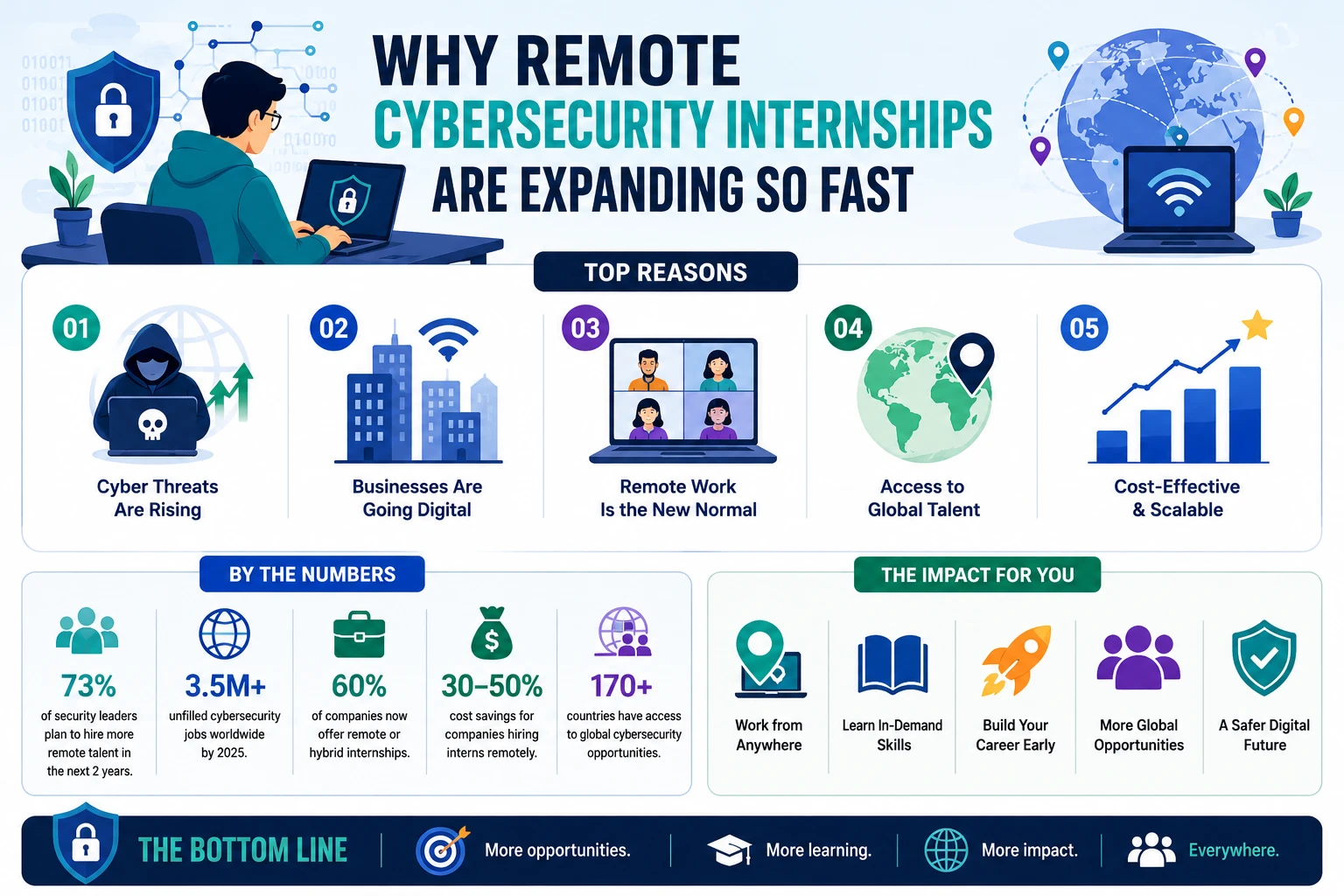
Cybersecurity became one of the most remote-friendly technology industries because security work already relied heavily on digital infrastructure.
Security analysts monitor systems online.
Threat hunters investigate cloud-based activity.
Incident responders collaborate through remote communication platforms.
Compliance teams manage documentation digitally.
That made remote hiring easier for employers.
At the same time, organizations face a serious cybersecurity talent shortage. Businesses struggle to hire enough security professionals to protect modern infrastructure, especially as ransomware attacks, phishing campaigns, cloud breaches, and identity-based attacks continue to increase.
Companies realized internships could help them build future talent pipelines earlier.
Remote internships solve multiple problems simultaneously.
For employers, remote programs:
- Reduce overhead costs
- Expand hiring beyond local markets
- Increase workforce diversity
- Create access to global talent
- Improve scheduling flexibility
For you, the benefits are even more valuable.
You Can Apply Globally
Years ago, your internship options depended heavily on your location.
Now you can apply to:
- Technology companies
- Financial institutions
- Managed security providers
- Government contractors
- Healthcare organizations
- Security startups
across multiple countries.
That dramatically increases your opportunities.
You Gain Real Security Experience
Cybersecurity employers care about practical ability.
A certification helps, but real experience matters more.
During a remote internship, you may work with:
- SIEM platforms
- Endpoint detection tools
- Cloud dashboards
- Security monitoring systems
- Incident management workflows
- Threat intelligence platforms
That hands-on exposure improves your resume immediately.
You Build Professional Credibility
Internships give you professional references and industry connections.
That matters because cybersecurity hiring often depends heavily on networking and referrals.
The people you work with during your internship may later help you secure:
- Junior analyst roles
- Security engineering positions
- Cloud security jobs
- Internal referrals
- Mentorship opportunities
You Learn How Modern Security Teams Operate
Remote work has become standard across many cybersecurity environments.
Internships teach you how to:
- Communicate asynchronously
- Write professional documentation
- Manage tasks independently
- Collaborate across time zones
- Present findings clearly
Those skills improve your long-term employability.
Competition Is Extremely High
There’s one reality you need to understand.
Remote cybersecurity internships attract massive numbers of applicants.
Some listings receive thousands of applications within days.
That means enthusiasm alone won’t separate you.
You need:
- Practical projects
- Technical fundamentals
- Strong communication skills
- A targeted resume
- Consistent application efforts
Fortunately, many applicants still apply with weak preparation.
If you build real technical skills and demonstrate initiative, you can stand out faster than you think.
Best Types of Remote Cybersecurity Internships
Cybersecurity includes multiple career paths.
Understanding the different internship categories helps you focus your learning and apply strategically.
| Internship Type | Main Responsibilities | Best For | Difficulty Level | Average Pay |
|---|---|---|---|---|
| SOC Analyst Internship | Monitor alerts and investigate incidents | Beginners | Moderate | $15 to $30/hour |
| Penetration Testing Internship | Simulate attacks and identify vulnerabilities | Technical learners | High | $25 to $45/hour |
| Cloud Security Internship | Secure AWS, Azure, and cloud systems | Cloud-focused candidates | High | $30 to $50/hour |
| GRC Internship | Risk analysis and compliance documentation | Business-oriented candidates | Moderate | $18 to $35/hour |
| Threat Intelligence Internship | Research cyber threats and attacker tactics | Analytical learners | Moderate | $20 to $40/hour |
| Application Security Internship | Review code and secure applications | Developers | High | $30 to $55/hour |
| Incident Response Internship | Assist with breach investigations | Fast learners | High | $25 to $45/hour |
SOC Analyst Internships
Security Operations Center internships are often the best entry point for beginners.
You’ll learn how organizations detect suspicious activity and respond to threats.
Typical responsibilities include:
- Reviewing security alerts
- Monitoring SIEM dashboards
- Investigating phishing attempts
- Escalating suspicious activity
- Documenting incidents
- Reviewing endpoint events
This role helps you build strong defensive security foundations.
Many successful cybersecurity professionals start in SOC environments before specializing.
Penetration Testing Internships
Penetration testing internships focus on offensive security.
You simulate attacks to identify vulnerabilities before real attackers exploit them.
These internships usually require stronger technical knowledge.
You’ll often need experience with:
- Linux
- Networking
- Web security
- Scripting
- Vulnerability scanning
Common tools include:
- Burp Suite
- Nmap
- Metasploit
- Wireshark
- Kali Linux
These positions are highly competitive because many beginners target ethical hacking roles first.
Cloud Security Internships
Cloud security demand continues to grow rapidly.
Businesses rely heavily on AWS, Azure, and Google Cloud infrastructure, which creates constant demand for cloud-focused security professionals.
Remote cloud security interns may assist with:
- Identity management
- Access control reviews
- Security monitoring
- Cloud configuration analysis
- Container security
- Compliance validation
Cloud security experience can significantly improve your future earning potential.
Governance, Risk, and Compliance Internships
Not every cybersecurity role involves technical hacking.
Governance, Risk, and Compliance positions focus on organizational security processes.
You may work on:
- Security policies
- Audit preparation
- Risk assessments
- Compliance documentation
- Framework implementation
This path works well if you have strengths in:
- Communication
- Documentation
- Business operations
- Law or compliance
- Project coordination
Application Security Internships
Application security internships are ideal if you already know programming.
These roles focus on securing software and web applications.
You may help with:
- Secure code review
- API security testing
- Vulnerability analysis
- Static analysis tools
- OWASP Top 10 testing
Developers transitioning into cybersecurity often perform well in AppSec roles.
Skills You Need Before Applying for Remote Cybersecurity Internships
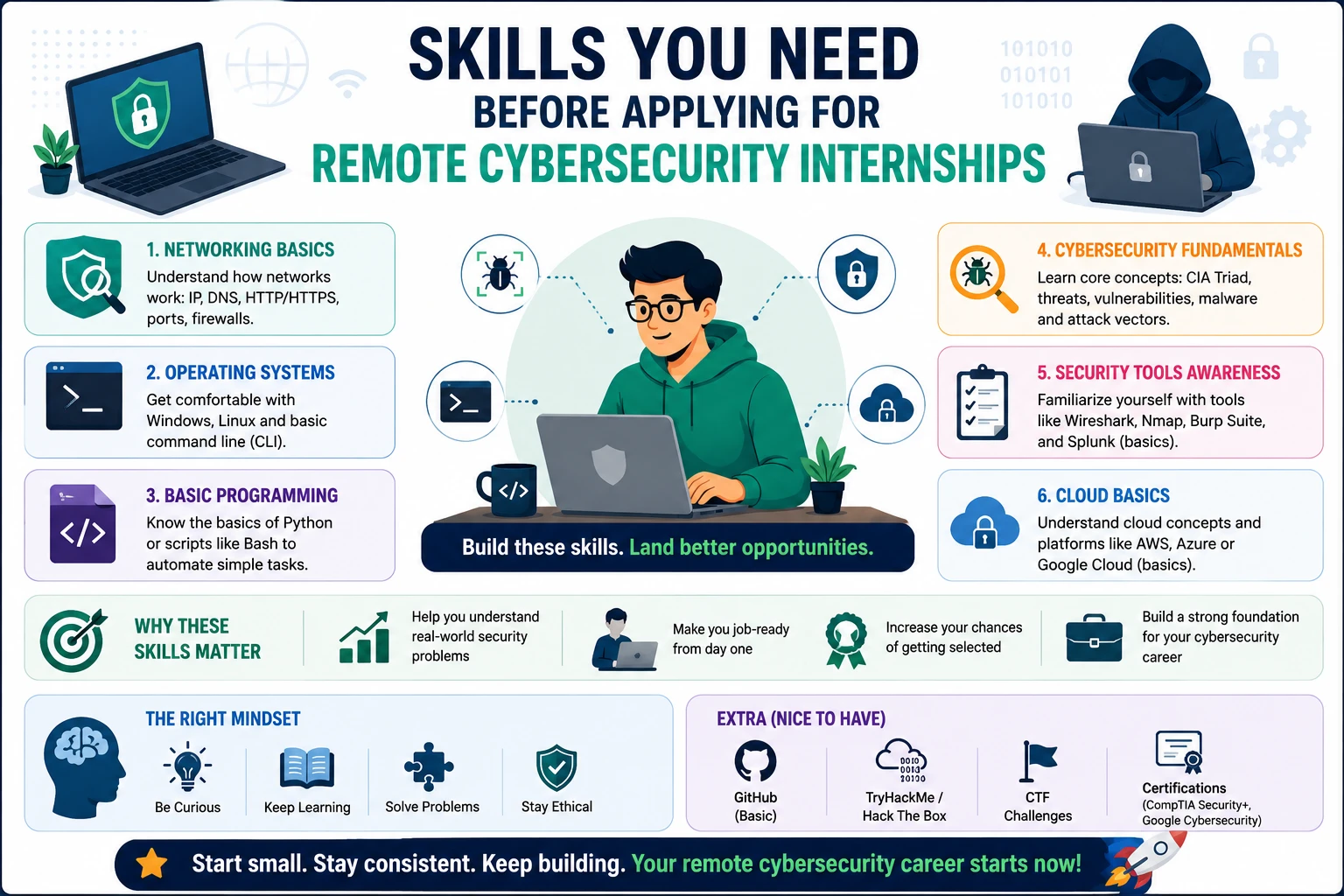
One of the biggest myths in cybersecurity is that you need expert-level skills before applying for internships.
You don’t.
Companies understand interns are still learning.
What employers actually want is evidence that you:
- Understand core concepts
- Learn independently
- Solve problems consistently
- Show technical curiosity
Networking Fundamentals
Networking knowledge forms the foundation of cybersecurity.
You should understand:
- IP addressing
- DNS
- TCP/IP
- Ports and protocols
- Firewalls
- VPNs
- Routing basics
Without networking knowledge, security concepts become much harder to understand.
Linux and Windows Basics
Most security environments rely heavily on Linux and Windows systems.
Important beginner skills include:
- Basic Linux commands
- File permissions
- User management
- Process monitoring
- Windows security basics
- System logs
You don’t need advanced administration experience initially.
Security Fundamentals
You should understand common cybersecurity concepts such as:
- Malware
- Phishing
- Social engineering
- Authentication
- Encryption
- Vulnerabilities
- Risk management
Employers expect foundational awareness.
Basic Scripting Skills
You don’t need to become a software engineer.
However, basic scripting helps tremendously.
Python remains one of the most useful cybersecurity languages because it supports:
- Automation
- Log parsing
- Security scripting
- API interactions
- Threat analysis
Even beginner scripting projects can strengthen your applications.
Soft Skills Matter More Than Most Candidates Realize
Technical skills alone won’t guarantee interviews.
Remote cybersecurity internships require strong communication.
Employers value candidates who can:
- Explain technical findings clearly
- Write documentation professionally
- Manage time independently
- Collaborate remotely
- Stay organized
Strong communication skills often separate successful candidates from equally technical applicants.
Certifications That Strengthen Applications
Certifications won’t replace practical experience, but they can improve credibility.
Popular beginner certifications include:
| Certification | Estimated Cost | Difficulty | Best For |
| CompTIA Security+ | Moderate | Beginner to Intermediate | General cybersecurity |
| ISC2 Certified in Cybersecurity (CC) | Low | Beginner | Foundational security knowledge |
| Google Cybersecurity Certificate | Affordable | Beginner | Career changers |
| CompTIA Network+ | Moderate | Beginner | Networking fundamentals |
| Microsoft Security Certifications | Varies | Beginner to Intermediate | Cloud security pathways |
If your budget is limited, prioritize practical labs and projects alongside certifications.
Build a Home Cybersecurity Lab
A home lab can dramatically improve your applications.
You can practice safely using:
- VirtualBox
- VMware
- Kali Linux
- Windows virtual machines
- Splunk free editions
- Wireshark
- TryHackMe
- Hack The Box
Document everything you learn.
Recruiters love seeing candidates who actively build skills outside of classrooms.
Where to Find Remote Cybersecurity Internships
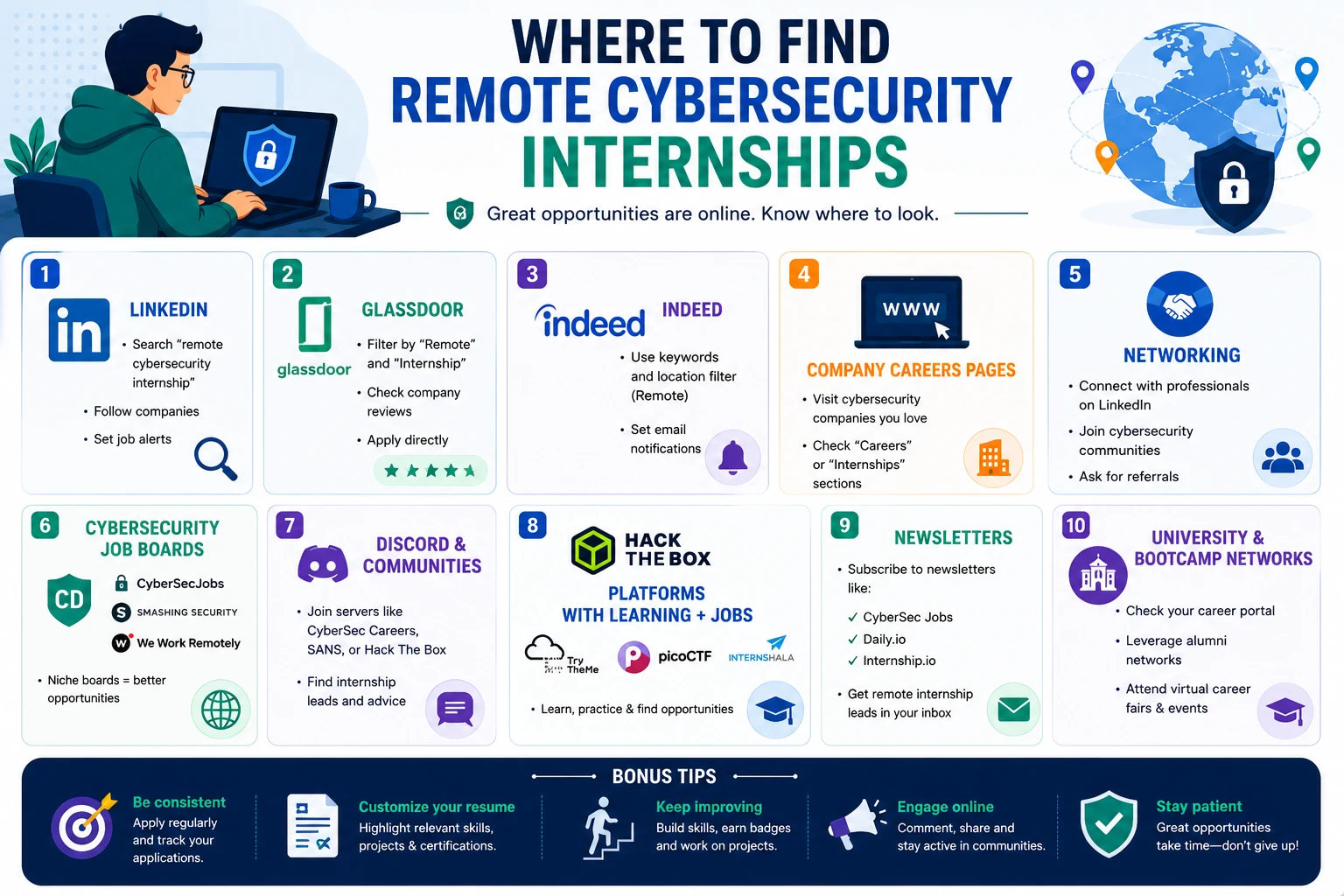
Finding legitimate remote cybersecurity internships requires more than casually scrolling job boards.
You need targeted strategies.
LinkedIn remains one of the best platforms for cybersecurity recruiting.
Search using phrases like:
- Remote cybersecurity internship
- Remote information security intern
- Virtual SOC analyst internship
- Work from home cybersecurity internship
- Cloud security intern remote
Optimize your LinkedIn profile carefully.
Include:
- Technical skills
- Security projects
- Certifications
- GitHub links
- Cybersecurity coursework
- Lab experience
Recruiters actively search LinkedIn for technical candidates.
Company Career Pages
Many companies post internships directly on their websites before third-party job boards.
Organizations frequently offering cybersecurity internships include:
- Microsoft
- IBM
- Cisco
- CrowdStrike
- Palo Alto Networks
- Deloitte
- PwC
- Amazon
- Accenture
Checking career pages regularly can help you apply earlier.
Cybersecurity Communities
Networking communities often reveal opportunities before public postings.
Useful places include:
- Reddit cybersecurity communities
- Discord servers
- Security Slack groups
- University cybersecurity clubs
- Capture The Flag communities
Many professionals share internship openings internally before broader distribution.
Internship Platforms
Dedicated internship websites can simplify searches.
Useful platforms include:
- Handshake
- Simplify
- Indeed
- Glassdoor
- Wellfound
- Internships.com
Set job alerts so you can apply quickly after new listings appear.
Early applications often receive more recruiter attention.
Government and Nonprofit Programs
Government agencies and nonprofit organizations also support cybersecurity training pipelines.
Some programs include:
- Paid internships
- Structured mentorship
- Security bootcamps
- Scholarship opportunities
- Career placement assistance
These pathways can help beginners build initial experience.
How You Can Stand Out From Other Applicants
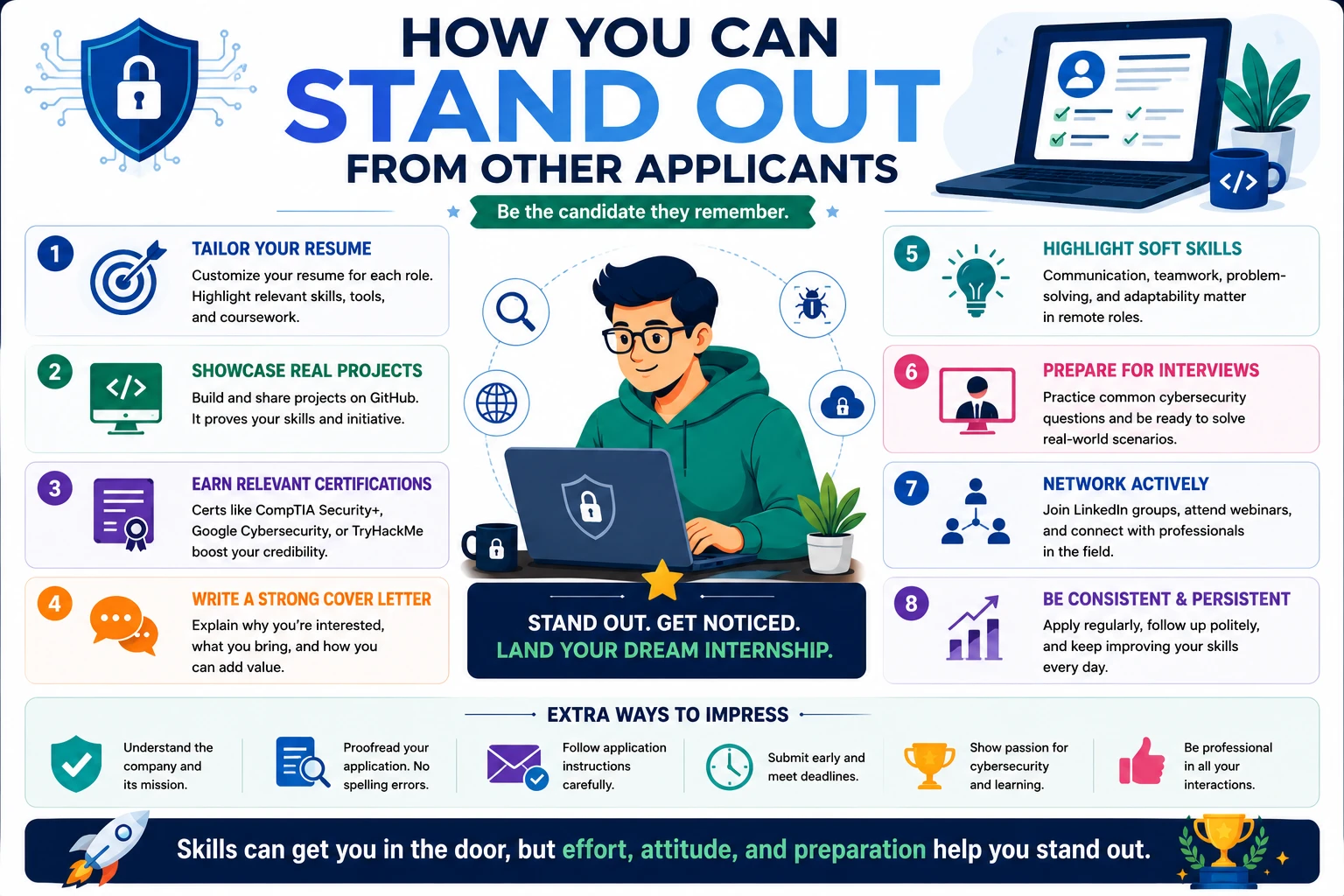
This is where most candidates fail.
They submit generic resumes with zero proof of practical ability.
Recruiters see thousands of applications like that.
You need evidence that you can actually work in security environments.
Create Real Cybersecurity Projects
Projects instantly improve your credibility.
Examples include:
- Building a home SOC lab
- Creating Python security scripts
- Writing phishing analysis reports
- Solving Hack The Box machines
- Performing vulnerability scans
- Building security dashboards
- Creating incident response walkthroughs
Even beginner projects matter if documented clearly.
Build a GitHub Portfolio
GitHub functions like a public technical portfolio.
You can upload:
- Scripts
- Lab walkthroughs
- Documentation
- Automation projects
- Security tools
- Writeups
Recruiters often review GitHub profiles before interviews.
Write About Cybersecurity
Publishing content helps demonstrate genuine interest.
You can write about:
- Security labs
- Threat analysis
- Lessons learned
- CTF walkthroughs
- Security tools
- Career progress
Even simple LinkedIn posts can strengthen your professional visibility.
Tailor Every Resume
Generic resumes hurt your chances.
Match your resume to each role.
Highlight:
- Relevant projects
- Technical tools
- Certifications
- Coursework
- Security labs
- Programming skills
Keep formatting clean and easy to scan.
Avoid AI-Generated Resume Language
Recruiters increasingly recognize generic AI-generated applications.
Weak resumes often contain:
- Repetitive wording
- Generic summaries
- Unrealistic skill claims
- Vague accomplishments
Focus on authentic experiences and measurable projects instead.
Prepare for Technical Interviews
Many remote cybersecurity internships include technical interviews.
You may be asked about:
- Networking basics
- Linux commands
- Security concepts
- Incident response
- Common attacks
- Web vulnerabilities
Interviewers usually care more about your reasoning process than perfect answers.
Common Mistakes That Quietly Destroy Internship Applications
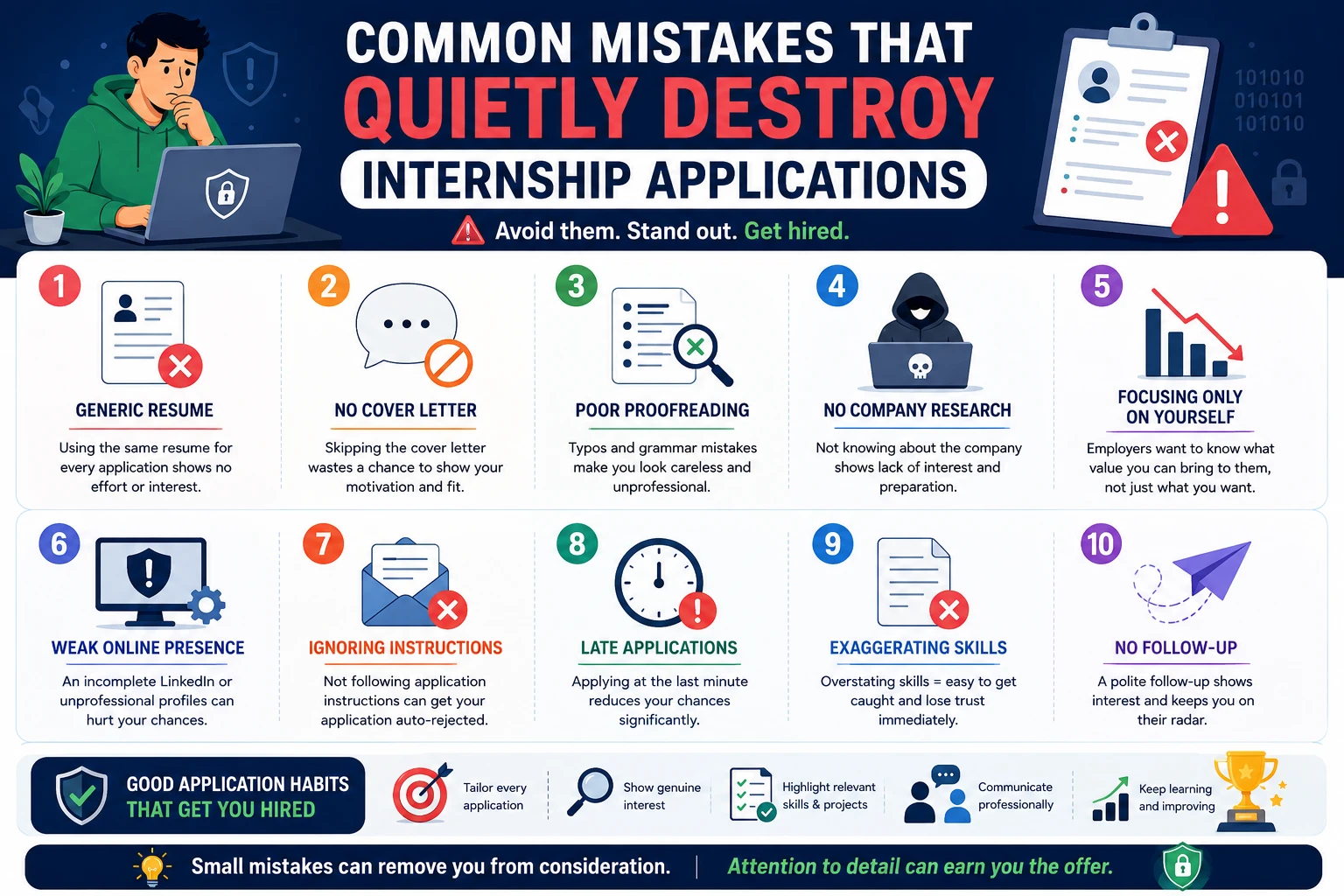
Many candidates unknowingly sabotage their own opportunities.
Avoid these mistakes.
Applying Without Hands-On Practice
Certifications alone rarely impress recruiters anymore.
You need practical exposure.
Even small projects help demonstrate initiative.
Ignoring Defensive Security Roles
Many beginners focus only on ethical hacking.
That limits opportunities.
Defensive security roles often:
- Offer more internship openings
- Build stronger fundamentals
- Create long-term career growth
Starting in a SOC role can still lead to penetration testing later.
Waiting Until You Feel Fully Ready
You’ll probably never feel completely prepared.
Apply before you think you qualify.
Internship descriptions often represent ideal candidates rather than minimum requirements.
Using Weak LinkedIn Profiles
Recruiters frequently check LinkedIn profiles.
A weak profile with no projects, certifications, or activity can hurt credibility.
Neglecting Networking
Cybersecurity remains relationship-driven.
Many internship opportunities come through:
- Referrals
- Communities
- Conferences
- Mentorship relationships
- Professional connections
Networking consistently improves your odds.
Remote Cybersecurity Internship Salary Expectations
Remote cybersecurity internships vary significantly in compensation.
Some focus purely on experience.
Others pay extremely competitive rates.
| Region | Typical Internship Pay |
| United States | $20 to $50/hour |
| Europe | €15 to €35/hour |
| Middle East | Competitive monthly stipends |
| Asia-Pacific | Varies widely by country |
Factors That Influence Pay
Compensation depends on:
- Technical specialization
- Existing experience
- Certifications
- Company size
- Internship difficulty
- Geographic region
Cloud security and application security internships often pay the highest rates.
Long-Term Career Growth
Cybersecurity remains one of the highest-paying technology industries.
After internships, you may progress into:
- SOC Analyst
- Security Engineer
- Penetration Tester
- Threat Hunter
- Incident Responder
- Cloud Security Engineer
- Application Security Engineer
Experienced professionals often earn strong salaries because cybersecurity expertise remains in high demand globally.
Pros and Cons of Remote Cybersecurity Internships
Advantages
- Access to global opportunities
- Flexible work environments
- Lower relocation costs
- Strong technical skill development
- Exposure to cloud infrastructure
- Improved remote collaboration experience
- Faster networking opportunities online
Disadvantages
- Extremely competitive applications
- Fewer face-to-face mentorship opportunities
- Communication challenges across time zones
- Requires strong self-discipline
- Harder to build personal workplace relationships initially
For most candidates, the benefits outweigh the drawbacks.
Step-by-Step Roadmap to Get Your First Remote Cybersecurity Internship
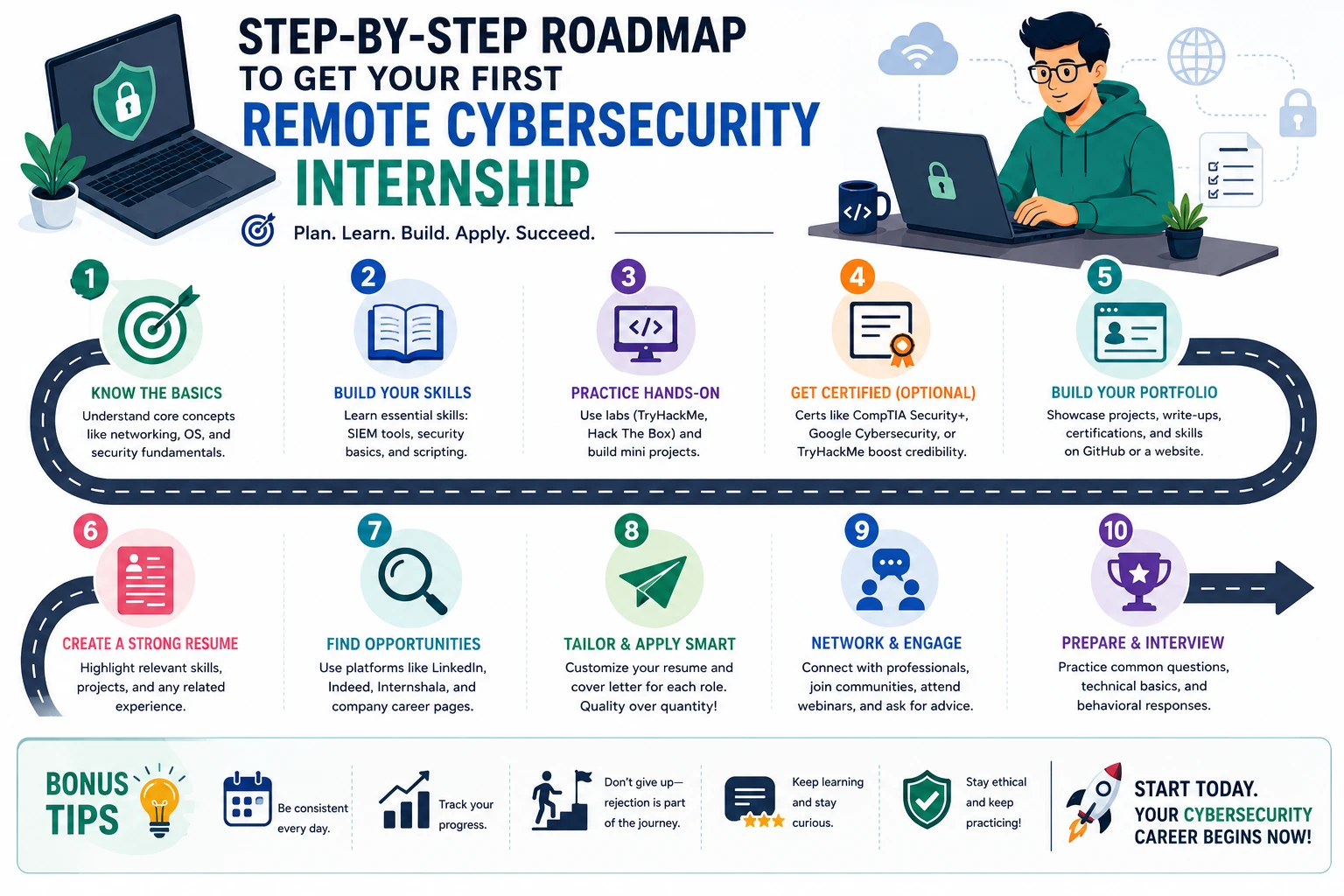
If you want faster results, focus on execution instead of endless preparation.
Step 1: Learn Networking and Linux Basics
Estimated timeline: 1 to 2 months.
Focus on:
- TCP/IP
- DNS
- Firewalls
- Linux commands
- System fundamentals
Step 2: Build a Home Lab
Estimated timeline: 2 to 4 weeks.
Practice:
- Log analysis
- Security monitoring
- Vulnerability scanning
- Basic scripting
Step 3: Complete Hands-On Cybersecurity Platforms
Estimated timeline: ongoing.
Use platforms like:
- TryHackMe
- Hack The Box
- Blue Team Labs Online
- PicoCTF
Step 4: Build Public Projects
Estimated timeline: ongoing.
Upload projects to GitHub and document your learning process.
Step 5: Optimize Your LinkedIn Profile
Estimated timeline: 1 week.
Showcase:
- Certifications
- Projects
- Labs
- Technical skills
- Security interests
Step 6: Apply Consistently
Estimated timeline: ongoing.
Treat applications like a numbers game.
Most candidates quit too early.
Step 7: Network Every Week
Estimated timeline: ongoing.
Attend:
- Webinars
- Security meetups
- Online communities
- CTF competitions
Opportunities often emerge through conversations before public listings appear.
Final Thoughts
Remote cybersecurity internships have completely changed how people enter the security industry.
You no longer need to live near a major technology hub or wait until graduation to gain meaningful experience.
Companies worldwide now hire remote interns to:
- Monitor threats
- Investigate incidents
- Secure cloud systems
- Improve compliance
- Analyze vulnerabilities
- Support security operations
The candidates who succeed aren’t always the smartest.
They’re usually the most consistent.
If you build practical projects, strengthen your technical foundations, improve communication skills, and apply consistently, you can separate yourself from thousands of applicants who rely only on certifications.
Start small.
Build labs.
Document your progress.
Network intentionally.
Apply before you feel fully ready.
That momentum matters more than perfection.
Your first remote cybersecurity internship could become the experience that launches a long-term career in one of the fastest-growing technology industries in the world.
