Entry level cyber security analyst jobs remote are beginner-friendly security roles you can do from home. You can qualify with certifications like Security+ or Google Cybersecurity and get hired without experience if you have basic networking, Linux, and security knowledge.
You want a cybersecurity job that lets you work from home, earn a good salary, and build a long-term career in tech. When you search for entry level cyber security analyst jobs remote, most listings ask for experience, which makes it feel impossible to start. The reality is different. Companies hire beginners every month, including remote analysts, as long as you show the right skills and certifications.
Cybersecurity teams need people who can monitor alerts, review logs, and follow security procedures. These tasks do not require years of experience, but they do require basic knowledge and hands-on practice. If you prepare the right way, you can qualify for remote cybersecurity jobs faster than you think.
In this guide, you will learn what entry level cyber security analyst jobs remote really mean, what skills employers expect, what tools you should know, real job market statistics, reviews of security tools, companies hiring beginners, salary expectations, and how to get hired step by step.
Read More On: What Is a Network Security Key?
What Entry-Level Cyber Security Analyst Jobs Remote Really Mean

When you see entry level cyber security analyst jobs remote, the role usually focuses on monitoring systems and helping senior security staff protect company networks. Many beginners think cybersecurity means hacking, but most entry-level jobs involve watching alerts, checking logs, and following security procedures. Companies need analysts who can notice problems early and report them before they turn into serious incidents.
Remote analyst roles exist because security tools allow companies to monitor networks from anywhere. Security Operations Centers, often called SOC teams, use dashboards and monitoring software that can be accessed online. This means junior analysts can work from home while still helping protect systems.
One reason beginners get confused is that companies use different job titles for the same type of work. If you search only for cyber security analyst, you will miss many entry-level opportunities. Recruiters often post junior roles under different names, even when the responsibilities are similar.
Common job titles you should search for include junior cyber security analyst, SOC analyst level 1, information security analyst entry level, security operations center analyst, IT security analyst, threat monitoring analyst, and cybersecurity technician. All of these can be entry-level positions, and many of them allow remote work.
In most beginner roles, your daily tasks are simple but important. You may watch alerts from a SIEM tool, review login activity, run vulnerability scans, or write reports about suspicious events. You are not expected to solve complex attacks alone. Your job is to follow procedures and escalate problems to senior analysts.
| Task | What you actually do |
|---|---|
| Monitor alerts | Watch security software for warnings |
| Review logs | Check system activity |
| Investigate events | Look for unusual behavior |
| Run scans | Find weaknesses in systems |
| Write reports | Document incidents |
| Follow playbooks | Use company procedures |
Remote jobs can be more competitive because many people apply, but companies still hire beginners every week. If you understand what these roles really involve, you can prepare for the skills employers actually want instead of learning random topics that do not help you get hired.
Read More On:What Does A Cyber Threat Intelligence Analyst Do?
Skills You Need for Entry-Level Remote Cyber Security Analyst Jobs
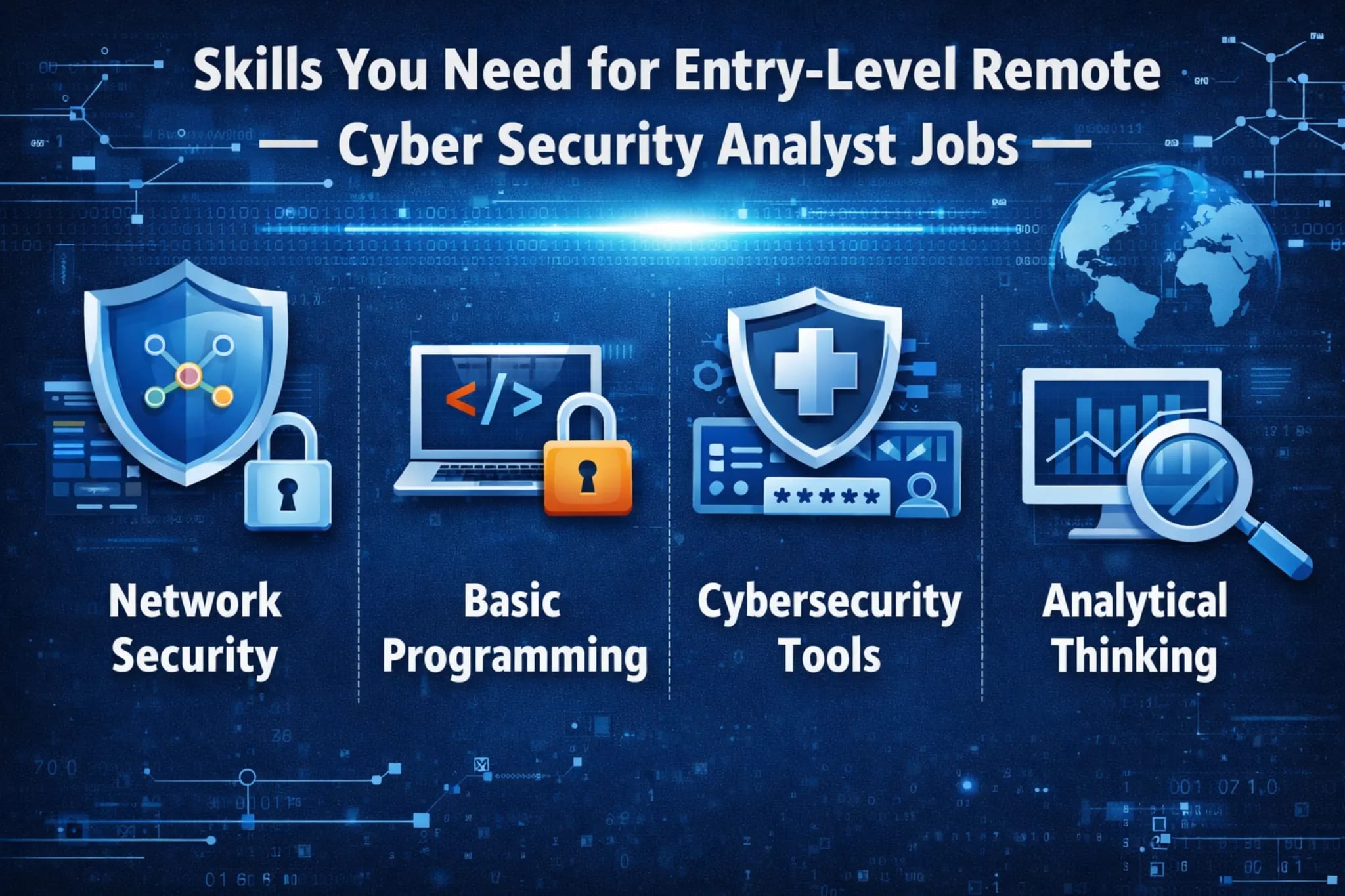
To get entry-level cyber security analyst jobs remote, you do not need advanced hacking skills, but you do need a strong understanding of basic IT and security concepts. Most employers look for candidates who know how networks work, understand operating systems, and can use simple security tools. If you focus on the right fundamentals, you can qualify for many beginner roles even without previous job experience.
One mistake many beginners make is trying to learn everything at once. Cybersecurity is a large field, and companies do not expect entry level analysts to know advanced penetration testing or exploit development. They want someone who understands how systems work, how attacks happen, and how to detect suspicious activity.
You should focus on the core skills that appear in most job descriptions for entry level cyber security analyst jobs remote.
Check out our latest blog on How to Fix Kernel Security Check Failure and Check for Malware
Core skills you should learn first
- Networking basics, including TCP, IP, ports, DNS, and firewalls
- Linux fundamentals, such as file permissions, commands, and processes
- Windows security basics, including users, groups, and event logs
- Log analysis and understanding system activity
- SIEM basics and how alerts work
- Vulnerability scanning concepts
- Basic scripting with Python or Bash
- General cybersecurity concepts like malware, phishing, and ransomware
These skills show employers that you understand how systems operate and how security teams detect problems.
Another important factor for beginners is certification. Many remote cybersecurity jobs use certifications as proof that you know the fundamentals. You do not need many certificates, but having one strong certification can increase your chances of getting interviews.
Check out our latest blog on MGM Cyber Attack Las Vegas: Timeline, Losses (2026)
Best certifications for beginners
| Certification | Difficulty | Why it helps |
|---|---|---|
| CompTIA Security+ | Medium | Most requested for entry level jobs |
| Google Cybersecurity Certificate | Easy | Good for beginners |
| CompTIA Network+ | Medium | Strong networking knowledge |
| ISC2 Certified in Cybersecurity | Easy | Good starter cert |
| CEH | Hard | Better after experience |
Security+ appears in many listings for entry level cyber security analyst jobs remote, because it covers networking, threats, and security tools.
Besides certifications, employers also like to see hands-on practice. You can build experience at home by using virtual machines, training labs, and free cybersecurity platforms.
Practice projects you can add to your resume
- Built a home lab using VirtualBox or VMware
- Installed Linux and practiced commands
- Used Wireshark to capture network traffic
- Scanned a network with Nmap
- Ran vulnerability scans with Nessus
- Completed TryHackMe learning paths
- Practiced log analysis in lab environments
These projects show that you are serious about learning, even if you have never worked in cybersecurity before. For remote roles, this matters even more because employers cannot see you in person, so your resume must prove your skills.
If you learn these basics and practice regularly, you already meet the requirements for many entry level cyber security analyst jobs remote.
Tools Used in Entry Level Cyber Security Analyst Jobs (With G2 and Capterra Reviews)
When employers post entry level cyber security analyst jobs remote, they often list security tools in the job description. This does not mean you need expert-level knowledge, but you should understand what these tools do and how analysts use them. Many beginners get rejected because they only study theory and never practice with real software.
Security teams rely on monitoring tools, scanners, and log analysis platforms to detect threats. The good news is that many of these tools have free versions, training labs, or trial environments that you can use at home. Reviews from platforms like G2 and Capterra show that beginners can learn these tools faster than they expect, especially if they practice in small labs.
Learning even a few of the common tools used in SOC environments can make your resume stand out when applying for entry level cyber security analyst jobs remote.
Common tools used in junior cybersecurity roles
- Splunk for log monitoring and SIEM alerts
- Wireshark for packet and network traffic analysis
- Nessus for vulnerability scanning
- Nmap for network discovery
- Kali Linux for security testing tools
- TryHackMe for guided cybersecurity labs
- Hack The Box for hands-on practice
- Microsoft Defender or similar endpoint tools
These tools appear frequently in job descriptions because companies use them in real security operations centers.
What users say about these tools (review summaries)
| Tool | What it is used for | Review summary from users |
|---|---|---|
| Splunk | SIEM and log analysis | Verybeginner-friendlyy |
| Wireshark | Packet analysis | Essential for learning networking |
| Nessus | Vulnerability scanning | Easy to run scans for beginners |
| Nmap | Network scanning | Popular for learning basics |
| TryHackMe | Training platform | Good for real-world skills |
| Hack The Box | Practice labs | Good for real world skills |
User feedback on review platforms often mentions that Splunk is one of the most requested SIEM tools in entry-level cybersecurity analyst jobs. Many reviewers say the interface can feel complex at first, but basic log searching is enough for junior roles.
Wireshark is often recommended for beginners because it helps you understand how network traffic works. Reviews frequently mention that learning packet analysis makes it easier to understand alerts in security tools.
Nessus and Nmap are also common in training environments. Users often say these tools are good for learning vulnerability scanning and network discovery, which are tasks junior analysts may perform.
Training platforms like TryHackMe and Hack The Box receive strong feedback from beginners. Many reviewers say guided labs helped them prepare for certifications and interviews, especially for SOC analyst positions.
Why tools matter for remote jobs
Remote cybersecurity roles often require you to work independently, so employers prefer candidates who already know basic tools.
Learning tools help you:
- Show practical experience
- Pass resume screening
- Answer interview questions
- Understand real SOC tasks
- Feel more confident on the job
If you know even a few of these tools, you already have an advantage when applying for entry level cyber security analyst jobs remote.
Cybersecurity Job Market Statistics for Remote Entry Level Analysts
The demand for cybersecurity professionals continues to grow every year, which is one reason entry level cyber security analyst jobs remote are becoming more common. Companies depend on digital systems, cloud platforms, and online services, and every system needs protection. Because of this, organizations need more analysts to monitor activity, detect threats, and respond to incidents. Even beginner roles are in demand because senior engineers cannot handle all daily monitoring tasks alone.
Workforce reports, labor statistics, and industry surveys consistently show that cybersecurity has one of the largest skill shortages in the technology field. This shortage creates opportunities for people who are starting their careers, especially those who have certifications, home lab practice, or basic IT knowledge.
Several industry studies show how strong the demand really is.
| Statistic | Source type | What it means |
|---|---|---|
| Millions of cybersecurity jobs remain unfilled worldwide | Workforce studies | Companies need more analysts |
| Security analyst ranked among the top IT careers | Labor statistics reports | Much faster than average careers |
| Most organizations plan to increase security hiring | Industry surveys | More job openings |
| Remote tech jobs increased after cloud adoption | Hiring trend reports | More remote roles |
| Strong long-term demand | Career reports | Strong long term demand |
One major reason for this growth is the increase in cyber attacks. Businesses now face phishing, ransomware, and data breaches more often than in the past. Even small companies need monitoring tools and security staff. Because monitoring can be done online, many organizations allow analysts to work remotely, which increases the number of entry level cyber security analyst jobs remote available each year.
Another factor is the shift to cloud computing. Companies no longer keep all systems in one office. Instead, they use online infrastructure that can be managed from different locations. This allows security teams to work from home while still watching alerts, logs, and system activity.
Cybersecurity workforce reports also show that many companies struggle to find junior analysts who understand basic networking, operating systems, and security tools. This means beginners who prepare correctly can still compete, even without previous job experience.
Key reasons demand stays high:
- More cyber attacks every year
- More cloud and remote systems
- Not enough trained professionals
- 24/7 monitoring needed
- Compliance and data protection laws
Because of these factors, entry level cyber security analyst jobs remote are expected to stay in demand for many years. For beginners, this means the field is competitive, but the opportunity is real if you build the right skills and apply consistently.
Salary and Remote Work Trends for Entry Level Cyber Security Analyst Jobs

One reason many people search for entry level cyber security analyst jobs remote is the salary. Cybersecurity pays more than most beginner level tech roles, and remote positions often pay the same as on-site jobs. Companies are willing to offer strong starting salaries because security is critical for business operations. Even junior analysts help protect systems, prevent data loss, and reduce the risk of expensive cyber attacks.
Salary depends on several factors, including your country, certification, company size, and technical skills. Candidates who have Security+, networking knowledge, or hands-on lab experience usually earn more than beginners with only theory.
Average salary for entry level cybersecurity analysts
| Location | Average starting salary |
|---|---|
| United States | 55k to 85k per year |
| Canada | 50k to 75k per year |
| United Kingdom | 28k to 45k per year |
| UAE | 8k to 15k AED per month |
| India | 4L to 10L per year |
Remote jobs sometimes pay higher if you work for international companies, especially companies based in the United States. Many organizations hire remote analysts from different countries because monitoring systems can be done online.
Salary also grows quickly in cybersecurity. After one or two years of experience, many analysts move into higher-paying roles such as security engineer, incident responder, or cloud security specialist.
Typical salary growth in cybersecurity
| Experience level | Average salary range |
|---|---|
| 2 to 3 years of experience | 55k to 85k |
| Mid-level analyst | 80k to 110k |
| Mid level analyst | 110k to 140k |
| Senior analyst | 140k plus |
| Security engineer | 150k plus |
Another reason remote cybersecurity jobs are increasing is the growth of cloud services and online infrastructure. Companies now use remote servers, cloud storage, and web applications, which means security teams can monitor systems from anywhere.
Common reasons companies allow remote security analysts:
- Security tools work through web dashboards
- Monitoring does not require physical access
- Companies run 24-hour SOC teams
- Global teams cover different time zones
- Remote work reduces office costs
Because of these changes, entry level cyber security analyst jobs are more common today than they were a few years ago. However, remote roles also receive more applications, so beginners need strong resumes, certifications, and practice projects to stand out.
Pros and cons of remote cybersecurity jobs
Pros
- Work from home
- Good starting salary
- High-demand career
- Fast promotion opportunities
- Global job options
Cons
- High competition
- Night shift possible in SOC roles
- Requires self learning
- Can feel stressful at first
Even with competition, cybersecurity remains one of the best careers you can start without a degree, especially if your goal is to get a remote job with long-term growth.
Where to Find Entry Level Cyber Security Analyst Jobs Remote Faster
Finding entry level cyber security analyst jobs remote is not only about skills. You also need the right search strategy. Many beginners apply to a few jobs and stop when they do not get replies. Remote cybersecurity roles receive many applications, so you need to search in multiple places, use different keywords, and apply consistently. The people who get hired are usually the ones who treat job searching like a daily task.
Most companies post jobs on large job boards, but some roles appear only on company websites or smaller remote work platforms. If you search only one site, you miss many opportunities.
Best websites to search for remote cybersecurity jobs
- LinkedIn Jobs
- Indeed
- Glassdoor
- Wellfound
- Remote OK
- We Work Remotely
- USAJobs
- Company career pages
LinkedIn is one of the best platforms because many recruiters search for candidates there. Keeping your profile updated with certifications, skills, and projects can help recruiters find you even if you do not apply first.
Another important step is using the right keywords. Companies do not always use the same job title, so searching only one phrase can limit your results.
Keywords you should search for
- entry-level cyber security analyst remote
- junior soc analyst remote
- Information Security Analyst Entry Level
- Cybersecurity remote, no experience
- security analyst level 1 remote
- cybersecurity internship remote
- It Security Analyst Junior
Using different keyword combinations helps you find jobs that other applicants miss.
You also need to apply regularly. Many beginners apply to five jobs and stop, but remote roles often require dozens of applications before you get interviews.
How many jobs should you apply to
| Level | Applications per day |
|---|---|
| Beginner | 10 to 20 |
| With certification | 5 to 10 |
| With experience | 3 to 5 |
Consistency matters more than luck. Many people get their first cybersecurity job after 50 to 100 applications.
What your resume should include
- Certification such as Security+
- Networking knowledge
- Linux basics
- Security tools practice
- Home lab projects
- TryHackMe or Hack The Box
- GitHub or notes
- Any IT experience
Example projects you can list
- Built a home lab using VirtualBox
- Captured packets with Wireshark
- Scanned the network with Nmap
- Ran vulnerability scans
- Completed TryHackMe path
- Practiced log analysis
Employers like proof that you practice, even if you have never worked in cybersecurity before. This is especially important for entry level cyber security analyst jobs, remote, because companies want to know you can work independently without constant supervision.
If you search daily, apply consistently, and keep improving your resume, your chances of getting interviews increase a lot.
Step-by-Step Roadmap to Get Entry Level Cyber Security Analyst Jobs Remote
If you feel overwhelmed trying to break into cybersecurity, you are not alone. Many beginners study random topics, switch courses often, and never feel ready to apply. The fastest way to get entry level cyber security analyst jobs remote is to follow a clear roadmap. You do not need to learn everything. You need to learn the right things in the right order and show proof that you can use them.
Most remote junior analyst roles require basic networking, operating system knowledge, one certification, and some hands-on practice. If you follow a structured plan, you can become job-ready in a few months instead of wasting a year studying the wrong topics.
Below is a simple roadmap that many beginners use to enter cybersecurity.
Step 1 – Learn networking fundamentals
Cybersecurity depends on networking. You should understand how devices communicate, what ports are, and how traffic moves across a network.
Focus on:
- IP addresses
- TCP and UDP
- DNS
- HTTP and HTTPS
- Firewalls
- Routers and switches
- Subnets basics
Network+ study material is a good starting point, even if you do not take the exam.
Step 2 – Learn Linux and Windows basics
Most security tools run on Linux, and most companies use Windows systems. You should know how to navigate both.
Practice:
- Linux commands
- File permissions
- Processes
- Users and groups
- Windows event logs
- Basic system settings
You can practice using virtual machines at home.
Step 3 – Get one strong certification
You do not need many certificates, but having a recognized certification helps you pass resume screening.
Best options for beginners:
- Security+
- Google Cybersecurity Certificate
- ISC2 Certified in Cybersecurity
- Network+
Security+ appears in many entry-level cybersecurity analyst jobs in remote listings.
Step 4 – Build a home lab
Employers like to see practice, not only theory.
You can build a simple lab using:
- VirtualBox or VMware
- Kali Linux
- Windows VM
- Wireshark
- Nmap
- Nessus
- TryHackMe
Lab practice shows that you can work with real tools.
Step 5 – Practice on training platforms
Guided labs help you understand real security tasks.
Popular platforms:
- TryHackMe
- Hack The Box
- LetsDefend
- CyberDefenders
Many beginners get interview questions based on these topics.
Step 6 – Create a strong resume and LinkedIn
Make sure your resume shows:
- Certification
- Skills
- Tools
- Lab projects
- Courses
- IT knowledge
Recruiters search LinkedIn for keywords, so your profile should include cybersecurity terms.
Step 7 – Apply every day
Do not wait until you feel perfect.
Apply while learning.
- Apply to remote jobs.
- Apply to on-site jobs
- Apply to internships
- Apply to SOC roles
- Apply to IT security roles
Most beginners get hired after consistent applications.
Step 8 – Keep learning after applying
Even after you start applying, continue improving.
Learn:
- SIEM basics
- Cloud basics
- Incident response
- Log analysis
- Security monitoring
The more skills you add, the better your chances of getting entry level cyber security analyst jobs remote.
Following this roadmap keeps you focused and prevents you from wasting time on topics that do not help you get hired.
Not sure where to start in cybersecurity? Read our full hackthebox vs tryhackme guide to understand which platform gives better learning paths, realistic labs, and career value.
Final Thoughts
Entry level cyber security analyst jobs remote are possible to get if you learn the right skills and stay consistent. You do not need expert knowledge, but you should understand networking, operating systems, and basic security tools. One certification and some hands-on practice can make a big difference.
Remote roles are competitive, so apply regularly while improving your skills. Cybersecurity demand continues to grow, and companies still need junior analysts to monitor systems and respond to alerts. If you keep learning and applying, you can get your first remote cybersecurity job even without experience.
Frequently Asked Questions
Can you work remotely as a cybersecurity analyst?
Yes, many companies allow remote cybersecurity analysts to monitor systems, review alerts, and handle security incidents from home.
What qualifications do I need for entry level cyber security analyst jobs?
Most jobs require basic networking knowledge, Security+ certification, Linux skills, and an understanding of security tools like SIEM software.
Are entry level cyber security jobs hard to get?
They are competitive, but candidates with certifications, labs, and consistent applications often get interviews within a few months.
Do remote cybersecurity jobs pay well for beginners?
Yes, entry level remote cybersecurity analysts often earn good salaries compared to other beginner tech roles in IT.
Where can I find entry level cyber security analyst jobs remote?
You can find remote cybersecurity jobs on LinkedIn, Indeed, company career pages, and remote job websites daily.