Table of Contents
In 2026, enterprise cyber security means building a proactive SOC that predicts, not reacts.
The top 10 strategies include Zero Trust, AI-driven detection, Continuous Threat Exposure Management, and resilience planning, all designed to protect your business from modern, fast-evolving threats.
You probably remember that sinking feeling, the one that hits when an alert floods your dashboard at 2 a.m. Was it a false positive again? Or did someone just breach the finance server?
In 2026, this isn’t rare. According to IBM’s Cost of a Data Breach Report, the average enterprise now takes 204 days to identify an attack.
That’s seven months of unnoticed exposure, enough time for attackers to move laterally, steal data, and vanish.
And you? You’re expected to prevent it all with a budget that barely covers your EDR renewal.
Here’s the truth: big vendors will promise “AI-powered everything,” but unless your SOC adapts faster, you’ll always be two steps behind.
That’s why I wrote this guide, not for the vendors, but for you, the SOC lead, the CISO, or the one who has to explain to the board why an alert turned into a breach.
Let’s talk about 10 enterprise cyber security strategies your SOC needs in 2026, practical, measurable, and built around your real-world challenges.
Check out our latest blog on Unlock FF Beta: APK Risks & Account Safety
The Strategic Shift for Enterprise SOCs

You’ve noticed it too, the world’s changed, but most SOCs haven’t. Five years ago, your biggest worry was malware on an endpoint or a user clicking a bad link.
Today, you’re defending hybrid clouds, remote workforces, third-party APIs, and an AI-powered adversary who never sleeps.
That’s not evolution, that’s a revolution.
From Reactive Defense to Predictive Security
You can’t win today’s battles with yesterday’s playbooks. Traditional SOCs chase alerts. Modern SOCs chase intent, the “why” behind every indicator. Your team’s job isn’t to drown in dashboards; it’s to anticipate what’s next.
That means:
Using threat intelligence feeds not just to detect attacks, but to predict attacker behavior.
Correlating business context with security telemetry because a blocked IP is meaningless if it’s tied to a $10M revenue stream.
Turning from “incident response” to continuous threat readiness.
From Tool-Centric to Outcome-Centric
You’ve probably heard the pitch a hundred times: “Our platform gives 360-degree protection.” Yet, what matters isn’t how many tools you have, it’s how well they work together.
In 2026, the winning SOCs are those that:
Focus on integration, not accumulation.
Align every tool and process to a measurable outcome, reduce risk exposure, faster containment or zero business downtime.
Evaluate success by business resilience, not alert volume.
“Enterprises don’t fail because they lack tools. They fail because they lack strategy.”
Dr. Gilad Rosner, Privacy & Security Researcher
From Compliance to Cyber Resilience
Compliance keeps auditors happy; resilience keeps businesses alive. You already know the difference: one checks boxes, the other survives breaches.
A resilient SOC doesn’t just detect; it adapts. It learns from every incident, patches faster, and builds muscle memory. It treats cyber security as a continuous business process, not an annual project.
Reactive SOC | Resilient SOC |
Focused on alerts | Focused on adversary intent |
Measures success by volume | Measures success by impact |
Operates in silos | Operates cross-functionally |
Reacts to breaches | Anticipates them |
Compliance-driven | Business-driven |
Ask yourself:
If your SOC disappeared for a day, would the business even notice? In 2026, the answer must be yes. Your SOC should be the nerve center of your enterprise, not a back-office function.
The New Mission: Cyber Security as a Business Enabler
This is the real strategic shift: your SOC isn’t a cost center anymore. It’s your enterprise’s competitive advantage.
Every alert you contain faster than your competitors saves money, reputation, and customer trust.
The modern enterprise doesn’t protect for the sake of security; it protects to move faster, scale confidently, and earn trust in a connected world.
So, if your SOC still thinks like an IT department, 2026 is your turning point. It’s time to evolve into a strategic defense hub that aligns cyber operations with business growth.
Read More On: Cyber Security Monitoring: Best Practices Guide 2026
Strategy 1: Build a Zero-Trust-First SOC

You’ve heard the term a hundred times: Zero Trust. Every vendor claims they have it. Every framework mentions it. But for your SOC, Zero Trust isn’t a trend. It’s survival.
Let’s be honest, your network perimeter doesn’t exist anymore. Your users log in from airports, coffee shops, and home networks you can’t control.
Your data lives across clouds, and half of your partners have direct access to your systems. If you still trust “inside traffic,” you’re already exposed.
What Zero Trust Really Means for You
Zero Trust doesn’t mean paranoia; it means proof. It’s the belief that no user, device, or process should be trusted automatically, no matter where it sits.
In a Zero-Trust-first SOC, every access request goes through the same question:
“Should this be allowed right now?”
That one question changes everything because it turns your SOC from a reactive guardrail into a proactive gatekeeper.
How to Build a Zero-Trust SOC
You don’t need to rebuild your entire architecture overnight. Start with small, visible wins that tighten your defenses where it matters most.
Step 1: Map your crown jewels.
Identify the assets that would cause the most damage if compromised financial systems, customer data, and privileged accounts. This is where your Zero-Trust journey starts.
Step 2: Enforce least privilege.
Nobody, not even your administrators, should have more access than they need at any given time. Apply role-based access controls (RBAC) and session-based credentials.
Step 3: Use adaptive authentication.
Don’t rely on static MFA. Go further with risk-based authentication that considers device trust, user behavior, and location.
Step 4: Segment your network.
Break the internal network into micro-zones. If an attacker compromises one area, they shouldn’t be able to move laterally.
Step 5: Monitor continuously.
Log everything. The power of Zero Trust isn’t in denying access; it’s in watching how legitimate access behaves.
What Success Looks Like
When your SOC adopts Zero Trust, breaches don’t vanish; they stop spreading. An attacker can no longer pivot freely across systems. Every credential becomes a controlled asset.
Zero Trust shifts your mindset from “keep them out” to “limit what happens when they get in. That’s the quiet strength of modern enterprise cyber security, not perfection, but containment.
Quick Self-Check
Question | If you answered “no”… |
Do you have a current map of all privileged accounts? | Start there, attackers always do. |
Can you monitor user behavior across clouds in real time? | You’re missing key telemetry. |
Does every system enforce MFA with context-aware rules? | Upgrade to adaptive policies. |
Can your SOC isolate a compromised user session in seconds? | Automate containment workflows. |
The faster you can answer “yes” to these questions, the closer you are to true Zero Trust.
Pros & Cons of Zero Trust
Pros | Cons |
Limits lateral movement | Requires cultural buy-in |
Reduces insider threats | Complex rollout in legacy networks |
Strengthens access control | May slow early user access |
Expert insight:
“Zero Trust isn’t about distrust. It’s about continuous verification.” John Kindervag, Creator of Zero Trust Framework
Strategy 2: Automate Detection and Response with AI

You know that feeling the dashboard lights up like a Christmas tree. Another “critical” alert. Then another. Within minutes, your SOC is buried under noise.
It’s not that your analysts aren’t skilled, it’s that attackers have more time, more automation, and zero fatigue. That’s the gap automation closes for you.
In 2026, SOC automation isn’t optional; it’s oxygen. Without it, your analysts will burn out before your defenses do.
Why Automation Matters to You
Think about how many repetitive tasks eat up your day:
Investigating phishing emails.
Correlating logs across SIEMs.
Closing false positives.
Escalating incidents manually.
Every hour spent doing those is an hour not spent hunting real threats.
Automation doesn’t replace your team it frees them to think. It handles the repetitive so your analysts can focus on creative defense: identifying intent, patterns, and unseen risk.
When your SOC automates right, alerts turn into actions instantly.
How to Automate the Right Way
Step 1: Identify repetitive, high-volume tasks.
Look for patterns: phishing triage, malware quarantine, policy violations. Start small. Prove value. Scale from there.
Step 2: Integrate your SIEM and SOAR platforms.
Your tools must talk to each other. Automation only works when your data flows freely between systems.
Step 3: Build playbooks for recurring incidents.
Document step-by-step responses for common attacks. Then automate those steps in your SOAR.
Step 4: Keep the human in the loop.
Automate 80%, but let analysts review critical decisions. Automation should assist judgment, not override it.
Step 5: Measure success.
Track time saved, false positives reduced, and containment speed improved. If your SOC isn’t getting faster, smarter, and calmer, your automation is missing the point.
What a Smarter SOC Feels Like
Imagine your SIEM detecting a phishing campaign. In seconds, your SOAR isolates affected inboxes, blocks sender domains, and updates firewall rules automatically.
Your analysts don’t scramble. They verify, fine-tune, and move to the next threat. That’s not a theory, that’s your future.
Automation doesn’t make you hands-off; it makes you hands-free. And when the next wave of alerts hits, your SOC won’t panic, it’ll perform.
Quick Automation Checklist
Question | If you answered “no”… |
Do you have defined playbooks for the top 5 attack types? | Start building them today. |
Can your SIEM trigger response actions automatically? | Integrate it with a SOAR. |
Do your analysts still manually close duplicate alerts? | Enable auto-correlation rules. |
Can you measure the time saved by automation? | Add this KPI to your SOC dashboard. |
Pros & Cons of SOC Automation
Pros | Cons |
|---|---|
Reduces MTTR and fatigue | Requires strong data quality |
Improves accuracy | Needs oversight to prevent false actions |
Enables 24/7 monitoring | High initial setup effort |
Expert insight:
“SOC automation isn’t about replacing analysts, it’s about giving them time to think.” Theresa Payton, Former White House CIO
Strategy 3: Continuous Threat Exposure Management (CTEM)

Let’s face it, vulnerability scans are outdated the second they finish. By the time you get your “monthly patch report,” attackers have already found their next entry point.
You don’t need another static scan. You need constant awareness, a living map of every system, endpoint, and misconfiguration that could be weaponized against you.
That’s where Continuous Threat Exposure Management (CTEM) comes in.
Why CTEM Changes the Game
You know what it’s like, your SOC patches one hole, three more appear. The problem isn’t effort. It’s visibility.
Traditional vulnerability management tells you what’s wrong. CTEM tells you what’s exploitable right now.
It’s not about fixing everything; it’s about fixing what matters most.
CTEM brings context into the picture:
Which assets are exposed to the internet?
Which ones hold sensitive data?
Which vulnerabilities have active exploits in the wild?
That’s how you turn security from guesswork into precision.
How to Build Continuous Threat Exposure Management
Step 1: Inventory Everything.
Start with complete visibility of endpoints, cloud assets, APIs, and third-party connections. If you don’t know it exists, you can’t protect it.
Step 2: Prioritize Based on Business Impact.
Not all vulnerabilities are equal. Focus on the ones that could disrupt operations or expose critical data.
Step 3: Correlate Threat Intelligence.
Feed live exploit data into your exposure program. If a vulnerability is being actively weaponized, it jumps to the top of your list.
Step 4: Automate Validation and Re-testing.
Use continuous scanning tools to verify that fixes actually work. Don’t rely on one-time patches attackers certainly won’t.
Step 5 Measure Exposure, Not Just Vulnerabilities.
Track metrics like “time to remediate exploitable assets” or “percentage of external exposures closed.” That’s what tells leadership your SOC is improving.
What a CTEM-Driven SOC Looks Like
You don’t wait for quarterly reports anymore. You see your attack surface shrinking in real time. You know which systems matter most and which ones can wait.
Your SOC isn’t reacting to alerts it’s predicting where the next one will come from.
And when you walk into that board meeting, you’re not explaining vulnerabilities. You’re showing reduced exposure, lower risk, and measurable resilience.
Quick CTEM Checklist
Question | If you answered “no”… |
Do you have a live inventory of all assets? | Deploy continuous asset discovery tools. |
Can you see which vulnerabilities have active exploits? | Integrate threat intel feeds. |
Are fixes validated automatically? | Add automated verification scans. |
Can you measure exposure trendlines over time? | Track exposure reduction per quarter. |
Strategy 4: Align SOC Metrics with Business Outcomes

You already know the problem: You’re defending a multi-million dollar enterprise, but the board only sees “a cost center.”
They don’t see your team’s late nights, your patched vulnerabilities, or the breach you silently prevented last week.
Why? Because you’re talking in alerts and they’re listening for impact.
In 2026, successful SOCs stop reporting activity. They report outcomes.
Why This Matters
Your CEO doesn’t care about “mean time to detect.” They care about how much downtime you prevented, how much data you protected, and how fast you got the business back on its feet.
You’re not defending servers. You’re protecting productivity, reputation, and trust the real currency of enterprise cyber security.
So the question isn’t: “How many threats did we detect?” It’s: “How much risk did we reduce this quarter?”
When you start answering that, leadership starts paying attention.
How to Align Your SOC with Business Goals
Step 1: Translate Technical Metrics into Business Language.
Replace jargon with outcomes:
MTTR → “Time it took to protect revenue operations.”
False positives reduced → “Fewer analyst hours wasted.”
Downtime avoided → “Uninterrupted customer experience.”
Step 2: Identify What the Business Values Most.
For a healthcare client, it might be data confidentiality. For a fintech, transaction uptime. Align your metrics around what keeps the business alive.
Step 3: Build Executive Dashboards.
Show KPIs that answer “What’s working?” and “Where are we exposed?” Use visuals that connect security posture to revenue impact or compliance risk.
Step 4: Report Progress Like a Product.
Treat your SOC like an internal product team. Share wins, backlog items, and risk reductions each quarter. That’s how you turn board reviews into conversations not explanations.
Step 5: Tie Every Strategy to ROI.
For every project you propose, show the value:
“This $30K automation project saves 150 analyst hours a month.”
“This identity upgrade cuts breach likelihood by 40%.”
Once you do that, budgets stop being battles.
What Happens When You Get This Right
Your leadership stops seeing security as overhead. They start seeing it as strategic infrastructure like finance or logistics.
The next time an incident happens, you’re not blamed. You’re trusted.
Because you’ve proven that security isn’t just protection it’s performance.
Example Metrics Transformation
Old SOC Metric | Business-Aligned Metric |
1,200 alerts processed | 95% threat containment rate |
50 phishing emails blocked | $150K in fraud prevented |
MTTR: 6 hours | Revenue downtime avoided: 98% |
30 vulnerabilities patched | Risk reduction: 82% of critical assets |
Strategy 5: Secure the Hybrid & Multi-Cloud Reality
Let’s be real your enterprise isn’t in one cloud anymore. You’ve got workloads on AWS, databases in Azure, collaboration tools on Google Cloud, and a few legacy servers that no one dares to touch.
You’re not alone. According to NordLayer, over 76% of enterprises now use two or more cloud providers and most lack unified visibility.
That’s why hybrid and multi-cloud security has quietly become your biggest blind spot.
Why Hybrid Complexity Hurts
Clouds don’t fail; misconfigurations do. Every week, another company makes headlines because a storage bucket was left public or an API key was exposed.
You don’t need another tool; you need clarity. Clarity on:
Who has access to what?
Which cloud assets are publicly reachable?
How data moves between regions and services.
When your SOC sees everything not just what your vendors want you to see you finally regain control.
How to Secure a Hybrid & Multi-Cloud Environment
Step 1: Centralize Visibility.
Integrate logs and telemetry from all cloud platforms into one SOC view. Your SIEM should speak AWS, Azure, and GCP fluently.
Step 2: Apply Identity-Based Policies Everywhere.
Cloud security is identity security. Use conditional access, role-based permissions, and unified identity providers.
Step 3: Use Cloud Security Posture Management (CSPM).
Continuously scan configurations for drift, policy violations, and exposed assets. Automate alerts for new services deployed without security baselines.
Step 4: Encrypt and Segment Data Flows.
Treat every inter-cloud connection as untrusted. Use VPNs, private peering, or zero-trust network access to secure traffic between environments.
Step 5: Regularly Test for Misconfigurations.
Run red-team simulations focused on cloud privilege escalation, cross-account access, and container breakout risks.
What Success Looks Like
You stop guessing. You can open one dashboard and instantly answer:
“Which of our assets are internet-exposed right now?” Your SOC knows where data lives, who can touch it, and how it moves.
When an anomaly appears an unfamiliar IP, an unsanctioned API call your system isolates it automatically.
That’s hybrid visibility. That’s control.
Quick Hybrid-Cloud Security Checklist
Question | If you answered “no”… |
Are all clouds feeding into a single SIEM? | Connect and normalize logs. |
Do you have identity parity across all clouds? | Integrate with a single IdP. |
Are misconfigurations scanned continuously? | Deploy CSPM or CNAPP tools. |
Can you isolate a workload across clouds instantly? | Automate inter-cloud response playbooks. |
Strategy 6: Build Identity-Centric Defense

Here’s a hard truth Most attackers don’t “break in.” They log in.
In nearly every major breach over the last two years, compromised credentials were the key. And if you think your MFA setup has you covered, think again.
Attackers have learned to phish MFA tokens, hijack sessions, and exploit forgotten service accounts faster than your SOC can revoke them.
In 2026, identity is your new perimeter, and your defense starts with controlling who can do what, when, and why.
Why Identity is Your Weakest (and Strongest) Link
You’ve seen it happen an admin leaves, but their credentials linger. A vendor gains access “just for testing,” and no one remembers to disable the account.
A developer reuses passwords across systems because “it’s temporary.” That’s how real breaches begin.
When you build an identity-centric defense, you don’t just block intrusions you contain movement. Even if someone gets in, they can’t go far.
Identity is no longer a user problem; it’s an infrastructure strategy.
How to Build an Identity-First SOC
Step 1 Get a Complete Identity Inventory.
List every user, admin, service account, and API key across all systems cloud and on-prem. You can’t defend what you don’t know exists.
Step 2 Enforce Least Privilege Everywhere.
Review roles quarterly. Remove standing privileges; replace them with just-in-time (JIT) access. The smaller your attack surface, the smaller your blast radius.
Step 3 Harden Authentication.
Upgrade from static MFA to adaptive MFA that reacts to device, location, and behavior. Add conditional access for risky logins.
Step 4 Monitor Behavior, Not Just Logins.
Use user and entity behavior analytics (UEBA) to flag abnormal movements like an HR account suddenly downloading firewall configs.
Step 5: Automate Identity Lifecycle.
When an employee leaves or a project ends, their access should vanish automatically, no tickets, no manual cleanup.
What an Identity-Centric SOC Feels Like
You stop firefighting privilege issues. Your SOC sees a clear map of who’s inside, where they are, and what they’re touching.
You detect anomalies before they become incidents a user logging in from two countries, or a service account suddenly accessing production.
When identity becomes your control plane, everything else falls into place.
Attackers can’t escalate, pivot, or hide. They get in and stay stuck.
Identity Defense Checklist
Question | If you answered “no”… |
Do you have a full inventory of all accounts? | Integrate with IAM or HR systems. |
Is MFA adaptive and risk-based? | Upgrade to conditional access. |
Do privileged accounts use JIT access? | Implement PAM automation. |
Can your SOC detect lateral movement by identity? | Add UEBA analytics to your SIEM. |
Strategy 7: Manage Third-Party & Supply-Chain Risk

You could lock down every endpoint, patch every server, and still get breached. All because of a vendor you trusted.
It’s not your firewall that fails. It’s the forgotten supplier, the external developer, the managed service with weak access controls.
That’s the supply-chain problem in 2026: you’re only as secure as everyone you connect with.
Why Supply-Chain Risk is Your Hidden Exposure
Think about it: your business relies on dozens, sometimes hundreds of partners. They host your code, process your payments, maintain your cloud services, and integrate into your APIs.
Each one is a potential attack path. If even one is compromised, attackers can walk right into your environment through a trusted connection.
The MOVEit and SolarWinds incidents weren’t just wake-up calls; they were blueprints for how modern supply-chain attacks work. Attackers don’t hack you; they compromise someone who already has access.
So the real question isn’t if a partner will get breached. It’s how fast your SOC will know and respond when it happens.
How to Bring Third-Party Risk into Your SOC
Step 1: Create a Live Vendor Inventory.
List every third party that connects to your network, cloud, or data. Categorize them by access level and business criticality.
Step 2: Assign Risk Scores.
Rate vendors based on security posture certifications, breach history, and access privileges. If a marketing SaaS holds customer data, it deserves the same scrutiny as your internal CRM.
Step 3: Monitor Vendor Activity.
Don’t wait for quarterly audits. Feed vendor logs into your SIEM, monitor login patterns, and flag unusual data transfers.
Step 4: Automate Risk Reviews.
Set alerts for expired certificates, missing compliance documents, or inactive accounts with lingering permissions. Automation ensures you don’t lose track between audits.
Step 5: Simulate Joint Incident Response.
Invite your key vendors to tabletop exercises. If you both rely on each other, you both need to know how to react together.
What a Supply-Chain-Ready SOC Looks Like
You don’t need to panic every time there’s news of a vendor breach. You already know who connects to what, and which systems are insulated.
When a partner gets compromised, your SOC doesn’t scramble it isolates, verifies, and recovers.
You see dependencies clearly. You understand exposure instantly. You control the narrative.
That’s what modern enterprise resilience looks like.
Supply-Chain Security Checklist
Question | If you answered “no”… |
Do you have a real-time list of all vendors with access? | Build a dynamic vendor registry. |
Are vendors risk-ranked by access sensitivity? | Assign and update risk scores. |
Do vendor logs feed into your SIEM? | Integrate third-party telemetry. |
Have you run joint IR exercises with key partners? | Schedule tabletop sessions quarterly. |
Strategy 8: Shift Left with DevSecOps
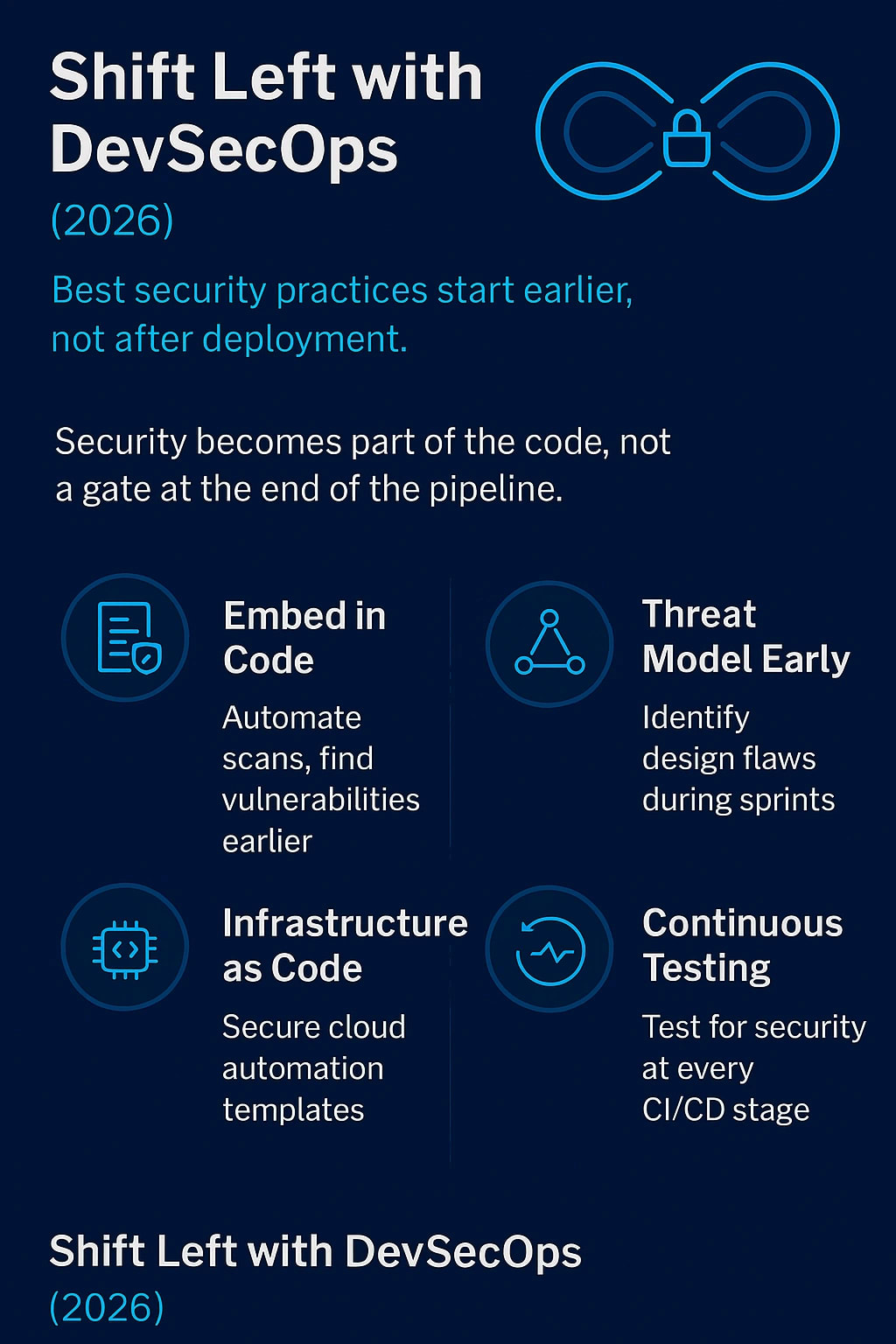
You’ve seen it happen: developers race to meet release deadlines, security reviews happen at the last minute, and your SOC gets looped in when the product is already live. By then, it’s too late.
Fixing a security flaw after deployment costs up to 30 times more than fixing it in development. But that’s not just a number; that’s time, reputation, and customer trust slipping away.
If your SOC still waits for production alerts, you’re reacting to problems that could’ve been prevented at the commit stage.
That’s where DevSecOps changes everything.
Why Shifting Left Matters
DevSecOps isn’t about adding another stage in the pipeline; it’s about changing the order of thinking.
Instead of “develop → test → secure,” you build with security baked in. Your SOC works hand-in-hand with developers from day one, catching issues before they ever touch production.
You stop being the “department of no” and start being the team that keeps releases on schedule and safe.
How to Embed Security in Your Pipeline
Step 1: Start with Developer Enablement.
Give dev teams lightweight scanning tools they can use directly in IDEs. If they find issues early, you won’t see them later.
Step 2: Automate Everything.
Integrate SAST (Static Application Security Testing) and DAST (Dynamic Testing) into CI/CD. No manual approvals. Every build runs a security check by default.
Step 3: Secure Your Dependencies.
Track open-source libraries and versions. A single outdated dependency can open your entire app to known exploits.
Step 4: Adopt Infrastructure as Code Security.
Scan Terraform, Kubernetes, or CloudFormation templates before deployment. Prevent insecure configurations before they go live.
Step 5: Close the Feedback Loop.
Feed SOC findings back to developers as learning insights not blame reports. The goal isn’t punishment; it’s progress.
What DevSecOps Feels Like in Practice
Instead of long email chains after a failed pen-test, issues get fixed at commit. Instead of delays, your developers push secure code confidently.
And your SOC doesn’t need to police every line of code because your pipeline does it automatically.
That’s what modern collaboration looks like: Security doesn’t slow you down it scales with you.
DevSecOps Checklist
Question | If you answered “no”… |
Are security scans built into every pipeline? | Integrate SAST/DAST tools. |
Do developers get instant feedback on issues? | Add pre-commit hooks. |
Are open-source dependencies tracked automatically? | Use SBOM or dependency management tools. |
Is IaC scanning part of deployment gates? | Add policy-as-code tools. |
Strategy 9: Build a Human-Centric SOC Culture
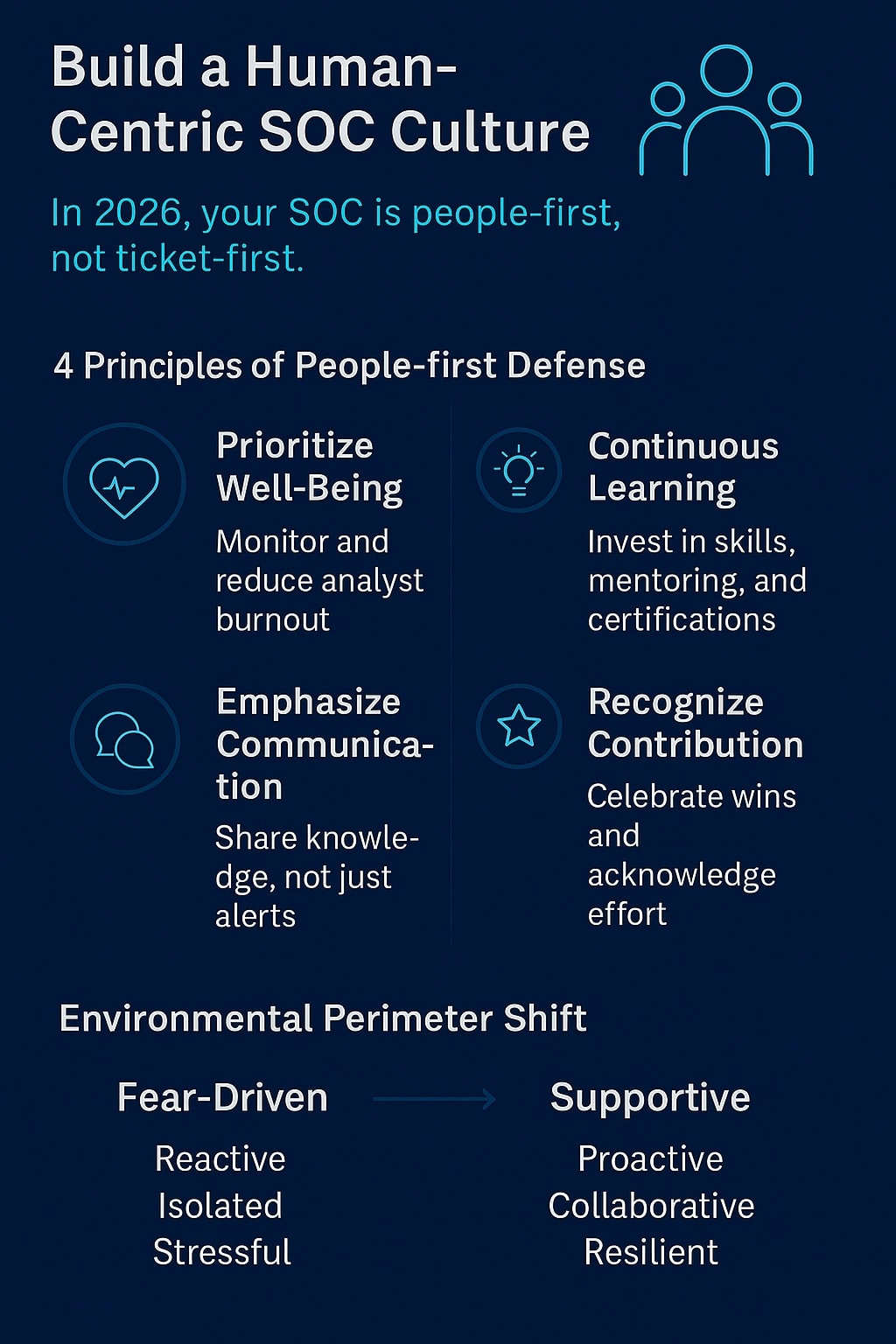
You can buy every security tool on the market but if your analysts are exhausted, disconnected, or afraid to make mistakes, those tools won’t save you.
A SOC is only as strong as the people behind it. And in 2026, the best-performing SOCs aren’t the ones with the biggest tech stacks they’re the ones that treat people like a strategic asset, not a replaceable part.
Why Culture Matters More Than Technology
You’ve probably seen it: Analysts glued to screens, skipping breaks, chasing alerts they know are false positives.
Over time, fatigue sets in. Creativity dies. Mistakes happen. That’s not a technology issue it’s a culture issue.
A strong SOC culture does three things well:
It permits analysts to think, not just react.
It turns threat-hunting into a learning opportunity.
It creates psychological safety people can flag risks without fear of blame.
How to Build a Human-Centric SOC
Step 1: Encourage Threat Hunting Over Alert Chasing.
Set aside time each week for analysts to proactively hunt. Let them explore hypotheses, not just tickets. When they hunt, they learn; when they learn, they detect faster.
Step 2: Create a Feedback Loop.
After every incident, hold short, blameless reviews. Ask, “What worked? What slowed us down?” Document lessons and update playbooks together.
Step 3: Invest in Upskilling and Cross-Training.
Rotate analysts through threat intel, forensics, and red-team exercises. The broader their experience, the sharper their instincts.
Step 4: Build Purple Team Collaboration.
Get red-teamers and blue-teamers in the same room. The point isn’t competition it’s shared improvement.
Step 5: Protect Mental Health.
Implement manageable shifts, peer-support programs, and mandatory downtime after major incidents. A burned-out analyst can’t defend a 24/7 threat landscape.
What a Human-Centric SOC Feels Like
It’s calm during chaos. Your analysts communicate instead of panicking. They share discoveries, teach each other, and take pride in collective wins.
You don’t need to micromanage; you empower. Because when your team feels trusted, they’ll go the extra mile when it truly counts.
That’s not soft management that’s strategic defense.
SOC Culture Health Checklist
Question | If you answered “no”… |
Do your analysts get weekly threat-hunting time? | Schedule dedicated sessions. |
Are post-incident reviews blameless and fast? | Redesign your review process. |
Do teams cross-train between red and blue? | Launch internal exchange weeks. |
Are burnout and workload measured? | Add human KPIs to your SOC dashboard. |
Strategy 10: Prepare for Resilience, Not Perfection
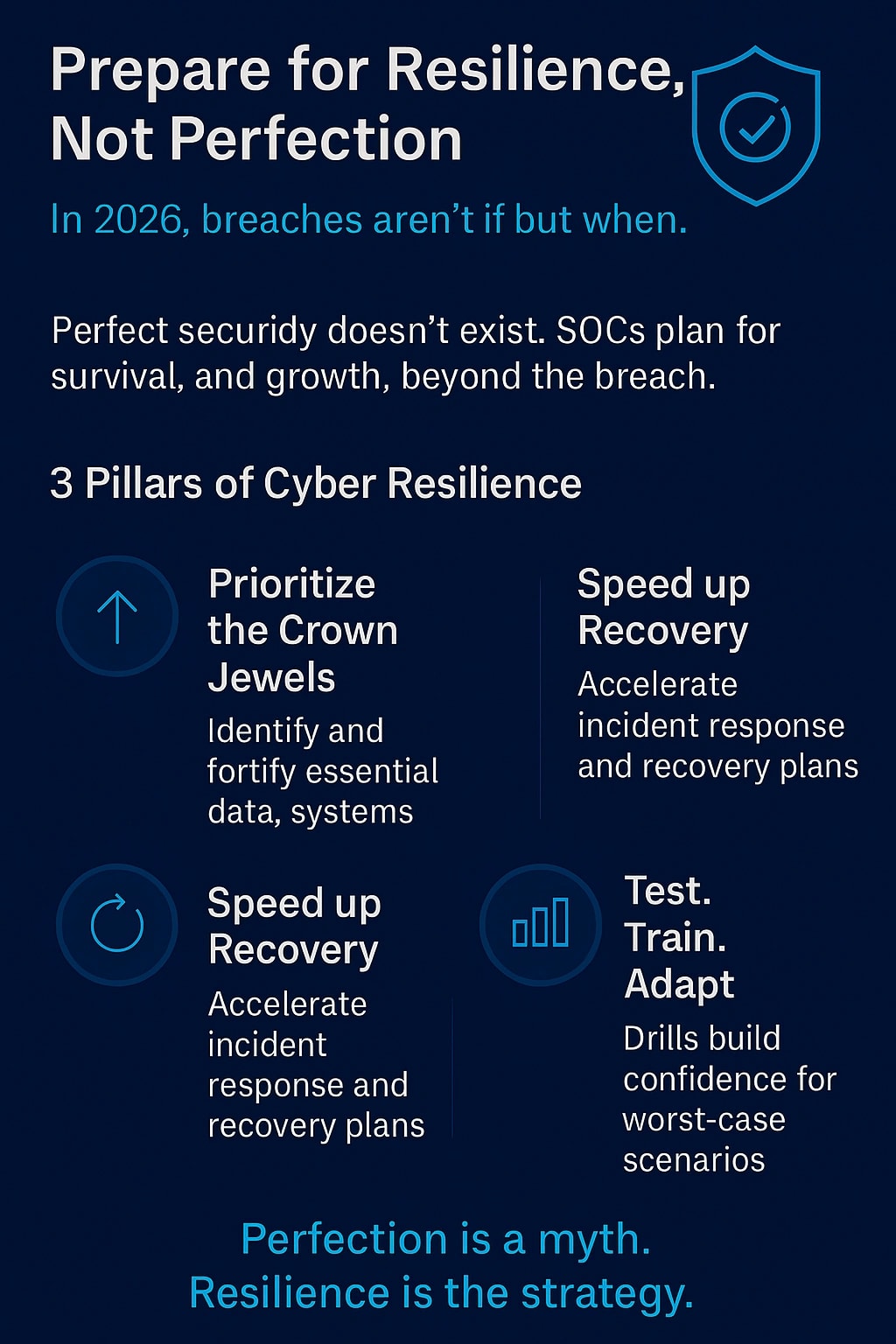
Let’s be honest no SOC can stop every attack. Even the best defenses fail. What separates great SOCs from good ones isn’t the number of breaches they prevent it’s how fast they recover when one happens.
In 2026, resilience is your ultimate measure of strength. Not zero incidents, but zero panic.
Why Resilience Beats Perfection
You’ve probably sat in that war room before screens flashing red, teams scrambling, phones buzzing. The first few minutes decide everything: containment, communication, control.
If your SOC doesn’t have muscle memory for those moments, even a small incident can spiral into chaos. That’s why resilience is more than a buzzword it’s a discipline.
A resilient SOC accepts that failure will happen and prepares so well that when it does, nobody flinches.
How to Build a Resilient SOC
Step 1: Run Tabletop Exercises Regularly.
Simulate breaches quarterly. Make them realistic incomplete data, false leads, eand xternal pressure. You’ll learn how your team really reacts when it counts.
Step 2: Perfect Your Playbooks.
Every incident should leave your playbook smarter. Document timelines, decisions, and lessons. The goal isn’t speed it’s precision.
Step 3: Strengthen Cross-Department Coordination.
When an incident hits, it’s not just your SOC that responds it’s legal, PR, operations, and leadership. Run drills together. Build shared response channels.
Step 4: Test Your Backups and Recovery Plans.
Don’t assume backups work restore them regularly. A broken backup during a ransomware attack isn’t a fallback; it’s a failure.
Step 5: Learn From Every Incident.
Conduct post-mortems that focus on growth, not blame. Update detection logic, patch blind spots, and share findings openly.
What Resilience Looks Like in Action
A breach happens. Your team isolates the threat within minutes. Comms are calm. Leadership is informed. Operations stay online.
By the next day, your SOC has already learned from it and adjusted defenses. That’s not luck, that’s resilience in motion.
You don’t chase perfection anymore. You design systems that bend but never break.
Resilience Readiness Checklist
Question | If you answered “no”… |
Do you run quarterly tabletop exercises? | Schedule one now even if small. |
Are IR playbooks updated after every incident? | Build an automatic review cycle. |
Do cross-functional teams know their roles? | Host integrated drills. |
Have you tested data recovery in the last 90 days? | Validate backups immediately. |
Prioritisation & Implementation Roadmap
Now that you’ve seen all 10 strategies, the next question is obvious where do you start?
You don’t need to rebuild your SOC overnight. Start small, prove value, then scale what works. Security maturity isn’t about how much you do it’s about how well you sequence it.
Phase 1 Quick Wins (0–90 Days)
These are the low-hanging improvements that instantly increase visibility and reduce risk:
Implement MFA and least-privilege access for critical systems.
Centralize logging across clouds for a unified SOC view.
Build automation playbooks for phishing and endpoint isolation.
Conduct a tabletop exercise to test incident readiness.
Goal: Build momentum and quick confidence.
Phase 2 Foundation (3–6 Months)
Lay down scalable processes that make your SOC consistent and predictable.
Integrate SIEM + SOAR for faster detection and response.
Begin Continuous Threat Exposure Management (CTEM).
Launch a developer security awareness program.
Start aligning SOC metrics with business KPIs.
Goal: Establish stability and predictability.
Phase 3 Expansion (6–12 Months)
Once your basics are solid, focus on resilience and maturity.
Extend Zero Trust and identity governance across departments.
Formalize your third-party risk management program.
Automate patch validation and remediation tracking.
Conduct quarterly purple-team exercises.
Goal: Build a proactive, self-learning SOC that scales with business growth.
Pro Tip:
Treat your roadmap like a security product roadmap. Review it quarterly, celebrate wins, and adapt to new threats fast.
Enterprise Cybersecurity Simplified
Protect your organization from evolving threats with real-time detection, AI-driven defenses, and continuous risk monitoring built for scale and resilience.
Tailoring to Your Organisation
Every enterprise is unique and so is its risk appetite. What works for a multinational might be overkill for a regional enterprise.
That’s why your strategy must fit your size, structure, and sector not someone else’s blueprint.
For Mid-Market SOCs
You may not have a 24/7 team or full SOAR capabilities yet.
Focus on:
Centralized visibility (SIEM + Cloud integrations).
Automating the top 3 recurring alerts.
Partnering with an MSSP for extended monitoring.
Simple, fast playbooks over complex frameworks.
Goal: Strong fundamentals without enterprise overhead.
For Large Enterprises
Scale brings complexity and that’s your biggest risk.
Focus on:
Identity federation and zero-trust orchestration.
Cross-team automation between security, IT, and DevOps.
Formal vendor risk and data flow mapping.
Dedicated threat-hunting and purple-team units.
Goal: Transform speed into resilience without adding chaos.
For Highly Regulated Sectors (Finance, Healthcare, Energy)
Compliance is your floor, not your ceiling.
Focus on:
Continuous compliance monitoring.
Encryption and tokenization of sensitive data.
Fast detection-to-reporting pipeline for auditors.
Automated evidence collection from SIEMs.
Goal: Blend governance with agility compliance by design.
Pro Tip:
Don’t copy frameworks; customize them. Your SOC should look like your business not like someone else’s PowerPoint.
Check out our other blogs:
NotEvil Search Engine: How It Works and What You Can Find
10 Online Best Dark Web Search Engines for Tor Browser
Measure Success & Continuously Improve
You can’t improve what you don’t measure. And in 2026, SOC performance isn’t about vanity numbers it’s about proving progress.
A mature SOC doesn’t wait for breaches to validate its work. It measures, learns, and evolves continuously.
Key Performance Areas to Track
Detection:
Mean Time to Detect (MTTD)
Detection coverage across assets
False positive ratio
Response:
Mean Time to Respond (MTTR)
Containment success rate
Incident repeat rate
Exposure:
% of exploitable assets remediated
External attack surface reduction
Identity risk score trends
Business Impact:
Downtime prevented
Revenue at risk mitigated.
Compliance audit success rate
Continuous Improvement Loop
Detect smarter Tune detections using incident feedback.
Respond faster, Automate routine steps, and learn from anomalies.
Review honestly, Post-mortems after every major incident.
Train regularly, Hunt, simulate, and update playbooks.
Report visibly Share business wins from security actions.
Improvement isn’t about adding tools it’s about refining muscle memory. Every incident makes your SOC sharper.
Pro Tip:
Security maturity isn’t measured by the absence of incidents it’s measured by the speed and clarity of your response when they happen.
Check out our latest blog on Cybersecurity High-Speed Internet for the US Navy | Guide
Final Thoughts
If there’s one thing 2026 has made clear, it’s this: enterprise cyber security isn’t just IT’s problem anymore. It’s the heartbeat of your business.
You’re not protecting systems; you’re protecting trust the trust of customers, investors, and every employee who logs in, believing their work is safe.
The tools you choose matter, but the strategy behind them matters more. Your SOC doesn’t need to be perfect; it needs to be prepared.
And that preparation comes from small, consistent improvements one Zero Trust policy, one automated playbook, one trained analyst at a time.
Each of the 10 strategies you’ve explored is a building block. Together, they form the framework of a resilient, adaptive enterprise.
You already have what most organizations don’t awareness. Now it’s about execution.
Because cyber threats evolve daily, but so can you.
So take the roadmap. Start with one strategy this week. Whether it’s automating a response, refining identity controls, or building a more human SOC, every small change compounds into real resilience.
In the end, enterprise cyber security isn’t about avoiding attacks. It’s about standing strong when they come and proving your SOC is ready for whatever’s next.
Want to see how these strategies could strengthen your SOC? Reach out here. I’ll help you assess where your enterprise stands today and what steps will make you unshakeable tomorrow.
Check out our latest blog on Cyber Tanks: What It Teaches About Cyber Attacks
Frequently Asked Questions
What does enterprise cyber security mean for global organizations?
It’s the practice of protecting large, distributed enterprises from digital threats by securing users, data, and systems across on-premise, cloud, and hybrid environments.
How do enterprise cyber security strategies differ from small-business security?
Enterprises secure complex global networks with SOCs, automation, and Zero Trust frameworks, while small businesses focus mainly on device-level and perimeter protection.
What are the critical components of a robust enterprise cyber security programme?
Zero Trust, identity management, continuous threat exposure, AI-based detection, and incident response are the key pillars of enterprise cyber security.
How can an SOC measure success in enterprise cyber security in 2026?
Tracking reduced detection time, faster response, minimized downtime, and measurable risk reduction aligned with business goals.
What common challenges do enterprises face when implementing enterprise cyber security frameworks?
Tool overload, talent shortages, inconsistent global policies, and poor executive alignment remain the biggest enterprise cyber security challenges.