Table of Contents
Is cybersecurity oversaturated? No, cybersecurity is not oversaturated in 2025. While competition has increased at the entry level, the industry still faces a global talent shortage, especially in mid and senior roles.
Skilled professionals with the right certifications and real-world experience remain in high demand across sectors like finance, healthcare, government, and tech.
Cybersecurity has exploded in popularity over the past decade, but with bootcamps popping up everywhere and thousands of new candidates entering the field, many aspiring professionals are starting to ask: Is cybersecurity oversaturated in 2025?
It’s a fair questio,n especially if you’re just starting or transitioning from another tech field. On one hand, companies are desperate for security talent to fight off ransomware, phishing, and nation-state attacks. On the other hand, entry-level roles seem harder to land than ever.
In this guide, we’ll break down the real state of the cybersecurity job market. You’ll learn where the field is crowded, where opportunity still thrives, and what it takes to stand out in today’s evolving threat landscape.
Whether you’re planning to enter the industry or questioning if it’s too late to start, this post is for you.
Thousands Compete, But Are There Still Jobs?

In 2025, the cybersecurity field is flooded with aspiring professionals, but many are asking a troubling question:
If so many people are applying, why aren’t more people getting hired?
The short answer: cybersecurity isn’t oversaturated, but entry-level applications are.
The Entry-Level Illusion: Where Everyone’s Competing
Thousands of students complete bootcamps, online courses, and cybersecurity degrees every month. According to a 2024 report by (ISC)², over 700,000 professionals entered the global cybersecurity talent pool in the past 18 months alone.
But here’s the reality:
Over 60% of those new entrants are applying for the same 3–5 entry-level roles
Most lack real-world experience or practical skills
Hiring managers are flooded with nearly identical resumes, many showcasing the same certifications (e.g., CompTIA Security+ or CEH)
This leads to what industry leaders call a “false saturation effect,” the illusion that the market is full, when in fact, it’s just narrowly targeted.
Read More On: How can you prevent viruses and malicious code?
Common Overcrowded Entry Points:
SOC Analyst (Tier 1)
IT Security Associate
Junior Threat Intelligence Analyst
Security Compliance Trainee
These roles receive hundreds of applications per posting, many from underprepared candidates who are following the same online advice, without differentiating themselves.
The Demand Gap: Where Jobs Go Unfilled
Despite the perceived saturation, the global cybersecurity workforce shortage remains severe. According to (ISC )²’s Cybersecurity Workforce Study (2024):
The industry still needs 4 million more qualified professionals
Over 38% of organizations report being “significantly understaffed”
Critical roles in cloud security, GRC, AppSec, and detection engineering go unfilled for months
In sectors like healthcare, finance, energy, and government, job requisitions stay open because employers can’t find candidates with the right mix of skills, experience, and business understanding.
Read More On: Candle Search Engine: Lightning Fast Private Search
Why the Gap Persists:
The majority of new candidates focus only on entry-level theory
Employers now demand real-world skills, not just certs
Many jobs require hybrid knowledge (e.g., cloud + security, development + security)
This creates a paradox: There are jobs, but they’re not at the level most people are targeting.
The Real Problem Isn’t Job Availability, it’s Mismatch
The core issue isn’t that cybersecurity is oversaturated.
It’s that most newcomers are:
Aiming too low, where competition is highest
Skipping hands-on learning, which is now a baseline expectation
Underestimating specialization, where demand (and salaries) are higher
Hiring managers aren’t just looking for “certified” individuals; they want:
Analysts who can interpret logs in Splunk or Sentinel
Entry-level defenders who can triage alerts and write detection rules
GRC specialists who understand ISO 27001 or NIST 800-53 frameworks
Professionals who can speak both “tech” and “business”
The Truth: Yes, There Are Still Jobs, But Not for Everyone
If you’re looking for a job in cybersecurity in 2025, understand this:
Role Type | Competition Level | Hiring Demand |
SOC Analyst (L1) | Very High | Moderate |
High | Moderate | |
Cloud Security Analyst | Low–Moderate | Very High |
GRC or Compliance Lead | Moderate | High |
Detection Engineer | Low | Very High |
Threat Intelligence | Moderate | High |
Application Security | Low | Very High |
The hiring floodgates haven’t closed, but the bar has moved.
Cybersecurity is still one of the most in-demand fields in tech, but it’s no longer enough to show interest. You need to demonstrate capability.
Read More On: Incognito vs VPN: Which Protects Your Privacy Better?
Why You’re Struggling to Break In (And How to Fix It)
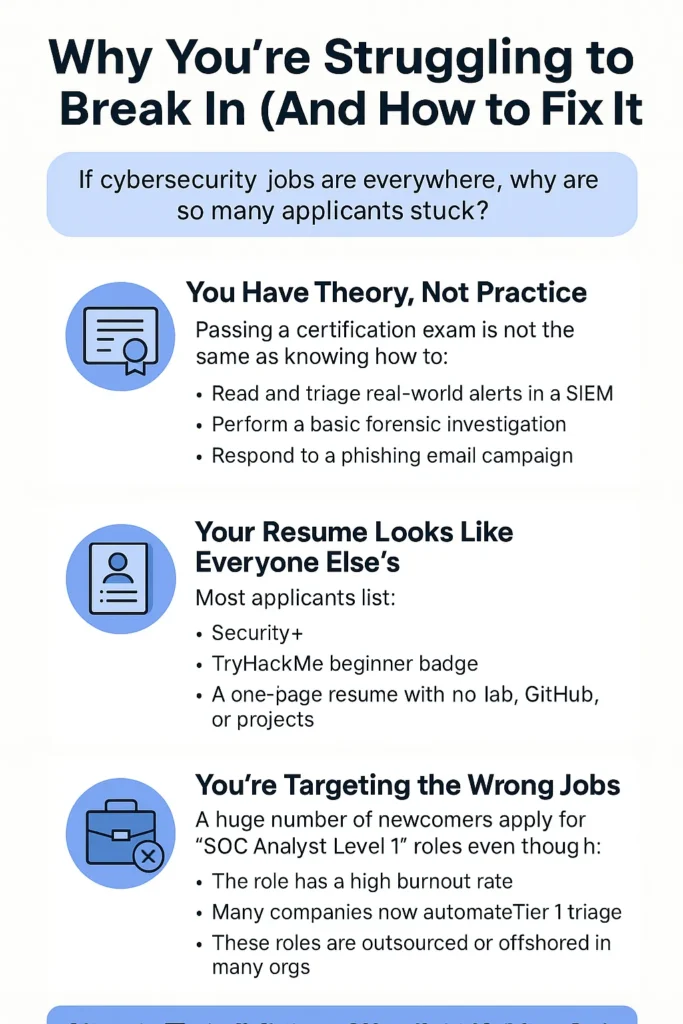
If cybersecurity jobs are everywhere, why are so many applicants stuck?
Here’s the uncomfortable truth: most job seekers aren’t struggling because there are no jobs; they’re struggling because they’re approaching the market like it’s 2015.
The field has evolved. Employers no longer hire based on enthusiasm and a Security+ cert alone. In 2025, they’re looking for readiness, relevance, and real-world skills, not just credentials.
Read More On: Cyber Security Bootcamp: Top 10 Programs & Labs
Common Reasons You’re Getting Rejected (Even if You’re “Qualified”)
1. You Have Theory, Not Practice
Passing a certification exam is not the same as knowing how to:
Read and triage real-world alerts in a SIEM
Perform a basic forensic investigation
Respond to a phishing email campaign
Write a basic PowerShell or Python script
In a 2024 hiring survey by ISACA, 72% of cybersecurity managers said that hands-on experience is more important than certifications alone.
Read More On: Clearnet vs Darknet: Key Differences Explained
2. Your Resume Looks Like Everyone Else’s
Most applicants list:
But hiring managers scan hundreds of these per week. If your application doesn’t show:
What you’ve built (labs, detections, reports)
What you know (blogs, case studies, tools you’ve used)
What you can explain (soft skills, situational judgment)
…it ends up ignored.
Read More On: Deep Search Engine: Explore Beyond Google
3. You’re Targeting the Wrong Jobs
A huge number of newcomers apply for “SOC Analyst Level 1” roles even though:
The role has a high burnout rate
Many companies now automate Tier 1 triage
These roles are outsourced or offshored in many orgs
Meanwhile, less-glamorous but in-demand roles go unfilled:
Risk and Compliance Assistant
Cloud Security Intern
Cybersecurity Project Coordinator
Security Governance Analyst
These are easier to land, less competitive, and offer faster career growth.
Read More On: How to block radiation from wifi router?
How to Fix It (Without Wasting 12 Months)
1. Build a Homelab That Mimics the Real World
You don’t need expensive gear. Use:
VirtualBox + Kali + Windows for attacker/defender labs
Security Onion, Wazuh, or Splunk Free for detection training
Document what you do: screenshots, configs, mini-case studies
This becomes proof that you can do more than memorize acronyms.
2. Learn One Detection Platform + One Scripting Language
Detection platform: Splunk, Elastic, or Microsoft Sentinel
Scripting: Python or PowerShell is used in 80% of SOC teams
Focus on applied skill: create detections, analyze logs, and build small tools.
3. Write & Share: Your Work > Your Certs
Google doesn’t hire based on paper it hires based on proof-of-thought.
Start a simple blog, LinkedIn series, or GitHub repo where you:
Analyze a real-world attack (e.g., phishing, ransomware, C2)
Show how you built a detection rule or script
Write lessons from a TryHackMe or HTB challenge, but in your own words
Recruiters Google you. Give them something to find.
4. Target Roles That Match Your Current Skill Tier
Start where the market is thinnest in competition:
Your Skill Level | Suggested Target Roles |
Beginner (0–6 mo) | GRC assistant, IT compliance intern, asset analyst |
Intermediate | SOC Tier 1, vulnerability analyst, IR support |
Advanced | Threat hunter, detection engineer, AppSec |
Don’t just apply research to the problems those roles solve and show how you can help.
Final Thought for This Section:
If you’re not getting interviews, it’s not because cybersecurity is oversaturated.
It’s because you’re not yet standing out where the hiring happens.
Fix that, and your job search transforms from “cold applications” to qualified conversations.
Read More On: Is Cybersecurity Oversaturated? Career Guide Inside
Where the Real Shortage Is: Jobs Nobody’s Applying For
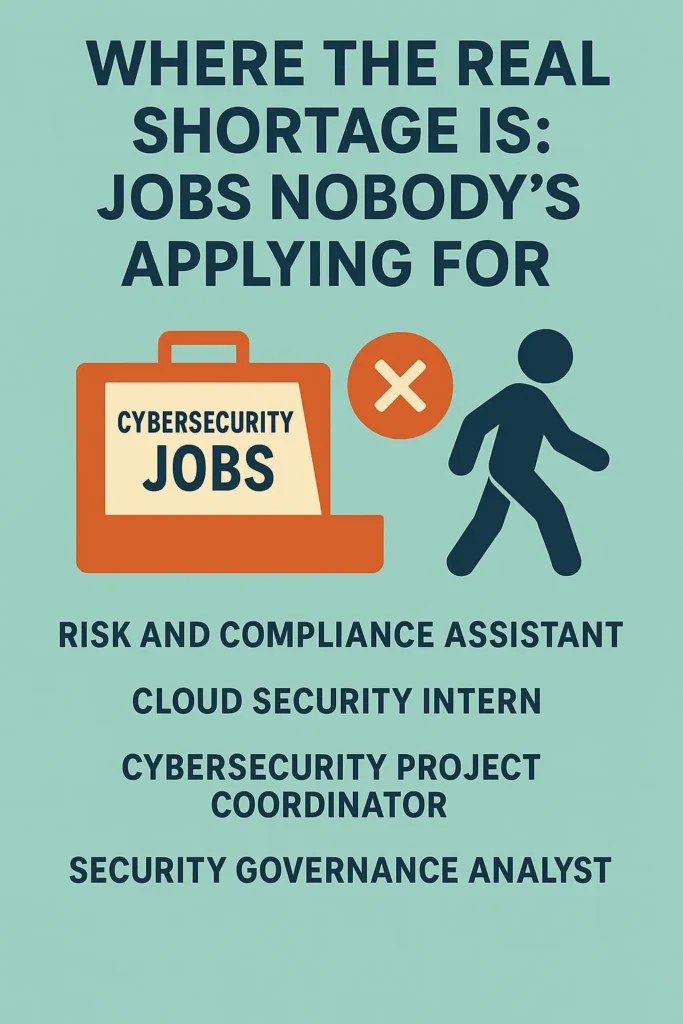
Here’s what most cybersecurity newcomers never hear:
The jobs with the highest demand aren’t the ones flooding your LinkedIn feed.
While everyone’s chasing SOC roles or red team internships, employers are quietly struggling to fill critical, high-impact positions, many of which don’t even require deep technical expertise.
The result? A talent mismatch that leaves great jobs unfilled while job seekers stay unemployed.
The Most Ignored Yet In-Demand Roles in Cybersecurity
A 2024 report by CyberSeek (backed by NICE/NIST) revealed that 58% of open cybersecurity positions in the U.S. are mid-tier or non-technical roles. Most applicants never even consider these because:
They sound “boring”
They’re not hyped on Reddit or Twitter
They’re misunderstood or misclassified
Let’s change that.
Underrated Roles That Are Hiring Now
1. GRC (Governance, Risk, and Compliance) Analyst
Demand: Very High
Requirements: Basic IT knowledge, understanding of frameworks (ISO 27001, NIST, GDPR)
Why it’s hot: Every enterprise is under regulatory pressure. GRC roles are foundational to risk management and breach prevention.
Bonus: GRC often leads to senior strategy roles, and pays well without deep tech
2. Cloud Security Analyst
Demand: Exploding
Requirements: Basic cloud knowledge (AWS/GCP/Azure), familiarity with IAM, logging, and misconfiguration risks
Why it’s hot: Cloud breaches are everywhere, and misconfigurations are the #1 cause.
Bonus: Combine this with DevOps knowledge and you’re headhunted
3. Detection Engineer / Content Developer
Demand: Increasing
Requirements: Understanding of attacker behavior, SIEM tools, scripting (Python, KQL, SPL)
Why it’s hot: Modern SOCs are shifting toward proactive detection, not just log watching.
Bonus: This is where real-world threat hunting begins
4. Security Awareness Program Coordinator
Demand: Strong in enterprise, government, and finance
Requirements: Communication skills, basic cyber hygiene, ability to run training programs
Why it’s hot: Human error is the root of 80%+ of breaches. This role fixes that.
5. Cybersecurity Project Manager / Coordinator
Demand: Growing in cross-functional teams
Requirements: Project management background, understanding security timelines, and team coordination
Why it’s hot: Complex security implementations need people who can deliver not just code.
Bonus: Great for career switchers from operations or non-technical fields
Real Salary Benchmarks (US/Global Averages)
Role | Avg Salary (US) | Avg Salary (UAE/Europe) |
GRC Analyst | $85,000 | AED 240,000 / €55,000 |
Cloud Security Analyst | $105,000 | AED 300,000 / €65,000 |
Detection Engineer | $115,000 | AED 320,000 / €70,000 |
Security Awareness Manager | $90,000 | AED 250,000 / €58,000 |
Cybersecurity Project Lead | $100,000 | AED 275,000 / €60,000 |
Source: Glassdoor, PayScale, GulfTalent, CyberSeek (2024–2025 projections)
What You Can Do Today
Shift your target job titles on LinkedIn and job boards
Study one framework (e.g., NIST CSF or ISO 27001)
Create a short portfolio project: a sample audit report, cloud misconfig simulation, or detection rule
Engage in niche forums (CloudSecList, r/GRC, Detection Engineering Slack)
Don’t follow the herd.
While the majority fight over a handful of jobs, high-paying, high-growth roles are waiting for those willing to go deeper or just a little to the side.
Read More On: What Is Baiting in Cyber Security? Don’t Fall For It
Is Cybersecurity Still Worth It in 2025?
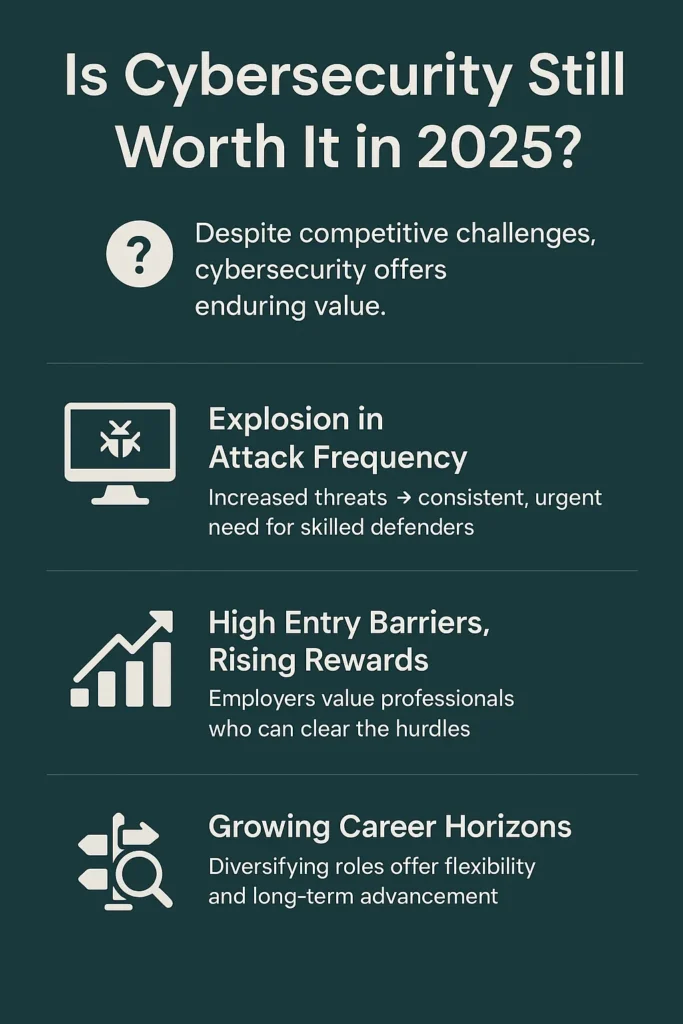
With AI tools rewriting code, cloud platforms automating security controls, and the entry-level job race getting tighter, many professionals are asking:
Is cybersecurity still a smart long-term career, or are we heading toward a bubble?
Let’s cut through the noise. The short answer?
Yes, cybersecurity is worth it in 2025, but only if you play it smart.
The Industry Is Still Growing Fast
Cybersecurity remains one of the fastest-growing fields globally. According to the U.S. Bureau of Labor Statistics:
32% job growth expected for information security analysts from 2022 to 2032
That’s more than 6x faster than the average job market
The median pay is over $112,000 per year in the U.S.
Globally, the cybersecurity market is projected to hit $538 billion by 2030, driven by:
Cloud adoption
AI-driven attacks
State-sponsored cyber warfare
Global regulatory pressure (GDPR, DPDP Act, NIS2, etc.)
This isn’t hype. This is defense infrastructure for the digital economy, and governments and enterprises are doubling down.
Use Our Cybersecurity Risk Calculator
Will AI Kill Cybersecurity Jobs?
AI is transforming cybersecurity, but not replacing it.
Here’s what’s happening:
AI is improving alert triage, threat detection, and log analysis
But attackers are also using AI to write malware, bypass filters, and social engineer victims
The result: Cybersecurity roles are becoming more strategic, creative, and threat-focused
Gartner predicts that by 2026:
60% of security operations will rely on AI-augmented decision-making
But human professionals will still lead investigations, policy decisions, and breach responses
AI can’t replace human context, risk judgment, or business communication.
It’s a tool, not a takeover.
What Makes Cybersecurity a Future-Proof Career?
Factor | Future Outlook (2025–2030) |
Job Stability | Very High |
Remote Work Opportunities | Strong and growing |
Resistance to Automation | High (especially GRC, threat hunting) |
Cross-industry Demand | Universal (healthcare, finance, defense, retail) |
Career Mobility | Clear ladder + lateral mobility |
International Relevance | Certifications transfer globally |
Unlike many tech roles that come and go with frameworks, cybersecurity is embedded into law, infrastructure, and digital governance.
The Catch: It’s Not Worth It for Everyone
Cybersecurity isn’t a “quick win” field. It’s not:
A guaranteed $100K job after one bootcamp
A field you can coast through without updating your skills
Free of stress, accountability, or evolving threats
But if you’re willing to:
Learn deeply and not just chase certs
Work smart and not just hard
Position yourself where demand exists
…then cybersecurity remains one of the most resilient, respected, and rewarding careers in tech.
Read More On: What Is an Insider Threat Cyber Awareness?
Cybersecurity Career Myths That Keep You Stuck
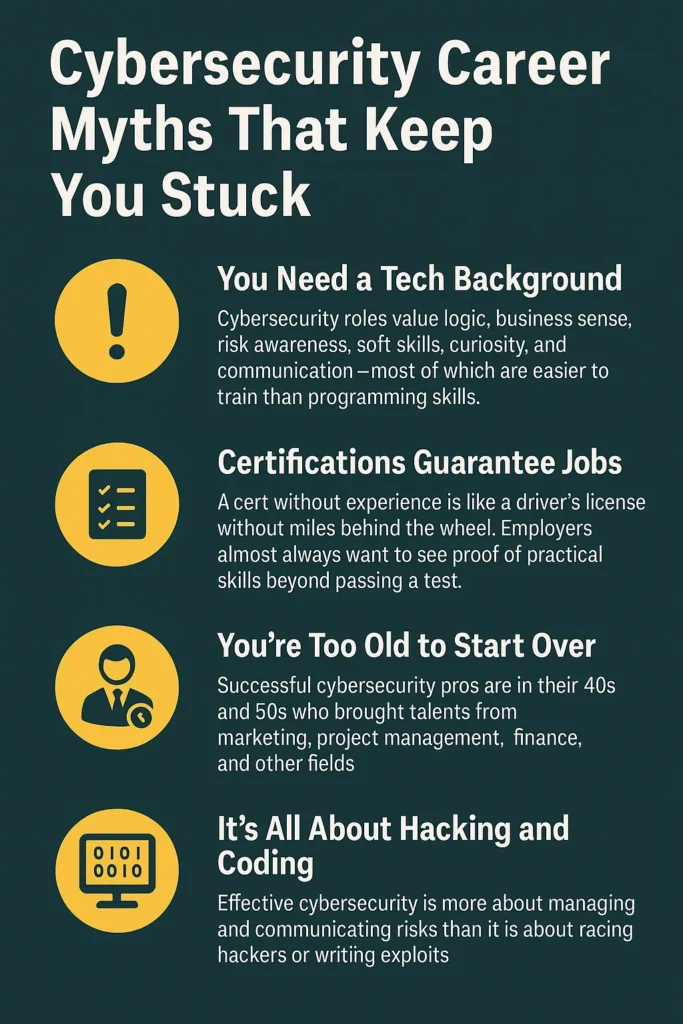
If you’re struggling to break into cybersecurity, chances are it’s not your intelligence or work ethic holding you back; it’s the outdated advice you’ve been following.
The internet is full of well-meaning but harmful myths that confuse beginners, inflate expectations, and delay actual progress.
Let’s break down the most persistent lies and what the real path looks like in 2025.
Read More On: The Role of ZTNA and VPN in Modern Cybersecurity Strategies
Myth #1: You Need a Computer Science Degree to Get Hired
Reality: Most hiring managers don’t care about your degree; they care about your skills.
In fact, in a 2024 (ISC ² survey, over 59% of cybersecurity professionals entered the field without a computer science background.
What they had instead:
Practical labs or homelabs
Certifications like Security+ or Azure Fundamentals
A GitHub, blog, or real-world detection project
In cybersecurity, proof of skill consistently outperforms paper pedigree.
Myth #2: Certifications Guarantee You a Job
Reality: Certifications get you past HR filters, but they do not get you hired.
Too many candidates stop at Security+, thinking it’s a golden ticket.
Hiring managers are overwhelmed with resumes that list 3–5 certs but zero hands-on experience.
A detection rule you’ve written or a malware analysis walkthrough is 10x more powerful than a PDF certificate.
Myth #3: You Need to Be a Hacker to Work in Cybersecurity
Reality: Ethical hacking is just one small part of the field.
The majority of cybersecurity jobs involve:
Defense (SOC, detection, blue team)
Compliance (GRC, audit, privacy)
Architecture & monitoring (cloud, IAM, SIEM)
Training & awareness
You don’t need to think like a hacker. You need to understand systems, risk, and behavior, and solve real-world business problems.
Read More On: Top 10 SIEM Use Cases for 5G Security
Myth #4: You’ll Start as a SOC Analyst, Then Work Your Way Up
Reality: The SOC path is common but not mandatory.
Many companies now outsource or automate Tier 1 SOC roles.
If you’re better at communication, writing, or research, you can start in:
GRC
Threat intel
Security awareness
Risk analysis
Entry points are wide but only if you stop chasing the “default” path.
Myth #5: It’s Too Late to Start Cybersecurity in Your 30s or 40s
Reality: Many of the best security professionals started late, often after careers in IT, finance, healthcare, education, or even law.
In 2025:
Employers need hybrid talent people who understand both business and tech
Mid-career switchers often bring stronger soft skills, maturity, and focus
You’re not behind, you’re just bringing a different kind of value
Age isn’t a disadvantage in cybersecurity. In some cases, it’s your competitive edge.
Replace the Myths With This Truth:
Cybersecurity isn’t gated by education, titles, or hype.
It rewards clarity, consistency, and demonstrated value.
If you’re stuck, it’s not because the field is oversaturated. It’s because you’ve been aiming at the wrong target, with the wrong playbook.
Read More On: 10 Online Best Dark Web Search Engines for Tor Browser
Beginner-Friendly Cybersecurity Roles That Aren’t Oversaturated
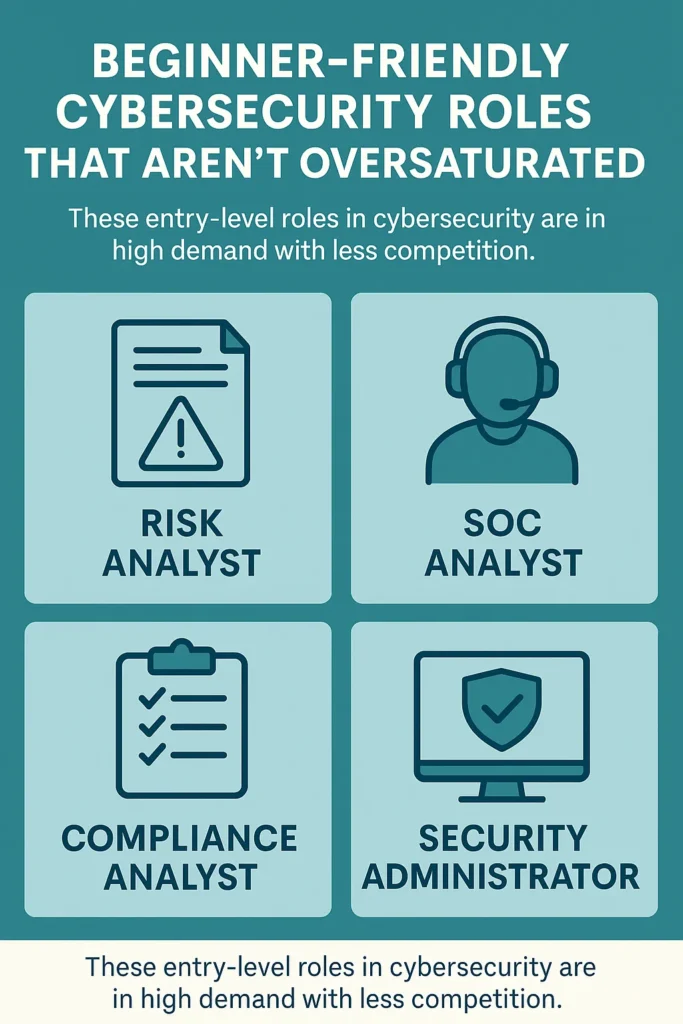
Not all entry-level cybersecurity jobs are created equal.
While thousands of candidates crowd around the same handful of titles, SOC analyst, security associate, or junior pen tester, other roles are easier to land, less competitive, and just as valuable for long-term growth.
If you’re breaking into cybersecurity in 2025, your first job doesn’t have to be flashy. It just needs to:
Get you past the HR firewall
Put yourself next to real systems, data, and threats
Give you room to grow
Let’s walk through the most underutilized but beginner-friendly roles in the industry right now.
1. GRC (Governance, Risk, and Compliance) Assistant
Why it’s beginner-friendly:
Doesn’t require deep technical skills
Teaches you the core of cyber frameworks (NIST, ISO, SOC 2)
Highly transferable to consulting, audit, or even CISO paths
What you’ll do:
Assist in creating risk assessments and security policies
Help with vendor questionnaires, compliance reports, and internal controls
Work with security teams and business units
Ideal for: Career switchers, business grads, and policy-savvy communicators
2. Cloud Security Intern or Analyst (Foundations)
Why it’s underrated:
Most people think “cloud” = senior level only
But many orgs now offer cloud security onboarding programs or junior roles
What you’ll learn:
AWS/Azure basics, IAM, S3 misconfigs, shared responsibility model
Log analysis, monitoring policies, identity-based controls
Ideal for: Beginners who’ve done a cloud bootcamp or passed the AWS Certified Cloud Practitioner
3. Security Awareness Coordinator
Why it’s overlooked:
Not considered “technical,” but it impacts every employee
High ROI for companies = high value internally
What you’ll do:
Create phishing simulations and employee training content
Manage LMS platforms and help report on compliance readiness
Act as a bridge between security and HR or training teams
Ideal for: Communicators, teachers, designers, and storytellers
4. Vulnerability Management Support
Why it works:
Often part of IT teams, but heavily involved in security posture
Exposes you to CVEs, patching workflows, and real operational risk
What you’ll do:
Run scans using tools like Nessus, Qualys, or OpenVAS
Assist in prioritizing vulnerabilities based on CVSS and asset value
Learn how IT and security talk to each other
Ideal for: Tech-savvy beginners who like process + data
5. IT Support / Helpdesk With Security Tasks
Why it’s a hidden gem:
Many orgs embed cybersecurity responsibilities in support teams
You learn user behavior, endpoint protection, MFA rollouts, and phishing cases
What you’ll touch:
Security tickets, incident escalation, and password policy enforcement
DLP software, antivirus, and endpoint management platforms
Ideal for: Entry-level tech workers transitioning into security
Comparison Snapshot: Entry-Level Cybersecurity Roles
Role | Competition | Technical Depth | Career Growth |
SOC Analyst (Tier 1) | Very High | Medium | Moderate |
GRC Assistant | Low | Low | High |
Cloud Security Intern | Moderate | Medium | Very High |
Security Awareness Coordinator | Low | Low | Medium |
Vulnerability Mgmt Support | Moderate | Medium | High |
IT Support (Security-leaning) | Low | Low | Moderate |
How to Stand Out in a Crowded Cyber Job Market
So you’ve got the certs, built your homelab, and submitted dozens of applications, yet you’re still ghosted.
Here’s the reality in 2025: skills alone aren’t enough.
To break through the noise, you must position yourself as a problem-solver, not just another entry-level candidate.
This section will show you how to differentiate yourself fast, using methods that hiring managers respect and remember.
1. Think Like a Hiring Manager, Not a Job Seeker
Most applicants are focused on what they want:
“I want to become a SOC analyst.”
“I want to get into cybersecurity.”
But hiring managers are focused on what they need:
“Can this person triage alerts, write detection logic, or communicate risk to stakeholders?”
“Will this person take initiative without needing hand-holding?”
Switch your framing from ‘I want’ to ‘Here’s how I solve your problem.’
2. Build a Public Work Portfolio (Even if You’re a Beginner)
Hiring teams don’t just hire resumes; they hire evidence.
Even if you’re brand new, you can showcase:
Detection logic from Splunk, Sentinel, or Elastic
Incident response write-ups from TryHackMe or simulated labs
GRC policy examples or mock audit reports
Threat intelligence breakdowns of recent ransomware attacks
Visual dashboards from SIEM or open-source tools (e.g., Wazuh, Zeek)
Post them to:
GitHub (for code/scripts/detection queries)
A personal blog or Medium
LinkedIn as mini case studies (weekly posts work incredibly well)
2025 Hiring Insight: Employers now search your name before they download your resume.
3. Write to Be Discovered, Not Just to Apply
Most candidates apply → wait → repeat.
Smart candidates attract recruiters by:
Writing blog posts on common vulnerabilities (e.g., how you remediated a misconfigured S3 bucket)
Posting analysis of breaking news breaches (e.g., CrowdStrike outage, MOVEit vulnerabilities)
Creating simple detection walkthroughs on platforms like Hashnode, Substack, or Notion
Tip: Every good post you write becomes a 24/7 recruiter magnet.
4. Master One Tool That Shows Real-World Readiness
Instead of chasing every buzzword, get deep with:
Splunk or Sentinel (for detection content)
Burp Suite or OWASP ZAP (for web app testing)
Nessus or OpenVAS (for vuln scanning)
MITRE ATT&CK Navigator (for threat mapping)
Proficiency in one real-world platform speaks louder than five random labs.
When you show familiarity with the tools already in the job description, you become a safer bet.
5. Network Strategically, Not Desperately
Stop cold-messaging 50 people a week with “Can you refer me?”
Instead:
Attend virtual meetups and say something insightful during Q&A
Engage with niche Slack groups (e.g., Detection Engineering, Purple Team, CloudSecList)
Leave valuable comments on LinkedIn posts by hiring managers
Ask for feedback on a project, ot just a job
People hire those who are visible, valuable, and verified by their work.
6. Optimize Your Resume for Outcomes, Not Inputs
Most resumes say:
“Completed Security+”
“Participated in TryHackMe challenges”
Better resumes say:
“Built 3 detection rules in Splunk and validated them using MITRE ATT&CK mappings”
“Reduced alert fatigue by automating log filters during homelab triage”
Focus on what you did, not just what you attended.
Future Outlook: Is Cybersecurity Still a Good Career?
We’ve covered the job market realities, entry-level myths, and overlooked roles, but you might still be wondering:
Is cybersecurity a good long-term career choice?
The short answer: Yes, if you choose your path strategically.
Cybersecurity continues to offer:
One of the fastest-growing job sectors globally
Strong salaries and upward mobility across all levels
Resistance to automation and economic downturns
Global relevance across industries and regions
A clear path from beginner to specialist, architect, or CISO
However, the field is evolving fast roles are becoming more integrated with cloud, AI, and governance. The winners will be those who adapt early, go deep, and bring value beyond certs.
Want the full breakdown?
I’ve already written a complete, in-depth guide on this topic:
Is Cybersecurity a Good Career?
It covers:
Pros and cons of cybersecurity in 2025
Day-to-day work expectations
Career paths and salary projections
Who should (and shouldn’t) pursue it
Final Thoughts
Is cybersecurity oversaturated in 2025?
Not even close.
What’s happening is a misalignment between where candidates are looking and where the actual demand exists.
The entry-level job market feels overcrowded because everyone is applying to the same handful of roles with the same basic credentials. But when you look at the industry from a hiring manager’s perspective, there’s a very different story:
Millions of jobs remain unfilled, especially in cloud security, compliance, and detection engineering
Specialized and mid-level roles are growing faster than the talent pool
Real-world skills, proof-of-work, and positioning matter more than ever
If you’re serious about breaking into cybersecurity, the question isn’t “Is cybersecurity oversaturated?”
It’s:
“Am I targeting the right roles, building the right skills, and positioning myself to stand out?”
Because the truth is:
Cybersecurity is one of the few tech careers that’s still growing, still hiring, and still wide open for those who are prepared.
Ready to Take the First Step?
Forget the hype. Bypass the crowd.
Start building skills that solve real security problems, and your career will build itself.
Frequently Asked Questions
Are cybersecurity internships easier to get than full-time roles?
Not necessarily. Many internships are just as competitive as full-time roles, especially at large companies. Smaller firms and startups, however, may offer easier access to real-world experience.
Do employers reject candidates who only have certifications like Security+ without practical skills?
Yes. Certifications may pass initial filters, but hiring managers increasingly value hands-on labs, detection content, and real-world projects over certificates alone.
Which cybersecurity specializations still have low competition but high demand?
Fields like cloud security, threat intelligence, ICS/OT security, and AppSec are underfilled and growing, making them strong entry paths for candidates who specialize.
Why does the cybersecurity field feel overcrowded if there are still open positions?
Many applicants target the same entry-level roles, creating a perception of saturation—even though specialized and skill-based positions remain unfilled.
Can career switchers succeed in cybersecurity without an IT background?
Absolutely. Many professionals from fields like teaching, finance, or law enter cybersecurity through GRC, policy, awareness, or compliance roles that value communication and analysis.