Cybersecurity stocks represent companies that build software and services to protect networks, data and digital infrastructure.
With cyber threats on the rise globally, these stocks offer strong growth potential, balanced by valuation, competition and regulatory risks.
You didn’t wake up randomly thinking about cybersecurity stocks.
Maybe you saw another headline about a hospital shutdown. Maybe your company rolled out mandatory security training again. Or maybe you looked at your portfolio and thought, “I need exposure to something that survives recessions and still grows.”
You’re not wrong.
Cybercrime costs are projected to cross trillions of dollars annually over the next decade. That money doesn’t disappear. It flows toward companies that stop attacks, detect breaches and keep businesses running. That’s where cybersecurity stocks enter your investing story.
But here’s the part most blogs skip:
Not every cybersecurity stock is a good investment for you.
Let’s fix that.
Check out our latest blog on : Google Gmail Data Breach: What’s Actually Happening (2026)
Who are cybersecurity stocks really for

Before you look at charts, tickers, or analyst targets, pause and look at yourself. Cybersecurity stocks don’t reward every investor equally.
They reward specific mindsets, time horizons and expectations. If you know which group you fall into, your decisions get clearer and mistakes shrink fast.
Let’s break this down in a way that feels honest, not aspirational.
If you think like a long-term owner, not a trader
Cybersecurity stocks suit you if you invest the way a business owner thinks.
You’re comfortable holding through:
- Earnings volatility
- Market rotations
- Temporary sentiment shifts
You understand that security spending compounds over time. Companies renew contracts, expand licenses and add modules year after year. That compounding shows up slowly in stock prices, not overnight.
If you enjoy watching fundamentals mature rather than candles spike, this sector fits your temperament.
Check out our latest blog on Data Leak Prevention: Complete Guide, Tools & Best Practices
If your job already taught you how expensive cyber risk is
If you work in IT, security, compliance, healthcare, finance, or enterprise operations, you already feel the problem these companies solve.
You’ve seen:
- Emergency patching on weekends
- Incident response chaos
- Vendor renewals approved without debate.
- Boards asking uncomfortable questions after breaches.
That lived experience gives you an edge. You’re not investing in an abstract idea. You’re investing in pain prevention. That alignment between your professional reality and your portfolio often leads to better conviction during drawdowns.
If you want growth without chasing hype cycles
Cybersecurity stocks appeal to buyers who want growth but hate noise.
You’re probably tired of:
- Viral tech narratives
- Revenue without discipline
- Products searching for problems
Security companies don’t sell dreams. They sell risk reduction. That keeps demand grounded in budgets, not buzz. Growth still happens, but it’s tied to renewals, compliance deadlines and threat escalation.
If you prefer growth anchored to necessity, this space makes sense.
If you care about downside protection as much as upside
Cybersecurity stocks attract investors who prioritize capital preservation over returns.
During economic slowdowns:
- Marketing budgets get cut
- Experimental tech pauses
- Security spending often continues.
Why? Because breaches during downturns cost jobs and reputations. Boards don’t gamble on that.
If you want exposure to tech without feeling fully exposed to economic mood swings, cybersecurity offers a defensive growth angle few sectors can match.
If recurring revenue matters to you
You value predictability.
Many cybersecurity companies run on:
- Annual subscriptions
- Multi-year enterprise contracts
- High renewal rates
That structure reduces revenue shock. It also smooths earnings and improves forecasting. If you like businesses where future cash flows feel visible, you’ll feel more comfortable here than in ad-driven or consumer-dependent tech.
If you accept complexity and competition
Cybersecurity stocks are not simple stories.
You need patience for:
- Crowded vendor landscapes
- Rapid feature overlap
- Constant product evolution
If you expect one winner to dominate forever, you’ll get frustrated. This sector evolves through consolidation, partnerships and platform shifts. Investors who accept that complexity tends to make calmer decisions.
Who cybersecurity stocks are not for
This matters just as much.
Cybersecurity stocks may not suit you if:
- You want fast momentum trades
- You panic during sector-wide sell-offs
- You expect linear growth.
- You buy stories instead of balance sheets.
The sector punishes impatience. It rewards understanding.
A quick self-check before you invest
Ask yourself:
- Can I hold this through a bad quarter?
- Do I understand how this company makes money?
- Would customers still pay during a downturn?
If you answer yes without forcing it, you’re likely the right buyer.
Cybersecurity stocks work best when they match who you are, not who you want to be as an investor. When your temperament aligns with the sector, decisions feel calmer, conviction stays intact and returns stop feeling accidental.
The growth story: why demand keeps rising
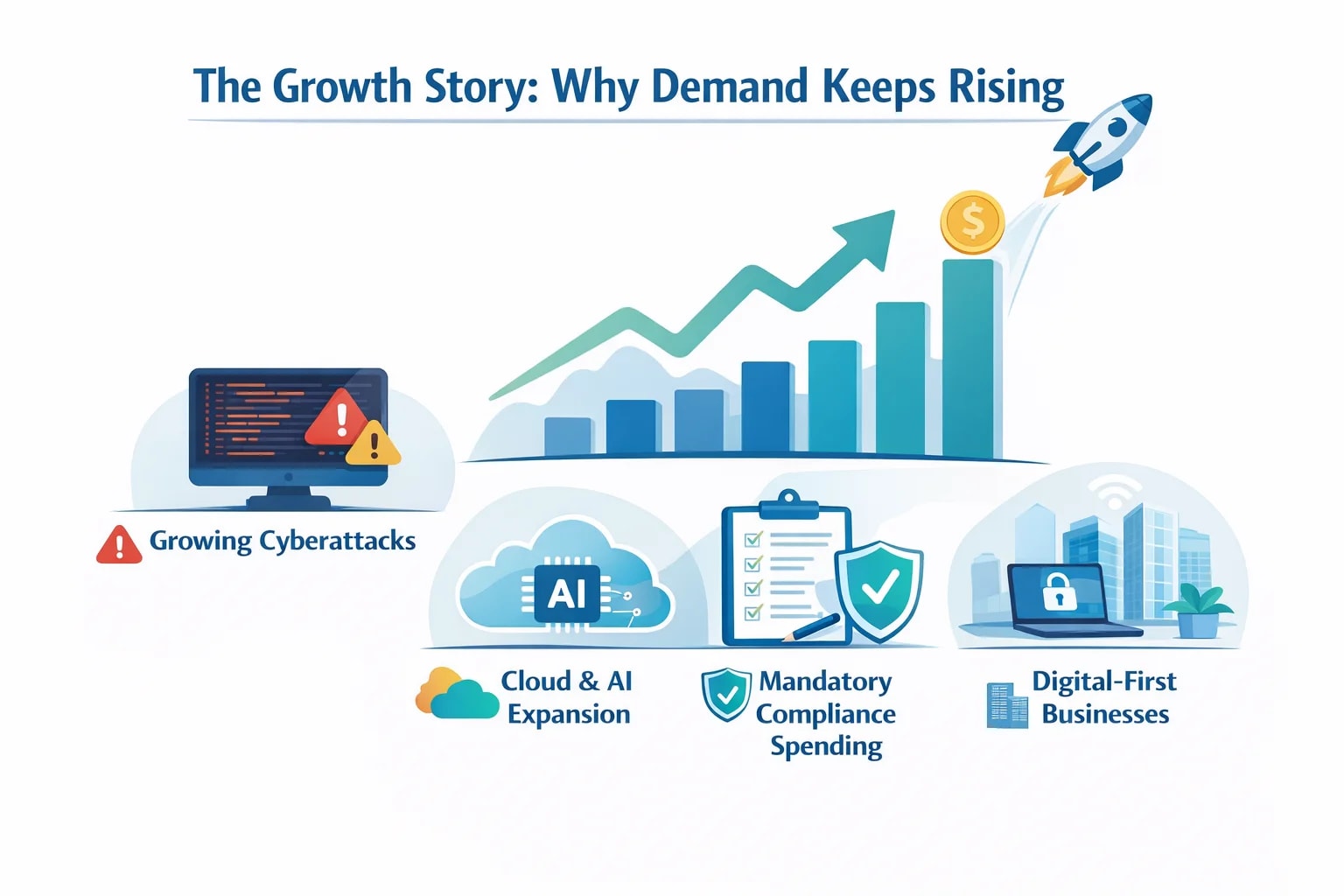
Cybersecurity demand doesn’t rise because boards feel optimistic. It rises because failure is visible, costly and personal. Every breach puts names, careers and balance sheets at risk.
That pressure reshapes how organizations spend and why cybersecurity budgets keep expanding even when everything else slows.
Here’s what’s driving that growth, without repeating the usual talking points.
Digital expansion creates permanent exposure
Your business footprint keeps stretching, even if headcount doesn’t.
- Cloud infrastructure replaces private networks.
- Employees log in from everywhere.
- Vendors plug into internal systems.
- Data moves across borders in seconds.
Each expansion adds access points that didn’t exist before. Security teams don’t “finish” protecting environments. They keep adapting. That ongoing adaptation fuels continuous demand for cybersecurity tools rather than one-time purchases.
Breaches now trigger consequences beyond IT.
Cyber incidents no longer stay inside the server room.
A single breach can lead to:
- Regulatory penalties
- Lawsuits and settlements
- Executive accountability
- Brand erosion
When CEOs and boards feel personal exposure, spending decisions change. Security stops competing with other IT priorities and starts behaving like insurance. That mindset shift sustains long-term growth across the sector.
“Cyber risk is business risk. Once leadership accepts that, budgets follow.” Board advisor, global financial services firm
Regulations force action, not intention.
Many companies don’t invest in security because they want to. They invest because they must.
- Data protection laws demand controls.
- Industry standards require audits.
- Insurance providers mandate safeguards.
Compliance deadlines don’t care about market sentiment. They arrive on schedule and force spending cycles regardless of the economic mood. This creates baseline demand that doesn’t disappear during downturns.
Attackers innovate faster than internal teams.
Threat actors move quickly, adapt tactics and share tools.
Organizations respond by:
- Layering defenses
- Buying specialized tools
- Outsourcing detection and response
That imbalance keeps pressure on buyers. Internal teams can’t build everything themselves. Vendors fill the gap. As attacks evolve, products expand. That cycle repeats, quarter after quarter.
Security tools embed themselves into operations.
Once deployed, cybersecurity products become hard to remove.
They integrate with:
- Identity systems
- Cloud platforms
- Network infrastructure
- Incident workflows
Replacing them creates risk and downtime. That stickiness leads to renewals, upgrades and add-on purchases rather than churn. For investors, that translates into revenue durability, not one-off sales spikes.
Spending shifts from prevention to resilience
The market moved past the idea of perfect defense.
Companies now spend on:
- Detection speed
- Response automation
- Recovery planning
This expands the addressable market. It’s no longer about blocking attacks alone. It’s about limiting damage and restoring operations fast. That broader scope pulls more budget into the ecosystem.
Security budgets behave differently in slowdowns.
During economic pressure:
- Marketing pauses
- Hiring freezes
- Experimental projects stall
Security spending rarely disappears. It gets scrutinized, but cuts feel dangerous. Boards prefer trimming growth initiatives over risking a breach during layoffs or restructuring. That defensive behavior keeps demand alive when other tech sectors contract.
Why this matters to you as an investor
You’re not betting on innovation cycles alone. You’re aligning with structural pressure that doesn’t ease.
Demand rises because:
- Exposure grows
- Accountability tightens
- Failure costs escalate
- Tools become embedded
That combination creates momentum that outlasts hype cycles and headlines.
Cybersecurity growth doesn’t feel exciting every quarter. It feels inevitable over time. And for the right investor, inevitability beats excitement.
How cybersecurity stocks actually make you money
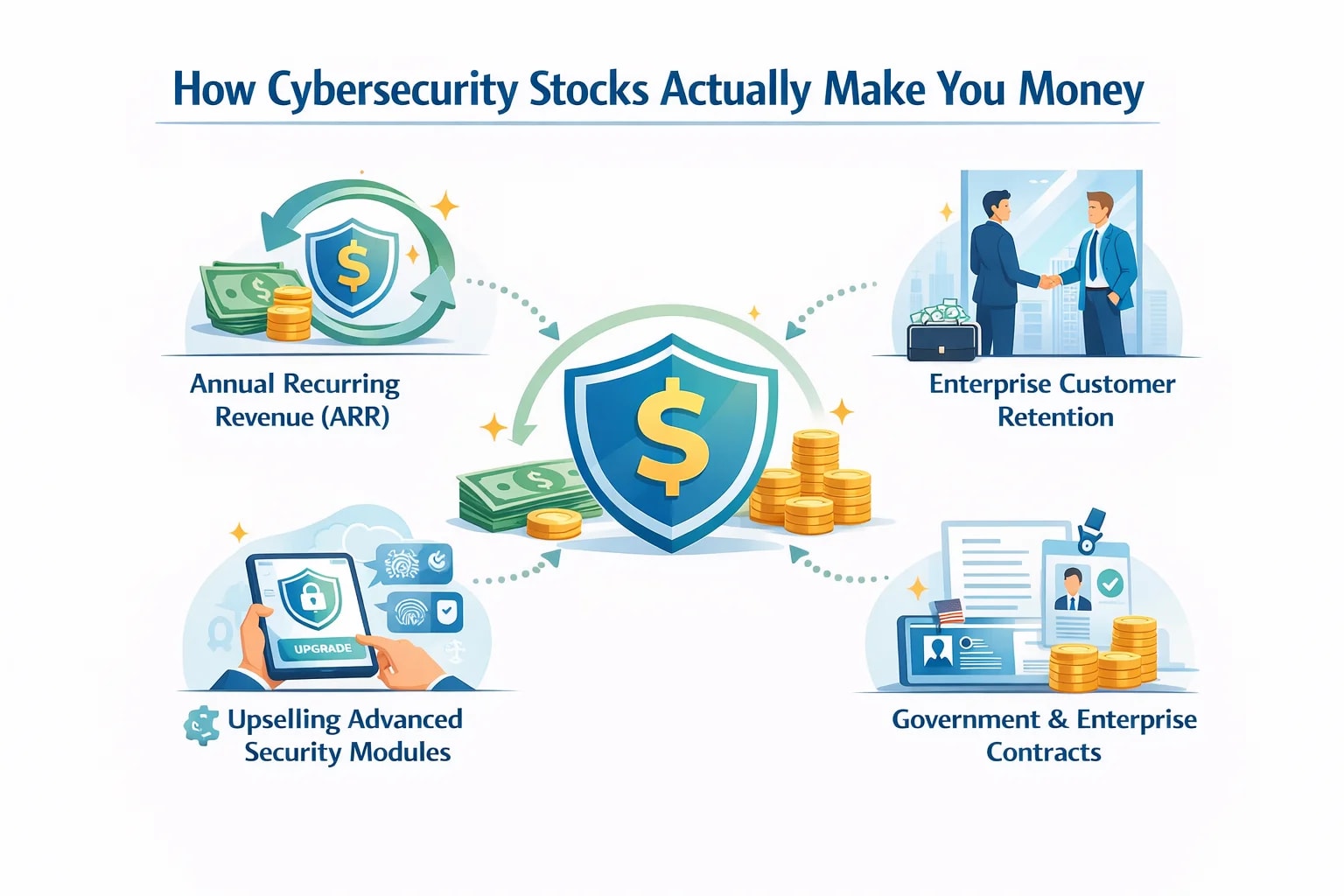
Returns in cybersecurity stocks don’t usually come from dramatic headlines or sudden breakthroughs. They come quietly, through business mechanics that reward patience more than prediction.
If you understand where the money really comes from, you stop chasing spikes and start spotting durable value.
Let’s break this down in plain terms, with your perspective as the investor front and center.
Compounding through renewals, not one-time wins
Most cybersecurity companies don’t sell once and walk away.
They sell:
- Annual subscriptions
- Multi-year enterprise contracts
- Tiered licenses that expand over time
Once a company deploys a security tool, ripping it out feels risky. That leads to renewals that stack year after year. Each renewal compounds revenue without the company needing to resell the same customer from scratch.
Your returns build slowly, but they build consistently.
Expansion inside existing customers
The best cybersecurity revenue doesn’t come from new logos. It comes from selling more to customers who already trust the product.
Expansion happens when:
- User counts increase
- New modules get added.
- Security scope widens
- Compliance requirements grow
This isquitet growth. It rarely trends on social media, but it shows up in earnings calls and long-term charts.
“The strongest signal in cybersecurity isn’t new customer growth. It’s expansion within existing accounts.” Enterprise software analyst
Pricing power during pressure
Cybersecurity companies often retain pricing power even when budgets tighten.
Why?
- The cost of a breach outweighs license fees.
- Security tools sit deep in operations.
- Boards hesitate to cut protective controls.
When companies can raise prices modestly without losing customers, margins improve. That margin expansion fuels shareholder returns more reliably than aggressive top-line growth alone.
Operating leverage as scale kicks in
Early-stage cybersecurity firms spend heavily on sales, research and marketing. As they scale, something important happens.
- Revenue grows faster than expenses.
- Margins widen
- Cash flow improves
That operating leverage often marks the moment when markets revalue the stock. Not because the product changed, but because the business matured.
If you’re early enough, that transition becomes a major source of upside.
Strategic acquisitions, not constant reinvention
Cybersecurity markets fragment quickly. No single vendor covers everything.
Strong companies respond by:
- Acquiring niche tools
- Folding them into platforms
- Cross-selling to existing customers
Done well, acquisitions accelerate growth without resetting trust. For you as an investor, this creates step-changes in revenue rather than slow organic buildup alone.
Scarcity and consolidation dynamics
The market can’t support hundreds of security vendors forever.
Over time:
- Smaller players get acquired
- Platforms absorb features
- Survivors gaina share
When consolidation accelerates, well-positioned companies benefit from reduced competition and stronger bargaining power. That shift often reflects in valuation multiples.
Returns reward patience, not timing perfection.
Cybersecurity stocks don’t usually reward perfect entry points. They reward staying invested while fundamentals strengthen.
Short-term price swings often reflect:
- Macro sentiment
- Rate changes
- Sector rotations
Long-term returns reflect:
- Contract growth
- Retention rates
- Margin expansion
If you focus on the second list, volatility stops feeling like danger and starts looking like noise.
What this means for your
If you expect:
- Quick flips
- Linear growth
- Constant excitement
This sector may disappoint you.
If you expect:
- Gradual compounding
- Durable demand
- Businesses that grow into their valuations
Cybersecurity stocks can reward you in a way few tech sectors do.
Returns here don’t announce themselves loudly. They accumulate while attention is elsewhere. And for investors who understand that, that’s often the point.
The risks investors underestimate
Cybersecurity stocks feel safe because the demand story sounds inevitable. That sense of safety is where many investors slip.
The risks aren’t obvious, loud, or dramatic. They sit quietly beneath strong narratives and only surface when expectations run ahead of reality.
If you understand these risks early, you stop reacting emotionally later.
Valuation risk hides behind great stories.
Cybersecurity companies often trade on future promise, not present cash flow.
When growth expectations get priced in:
- Even solid earnings can disappoint
- Good results may still lead to sell-offs
- Multiples compress without warning.g
You’re not just betting on execution. You’re betting on expectations staying high. When sentiment shifts, prices fall faster than fundamentals change.
This is where many investors confuse a great company with a great entry point.
Competition erodes differentiation faster than expected
Security problems are shared problems. That means solutions converge.
What starts as a breakthrough feature often becomes:
- A checkbox requirement
- A bundled add-on
- A commodity capability
New vendors emerge quickly. Large platforms copy features. Customers reduce tool sprawl. If a company can’t defend its position, revenue growth slows even when demand stays strong.
Customer consolidation works against vendors.
Enterprises want fewer tools, not more.
As security stacks mature:
- Buyers reduce vendor count
- Platforms replace point solutions.
- Renewal negotiations tighten
This favors a small group of winners and quietly hurts everyone else. The risk isn’t churn overnight. It’s slower expansion, tougher renewals and lower pricing power.
Technology shifts don’t wait for business models
Security tools must evolve faster than the threats they stop.
AI, automation and platform convergence can:
- Disrupt existing products
- Make tools redundant
- Shorten product lifecycles
If a company misses a shift, recovery takes time. Markets often price that delay harshly, even if long-term relevance remains intact.
Revenue visibility can mislead you.
Recurring revenue feels stable. That doesn’t mean it’s immune.
Risks include:
- Contract downgrades
- Delayed renewals
- Reduced seat counts
- Budget scrutiny during downturns
Revenue rarely collapses. It decelerates. Stock prices react long before income statements reflect the slowdown.
Regulatory exposure cuts both ways
Regulation drives demand, but it also raises costs.
Compliance requirements can:
- Increase operating expenses
- Slow product releases
- Create legal exposure
Companies that fail audits or mishandle disclosures pay twice: once in fines, once in market trust.
The table investors should actually look at
| Risk | Why it matters to you |
| Valuation compression | Strong companies can still deliver poor returns |
| Feature commoditization | Differentiation fades faster than expected |
| Vendor consolidation | Slower growth despite stable demand |
| Technology disruption | Products lose relevance before revenue disappears |
| Renewal pressure | Growth stalls without visible churn |
| Regulatory burden | Costs rise while margins tighten |
Read that table as a system, not a checklist. These risks often stack, not appear alone.
The risk most investors never admit
The biggest risk isn’t technology. It’s behavior.
- Buying after strong runs
- Selling during sector-wide fear
- Confusing price drops with broken businesses
Cybersecurity stocks test patience more than conviction. They reward investors who expect turbulence and plan for it.
If you price these risks in before you buy, volatility stops feeling like betrayal. It starts feeling like part of the deal.
That mindset shift matters more than any ticker symbol.
Growth vs stability: choosing your lane
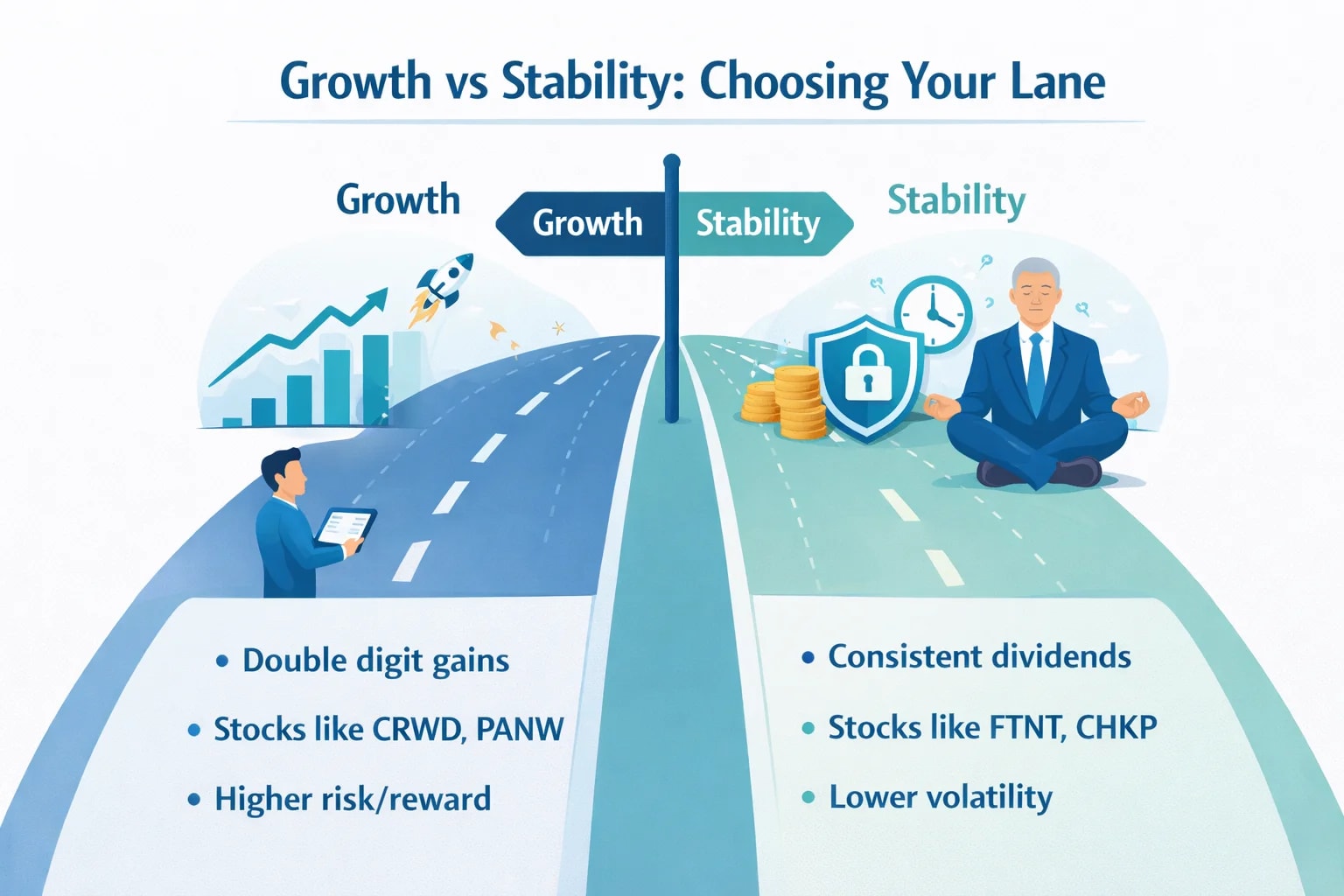
If you buy cybersecurity stocks without deciding why you’re buying them, you’ll feel confused the moment the market moves against you.
One bad quarter and you’ll wonder, “Should I sell?” One strong rally and you’ll think, “Should I add more?” That’s not investing. That’s reacting.
You need a lane.
In cybersecurity, your lane usually falls into one of two buckets: growth or stability. Both can work for you. The mistake is mixing them without a plan.
Lane 1: Growth-focused cybersecurity stocks
This lane fits you if you’re chasing long-term upside and you can stomach volatility.
You’re betting on:
- Rapid revenue expansion
- New market creation (cloud security, identity, AI security)
- Large enterprises are increasing spend per customer.
- Product platforms are expanding into multiple categories.
How these stocks behave
- They move hard on earnings.
- They can drop fast on guidance cuts.
- They often trade on future expectations.
- Valuations can swing with interest rates.
What you need to be comfortable with
- Holding through 30–50% drawdowns without panic
- Waiting for multi-year compounding
- Reading metrics like net retention and customer expansion
- Accepting that “good news” can still cause a sell-off if expectations were higher.
If you want excitement, this lane delivers. If you want calm, it won’t.
Lane 2: Stability-focused cybersecurity stocks
This lane fits you if you want exposure to cybersecurity while protecting your downside.
You’re looking for:
- Consistent cash flow
- Profitable or near-profitable operations
- Sticky enterprise customers
- Predictable renewals
How these stocks behave
- They tend to fall less during market fear.
- They recover more slowly, but steadier.
- They often reward patience through dividends or buybacks (where applicable)
- They rely less on hype and more on execution.
What you need to care about
- Margin trends
- Free cash flow
- Renewal quality
- Competitive moat through platform depth and ecosystem integration
This lane feels closer to “boring business strength.” In investing, boring often pays.
A simple decision framework (use this before you buy)
Ask yourself these four questions:
- How long can you hold without needing the money?
- 3–5+ years supports growth plays
- 1–3 years leans stability or diversified exposure
- How do you react to a 25% drop?
- If you’ll panic, don’t buy high-volatility growth names.
- If you’ll add calmly, growth can work.
- Do you enjoy following earnings and product cycles?
- Growth lane needs attention.
- The stability lane needs less monitoring.
- What role should cybersecurity play in your portfolio?
- Growth engine? Choose growth names
- Defensive tech allocation? Choose stability names
Your lane determines your strategy
If you choose growth
- Buy in phases, not one shot
- Expect volatility and plan entries around it.
- Focus on business quality over headlines.
If you choose stability
- Prioritize resilience metrics
- Avoid overpaying for “safety.”
- Treat it like a long-term core holding
The mistake you should avoid
Don’t buy a growth stock and expect stable behavior.
Don’t buy a stable compounder and expect it to “moon.”
If you align your expectations with your lane, you stop feeling surprised by normal price movement. You’ll still feel emotions, but you won’t make emotional decisions.
Pick your lane first. Then pick your stocks.
Pros and cons of investing in cybersecurity stocks

If you’re considering cybersecurity stocks, you’re already thinking like a practical investor: “Where’s the upside and what can hurt me?” That’s the right mindset here.
The sector has real tailwinds, but it also carries traps that catch buyers who fall in love with the story and ignore the mechanics.
Let’s break the pros and cons down in a way that helps you decide whether this fits your portfolio.
Pros of investing in cybersecurity stocks
1) Demand behaves like a necessity, not a luxury
Security spending doesn’t depend on consumer sentiment. A retailer can delay a store redesign. A hospital can’t “pause” breach protection.
When breaches become public and costly, budgets shift from optional to operational. That’s a strong foundation for long-term demand.
What this means for you: you’re investing in a category that stays relevant across business cycles, not a trend that fades when attention moves on.
2) Recurring revenue can create steady compounding
Many cybersecurity companies sell subscriptions and multi-year contracts. Once a tool is integrated, switching vendors creates risk, downtime and retraining costs.
That stickiness often translates into:
- Predictable renewals
- Upsells as needs expand
- Multi-product adoption over time
What this means for you: the business can grow without constantly “starting over” every quarter. Compounding becomes more plausible.
3) High switching costs support long-term customer retention
Cybersecurity tools sit deep inside infrastructure: identity, endpoints, cloud workloads, detection pipelines. Replacing them isn’t like changing a design tool. It’s an operational surgery.
What this means for you: strong products can retain customers even when competitors offer discounts.
4) Regulatory pressure acts like a demand engine
Data protection laws, industry standards, cyber insurance requirements and breach reporting rules push companies into spending. Whether leadership loves it or not, compliance deadlines arrive.
What this means for you: spending has structural support beyond “innovation excitement.”
5) The sector benefits from consolidation
Enterprises prefer fewer vendors. Over time, weaker vendors get acquired or squeezed out. That dynamic can boost stronger platforms that survive and expand.
What this means for you: quality companies can gain share not just through growth, but through market cleanup.
6) Cybersecurity aligns with major tech shifts
Cloud adoption, remote access, AI tools and digital identity keep expanding. Each shift introduces new risks. Security follows the shift.
What this means for you: cybersecurity demand rises alongside digital transformation, not after it.
Cons of investing in cybersecurity stocks
1) Great business doesn’t always equal great stock
Cybersecurity is a “popular good story” sector. Investors often price in future growth early. When a stock trades at a premium, it becomes fragile.
Even if the company performs well, the stock can drop if:
- Guidance misses expectations
- Growth slows slightly
- Market sentiment rotates away from tech.
What this means for you: entry price matters more here than most people admit.
2) Competition is relentless
The industry is crowded. Startups launch fast. Giants bundle features. Customers demand more for less.
Some companies lose differentiation when:
- Features become standard
- Platforms copy capabilities
- Buyers consolidate tool stack.
What this means for you: some “hot” names fade without collapsing. They just stop growing and the stock stagnates.
3) Product relevance can change quickly
Threats evolve and so do architectures. A tool can be essential today and less important tomorrow if the market shifts toward:
- Integrated platforms
- AI-led detection
- Identity-first security models
What this means for you: you can’t buy and ignore. You need periodic check-ins on product fit.
4) Revenue is recurring, but growth can decelerate
Recurring revenue creates stability, but it can hide slowdowns until the market has already repriced the stock.
Growth can slow through:
- Smaller expansions inside accounts
- Longer procurement cycles
- Reduced seat growth
- Budget rationalization
What this means for you: you may see the stock fall before you see the slowdown in financial statements.
5) Macros still hit the sector
Cybersecurity stocks sit in tech indices. They react to interest rates, risk appetite and market rotations.
When rates rise or risk appetite drops:
- High-multiple names fall harder
- Investors demand profitability sooner.
- Valuations compress
What this means for you: even “defensive tech” can be volatile.
6) Regulatory tailwinds come with compliance costs
Regulation drives demand, but it can also raise operational burdens for vendors: reporting, security assurance, legal risk and customer obligations.
What this means for you: costs can rise and margins can tighten, especially for smaller vendors.
Pros and cons table
| Pros | Cons |
| Spending driven by necessity | Valuation risk can crush returns |
| Recurring revenue supports compounding | A crowded market reduces differentiation |
| High switching costs improve retention | Product relevance can shift fast |
| Compliance deadlines fuel demand | Growth can slow quietly before visible |
| Consolidation benefits strong platforms | Rate cycles can compress multiples |
| Demand grows with digital adoption | Regulation can add cost and liability |
How to use this (so it helps you, not overwhelms you)
If you want long-term growth with structural demand, cybersecurity stocks can fit you well.
If you want predictable stability with low volatility, you’ll need to be selective or use diversified exposure.
Your best move is choosing your lane first: growth or stability. Then pick the kind of cybersecurity stocks that behave the way you expect.
What to look for before buying any cybersecurity stock
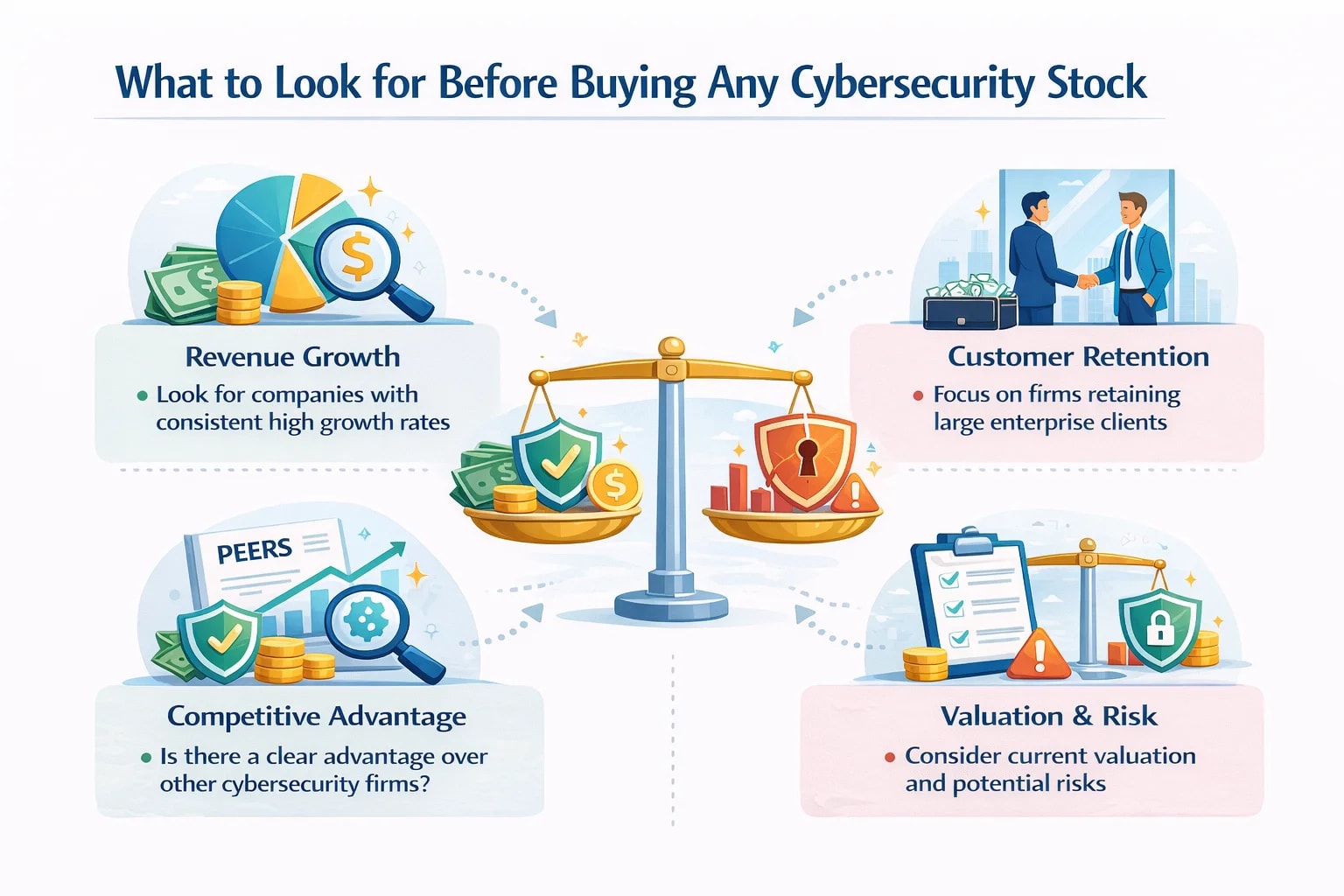
You said yes, so here’s a simple checklist you can use before you buy. Think of it as your “pre-buy filter” to avoid story-driven mistakes and focus on what drives real returns.
1) Start with the business model
Ask: How does this company get paid and how predictable is it?
Look for:
- Subscription or contract-based revenue
- High renewal behavior
- Clear pricing tiers
Red flags:
- Heavy reliance on one-time services
- Big revenue spikes with weak repeatability
2) Check retention and expansion signals
You want customers to stay and spend more over time.
Look for:
- Strong renewal language in earnings updates
- Evidence of upsells or multi-product adoption.
- Large enterprise customers are growing their usage.
Red flags:
- “Churn is stable,” but no mention of expansion
- Discounts are used to keep customers.
3) Understand what makes the product hard to replace
Your biggest edge comes from sticky tools.
Look for:
- Deep integration into identity, endpoints, cloud, or SOC workflows
- Platform adoption across multiple use cases
- Ecosystem integrations with major cloud and IT tools
Red flags:
- A single feature that competitors can copy
- A tool that buyers treat as optional
4) Watch the balance between growth and profitability
Not every company must be profitable today, but the path should be clear.
Look for:
- Improving margins over time
- Controlled operating expenses
- Rising cash flow trends
Red flags:
- Growth is slowing while spending stays high
- “Profitability later” with no timeline
5) Evaluate competitive positioning
Cybersecurity is crowded. You need a reason this company keeps winning.
Look for:
- Clear category leadership or niche dominance
- Strong reviews from enterprise buyers
- Consistent “win” mentions in reports.
Red flags:
- Generic positioning
- Competing on price alone
6) Don’t ignore valuation
Even the best cybersecurity stock can be a bad buy at the wrong price.
Look for:
- Reasonable expectations priced in
- Valuation compared to growth rate and margins
- Entry strategy using staged buying
Red flags:
- High hype + high valuation + slowing growth
- Buying after big run-ups without a plan
7) Know your risk lane before you buy
This keeps you from panic-selling.
- If you want growth, accept volatility and track execution.
- If you want stability, prioritize cash flow and resilience.
If the stock behaves differently from your lane, you’ll feel constant stress.
Quick “Buy-Ready” Scorecard
Use this fast test:
- Predictable revenue model
- Strong retention/expansion
- Hard-to-replace product
- Clear path to stronger cash flow
- Differentiation that lasts
- Valuation makes sense
If you’re getting 4+ yes answers, it’s worth deeper research. If not, you’re likely buying a narrative.
The escalation of the israel iran war has raised global cybersecurity concerns, as attacks linked to geopolitical tensions often spread beyond the original conflict zone.
Cybersecurity stock metrics in plain English
When you read about cybersecurity stocks, you’ll see the same metrics repeated. They’re not complicated once you tie each one to a simple question: Is this business getting stronger or weaker?
Here’s the short, usable guide.
ARR (Annual Recurring Revenue)
What it tells you: how much subscription revenue the company expects to collect each year from recurring contracts.
Why you care: ARR growth often predicts future revenue growth.
Green sign: ARR grows steadily and management talks about expansions.
Red sign: ARR growth slows, but the stock still trades like a hyper-growth name.
NRR (Net Revenue Retention)
What it tells you: whether existing customers are spending more over time after upgrades, expansions and cancellations.
Think of it like: Do customers grow with the product?
- Above 100% means customers are expanding spend.
- Below 100% means customers shrink or leave faster than expansion
Green sign: Strong NRR suggests the product is sticky and expanding.
Red sign: NRR falls for multiple quarters, often a warning that growth will slow.
Check out our latest blog on Digital Risk Protection for Enterprise Security
GRR (Gross Revenue Retention)
What it tells you: how much revenue the company keeps from existing customers before upsells.
Think of it like: How leaky is the bucket?
Green sign: High GRR means customers aren’t leaving.
Red sign: Weak GRR means churn is real and upsells may be masking it.
Customer growth vs “big deal” risk
What it tells you: whether growth comes from many customers or a few large ones.
Green sign: diversified customer base and steady adds.
Red sign: revenue depends on a small number of huge contracts (lumpy results).
Gross Margin
What it tells you: how much profit remains after delivering the product.
Higher margins often mean:
- Scalable software economics
- pricing power
- efficient delivery
Green sign: stable or rising gross margins.
Red sign: margins shrink due to discounting or high delivery costs.
Operating Margin
What it tells you: profitability after paying for sales, marketing, R&D and admin.
Cybersecurity firms often start low and improve with scale.
Green sign: operating margin improves over time.
Red sign: growth slows, but costs stay elevated.
Free Cash Flow (FCF)
What it tells you: cash left after operating costs and necessary investments.
This is where “good business” becomes “good investment.”
Green sign: FCF turning positive and improving.
Red sign: cash burn continues with no clear path to control expenses.
CAC (Customer Acquisition Cost)
What it tells you: how expensive it is to win a customer.
Green sign: CAC stabilizes or improves as brand and referrals grow.
Red sign: CAC rises while growth slows, often a sign of saturation.
Payback period
What it tells you: how long it takes to earn back the cost of acquiring a customer.
Shorter payback usually means healthier unit economics.
Green sign: payback shrinking as the business scales.
Red sign: payback expanding, meaning growth is getting more expensive.
“Rule of 40”
What it tells you: a quick health check for growth software firms.
Rule of 40 = growth rate + profit margin (or FCF margin)
Green sign: strong balance of growth and profitability.
Red sign: neither growth nor profitability is strong.
Mini cheat-sheet: what to prioritize
If you want growth lane: ARR growth + NRR + market expansion signals
If you want stability, lane: FCF + margins + retention + valuation discipline
Check out our latest blog on Why Phishing Is Not Often Responsible for PII Data Breaches
Final thoughts
Cybersecurity stocks can play a useful role in your portfolio because the demand behind them comes from necessity, not hype. The smart move is matching the sector to how you invest.
If you want simplicity and lower single-stock risk, one cybersecurity ETF gives you broad exposure without needing to track every earnings call.
If you prefer targeted bets, keep it tight: 2–3 stocks across different categories and measure them by fundamentals, not headlines.
Want to see how cybersecurity stocks could fit into your portfolio? Get in touch with me. I’d be happy to take a look and offer advice based on what’s worked for me.
Check out our latest blog on Cybersecurity High-Speed Internet for the US Navy | Guide
Frequently Asked Questions
Are cybersecurity stocks recession-proof?
Cybersecurity stocks tend to hold up better than many tech sectors during recessions because security spending is often non-negotiable. Companies may delay growth initiatives, but they rarely cut budgets tied to breach prevention, compliance and critical infrastructure protection.
Do cybersecurity stocks benefit from AI adoption?
Yes. Increased AI adoption expands attack surfaces, which directly drives demand for advanced threat detection, identity security and cloud protection. Many cybersecurity firms monetize AI twice by protecting AI systems and by embedding AI into their own security platforms.
Why are cybersecurity stocks so volatile despite strong demand?
High growth expectations, rich valuations and earnings sensitivity make cybersecurity stocks volatile. Even small changes in guidance, customer retention, or federal spending can trigger sharp price movements, especially for mid-cap and cloud-native security companies.
Are cybersecurity ETFs safer than individual cybersecurity stocks?
Cybersecurity ETFs reduce company-specific risk by spreading exposure across multiple vendors, but they still carry sector risk. Investors gain diversification across endpoint, cloud, identity and network security, though returns may be lower than picking a top-performing stock.
What financial metrics matter most when analyzing cybersecurity stocks?
Key metrics include annual recurring revenue (ARR) growth, net revenue retention (NRR), customer acquisition cost (CAC) and free cash flow margin. These indicators reveal whether a cybersecurity company can scale sustainably, not just grow fast.