Cybersecurity entry level jobs include roles like SOC analyst, threat monitoring analyst, junior incident responder, security operations technician and vulnerability analyst. These roles focus on alert handling, log review, basic threat response and security hygiene tasks you can learn without years of experience.
I remember the exact moment I tried breaking into cybersecurity. I had the passion, the curiosity, the late nights spent poking through logs on free tools, yet I couldn’t land that first role.
Every job post felt like a wall. Three years of experience for an entry level job? It didn’t make sense.
If you’re standing where I stood, you’re not lost. You’re early. That’s a powerful place to be. You don’t need a long resume to start. You need clarity, focus and a strategy. Once those three line up, the first job becomes reachable even if you’re switching careers or starting fresh.
Let me walk you through the exact roles that open the door for beginners and what you can expect once you step inside.
Check out our latest blog on : Google Gmail Data Breach: What’s Actually Happening (2026)
SOC Analyst (L1)
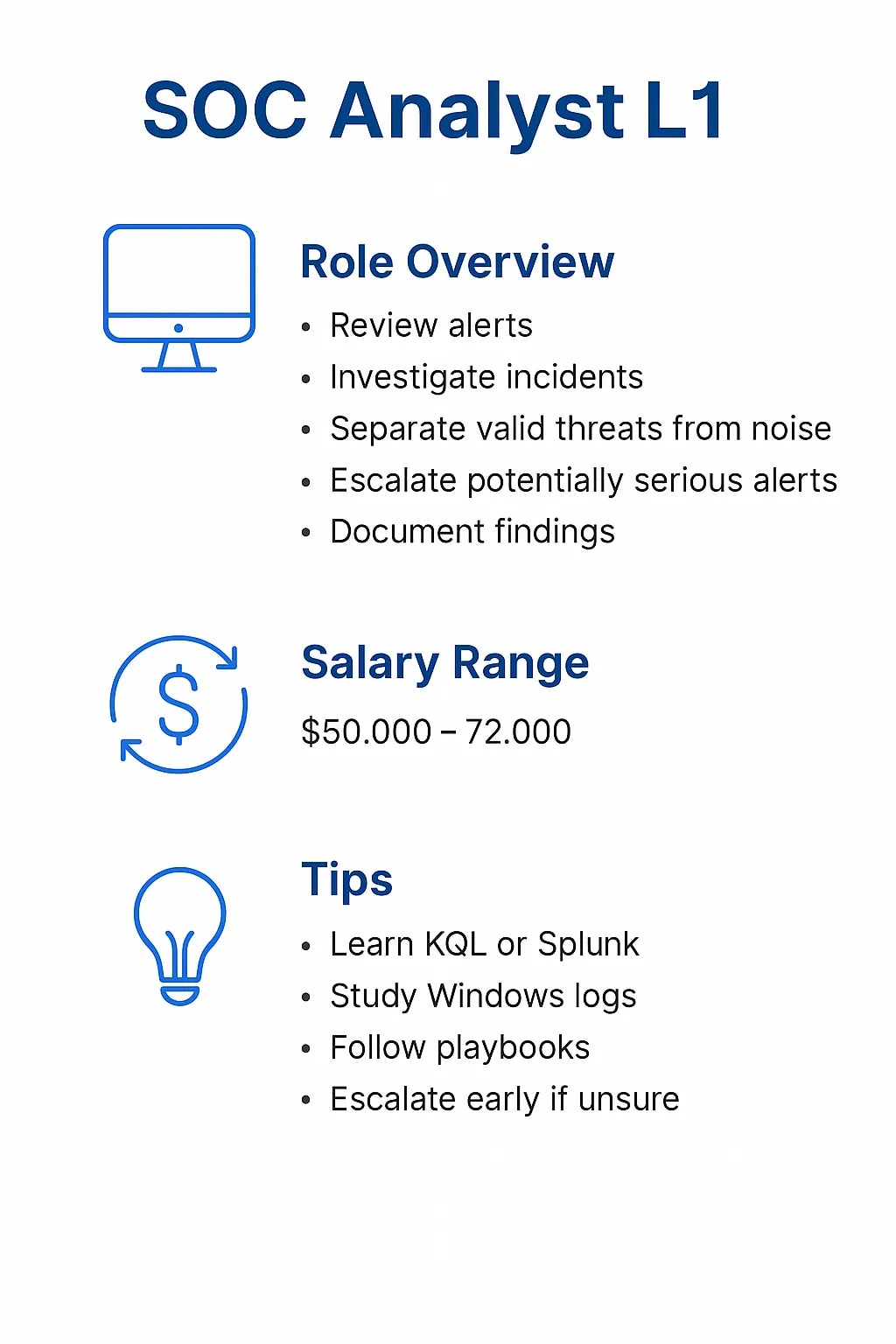
My first break came through an L1 SOC role. If you want a real entry point into cybersecurity, this is the one that gives you instant exposure to live threats, real alerts and active incidents.
You sit at the front line. Every alert reaches you first, which means you learn faster than in any other beginner role.
What You Do Day to Day
As an L1 analyst, you spend your shift inside the SIEM watching alerts roll in from servers, endpoints, firewalls and cloud apps. Your job is to separate noise from danger. That skill grows fast.
You will
• review authentication alerts
• inspect suspicious IPs
• check user behavior patterns
• confirm if an alert is harmless or real
• escalate risky events to L2 or IR
• document your investigations
• follow playbooks for repeat scenarios
• track threat intel feeds for common indicators
You become the gatekeeper. You decide which alerts need deeper attention. This teaches you judgment, which becomes your strongest asset later.
You also learn how to work with logs across Windows, Linux, network devices and cloud platforms. You start spotting patterns instinctively. A failed login at 3 AM with a foreign IP hits you differently after enough cases.
Salary Range
Entry salaries depend on the country and industry. On average, you can expect:
• UAE: 7k to 14k AED for junior roles
• US: 50k to 72k USD
• UK: 25k to 35k GBP
• India: 3.5 to 6 LPA
• EU: 32k to 48k EUR
SOC salaries grow fast because the leap from L1 to L2 is usually one to two years if you practice consistently.
Tips to Succeed From Day One
When I joined my first SOC, I felt overwhelmed. Here’s what helped me succeed.
• Learn basic KQL or Splunk query skills
• Build confidence with Windows event logs
• Understand common attack paths like brute force and phishing
• Keep personal notes for repeated alert types
• Escalate early when unsure
• Ask L2 analysts why they made certain decisions
• Document every case you handle because it builds your experience record
If you enjoy puzzles, patterns and fast decision making, you will grow quickly in this role. SOC Analyst L1 turns you into someone who sees threats before others even notice them.
Threat Monitoring Analyst

I moved into this role after gaining confidence inside the SOC. If you enjoy spotting patterns early instead of waiting for alerts to fire, this role fits you well. You shift from reacting to events to reading the environment like a radar. You notice behaviors long before they turn into incidents, which makes your work calm but sharp.
What You Do Day to Day
You spend your day inside dashboards that show user behavior, login activity, cloud logs and network shifts. Nothing dramatic happens at once. You look for signals that feel out of place.
You will
• monitor login patterns across users
• watch for unusual device enrollments
• check for privilege use that feels odd
• track risky geolocations
• study repeated failed login bursts
• verify sudden permission changes
• analyze early signs of account compromise
• check new application traffic across the network
This role trains your instincts. You start seeing small signs that point to bigger risks. A login from a new city might not matter, but combine it with a new device and an Office 365 mailbox rule and you know something is moving.
Threat monitoring is subtle work. You catch threats before they become incidents, which saves the SOC team countless hours.
Salary Range
Threat monitoring roles pay slightly more than pure L1 roles because the work touches behavior analytics.
• UAE: 9k to 16k AED
• US: 55k to 78k USD
• UK: 28k to 38k GBP
• India: 4 LPA to 7 LPA
• EU: 34k to 52k EUR
Once you master user behavior and cloud logs, your path into threat hunting or incident response becomes easier.
Tips to Succeed From Day One
• Learn identity logs from Azure AD and Okta
• Track common risky patterns like MFA fatigue and impossible travel
• Build a simple checklist for user behavior anomalies
• Keep notes from every case because patterns repeat
• Study common phishing sequences since they show early hints in logs
• Compare normal user behavior across teams to spot when something feels off
You’ll enjoy this role if you like quietly observing systems and catching the earliest signs of trouble. It feels like detective work without the chaos of an active incident.
Junior Incident Responder
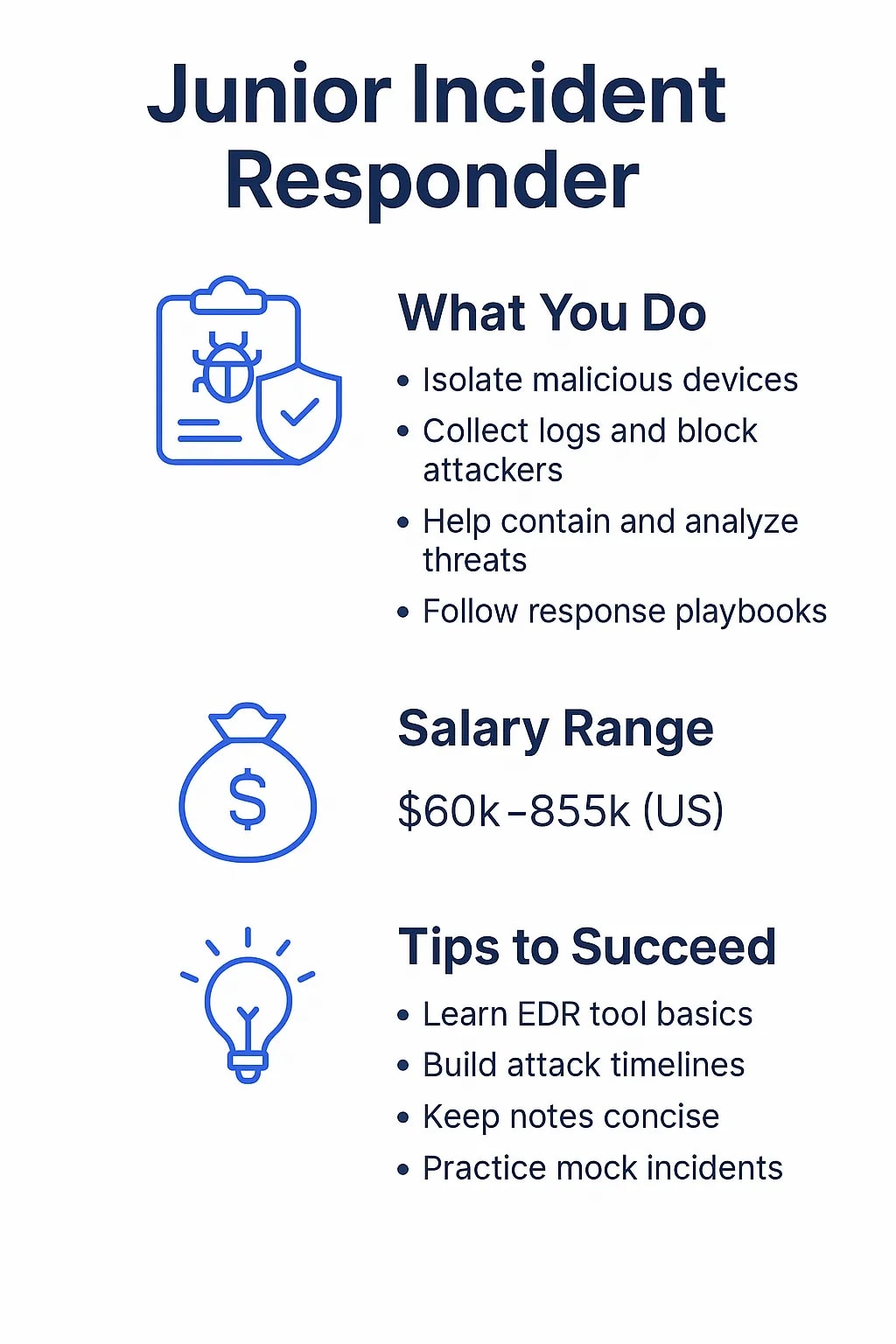
I still remember the first time I joined an IR bridge call. Alerts were no longer theory. The threat was real and everyone looked at me to move fast. If you want a role that tests your instincts, this is where you grow the quickest. You stop reading about attacks and start facing them directly.
What You Do Day to Day
As a Junior Incident Responder, you jump in when something breaks the safe zone. You work with SOC and engineering teams to contain threats before they spread. The job feels intense at times because you work against the clock, but the learning curve is unmatched.
You will
• isolate infected devices
• collect logs for evidence
• help block malicious IPs
• reset compromised accounts
• kill suspicious processes through EDR
• review attack timelines
• validate alerts that escalate
• follow containment playbooks
• support senior responders with the data they need
This job teaches you how attackers actually move inside an environment. You see lateral movement, privilege escalation attempts, mailbox rule abuse, malicious scripts and cloud compromise events. Every incident adds a new layer to your experience.
Salary Range
Incident response pays well for beginners because the work protects the business directly.
• UAE: 10k to 18k AED
• US: 60k to 85k USD
• UK: 30k to 40k GBP
• India: 5 LPA to 8 LPA
• EU: 36k to 55k EUR
Once you have one year of IR experience, you become a strong candidate for L2 SOC, threat hunting, or full incident response roles.
Tips to Succeed From Day One
• Learn EDR navigation because IR depends heavily on endpoint evidence
• Build a mental timeline for each alert so you understand the sequence of events
• Keep your case notes tight and factual because management reads them
• Never hesitate to isolate a device when signals look serious
• Ask senior responders how they made containment decisions
• Practice mock IR scenarios in your lab to build confidence
• Understand phishing attacks because they make up a large part of real incidents
If you enjoy fast action, this role will energize you. You learn by doing and every incident makes you sharper than the day before.
Security Operations Technician

I stepped into this role when I wanted to understand how security tools actually work behind the scenes. If you like solving problems with your hands, this role is perfect for you.
You support the entire security stack and you keep the environment stable so analysts and engineers can do their jobs without disruption.
What You Do Day to Day
Security Operations Technicians handle the backbone of the SOC. Instead of chasing threats, you make sure the tools that catch threats stay healthy. This job gives you a clear view of how logs enter the SIEM, how connectors break, how sensors collect data and how alerts get generated.
You will
• fix log ingestion issues
• maintain SIEM connectors
• onboard new data sources
• check EDR agent health
• troubleshoot firewall and proxy logs
• verify email security policies
• work with engineering teams to keep sensors running
• respond to tool outages before they impact monitoring
• document recurring technical problems
This role builds your tool confidence. When you understand how data flows from endpoints to SIEM dashboards, you become a far stronger analyst later. You also learn how each product behaves, which gives you practical experience you cannot get from textbooks.
Salary Range
This role pays well because you support critical infrastructure.
• UAE: 8k to 16k AED
• US: 52k to 75k USD
• UK: 27k to 36k GBP
• India: 3.5 LPA to 6.5 LPA
• EU: 32k to 48k EUR
With enough experience, you can move into SOC L1, SIEM engineering, or endpoint security roles with ease.
Tips to Succeed From Day One
• Learn basic Linux commands since many connectors run on Linux machines
• Practice onboarding logs into a free SIEM in your home lab
• Keep documentation updated because future issues often match past ones
• Understand how firewalls, proxies and EDR tools push data
• Ask SIEM engineers to explain how parsing works
• Build the habit of catching issues before analysts report them
• Track recurring log failures and escalate patterns
If you enjoy understanding how things work, this role gives you the perfect entry point into the technical side of cybersecurity. It builds a foundation that supports every future step you take.
Vulnerability Analyst

I stepped into this role when I wanted a job that felt structured instead of reactive. If you prefer steady analysis over urgent incidents, this role suits you well. You study weaknesses across the environment, then guide teams on how to fix them. It sharpens your understanding of how real systems fail and how attackers take advantage of those gaps.
What You Do Day to Day
Your job is to scan systems, review the results then decide what matters most. Some vulnerabilities look scary but pose no real threat. Others hide quietly yet open the door for privilege escalation or remote access. You learn to separate noise from risk.
You will
• run vulnerability scans on servers, endpoints and cloud systems
• review CVSS scores
• validate findings before reporting
• track patching progress across teams
• check configuration weaknesses
• investigate exploited vulnerabilities
• create clean reports for management
• work with IT to schedule patch windows
• ensure critical issues get fixed before attackers find them
This role teaches you how attackers think. You see how misconfigurations, old software and weak settings turn into attack paths. You also learn how to explain risk in simple language because business teams don’t speak in CVEs and CVSS. They need clear impact and fixes.
Salary Range
Vulnerability roles pay well because they reduce risk across the entire company.
• UAE: 9k to 18k AED
• US: 55k to 82k USD
• UK: 28k to 40k GBP
• India: 4 LPA to 7.5 LPA
• EU: 34k to 52k EUR
This role opens doors to security engineering, cloud security and red team paths later.
Tips to Succeed From Day One
• Learn how to use Nessus, Qualys, or Rapid7
• Understand the real meaning of CVSS scoring
• Build the habit of validating findings because scanners generate false positives
• Study exploited vulnerabilities from recent breaches
• Create short, clear reports that explain risk without jargon
• Track deadlines realistically because patching takes coordination
• Work closely with IT teams instead of putting pressure
If you enjoy analysis that makes a measurable impact, this role gives you a strong and steady entry point into cybersecurity.
Skills You Need Right Now

When I started out, I felt lost because every job post listed ten tools I had never touched. Then I realised entry-level roles don’t expect mastery. They expect readiness. You need a handful of skills that show you can learn fast and handle security basics without fear.
I’ll break down what matters most.
Use these as your foundation.
Technical Skills
• SIEM Basics
Learn how to read logs, build simple queries and recognise patterns. You don’t need deep engineering knowledge at this stage. You only need to understand authentication logs, network events and alert categories. Use free versions of Splunk or Sentinel to build muscle memory.
• Operating Systems
Learn Windows event logs and Linux commands. When I joined my first SOC, I couldn’t even read an event ID properly. Once I learned these basic,s my alert triage improved in weeks.
• Networking Fundamentals
You don’t need CCNA-level expertise. You only need to understand IPs, ports and protocols because nearly every incident touches the network.
• EDR Tools
You’ll work with Defender, CrowdStrike, or Carbon Black. Learn how to check processes, isolate machines and pull event timelines.
• Identity and Access Concepts
Learn MFA, password policies and common attack paths like password spraying and credential theft. You’ll see these every week in alerts.
Soft Skills
• Clear communication
When you escalate an alert, you must explain what you saw and why it matters without overthinking your words. Managers rely on your clarity.
• Calm under pressure
Incidents move fast. You can’t freeze when alerts spike. You breathe, you check facts, you act.
• Curiosity
Security changes daily. Curiosity keeps you learning without force.
Portfolio Skills
• Home lab work
Build a small SOC at home using free SIEMs. Capture logs from a Windows VM. Trigger fake alerts by performing harmless actions and investigate them.
• Document your findings
Write short case notes about what you tested and what you learned. Recruiters respect proof of execution more than certificates.
These skills help you stand out even without experience. They show you can adapt fast, which is what matters most in your first role.
Check out our latest blog on Why Phishing Is Not Often Responsible for PII Data Breaches
How to Land Your First Cybersecurity Job
I struggled for months because I applied blindly. Once I created a simple strategy, everything changed. You don’t need hundreds of applications. You need targeted moves that make your profile impossible to ignore.
Here’s the exact roadmap I used and what I guide beginners through now.
1. Build a Focused Resume
Highlight your lab work. Highlight your hands-on tasks even if they’re self-taught. List the tools you touched. Keep your resume clean. Hiring managers scan in seconds, so your wins need to pop.
2. Create a Simple Portfolio
A portfolio proves initiative. Add:
• SIEM practice investigations
• Your own incident timeline breakdown
• A short threat analysis
• Screenshots of your lab setup
• A case study of a vulnerability scan
This pushes you ahead of other beginners.
3. Target the Right Roles
Aim for roles that beginners get selected for:
• SOC Analyst L1
• Cybersecurity Technician
• IT Security Support
• Junior Threat Analyst
• Vulnerability Analyst
• Service Desk + Security Track
These roles don’t require years of experience.
4. Use the Right Learning Path
Study smart instead of getting stuck in random content. Build this cycle:
Learn – Practice in lab – Investigate your own logs – Document findings – Apply.
This creates skill confidence.
5. Network With Intention
I got my first role because I spoke to a hiring manager on LinkedIn. Share your lab work. Message SOC leads with short, respectful notes. Ask for feedback, not jobs. People remember you when a slot opens.
6. Prepare For Interviews
Most beginners fail because they memorise answers instead of understanding concepts. Learn to explain:
• What an alert means
• How do you escalate
• How do you verify false positives
• How you handle suspicious user activity
• What an IOC is
• What malware does
Interviewers want your thinking, not your memory.
7. Apply in Waves
Apply to 15–20 roles a week. Track results. Adjust your resume. Improve one thing every week.
Follow this system and your first role stops feeling distant. You start feeling ready.
Check out our recent blog on Cybersecurity Stocks: Growth, Risks & Returns
Final Thoughts
When I look back at my early journey, I remember the confusion and the pressure. I felt like everyone around me already knew more.
Then I learned something that changed everything. Entry-level cybersecurity isn’t about who knows the most. It’s about who moves with consistency. You only need to take the right steps every day.
If you’ve read this far, you’re not lost. You’re building momentum. You already think like someone who wants this field and that is half the battle.
The next half is execution. Build your lab. Practice alerts. Document everything. Stay curious. That approach carries you further than any certification.
You don’t need perfect timing to start. You need courage to begin. Every SOC analyst, incident responder, threat hunter and engineer you look up to began the same way. Unsure, underprepared, overwhelmed. They built skills one log at a time. You can do the same.
If you want guidance for your path, I can help. I’ve walked this road and I know how confusing the early months feel. I know how to turn scattered learning into a clear plan you can follow, even with a full-time job or studies. You don’t need to figure everything out alone.
If you want help choosing the right cybersecurity entry level jobs or if you’re unsure which skills fit your strengths, let’s talk. I’ll help you map your direction, pick the right tools, build your first lab and prepare for real-world interviews.
You can reach out through CyberLad and I’ll look at your profile and give you honest direction based on what actually works in today’s hiring market.
Check out our latest blog on What Is PII? Definition, Examples & Security Risks
Frequently Asked Questions
What cybersecurity entry level jobs are easiest to start with?
SOC Analyst L1 is the easiest starting point because you work with alerts, logs and basic investigations without needing deep engineering skills. You learn real threats early. You make decisions with support from L2 analysts. This role teaches you patterns, tools and reporting, which gives you a foundation to move into threat, I,R or engineering later.
Can I get cybersecurity entry level jobs without experience?
You can. Employers care more about your hands-on practice than your job history. Build a home lab, work with a free SIEM, investigate simple alerts and document your findings. Show your process in a small portfolio. A strong portfolio gives you an advantage over beginners who only list certifications with no practical proof.
Do entry level cybersecurity jobs require coding?
Most entry level roles do not require coding. SOC work, threat monitoring and vulnerability analysis focus on patterns, logs and security hygiene. You only need to understand basic scripts or commands when working with SIEM queries or endpoint tools. Coding becomes useful later when you move into engineering, detection or automation roles.
What certifications help most for entry level cybersecurity roles?
Choose certifications that prove your fundamentals instead of chasing advanced ones. Security+, Google Cybersecurity and Microsoft SC-900 fit entry level goals. If you want SOC roles, add a SIEM certificate like Splunk Core User or Sentinel KQL basics. These show you can handle tools and understand alerts without claiming expert-level knowledge.
How long does it take to land an entry level cybersecurity job?
Most motivated beginners land their first role in three to six months once they follow a consistent plan. Build a lab, learn SIEM basics, practice investigations and apply in waves. Share your work online to get noticed by SOC managers. Steady progress beats long study cycles because recruiters hire based on visible skills.