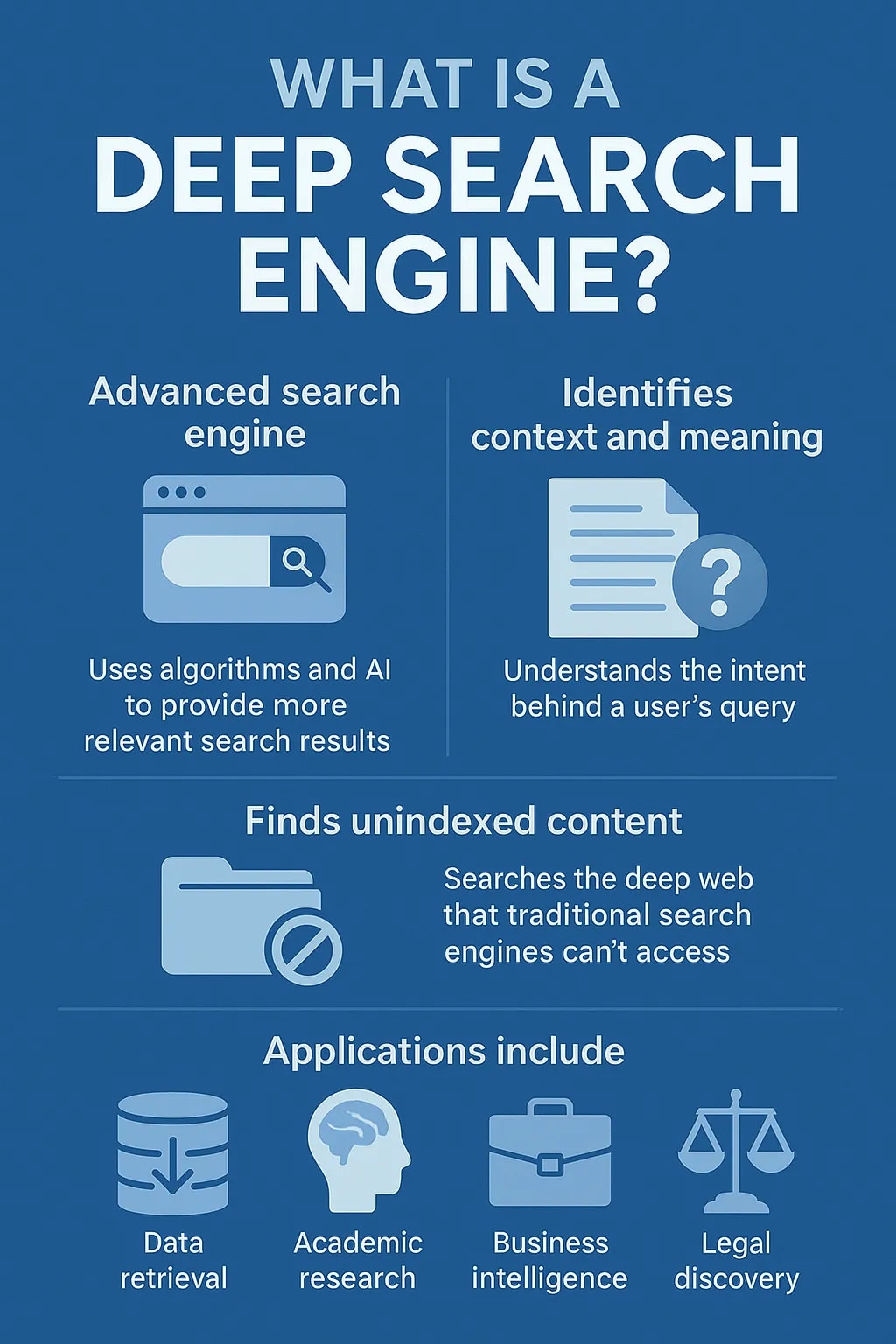
A deep search engine is a tool that goes beyond traditional search engines like GA deep search engine is a tool that goes beyond traditional search engines like Google by accessing content not fully indexed on the surface web. This includes databases, private networks, and parts of the deep web, helping you find more detailed or hidden information that standard search engines may miss.
Most of the internet is invisible to Google. What you see in search results is only a fraction of what actually exists online.
Deep search allows you to access:
- Academic and research databases
- Private or restricted content
- Deep web pages not indexed by Google
- Specialized search indexes and repositories
In this guide, you’ll learn how deep search engines work, how they differ from traditional search, the best tools available, and how to use them safely and effectively
Here’s a quick comparison between deep search engines and Google:
| Feature | Deep Search Engines | |
|---|---|---|
| Coverage | Surface web | Deep + hidden web |
| Privacy | Low | Higher |
| Data Type | General | Structured / niche |
| Access | Easy | Requires tools |
While Google is powerful for everyday searches, it only scratches the surface of what’s actually available online.
What Is a Deep Search Engine? (Meaning Explained)
Now that you understand the basic concept, it’s important to look at how deep search actually fits into the structure of the internet.
A deep search engine doesn’t just retrieve hidden data. It operates in environments where traditional search engines cannot function effectively, such as database-driven systems, restricted platforms, and dynamically generated content.
Instead of relying purely on indexed web pages, deep search tools interact with structured data sources, making them essential for research, analysis, and professional use cases.
Difference Between Surface Web and Deep Web
- Surface Web (Indexed): Content that search engines like Google, Yahoo, and Bing crawl regularly. These include blogs, social media posts, videos, and news articles.
- Deep Web (Unindexed but Legal): Databases, research archives, financial records, private intranets, and academic journals not indexed by general search engines.
- Dark Web (Anonymized & Risky): A subset of the deep web accessible only via tools like Tor, often associated with illegal activities but also used for privacy-focused communication.
The key distinction is that while the deep web is legal and often necessary for professionals, the dark web is where legality gets blurred.
A deep search engine doesn’t always mean “dark web search.” It simply means going beyond the surface.
You may also want to explore: What Is an Insider Threat Cyber Awareness?
Deep Search Engine vs Google: What’s the Difference?
A traditional search engine works by crawling millions of websites and indexing them for keyword-based searches.
However, this approach fails when content is hidden behind paywalls, authentication, or dynamic queries.
A deep search engine, in contrast, often connects directly to structured databases, APIs, or institutional archives to retrieve relevant results.
Instead of scraping websites, it queries information sources that aren’t visible to the open web.
For instance:
- Searching for “heart disease case study” on Google may give you blog posts and health websites.
- A deep search engine like PubMed will retrieve verified medical research papers published in peer-reviewed journals.
This makes deep search engines crucial for accuracy, credibility, and professional research.
Learn how to improve organic visibility and generate qualified leads with our cyber security SEO guide.
Are Deep Search Engines Better Than Google?
The answer depends on what you’re trying to achieve.
Google is designed for speed, convenience, and broad coverage of the surface web. It excels at finding websites, blogs, news, and general information quickly.
However, it struggles when content is hidden behind paywalls, stored in databases, or generated dynamically.
Deep search engines, on the other hand, are built for depth rather than convenience.
They access structured data sources, academic repositories, private networks, and specialized indexes that Google cannot fully crawl.
When Google is better:
- Every day searches and quick answers
- Shopping, news, and trending topics
- User-friendly browsing experience
When are deep search engines better?
- Academic and scientific research
- Legal, financial, or corporate data
- Cybersecurity and threat intelligence
- Accessing hidden or restricted information
In short, deep search engines are not replacements for Google; they are specialized tools that go further when accuracy, depth, and access to hidden data matter.
Why Google Can’t Access the Deep Web
Google is powerful, but it has limitations. Here’s why:
- Paywalls and Authentication: Academic databases like JSTOR or IEEE Xplore require subscriptions. Google’s crawlers can’t bypass these restrictions.
- Dynamic Content: Some sites generate content only after a user performs a search query, which traditional crawlers cannot trigger.
- Private Networks: Corporate intranets, government records, or medical systems are intentionally hidden from public indexing.
- Security and Privacy Rules: Certain databases are protected for compliance (HIPAA for medical data, GDPR for personal information) and cannot be exposed to general search.
As a result, while Google provides a broad overview of the surface web, it leaves out critical information that only deep search engines can uncover.
Related guide: St Paul Cyber Attack: What Really Happened
How Do Deep Search Engines Work?
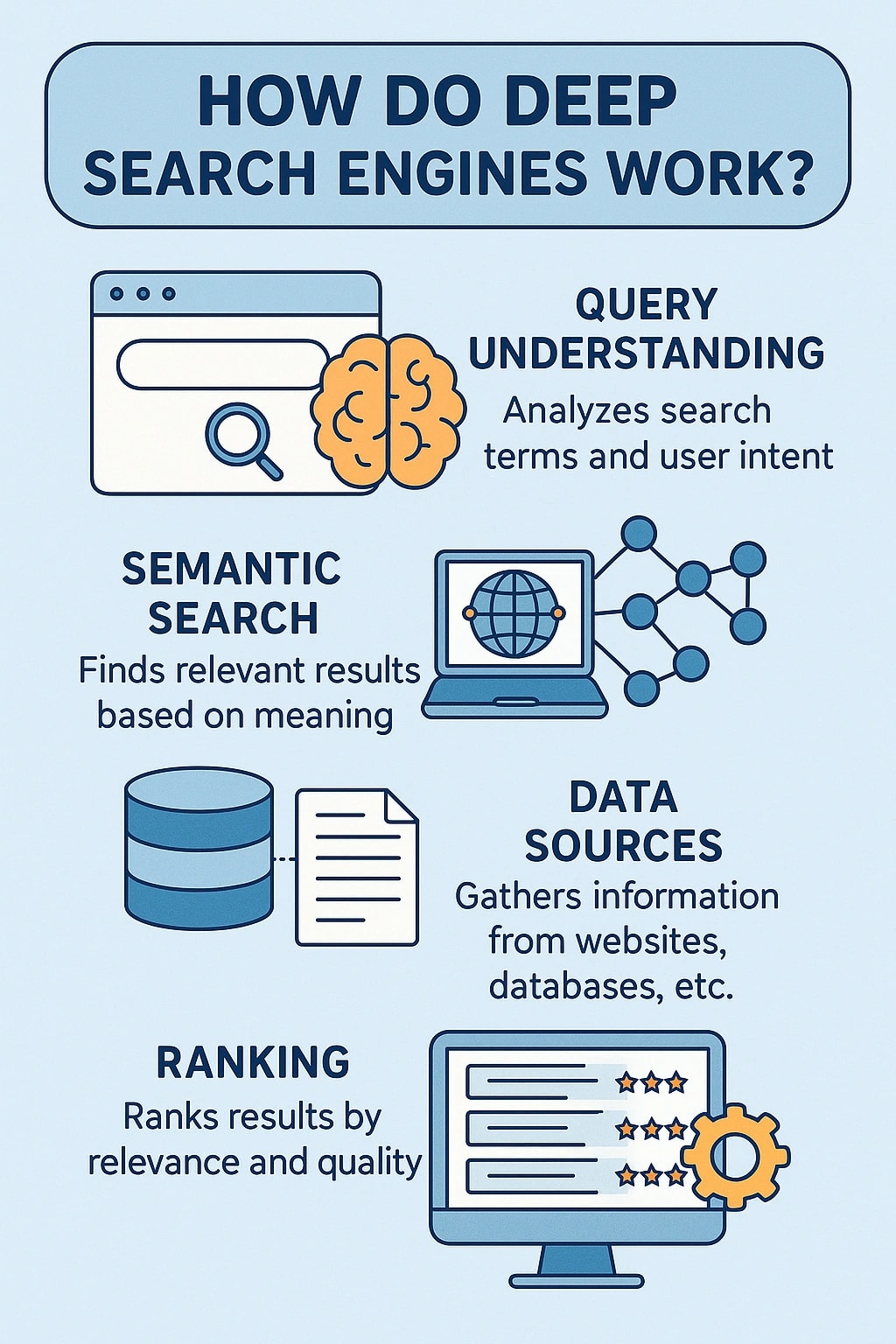
To understand how a deep search engine functions, it helps to first look at how Google or Bing works.
Traditional search engines rely on crawler bots that visit websites, index their content, and store it for retrieval.
When you type a query, Google matches your keywords with this indexed data and shows you results.
A deep search engine, however, uses a different approach because much of the deep web is not crawlable.
Instead, it relies on query-based access, specialized algorithms, and sometimes even encrypted pathways to fetch hidden information.
Crawling vs Querying Databases
- Crawling (Surface Web): Googlebot crawls pages, follows links, and indexes them. This works for static and public websites.
- Querying (Deep Web): A deep search engine sends direct queries to databases, APIs, or repositories that only return results when prompted. For example, a legal database won’t expose its content unless a search query is made by the user.
Example: When you search for a court case on a government portal, you’re not browsing an indexed page; instead, you’re querying a database that generates results dynamically.
Algorithms Behind Deep Search
Deep search engines don’t just rely on crawling; they use specialized algorithms to pull relevant data:
- Federated Search: Combines results from multiple databases at once (used in academic research portals).
- Semantic Search: Goes beyond keyword matching by understanding context, synonyms, and intent.
- Natural Language Processing (NLP): Lets the engine interpret human-like queries (e.g., “What is the GDP of India in 2024?”).
- Data Normalization: Since results may come from varied sources (databases, repositories, APIs), deep search engines normalize the data into a uniform format.
This makes them more effective for specialized research and business intelligence.
Read More On: Cyber Security Bootcamp: Top 10 Programs & Labs
Privacy, Encryption, and Security Features
Many deep search engines emphasize privacy and anonymity, unlike Google, which collects user data for ads. Features often include:
- No Tracking: Engines like DuckDuckGo don’t store search histories.
- Encrypted Queries: Some engines use HTTPS or even Tor routing for secure data transfer.
- Decentralized Indexing: Blockchain-based search engines distribute indexes to avoid single-point failures or surveillance.
- Darknet Gateways: Certain deep search tools, like Torch, specifically connect to .onion sites through the Tor network.
These features make deep search engines valuable for journalists, whistleblowers, and privacy-conscious users.
Example Workflow of a Deep Search Engine
- User Inputs Query: (e.g., “cybersecurity threat reports 2024”).
- Engine Interprets Intent: Using NLP and semantic analysis.
- Sources Queried: Academic archives (IEEE, Springer), government threat databases, and cybersecurity repositories.
- Data Retrieved: Multiple structured results pulled from otherwise hidden sources.
- Results Displayed: The engine normalizes the output into a user-friendly format (tables, links, documents).
Unlike Google, which shows indexed websites, a deep search engine brings out structured, niche-specific data.
Real-World Examples
- PubMed: Queries millions of medical studies hidden from Google.
- Wolfram Alpha: Uses computational knowledge instead of indexed sites.
- Pipl: Specializes in people search, accessing databases not on the surface web.
- Darknet Engines (Torch, Ahmia): Access hidden .onion websites.
Each works differently but shares one mission: unlocking hidden web data.
Benefits of Using a Deep Search Engine for Research and Privacy
For most people, Google is “good enough.” But for researchers, businesses, journalists, and cybersecurity experts, surface-level results fall short.
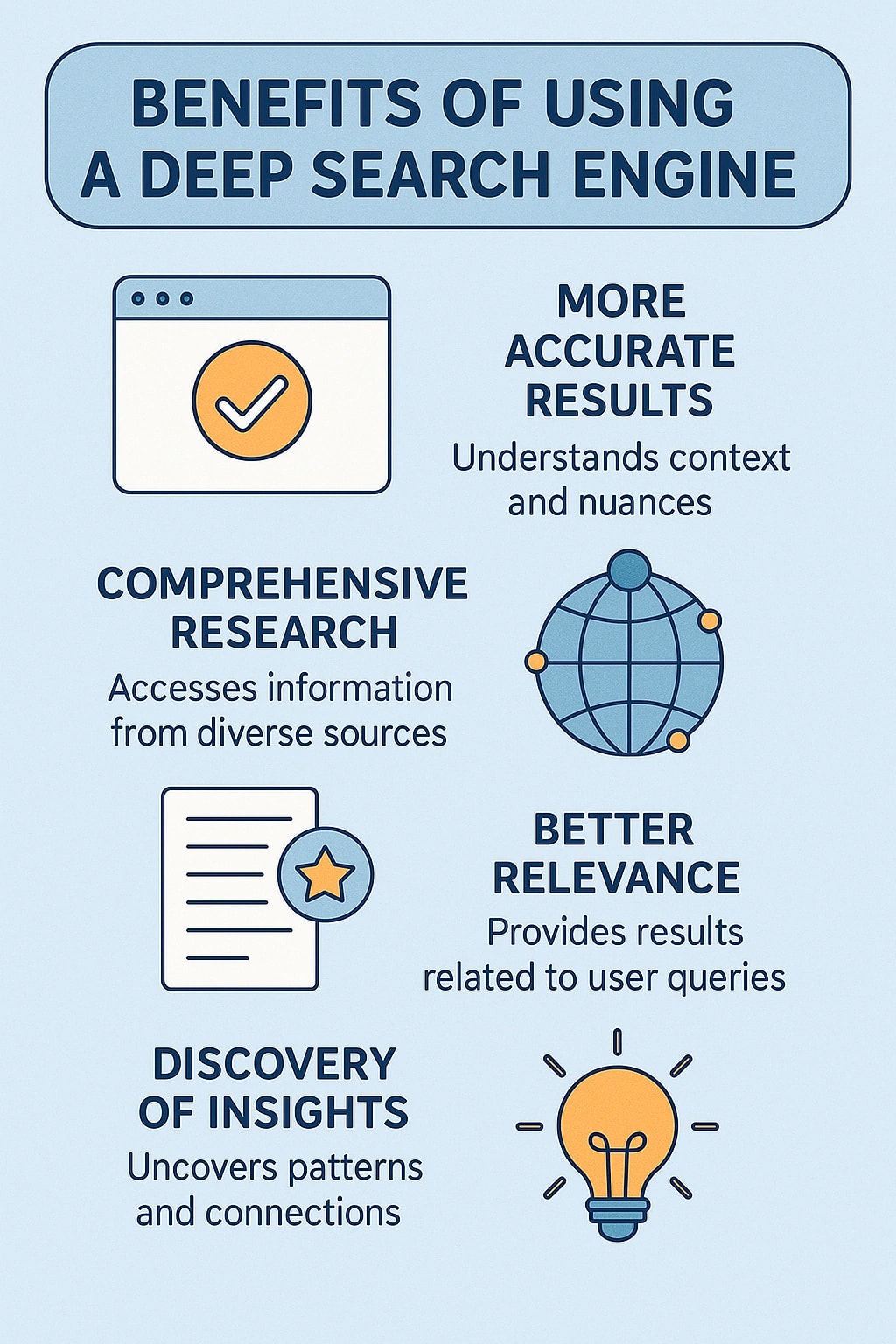
A deep search engine provides access to hidden, specialized, and high-quality information that traditional engines miss. Below are the biggest benefits of using one.
Access to Academic and Government Data
One of the biggest advantages is access to scholarly and official information.
- Academic Journals: Platforms like PubMed, IEEE Xplore, and JSTOR offer peer-reviewed content critical for scientific research. A deep search engine connects you directly to these resources.
- Government Databases: Legal case records, census data, financial filings, and policy documents often live in databases beyond Google’s reach.
- Educational Resources: University repositories, dissertations, and internal libraries are often accessible only via specialized search engines.
For example, a medical researcher searching “new cancer treatments” will find far more credible studies on PubMed than blog posts on Google.
Enhanced Privacy and Anonymity
Unlike Google, which thrives on data collection for advertising, many deep search engines are privacy-first.
- No Tracking: Engines like DuckDuckGo don’t log user activity.
- Anonymity: Some deep search engines route queries through encrypted networks, making it difficult for ISPs or governments to monitor usage.
- Darknet Safety: When used responsibly, tools like Torch allow anonymous access to hidden forums or resources without revealing personal identity.
For whistleblowers, activists, or journalists, this level of anonymity is not optional it’s essential.
Better Research for Professionals
Deep search engines are invaluable for professionals in law, medicine, academia, and business:
- Lawyers: Access to legal databases such as LexisNexis or court case archives.
- Doctors & Researchers: Retrieval of evidence-based studies for medical treatments.
- Students & Scholars: Access to dissertations, white papers, and peer-reviewed articles.
- Financial Analysts: Reviewing SEC filings, company records, and global trade data.
This leads to higher accuracy, credibility, and better-informed decisions.
Business Intelligence and Cybersecurity Applications
Businesses and cybersecurity teams benefit heavily from deep search engines.
- Competitive Intelligence: Monitoring patent filings, financial disclosures, or market reports not indexed by Google.
- Brand Protection: Searching across hidden forums and darknet marketplaces for leaked company data.
- Threat Hunting: Cybersecurity experts use deep search tools to track hacker chatter, malware indicators, and phishing campaigns.
- Recruitment & People Search: Tools like Pipl dig into hidden databases for employee verification or due diligence.
For instance, a cybersecurity analyst might use a deep search to find compromised company credentials being traded on darknet forums, something Google will never show.
More Accurate and Relevant Results
Surface search engines prioritize popular results based on SEO, ads, and ranking algorithms. Deep search engines, however, prioritize data relevance and authenticity.
- No Ad Bias: Results aren’t influenced by who pays the most for ads.
- Structured Data: Many deep search engines present information in structured, research-ready formats.
- Niche Precision: Instead of wading through irrelevant blog posts, you get access to curated, specialized sources.
This makes them a researcher’s best friend when accuracy matters more than convenience.
Global Knowledge Expansion
Deep search engines help bridge knowledge gaps.
They often provide access to international databases, multilingual content, and specialized archives that expand perspectives beyond Western or mainstream sources.
For example:
- An environmental scientist could access climate change datasets from NASA and the European Space Agency.
- A journalist might find foreign government records unavailable through U.S.-based search engines.
This global reach is critical in today’s interconnected world.
Pros and Cons of Deep Search Engines
Pros
- Access to hidden and unindexed data beyond Google
- Higher-quality information from academic and institutional sources
- Enhanced privacy with reduced tracking
- Valuable for professionals in research, law, and cybersecurity
- Ability to query structured databases directly
Cons
- Requires technical knowledge in some cases
- Slower performance compared to traditional search engines
- Risk of encountering malicious or illegal content (especially on darknet tools)
- Not ideal for general browsing or everyday queries
- Some databases require paid access or subscriptions
Understanding these trade-offs helps you choose the right tool for your specific needs while minimizing risks.
Is Deep Search Safe? Risks and Challenges Explained

While deep search engines unlock valuable information, they also present unique risks and operational challenges.
Users must understand these limitations to navigate responsibly and securely.
Exposure to Dark Web Content
A significant risk is unintended exposure to darknet domains. Many deep search engines, particularly those integrated with the Tor network, index .onion websites.
- Illicit Marketplaces: Drug trafficking, counterfeit goods, and stolen financial data are often listed on dark web marketplaces.
- Malicious Scripts: Some darknet pages deploy malware or phishing schemes designed to harvest user data.
- False Fronts: Fraudulent pages may appear legitimate but are designed to entrap unsuspecting visitors.
Example: A journalist looking for political dissident forums could accidentally encounter marketplaces selling compromised bank credentials.
This overlap between legitimate research and criminal activity requires strict caution and secure browsing practices.
Legality and Ethical Considerations
Not all content accessed via deep search engines is lawful.
- Jurisdictional Variance: What is legal in one country (e.g., accessing leaked government archives for research) may be criminal in another.
- Intellectual Property Violations: Downloading paywalled scientific papers through unofficial databases can constitute copyright infringement.
- Surveillance Risk: Law enforcement agencies monitor dark web activity. Even accidental clicks on suspicious links may trigger scrutiny.
Ethical dilemma: A researcher exploring leaked medical records for an academic study may inadvertently breach HIPAA or GDPR.
Thus, users must distinguish between ethical deep web research (e.g., PubMed, JSTOR) and illegal darknet exploration.
Reliability of Information Sources
Unlike curated academic databases, deep search results may include unverified or manipulated content.
- Disinformation Campaigns: Malicious actors deliberately post fabricated data on darknet forums to mislead.
- Outdated Repositories: Some deep web archives are not frequently updated, leading to obsolete information.
- Source Ambiguity: Identifying the origin of a dataset or document can be challenging, especially when anonymity tools mask ownership.
For cybersecurity analysts, relying on unvetted darknet intelligence could result in false positives during threat assessments.
Technical Complexity for New Users
Operating deep search engines often requires technical proficiency.
- Browser Requirements: Some engines demand Tor or I2P browsers.
- Configuration Barriers: Users must configure proxies, VPNs, or encryption layers for safe access.
- Learning Curve: Unlike Google’s simple interface, many deep search tools require advanced query syntax or database-specific search operators.
Example: Querying PubMed effectively requires knowledge of MeSH (Medical Subject Headings), which can overwhelm casual users.
This complexity limits accessibility for beginners and favors trained professionals.
Performance and Speed Limitations
Deep search engines often lag behind mainstream search engines in terms of response time and scalability.
- Latency: Querying multiple protected databases can cause delays.
- Limited Index Size: Many deep search engines index fewer sources compared to Google’s vast infrastructure.
- Server Reliability: Darknet search tools like Torch may experience frequent downtime due to DDoS attacks or node instability.
For researchers working under time-sensitive conditions, these limitations can hinder productivity.
Potential for Misuse
Like any technology, deep search engines can be exploited.
- Corporate Espionage: Competitors may scrape proprietary databases.
- Criminal Operations: Fraudsters use them to locate stolen identity records or hacking tools.
- Misinformation Amplification: Malicious actors can spread deepfake datasets or tampered government files disguised as legitimate research.
Without strict user accountability, deep search engines can contribute to cybercrime ecosystems.
Is DeepSearch Legit and Legal?
Yes, deep search itself is legitimate and legal. It refers to accessing information beyond the surface web, such as academic databases, private systems, and structured repositories that traditional search engines like Google cannot fully index.
However, legality depends on how you use deep search tools.
When Deep Search Is Legal
Deep search is completely legal when used for:
- Accessing academic research through platforms like PubMed or BASE
- Conducting business due diligence using verified databases
- Performing cybersecurity research and threat intelligence
- Retrieving public records, government data, or financial filings
These are standard, professional use cases where deep search engines provide valuable and compliant access to hidden data.
When It Becomes Risky or Illegal
Deep search can cross into legal or ethical issues when it involves:
- Accessing stolen or leaked data
- Downloading copyrighted content without permission
- Interacting with illegal marketplaces on networks like Tor Browser
- Attempting to bypass authentication or security systems
Even if the tool itself is legal, misuse can lead to serious legal consequences depending on your country’s laws.
Is DeepSearch Safe to Use?
Deep search engines are generally safe, but the level of risk depends on the platform:
- Low risk: Academic and research engines (e.g., Wolfram Alpha)
- Moderate risk: Privacy-focused engines (e.g., DuckDuckGo)
- Higher risk: Darknet search tools (e.g., Torch)
To stay safe:
- Avoid suspicious links
- Use secure browsers and VPNs
- Stick to trusted platforms
Does DeepSearch Actually Work?
Yes, deep search engines work effectively for specific use cases. They can retrieve:
- Data from academic and institutional databases
- Structured information not indexed by Google
- Niche or specialized content
However, they are not designed to replace Google. Instead, they complement it by providing deeper, more targeted results when standard search falls short.
Bottom Line
Deep search is both legitimate and powerful when used responsibly. The key difference lies not in the tool itself, but in how you use it. For research, cybersecurity, and professional analysis, deep search engines offer a significant advantage. Misuse, however, can quickly turn that advantage into risk.
7 Best Deep Search Engines and Tools (2026 Guide)
Deep search engines are not one-size-fits-all; each tool is designed with specific functions, data sources, and privacy models.
Below are some of the most notable engines in 2025, categorized by their primary use case.
1.DuckDuckGo – Privacy-Focused Search
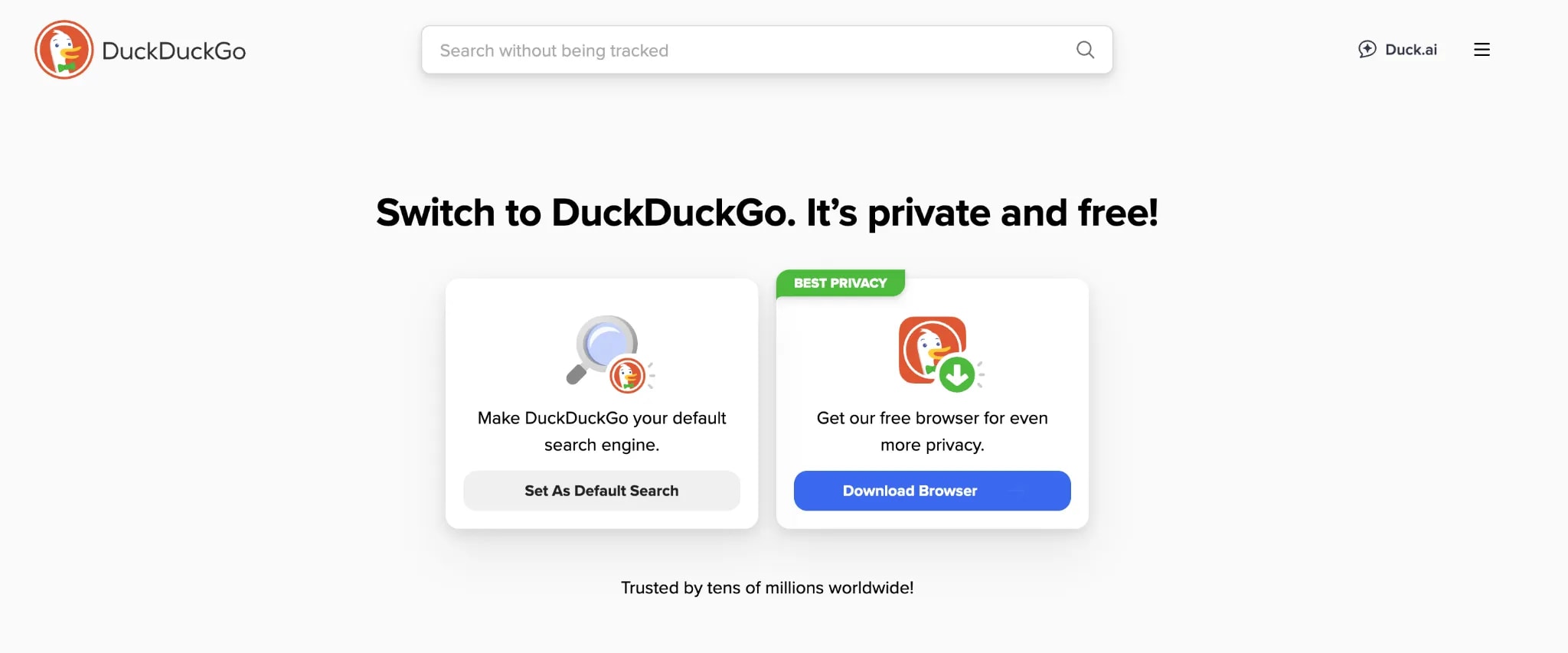
DuckDuckGo is not a pure deep web engine, but it operates differently from Google. It integrates federated search technology, pulling results from hundreds of sources (including Bing, Yandex, and Wikipedia) without storing user metadata.
- Strengths:
- No IP logging or user tracking
- Integration with Tor Browser for anonymous searches
- Effective for users who want privacy without complexity
- No IP logging or user tracking
- Limitations:
- Limited access to specialized databases
- Provides privacy, but not full deep web indexing
- Limited access to specialized databases
Ideal for users seeking mainstream results without surveillance, rather than hidden academic or darknet resources.
2.StartPage – Google Results Without Tracking
StartPage acts as a proxy layer over Google. It queries Google’s index on behalf of the user, stripping all identifiable metadata.
- Strengths:
- Google-level accuracy without profiling
- EU-based, compliant with GDPR privacy regulations
- Strong TLS encryption on all requests
- Google-level accuracy without profiling
- Limitations:
- Still bound to Google’s surface web index
- Does not unlock database-driven repositories
- Still bound to Google’s surface web index
Best for professionals who need Google-quality search with privacy guarantees.
3. Wolfram Alpha – Computational Deep Search
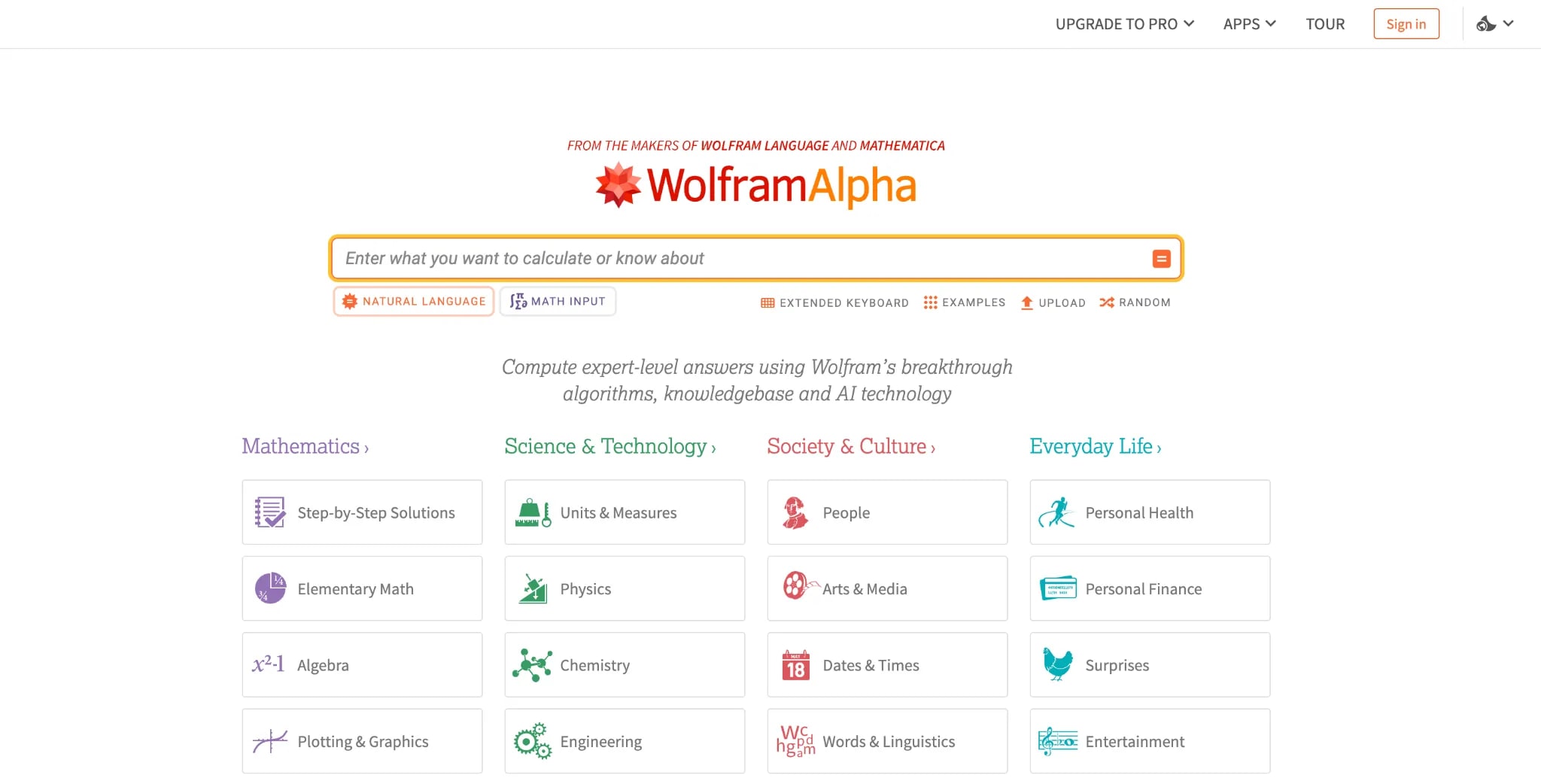
Unlike traditional keyword-based engines, Wolfram Alpha functions as a computational knowledge engine. It doesn’t just retrieve data; it computes answers from structured databases.
- Strengths:
- Accesses verified datasets across science, mathematics, and finance
- Performs real-time computation (e.g., solving equations, graphing functions)
- Useful for research requiring quantitative accuracy
- Accesses verified datasets across science, mathematics, and finance
- Limitations:
- Restricted to domains it covers (STEM-heavy)
- Requires precise query syntax for best results
- Restricted to domains it covers (STEM-heavy)
A go-to engine for engineers, data scientists, and financial analysts who require verified computational output.
4. Pipl – Deep People Search

Pipl specializes in identity intelligence by querying professional records, social platforms, and proprietary databases. It is widely used in fraud prevention, law enforcement, and corporate investigations.
- Strengths:
- Aggregates hidden records from government filings, company registries, and social traces
- Strong application in Know Your Customer (KYC) and due diligence workflows
- Subscription model ensures data quality and reliability
- Aggregates hidden records from government filings, company registries, and social traces
- Limitations:
- Not accessible for casual users (enterprise-focused)
- Raises ethical and privacy concerns if misused
- Not accessible for casual users (enterprise-focused)
Popular among compliance teams and investigators for verifying identities and uncovering fraud networks.
5. Torch – Darknet Search

Torch is one of the oldest .onion search engines designed specifically for Tor users. It indexes thousands of darknet domains inaccessible to the surface web.
- Strengths:
- Direct gateway into darknet marketplaces, forums, and leak sites
- Simple interface for .onion domain discovery
- Acts as a critical tool for cybersecurity monitoring
- Direct gateway into darknet marketplaces, forums, and leak sites
- Limitations:
- Results often contain illegal or malicious content
- High risk of malware and phishing traps
- Requires Tor Browser configuration
- Results often contain illegal or malicious content
Torch is used cautiously by threat intelligence teams rather than casual browsers.
6. Ahmia – Filtered Deep Web Search

Ahmia is a Tor-compatible search engine designed to make deep web exploration safer and more accessible. Unlike raw darknet indexes, it filters out harmful or illegal content, offering a cleaner gateway into .onion sites.
Strengths:
- Filters malicious and illegal content for safer browsing
- Accessible both on the regular web and via Tor
- Simple interface suitable for beginners
- Continuously updated index of active onion sites
Limitations:
- Smaller index compared to unfiltered darknet engines
- May exclude certain hidden services due to strict filtering
- Limited depth for advanced investigations
Ahmia is ideal if you want controlled access to the deep web without exposing yourself to high-risk content, making it a strong starting point for beginners.
7. BASE – Academic Deep Search Engine
BASE (Bielefeld Academic Search Engine) is one of the largest academic-focused search engines, indexing millions of documents from institutional repositories, journals, and research databases worldwide.
Strengths:
- Massive index of academic papers and open-access resources
- Strong coverage of institutional and university databases
- Advanced filtering for authors, publishers, and document types
- High reliability for scholarly and research-based queries
Limitations:
- Limited to academic and research content
- Not useful for general or commercial searches
- Some results may require subscriptions for full access
BASE is best suited for researchers, students, and professionals who need credible academic sources beyond what Google Scholar typically surfaces.
Comparison Table
| Tool | Best Use Case | Privacy Level | Access Type |
|---|---|---|---|
| DuckDuckGo | Private browsing | Medium-High | Web + Tor |
| Startpage | Private Google search | Medium | Web |
| Wolfram Alpha | Computational answers | Low | Web |
| Pipl | People search / KYC | Low | Enterprise |
| Torch | Darknet search | High | |
| Ahmia | Safe deep web browsing | High | Web + Tor |
| BASE | Academic research | Low | Web |
Other Notable Engines
- BASE (Bielefeld Academic Search Engine): Focused on academic papers and dissertations, indexing over 300 million documents from university repositories.
- Ahmia: A darknet engine that filters out known illicit marketplaces, making it safer for researchers who want access to forums without navigating criminal content.
- Yippy: A clustering engine that categorizes deep web results into organized topics, reducing noise for niche researchers.
Choosing the Right Deep Search Engine
Selecting a deep search engine depends on intent and operational need:
- Privacy Browsing: DuckDuckGo, StartPage
- Academic Research: BASE, PubMed, Wolfram Alpha
- Corporate Investigations: Pipl
- Cybersecurity Threat Hunting: Torch, Ahmia
Each tool is designed with a different technical architecture and security trade-off. Using the wrong engine not only wastes time but could also expose the user to unnecessary risks.
Real-World Use Cases of Deep Search Engines

Deep search engines are not abstract tools; they have specific, high-impact applications across academia, industry, journalism, and cybersecurity.
By unlocking hidden datasets and repositories, they provide strategic intelligence and validated information that surface engines cannot.
Academic Research
Universities and independent researchers rely on deep search engines to access peer-reviewed studies, dissertations, and scientific archives.
- Example: A PhD candidate studying climate change models may query databases like BASE or PubMed to extract climate data, simulation models, and published journals hidden behind paywalls.
- Benefit: Unlike Google, which retrieves general articles or blogs, these engines provide validated, citable data.
- Impact: Deep search engines accelerate knowledge production, ensuring research is built on verified sources rather than opinion pieces.
Corporate Due Diligence
Businesses conducting mergers, acquisitions, or partnership assessments use deep search tools to uncover financial, legal, and compliance-related records.
- Example: An investment firm evaluating a startup may use Pipl or Orbis to cross-check company registrations, shareholder filings, and litigation history.
- Benefit: Access to regulatory filings, bankruptcy records, and corporate disclosures reduces investment risk.
- Impact: Deep search enables data-driven decisions, preventing reliance on incomplete or manipulated public profiles.
Cybersecurity Threat Hunting
Security analysts leverage deep search engines to monitor hacker forums, track data leaks, and analyze malware discussions hidden in darknet domains.
- Example: A SOC (Security Operations Center) analyst might query Torch or Ahmia to detect chatter about zero-day vulnerabilities targeting financial institutions.
- Benefit: Early detection of leaked credentials, phishing kits, or malware source code provides a proactive defense advantage.
- Impact: Deep search enhances threat intelligence frameworks by integrating non-public indicators of compromise (IOCs).
Journalists and Investigative Work
Investigative reporters often require access to government records, leaked datasets, and confidential sources beyond Google’s reach.
- Example: A journalist covering corruption may use LexisNexis or deep legal databases to trace asset transfers and hidden connections between politicians and corporations.
- Benefit: Access to unindexed registries and whistleblower archives strengthens reporting credibility.
- Impact: Deep search tools enable fact-based journalism in an era where misinformation dominates surface platforms.
Healthcare and Medicine
Medical professionals use deep search engines to find clinical trials, treatment protocols, and pharmaceutical data unavailable through mainstream search.
- Example: A doctor treating a rare disease could query PubMed Clinical Trials to identify ongoing drug testing phases worldwide.
- Benefit: Access to real-time trial updates and anonymized patient data can guide treatment choices.
- Impact: Deep search contributes directly to improved patient care and medical innovation.
Law Enforcement and Forensics
Police departments and forensic investigators utilize deep search engines for identity verification, digital evidence collection, and criminal intelligence.
- Example: An anti-trafficking unit may query darknet engines to locate advertisements, chat logs, and cryptocurrency transaction trails connected to organized crime.
- Benefit: Deep search uncovers digital breadcrumbs inaccessible through Google or social media platforms.
- Impact: It strengthens criminal investigations by providing verifiable, court-admissible intelligence.
Competitive Intelligence and Market Research
Corporations analyzing competitors often need more than public websites; they require internal patents, procurement filings, and market performance data.
- Example: A technology company exploring acquisitions may query Wolfram Alpha and industry-specific archives to model financial performance based on hidden supply chain data.
- Benefit: Access to structured, non-public business records helps organizations identify hidden risks.
- Impact: Deep search gives companies an edge in highly competitive markets.
Humanitarian and Nonprofit Work
NGOs and aid organizations use deep search engines to uncover conflict zone data, government reports, and refugee movement statistics unavailable on surface web platforms.
- Example: A humanitarian group monitoring human trafficking routes could query government and NGO databases indexed only through specialized search engines.
- Benefit: Provides factual, location-based intelligence for strategic interventions.
- Impact: Deep search empowers organizations to save lives with accurate, timely data.
Deep Search Engine vs Darknet Search

The terms deep web and dark web are often used interchangeably, but they represent distinct layers of the internet with very different purposes.
For a deeper understanding: What Is Baiting in Cyber Security? Don’t Fall For It
Similarly, a deep search engine is not the same as a darknet search tool. Understanding these differences is crucial for anyone conducting legitimate research.
Key Differences
- Accessibility
- Deep Search Engines: Access databases, archives, and institutional repositories hidden behind authentication walls, paywalls, or query-based portals.
- Darknet Search Engines: Operate on the Tor or I2P networks, indexing .onion or hidden domains that cannot be reached with a standard browser.
- Deep Search Engines: Access databases, archives, and institutional repositories hidden behind authentication walls, paywalls, or query-based portals.
- Use Cases
- Deep Search Engines: Academic research, corporate due diligence, compliance checks, threat intelligence.
- Darknet Search Engines: Locating hidden forums, leak repositories, or darknet markets (often tied to illegal trade).
- Deep Search Engines: Academic research, corporate due diligence, compliance checks, threat intelligence.
- Data Quality
- Deep Search Engines: Structured, verifiable, often peer-reviewed or government-issued.
- Darknet Engines: Highly variable, frequently unverified, and sometimes intentionally deceptive.
- Deep Search Engines: Structured, verifiable, often peer-reviewed or government-issued.
Misconceptions About Deep Web and Dark Web
- Myth 1: The deep web is illegal.
Fact: The majority of the deep web is legal and necessary, such as medical records, subscription databases, and corporate intranets. - Myth 2: All deep search engines connect to the dark web.
Fact: Tools like PubMed, Wolfram Alpha, and BASE have nothing to do with darknet domains. - Myth 3: The dark web is always dangerous.
Fact: While darknet marketplaces host illicit trade, the same network is used by journalists, whistleblowers, and activists to protect anonymity.
Legal vs Illegal Use Cases
Deep Search Engines (Legal Applications):
- Accessing peer-reviewed journals through PubMed
- Conducting due diligence with Orbis or Pipl
- Running semantic research queries with Wolfram Alpha
- Mining census and demographic datasets for business or social projects
Darknet Search Engines (Risk-Prone Applications):
- Searching Torch for stolen credentials or hacking forums
- Browsing Ahmia for political dissident networks
- Locating illicit marketplaces offering drugs, counterfeit goods, or weaponry
Key takeaway: While deep search engines focus on unlocking structured, legal information, darknet search tools can easily lead to criminal environments if not used responsibly.
Use Our Cybersecurity Risk Calculator
Why the Confusion Persists
The confusion arises from the iceberg analogy often used to explain the internet:
- Surface Web (above water): Indexed by Google and Bing.
- Deep Web (below water): Legitimate, but hidden databases, academic resources, and medical records.
- Dark Web (deepest layer): An anonymized subset of the deep web, accessible only via Tor, often hosting illegal content.
Because both the deep web and dark web are hidden from standard indexing, casual users lump them together. In reality, their purpose, structure, and legal standing differ dramatically.
When Deep Search Crosses Into Darknet Search
There are scenarios where the boundaries blur:
- A cybersecurity analyst may query darknet engines to track ransomware groups targeting enterprises.
- A journalist might use Ahmia to connect with anonymous whistleblowers.
- Law enforcement may scrape Torch for evidence in organized crime investigations.
In these cases, darknet search becomes a legitimate investigative tool, but its risks remain high.
Safe Navigation Practices
- Segmentation: Use standard deep search engines for legal research; reserve darknet engines strictly for controlled investigations.
- Environment Isolation: Employ virtual machines or sandboxed environments when accessing darknet resources.
- Compliance Awareness: Ensure queries comply with local and international laws (e.g., GDPR, HIPAA).
- Security Stack: Always pair darknet searches with VPNs, Tor browser, and endpoint protection.
Future of Deep Search Engines

The next generation of deep search engines will not simply extend today’s capabilities; they will reshape how humans and machines interact with hidden data ecosystems.
Advances in AI, blockchain, and privacy-first infrastructure are setting the stage for a more intelligent and decentralized approach to search.
AI-Powered Semantic Search
Current deep search engines often depend on structured queries and database-specific syntax. In the future, AI-driven semantic models will remove these barriers.
- Natural Language Understanding (NLU): Instead of typing “cancer treatment clinical trial 2024 site:pubmed”, users will simply ask: “What clinical trials are underway for lung cancer this year?”
- Contextual Relevance: AI engines will interpret intent, disambiguate meanings, and deliver direct answers instead of links.
- Adaptive Learning: Engines will continuously refine search accuracy by analyzing user behavior without storing identifiable data.
Example: A deep search engine integrated with large language models could retrieve results from PubMed, normalize the data, and generate a summary with citations in real time.
Integration With Blockchain
Blockchain offers solutions to index integrity, censorship resistance, and decentralized ownership of search infrastructure.
- Immutable Indexing: Entries on blockchain-backed search engines cannot be tampered with, ensuring data authenticity.
- Decentralized Querying: Eliminates reliance on a single provider, distributing workloads across nodes.
- Tokenized Access: Researchers or corporations may pay micro-fees via cryptocurrency to query protected datasets.
Example: A blockchain-powered deep search engine could provide verifiable access to clinical trial registries, ensuring transparency in pharmaceutical research.
Rise of Private AI Assistants
The convergence of deep search with personal AI assistants will shift search from passive querying to active information orchestration.
- Agentic Search: AI assistants will proactively query multiple deep search engines to prepare curated reports.
- Privacy Sandboxing: Personal devices will process sensitive queries locally, avoiding third-party logging.
- Contextual Memory: Assistants will remember prior searches, tailoring results to ongoing projects without surveillance.
Example: A cybersecurity consultant could ask their AI assistant: “Summarize the latest darknet chatter about ransomware targeting healthcare.” The assistant would compile intelligence from Torch, Ahmia, and private feeds into a threat brief.
Enhanced Multimodal Capabilities
The future of deep search is not limited to text queries. Multimodal engines will handle audio, video, and image-driven searches.
- Image Querying: A researcher could upload a microscopic cell image, and the engine would retrieve related medical case studies from specialized archives.
- Voice Interaction: Journalists may ask voice-based queries while on the move, receiving results from legal or government archives.
- Video Indexing: Engines will analyze frame-level metadata from scientific or surveillance footage stored in hidden repositories.
Cybersecurity-Centric Search Models
Given the escalating threat landscape, specialized cybersecurity deep search engines will emerge.
- Threat Correlation Engines: Automatically correlate darknet chatter with real-world attack telemetry.
- Malware Pattern Search: Index malware signatures and exploits discussed in closed forums.
- Zero-Day Forecasting: Predict vulnerabilities by analyzing developer leaks or underground transactions.
These advancements will transform deep search into a proactive defense mechanism, not just an information tool.
Regulatory and Ethical Shifts
The future of deep search will also be shaped by evolving regulations.
- GDPR Successors: New privacy frameworks will dictate how personal and biometric data can be indexed.
- Data Sovereignty Laws: Countries may enforce that citizen data stays within national archives, affecting cross-border deep search.
- Ethical Standards: Institutions may require auditable AI search logs to prevent misuse in journalism, research, or forensics.
The Bottom Line
The deep search engine of tomorrow will be:
- AI-enhanced (semantic, predictive, and conversational)
- Blockchain-backed (verifiable and censorship-resistant)
- Privacy-first (no centralized tracking or surveillance)
- Domain-specialized (tailored for medicine, law, cybersecurity, finance)
In other words, the future points toward intelligent, decentralized, and context-aware discovery systems that empower both professionals and everyday users.
How to Stay Safe While Using Deep Search Engines

Deep search engines provide access to valuable but sensitive repositories, including academic databases, corporate filings, and even darknet intelligence.
However, because these tools intersect with hidden, unindexed, and sometimes malicious ecosystems, users must adopt strict safety protocols.
Use a VPN and Secure Browser
- VPN (Virtual Private Network): Always route traffic through a trusted VPN to prevent your ISP from logging queries or flagging unusual activity. Choose providers with no-log policies, AES-256 encryption, and DNS leak protection.
- Secure Browsers:
- For the deep web: Tor Browser (for .onion domains) or I2P (for anonymous overlay networks).
- For privacy-focused deep search: Hardened Chromium builds, such as Brave with shields enabled.
- For the deep web: Tor Browser (for .onion domains) or I2P (for anonymous overlay networks).
- Why it matters: Without VPNs and hardened browsers, your queries can be fingerprinted, exposing both your identity and intent.
Avoid Suspicious Links and Darknet Markets
Deep search engines sometimes return links to malicious domains.
- Phishing Risks: Fraudulent darknet forums mimic legitimate research portals to harvest credentials.
- Malware Payloads: Hidden sites may trigger automatic downloads of remote access trojans (RATs) or ransomware.
- Illicit Marketplaces: Accessing marketplaces for stolen credit cards or counterfeit goods can result in legal consequences even without purchase.
Best Practice: Validate URLs before visiting by cross-referencing them with trusted repositories such as Ahmia’s filtered index or law enforcement advisories.
Best Practices for Researchers
Researchers and professionals engaging with deep search engines should enforce controlled environments:
- Virtual Machines (VMs): Use isolated VMs (e.g., VirtualBox, VMware) for deep web exploration, ensuring infections do not affect host systems.
- Sandboxed Browsing: Tools like Firejail (Linux) or Windows Sandbox prevent malicious code execution.
- Minimal Identity Exposure: Never use personal accounts or real identifiers when accessing restricted repositories. Create burner accounts where authentication is required.
- Multi-Factor Authentication (MFA): If using academic or institutional deep search tools, always enable MFA to safeguard access credentials.
Use Encrypted Communication Channels
When collaborating with colleagues or sharing results from a deep search:
- PGP Encryption: Secure email communication with Pretty Good Privacy (PGP) to prevent interception.
- Secure Messengers: Use end-to-end encrypted platforms such as Signal or Threema when discussing sensitive findings.
- File Integrity Checks: Verify SHA-256 or MD5 hashes of downloaded files to confirm they have not been tampered with.
Distinguish Between Legal and Illegal Zones
Not all deep search activity is safe or legal.
- Legal Zones: Academic databases (PubMed, JSTOR), corporate filings (Orbis), computational engines (Wolfram Alpha).
- Grey Zones: Whistleblower platforms, leaked datasets legal in some jurisdictions, prosecutable in others.
- Illegal Zones: Darknet marketplaces, child exploitation domains, counterfeit services.
Rule of thumb: If a query produces data that seems too sensitive, personal, or illicit, avoid interaction.
Check out our latest blog on Cyber Tanks: What It Teaches About Cyber Attacks
Layer Security With Operational Discipline
- Compartmentalization: Separate research environments (different VMs or browsers) for academic search vs darknet intelligence gathering.
- Regular Updates: Keep Tor, VPN, and antivirus signatures updated to patch zero-day vulnerabilities.
- Logging Awareness: Even privacy-focused engines may log aggregate metadata. Avoid queries that expose personal identifiers or client-sensitive data.
- Incident Response Plan: If malware is suspected, have a containment workflow (disconnect VM, restore from snapshot, audit logs).
Example Research Workflow (Safe)
- Connect to a VPN with a no-logs policy.
- Launch an isolated VM with Tor Browser for darknet queries.
- Use Ahmia (filtered darknet search) instead of raw Torch.
- Validate suspicious links through multiple threat intelligence feeds.
- Export findings via encrypted storage or secure collaboration tools.
This workflow reduces exposure while maintaining research efficiency.
Check out our latest blog on Cybersecurity High-Speed Internet for the US Navy | Guide
Best Deep Search Engines by Use Case
Not all deep search engines serve the same purpose. Choosing the right one depends on your goal:
- For privacy-focused browsing: DuckDuckGo, Startpage
- For academic and research work: BASE, Wolfram Alpha
- For identity verification and investigations: Pipl
- For cybersecurity and threat intelligence: Torch, Ahmia
- For general deep web exploration: Ahmia, DuckDuckGo (Tor version)
Using the right tool for the right task not only improves efficiency but also reduces exposure to unnecessary risks.
Final Thoughts
A deep search engine is not just another browsing tool; it is a gateway to knowledge and intelligence beyond the reach of Google or Bing.
From academic research to cybersecurity monitoring, these engines unlock datasets that are hidden, structured, and often critical for informed decision-making.
At the same time, they come with responsibilities and risks. While engines like PubMed, Wolfram Alpha, and BASE provide legitimate access to scholarly material, darknet-focused engines such as Torch expose users to environments where malware, fraud, and illicit marketplaces exist.
The line between legal exploration and risky engagement can blur quickly without proper safeguards.
The future of deep search is moving toward AI-enhanced semantic querying, blockchain-based decentralization, and integration with private AI assistants. These innovations will make hidden data not only more accessible but also more intelligent, context-aware, and secure.
For professional researchers, analysts, journalists, and investigators, the ability to master deep search engines will remain a competitive edge.
But with this power comes a responsibility: to navigate ethically, protect privacy, and avoid misuse.
In short, a deep search engine is a powerful ally for those who respect its potential and respect the boundaries of the digital ecosystems it reveals.
Check out my previous blogs for more insights:
How to block radiation from wifi router?
Frequently Asked Questions
What is deep search?
Deep search is the process of accessing information beyond the surface web, including databases, private content, and pages not indexed by traditional search engines.
What is a deep search engine?
A deep search engine is a specialized tool that helps you find hidden or less accessible content across the internet, including deep web resources and private databases.
Is deep search legal?
Yes, deep search itself is legal. However, accessing illegal content on the dark web is not. It depends on how you use the tools.
Is DeepSearch legit?
DeepSearch tools can be legitimate, but not all services are trustworthy. Always verify the platform, avoid suspicious downloads, and prioritize well-known tools.
Does deep search work better than Google?
Deep search engines can uncover information that Google cannot index, especially in academic databases or the deep web. However, Google is still more efficient for general searches.
What is the difference between deep web and dark web?
The deep web includes all content not indexed by search engines, such as private databases. The dark web is a small part of the deep web that requires special tools like Tor to access.