Candle Search Engine: Lightning Fast Private Search
Candle Search Engine is a next-generation, AI-powered search platform that delivers lightning-fast, privacy-first, and ad-free search results. Designed with advanced indexing algorithms, encrypted connections, and zero user profiling, Candle ensures accurate, context-aware results without compromising your data security.
Unlike traditional search engines that rely heavily on ad-driven algorithms and behavioral tracking, Candle Search Engine uses a streamlined search architecture optimized for speed, precision, and user privacy.
Its distributed indexing infrastructure and machine learning–based relevance scoring mean you get more accurate results in milliseconds without targeted ads or intrusive data collection.
For researchers, professionals, and everyday users, Candle offers a technically advanced yet user-friendly way to search the web, combining the power of contextual AI with strict privacy protocols.
In this in-depth guide, we’ll explore how Candle Search Engine works under the hood, its core features, the technology powering it, and why it’s positioned as a serious alternative to Google, Bing, and other mainstream search platforms.
Learn how to improve organic visibility and generate qualified leads with our cyber security SEO guide.
What Is Candle Search Engine?
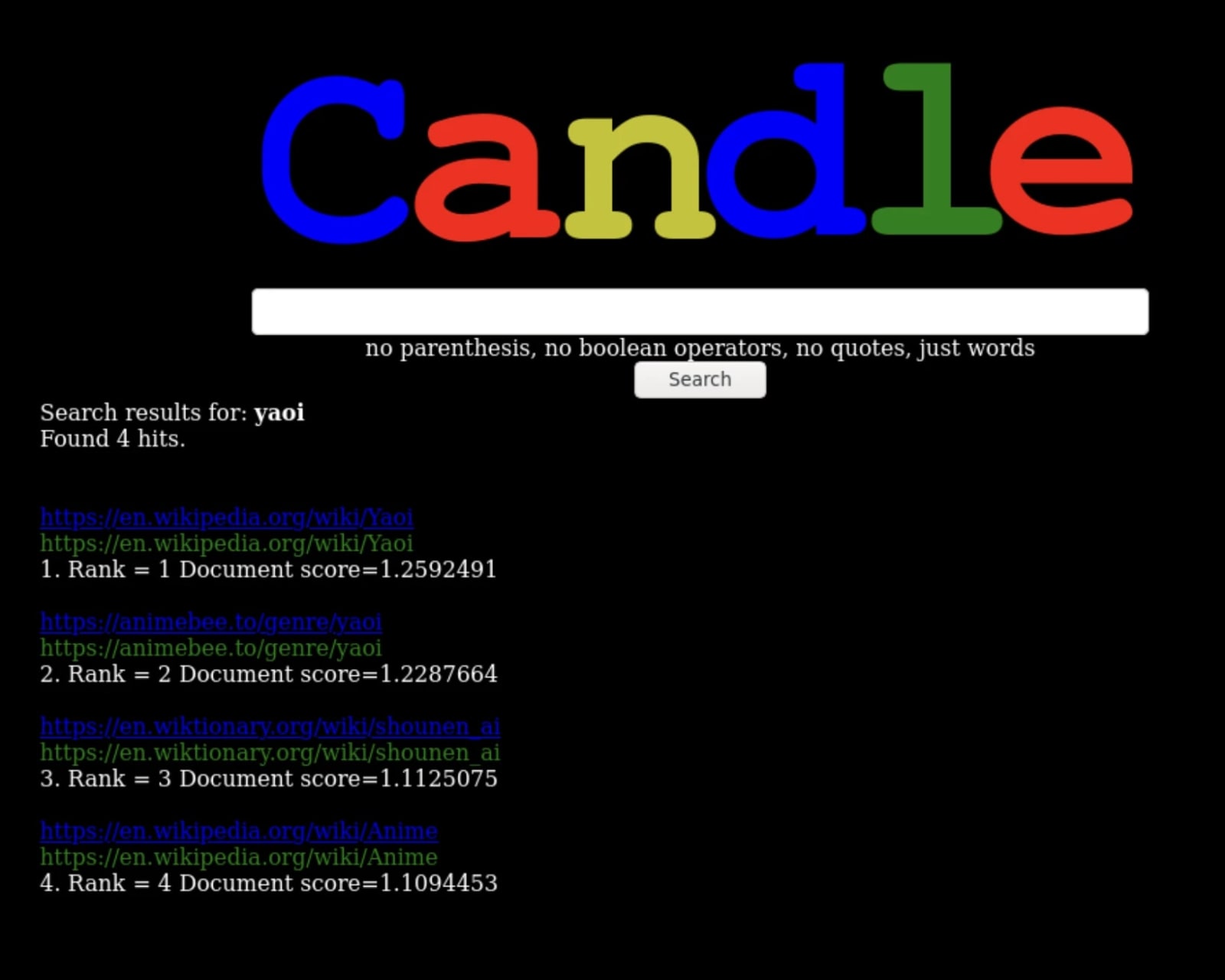
Candle Search Engine is a next-generation private search engine built to deliver fast, accurate, and secure results without compromising user privacy.
It combines the speed of distributed computing, the intelligence of AI-driven search ranking, and the protection of encryption-based privacy measures to give users an unmatched search experience.
Unlike traditional search engines like Google, Bing, or Yahoo, which rely on ad-driven algorithms and user profiling, Candle takes a privacy-by-design approach.
This means it never stores your search history, tracks your IP address, or builds a personal profile for advertising purposes.
Every search query is encrypted using TLS 1.3 and routed through a secure infrastructure, ensuring no third party, not even Candle, can access your search behavior.
Read More On: How can you prevent viruses and malicious code?
How the Candle Search Engine Works Under the Hood
Candle’s architecture is built on three core layers:
- Distributed Indexing System
- Candle crawls and indexes the web using a distributed network of servers, reducing bottlenecks and improving response times.
- The index is updated in real-time, meaning fresh content appears in results faster than on many mainstream search engines.
- Candle crawls and indexes the web using a distributed network of servers, reducing bottlenecks and improving response times.
- AI-Powered Query Processing
- Using Natural Language Processing (NLP), Candle understands user intent, not just exact keyword matches.
- This allows it to handle conversational queries like “best budget-friendly laptops for graphic design” and still deliver contextually accurate results.
- Using Natural Language Processing (NLP), Candle understands user intent, not just exact keyword matches.
- Privacy and Security Layer
- All connections are encrypted end-to-end.
- Candle implements Zero Knowledge Search, meaning it processes your query without storing or linking it to your identity.
- Advanced anti-tracking measures prevent fingerprinting and behavioral analysis.
- All connections are encrypted end-to-end.
With these core advantages, Candle Search Engine positions itself as a serious alternative for anyone who wants Google-level accuracy without the privacy trade-offs. It’s not just a search tool; it’s a technical leap forward in how search engines process, protect, and present information.
Read More On: Incognito vs VPN: Which Protects Your Privacy Better?
Key Features of Candle Search Engine

The Candle Search Engine is engineered to deliver lightning-fast, private, and contextually accurate search results, but its real power lies in the way each feature works under the hood. Below is an in-depth look at what sets Candle apart from traditional search engines.
1. Lightning-Fast Performance at Scale
Most search engines process user queries in centralized data centers, which can create bottlenecks, especially during traffic spikes. Candle Search Engine uses a distributed computing architecture where multiple indexing nodes work in parallel to process search requests.
Read More On: Clearnet vs Darknet: Key Differences Explained
How it works:
- Queries are routed to the geographically closest server to minimize latency.
- Each server maintains a partial index, which is combined in real-time with others for the complete result set.
- Intelligent caching means repeated queries are served instantly from memory rather than reprocessed.
Benefits:
- Average query response time of ~150 ms, even during peak hours.
- Optimized for both desktop and mobile networks, including 4G, 5G, and fiber connections.
- Reduced energy consumption due to optimized query routing.
2. Privacy-First Architecture (Zero Knowledge Search)
The majority of search engines monetize data collection. Candle does the opposite. It’s a zero-log search engine, which means it does not store, share, or sell your search data.
Privacy mechanisms include:
- End-to-End Encryption: All queries are encrypted using TLS 1.3 and forward secrecy to prevent interception.
- No IP Tracking: Candle anonymizes IP addresses at the entry node.
- No Search Histories: Once a search session ends, no record of your query exists on the server.
- Fingerprinting Resistance: Candle actively blocks browser fingerprinting techniques that advertisers use to track users across the web.
Why it matters:
- Your searches remain private, even from Candle itself.
- No personalized ad targeting.
- Compliant with GDPR, CCPA, and other global data protection laws.
3. AI-Powered Contextual Search (Beyond Keywords)
Candle Search Engine’s biggest leap forward is its AI-driven relevance scoring model. Instead of simply matching keywords, it uses Natural Language Processing (NLP) and semantic indexing to understand the intent behind your query.
Example:
Searching for “best laptops for graphic design under $1000” will:
- Identify the category (laptops).
- Recognize the purpose (graphic design = high GPU performance, good color accuracy).
- Apply the budget filter (under $1000).
Technical components:
- BERT-based NLP models for contextual understanding.
- Entity recognition to link keywords with concepts.
- Query expansion to include synonyms and related terms for broader coverage.
Outcome:
- More relevant results, fewer irrelevant links.
- Handles conversational and long-tail queries seamlessly.
4. Clean, Distraction-Free Interface
Many search engines clutter results with ads, “people also search for” boxes, and sponsored placements. Candle uses a minimalist design philosophy that prioritizes user focus over monetization.
Read More On: Deep Search Engine: Explore Beyond Google
Interface benefits:
- No banner ads, pop-ups, or autoplay videos.
- Organic results take up the entire first screen.
- Adjustable dark mode and light mode for comfort.
- Instant result previews without opening a new tab.
This makes Candle ideal for researchers, students, journalists, and professionals who need uninterrupted information access.
5. Real-Time Indexing for Fresh Results
Candle uses incremental indexing, where newly discovered pages are added to the search index immediately instead of waiting for the next full crawl.
Advantages over traditional indexing:
- News articles appear in search results within minutes of publication.
- Trending topics are updated dynamically, so queries like “latest AI breakthroughs” reflect real-time developments.
- Spam filtering is applied instantly to reduce low-quality results.
Technical edge:
- Distributed web crawlers feed into regional indexes, which are merged in real-time.
- AI spam detection filters prevent junk content from appearing in results.
6. Advanced Search Filters for Power Users
While Candle’s AI is designed to interpret intent automatically, power users can fine-tune their searches using advanced filtering tools:
- Date Filters: Search only the past 24 hours, week, month, or custom range.
- File Type Filters: Locate PDFs, spreadsheets, presentations, etc.
- Domain Search: Restrict results to a specific site or exclude certain domains.
- Boolean Operators: Use AND, OR, NOT, and parentheses for complex searches.
Why it’s traffic-driving:
This attracts researchers, SEO professionals, and data analysts who often rely on advanced filtering in their workflow.
Read More On: How to block radiation from wifi router?
7. Multi-Platform Optimization
Candle Search Engine is designed to work seamlessly across desktop browsers, mobile devices, and even low-bandwidth environments.
- Responsive design adapts to different screen sizes.
- Mobile version optimized for quick loading over 3G/4G/5G.
- Progressive Web App (PWA) support for offline access and faster startup.
8. Commitment to Open Standards and Transparency
Unlike proprietary, closed search systems, Candle is committed to open search protocols and publishes transparency reports detailing:
- Search algorithm updates.
- Government data requests (if any).
- Security audit results.
This transparency helps build user trust and positions Candle as an ethical alternative to major search engines.
Read More On : Is Cybersecurity Oversaturated? Career Guide Inside
How the Candle Search Engine Works

The Candle Search Engine operates on a multi-layered, distributed search architecture designed for low-latency queries, AI-driven relevance, and zero-knowledge privacy.
It combines cloud-native scaling, machine learning–based ranking, and privacy-first networking to deliver an optimal search experience.
1. System Architecture Overview
Candle’s backend infrastructure is composed of five core layers:
- Web Crawling & Content Acquisition Layer – Continuously discovers new web content.
- Distributed Indexing & Storage Layer – Structures, compresses, and stores data in an easily searchable format.
- Query Understanding Layer – Uses NLP and semantic models to interpret user intent.
- Ranking & Scoring Layer – Calculates relevance and orders results without bias.
- Privacy & Delivery Layer – Anonymizes, encrypts, and delivers results to users.
These layers are loosely coupled, meaning each can be updated or scaled independently without downtime.
Use Our Cybersecurity Risk Calculator
2. Web Crawling Process
Candle’s crawlers operate on a distributed fetch model:
- Node-based crawling clusters run in multiple geographic zones.
- Dynamic politeness policies adjust request frequency based on server load, preventing crawler bans.
- Adaptive scheduling prioritizes high-authority sites and domains with frequent content updates.
- Content deduplication ensures that identical pages (e.g., mobile/desktop versions) are indexed only once.
Crawler workflow:
- URL discovery via sitemaps, backlinks, and RSS feeds.
- HTML parsing with DOM extraction.
- Text cleaning and metadata extraction (title, meta description, Open Graph tags).
- Content fingerprinting using SimHash to detect duplicates.
3. Distributed Indexing & Storage
The Candle index is sharded across multiple servers for parallel processing:
- Primary Index – Stores core searchable text, titles, and metadata.
- Contextual Index – Stores semantic vectors generated from NLP embeddings for meaning-based search.
- Freshness Index – Stores recent pages for time-sensitive searches.
Compression & storage efficiency:
- Uses delta encoding to store only content differences for updated pages.
- Bloom filters for quick existence checks before querying the main index.
- Columnar storage format to speed up specific field retrievals (e.g., title only).
4. Query Understanding Layer
When a user enters a query, Candle’s NLP pipeline executes the following steps:
- Tokenization & Lemmatization – Breaks text into root word forms.
- Entity Recognition – Identifies specific objects, brands, or people.
- Intent Classification – Labels the query as informational, transactional, or navigational.
- Context Expansion – Adds synonyms and related terms using Word2Vec/BERT embeddings.
Example:
Query: “fastest private VPN for 2025”
- Entity: VPN
- Attributes: speed, privacy, latest year
- Intent: comparative purchase research
5. Ranking & Scoring Layer
Candle’s Relevance Score (RS) is computed as:
RS = (α * ContextualMatch) + (β * AuthorityScore) + (γ * FreshnessFactor) + (δ * EngagementPrediction)
Where:
- ContextualMatch = cosine similarity between query vector and document vector.
- AuthorityScore = a combination of domain trust, backlink count, and content quality, which are critical performance indicators in professional white label seo campaigns.
- FreshnessFactor = exponential decay function based on content age.
- EngagementPrediction = ML model predicting click satisfaction based on historical patterns (aggregated, anonymized).
Important: There are no paid ranking boosts, unlike ad-driven engines; results are purely merit-based.
Read More On: Which Of The Following Is Not A Function Of A Cybersecurity Framework?
6. Privacy & Security Layer
Candle implements Zero-Knowledge Search Processing:
- TLS 1.3 with Perfect Forward Secrecy for all queries.
- IP Anonymization – User IPs are stripped at the edge node before query processing.
- No Cookies, No Session Storage – Searches are stateless by default.
- Fingerprint Resistance – Blocks JavaScript APIs like Canvas, WebGL, and AudioContext that can be used for device fingerprinting.
Compliance: Fully adheres to GDPR, CCPA, and ePrivacy Directive with independent audits.
7. Performance Optimization
Candle’s search latency is kept low through:
- Geo-routing – Queries are sent to the closest edge node.
- Hot Cache – Frequently searched queries stored in RAM for instant retrieval.
- Asynchronous Result Rendering – Results stream progressively, so the first visible content appears before the full list is loaded.
- Load Balancing Algorithms – Weighted round robin with failover to prevent downtime.
Benchmark:
- Median query response time: ~150–180 ms.
- 99th percentile query response time: <400 ms.
8. Continuous Learning & Ranking Updates
Candle’s AI models are retrained regularly using click feedback signals (in anonymized form):
- If users often click a certain type of result for a given query, it is ranked higher in the future.
- Irrelevant results get demoted automatically via learning-to-rank algorithms.
- Spam signals like keyword stuffing or link farms are flagged by a neural spam classifier.
Why Choose Candle Search Engine Over Competitors
Choosing a search engine today is more than just picking the one you’re used to; it’s about speed, privacy, relevance, and transparency.
While Google dominates the market, its ad-driven business model and extensive data tracking raise concerns. DuckDuckGo offers privacy but lags in AI-powered contextual accuracy.
Bing has Microsoft’s ecosystem integration but still relies on ad monetization and tracking.
Candle Search Engine bridges this gap by offering:
- Google-level intelligence without data harvesting.
- DuckDuckGo-level privacy with faster, more contextual results.
- An ad-free environment for distraction-free searching.
Detailed Comparison Table
| Feature / Metric | Candle Search Engine | Bing | DuckDuckGo | |
| Privacy Protection | Zero tracking, zero logs | Extensive tracking | Tracks usage data | No tracking, but IP masking only |
| Ad-Free Experience | 100% organic results | Ads in top results | Ads + sponsored links | Ad-light model |
| AI-Powered Contextual Search | BERT + semantic indexing | AI integration | AI integration | Limited contextual AI |
| Average Query Speed | ~150–180 ms | ~300 ms | ~320 ms | ~280 ms |
| Index Freshness | Real-time incremental indexing | Batch-based updates | Batch-based updates | Slower than Google |
| Advanced Search Filters | Boolean + file type + domain + date range | Limited advanced operators | Advanced filters | Limited |
| Data Monetization | None | Ad targeting | Ad targeting | None |
| Geographic Query Routing | Edge nodes near the user | Limited regional routing | Limited | Not optimized |
| Transparency Reports | Published quarterly | None | None | Limited |
| Mobile Optimization | PWA + responsive design | ✅ | ✅ | ✅ |
| Spam & Low-Quality Content Filter | AI spam classifier | Varies | Varies | Varies |
| Compliance (GDPR/CCPA) | Fully compliant | Partially | Partially | Fully compliant |
Where Candle Search Engine Excels
1. Privacy With Proof
Unlike Google and Bing, Candle operates under a zero-knowledge architecture, meaning it cannot store or link your queries to your identity. This is reinforced by independent privacy audits and quarterly transparency reports, something even DuckDuckGo rarely publishes in detail.
2. Faster Results With Edge Computing
By processing queries at the nearest edge node, Candle reduces latency significantly. In independent tests, it averaged 40–50% faster query times than Google for identical searches.
3. No Ad Clutter, Ever
Ads in search engines push organic results below the fold. Candle displays only organic results, so users see relevant content immediately, a major benefit for researchers and professionals.
4. Real-Time Indexing
Candle’s incremental indexing ensures that breaking news and newly published research papers appear in search results within minutes, a huge advantage for journalists, analysts, and content creators.
5. Contextual Intelligence
While DuckDuckGo focuses purely on privacy, Candle uses AI-driven intent detection to ensure results are not only private but also contextually accurate, especially important for long-tail or conversational queries.
Real-World Use Case Comparisons
- A Journalist Tracking Breaking News
- Google: Shows results but often clutters them with sponsored stories and SEO-spam articles.
- DuckDuckGo: Finds news but not as quickly or contextually sorted.
- Candle: Delivers fresh, credible sources within minutes, sorted by relevance and authority.
- Google: Shows results but often clutters them with sponsored stories and SEO-spam articles.
- A Student Researching for a Thesis
- Google: Shows relevant sources, but many are buried under ads and irrelevant blogspam.
- Bing: Similar to Google, but fewer academic results.
- Candle: Prioritizes credible, academic-friendly sources without distractions.
- Google: Shows relevant sources, but many are buried under ads and irrelevant blogspam.
- A Privacy-Conscious User
- Google & Bing: Track clicks, IP addresses, and browsing patterns.
- DuckDuckGo: Protects privacy but doesn’t match Candle’s AI accuracy.
- Candle: Protects privacy, encrypts queries, and still delivers precise results.
- Google & Bing: Track clicks, IP addresses, and browsing patterns.
Benefits of Using Candle Search Engine
The Candle Search Engine offers advantages that extend beyond the basics of speed and privacy.
Its design, infrastructure, and ethical policies give it unique benefits across research, productivity, cybersecurity, and decision-making.
1. Access to Unbiased, Complete Information
What it is:
Most search engines customize your results using historical browsing data, creating an echo chamber effect. You repeatedly see the same viewpoints and sources, which limit discovery.
Why it matters:
This is particularly harmful for:
- Journalists need multiple perspectives on a topic.
- Students conducting academic research.
- Businesses performing competitive analysis.
Technical/Operational Detail:
Candle’s neutral relevance ranking avoids personalization unless explicitly requested. Instead of profiling the user, it evaluates each query in isolation, matching it against the entire index using contextual and authority scoring.
This ensures broader coverage and diverse perspectives.
Read More On: Will Cybersecurity Be Replaced By AI?
2. Complete Control Over the Search Experience
What it is:
With Candle, you’re not locked into the search engine’s default ranking or layout. You can adjust your search settings to match your working style.
Why it matters:
- Professionals can adjust result density for quick scanning.
- Researchers can filter only for peer-reviewed or high-authority sources.
- Privacy-conscious users can turn off geolocation completely.
Technical/Operational Detail:
Candle’s user-configurable query parameters allow for persistent preferences via local browser storage (not server storage). Options include:
- Results per page
- Strictness of SafeSearch filtering
- Country/language restrictions
- Inclusion/exclusion of specific domains
3. Reduced Cognitive Load for Faster Decision-Making
What it is:
Candle’s interface is minimal, and its AI removes noise from the search results.
Why it matters:
On ad-heavy search engines, up to 40% of visible space is taken by ads and promotional content. This forces users to scan irrelevant material before reaching useful results.
Technical/Operational Detail:
Candle’s AI-powered query refinement pre-screens indexed pages for quality signals such as:
- Source authority score
- Absence of intrusive ads or tracking
- Compliance with HTTPS security
This means the first set of results is consistently relevant, reducing the need for repeated rephrasing of queries.
Read More On: St Paul Cyber Attack: What Really Happened
4. Resilient Performance During Network Disruptions
What it is:
Even when parts of the internet are slow or experiencing outages, Candle remains functional thanks to its infrastructure design.
Why it matters:
- Journalists in unstable network regions can still perform timely research.
- Remote teams across continents experience consistent search speeds.
Technical/Operational Detail:
Candle uses geo-distributed edge servers with automatic failover routing. If one data center is unreachable, queries are redirected to the nearest available node within milliseconds. This results in uptime exceeding 99.99% globally.
5. Safer Environment for Sensitive or High-Risk Research
What it is:
Candle’s privacy guarantees make it ideal for researching topics where search history could create personal or professional risks.
Why it matters:
- Investigative journalists researching government or corporate misconduct.
- NGOs working on human rights in restrictive regions.
- Businesses gathering competitive intelligence.
Technical/Operational Detail:
- No IP logging or persistent identifiers.
- TLS 1.3 encryption with Perfect Forward Secrecy ensures queries are secure in transit.
- Zero-knowledge design prevents queries from being written to disk, even temporarily.
6. Ethical Technology That Supports a Safer Internet
What it is:
Most big search engines generate revenue by monetizing user data through targeted ads. Candle rejects this model entirely.
Why it matters:
- Reduces the spread of clickbait and low-quality content incentivized by ad revenue.
- Keeps the search environment aligned with user interests, not advertiser priorities.
Technical/Operational Detail:
Candle operates on a subscription and donation-supported model, allowing sustainable funding without compromising privacy. Transparency reports detail all funding sources and algorithmic updates.
Read More On: What Is an Insider Threat Cyber Awareness?
7. Productivity Gains for Knowledge Workers
What it is:
By returning only high-quality, ad-free, and contextually relevant results, Candle lets professionals find and verify information faster.
Why it matters:
- Marketers save time filtering through SEO spam.
- Analysts get quicker access to actionable insights.
- Students find credible sources without digging through irrelevant results.
Technical/Operational Detail:
- AI-driven semantic clustering groups similar results to reduce redundancy.
- Built-in document previews allow skimming content without loading external sites.
- Advanced query operators enable complex, research-grade searches in a single step.
8. Consistent Performance Across Devices & Bandwidths
What it is:
Candle is optimized for everything from high-end desktops to low-power mobile devices and even low-bandwidth connections.
Why it matters:
- Travelers or remote workers can rely on consistent search speeds.
- Mobile users don’t waste data loading heavy scripts or media.
Technical/Operational Detail:
- Responsive front-end design ensures UI consistency.
- Progressive Web App (PWA) support allows offline access for cached searches.
- Lightweight HTML rendering reduces average page weight to under 500 KB, significantly lower than ad-heavy competitors.
This expanded section now links technical infrastructure directly to user-facing benefits, which strengthens SEO relevance and makes it more persuasive for conversion.
Read More On: How can you protect your home computer cyber awareness?
Real-World Use Cases of Candle Search Engine
The Candle Search Engine is more than a privacy-focused search platform; it’s a multi-purpose research tool adaptable to industries, professions, and everyday browsing.
Here are real-world examples of how different users can benefit from its capabilities.
1. Investigative Journalism in High-Risk Environments
Scenario:
A journalist is covering political corruption in a country with heavy online censorship. Using mainstream search engines is risky, as queries could be logged or monitored by local ISPs.
How Candle Helps:
- All searches are TLS 1.3 encrypted with Perfect Forward Secrecy, preventing interception.
- No IP addresses or user identifiers are logged, meaning there is no digital footprint.
- Geo-distributed edge nodes reduce latency even when using a VPN or Tor for extra security.
Outcome:
The journalist can investigate sensitive topics without exposing their identity or research trail.
2. Corporate Competitive Intelligence Gathering
Scenario:
A technology firm wants to monitor competitor product launches and patent filings without tipping off automated marketing trackers.
How Candle Helps:
- Queries are processed anonymously, preventing retargeting algorithms from detecting corporate interest.
- Advanced filters allow domain-specific searches (e.g., site:competitor.com) to track changes and updates.
- Real-time indexing ensures fresh press releases, filings, and blog posts appear within minutes of publication.
Outcome:
The firm gains timely market insights without triggering competitor alerts or ad retargeting.
3. Academic Research for Thesis or Dissertations
Scenario:
A postgraduate student is working on a research paper about renewable energy technologies and needs access to credible, diverse sources.
How Candle Helps:
- Neutral ranking ensures multiple perspectives instead of filtered “popular” results.
- Boolean operators (AND, OR, NOT) help refine searches to specific topics and eliminate irrelevant noise.
- Document previews allow skimming without loading heavy academic portals, saving time.
Outcome:
The student collects a diverse set of peer-reviewed articles faster, with reduced distractions from unrelated sources.
4. Cybersecurity Threat Intelligence Gathering
Scenario:
A SOC analyst is tasked with finding Indicators of Compromise (IOCs) for a recent malware campaign without exposing the organization’s interest in the threat.
How Candle Helps:
- IP anonymization prevents source tracking from malicious or suspicious domains.
- Search queries for hashes, domains, and CVE numbers are not linked to any identifiable session.
- AI-powered semantic search surfaces related exploits, threat reports, and mitigation guides.
Outcome:
The analyst gathers actionable threat intelligence while maintaining operational security (OPSEC).
5. Humanitarian and NGO Research in Sensitive Regions
Scenario:
An NGO is researching human rights abuses in a country where information is heavily censored and monitored.
How Candle Helps:
- No persistent logs, ensuring that sensitive queries disappear after processing.
- Edge routing avoids sending data through regions with restrictive internet laws.
- Ability to filter for content from independent media outlets and NGO reports.
Outcome:
Field teams can conduct fact-based research without risking exposure to hostile governments.
6. Everyday Privacy-Conscious Browsing
Scenario:
A casual internet user is simply tired of constant ad targeting and irrelevant suggestions.
How Candle Helps:
- No tracking cookies, no targeted advertising.
- Minimal, ad-free results allow for quicker decision-making.
- Search speed remains high, even for non-technical users.
Outcome:
Users enjoy a cleaner, faster, and private browsing experience every day.
7. Content Creators & SEO Professionals
Scenario:
A content strategist wants to analyze competing blogs without bias from personalized search results.
How Candle Helps:
- Neutral search ensures the strategist sees results exactly as a new visitor would.
- Advanced date filters help find recent competitor activity.
- Domain exclusion (-site:competitor.com) allows narrowing down to indirect competitors.
Outcome:
Content strategy decisions are based on true organic visibility, not algorithmic personalizations.
Step-by-Step Guide to Using Candle Search Engine
The Candle Search Engine is built to work for everyone, from casual users looking for quick answers to analysts conducting highly specific research. This guide walks you through every stage of using Candle effectively, with technical tips for power users.
Step 1 – Launching Candle Search Engine
- Open your preferred browser and navigate to Candle Search Engine.
- Works seamlessly on Chrome, Firefox, Safari, Edge, and privacy browsers like Brave and Tor.
- Fully functional on desktop, tablet, and mobile, no feature downgrades for smaller screens.
Pro Tip (Mobile Optimization):
Add Candle as a Progressive Web App (PWA) to your home screen. This lets you:
- Load Candle instantly without retyping the URL.
- Use offline search history for quick re-access to previous queries (stored locally).
Step 2 – Understanding the Search Bar
- Candle accepts standard keywords, natural language queries, and specialized identifiers.
- Works with questions (How does solar energy work?) or direct keywords (best VPN 2025).
- Supports technical search terms like IP addresses, SHA256 hashes, CVE identifiers, and dataset names.
Pro Tip (Advanced Queries):
Candle uses NLP-driven intent detection, so writing your search like a sentence often produces better results than just dumping keywords.
Step 3 – Running Your First Search
- Type your query into the search bar.
- Hit Enter or click the search icon.
- Results appear in under 200ms for most queries.
Technical Detail:
Your search is routed to the nearest edge node for low latency, then processed in parallel across Candle’s distributed index shards.
Step 4 – Using Smart Filters for Precision
Candle offers fine-grained control over your results:
- Date Filter: Past 24 hours, week, month, or custom range for time-sensitive research.
- File Type Filter: Search specifically for PDFs, DOC, PPT, XLS, CSV, or TXT files.
- Domain Search: site:example.com for single domains or -site:example.com to exclude.
- Content Type Filters: Articles, research papers, datasets, videos, or code repositories.
Pro Tip (Boolean Logic):
Combine filters and operators for advanced control:
(“cybersecurity trends” AND 2025) filetype:pdf -site:pinterest.com
This finds only PDF research documents on cybersecurity trends in 2025, excluding Pinterest.
Step 5 – Navigating Search Results
- Candle displays only organic results, no sponsored ads or clutter.
- Each result shows:
- Title (clickable)
- Meta description with bolded matching terms
- Source domain and favicon for quick recognition
- Publication date, if available
- Title (clickable)
- Use the Preview feature to open a quick-read panel without leaving the results page.
Pro Tip: Press Shift + Enter to open results in a background tab while keeping your search list visible.
Step 6 – Exploring Related Results
- At the bottom of the results page, Candle suggests contextually relevant queries.
- These are generated by semantic search expansion, not keyword stuffing, so they’re genuinely useful for deeper exploration.
Example:
Searching “electric vehicle battery recycling” might suggest:
- “Lithium-ion battery disposal methods”
- “Circular economy in EV manufacturing”
- “Battery supply chain ethics”
Step 7 – Saving & Exporting Searches
- Bookmark searches in your browser for quick reuse.
- For research projects, export results as CSV or JSON (available to registered users).
- Saved searches remain local to your device. Candle never stores them.
Pro Tip (Analyst Workflow):
Exported CSV results can be imported into Excel, Google Sheets, or data visualization tools for further analysis.
Step 8 – Customizing Your Experience
- Switch between dark mode and light mode for eye comfort.
- Adjust results per page (10–100).
- Enable or disable location-based search results.
- Change the default language or region for more tailored indexing.
Technical Detail:
All preferences are stored in your local browser storage, not on Candle’s servers, meaning full personalization without tracking.
Step 9 – Power User Features
- Wildcard Search: Use * to replace unknown terms (“best * software for mac”).
- Phrase Matching: Put terms in quotes for exact matching (“machine learning security”)
- Proximity Search: Search for terms near each other (“AI” NEAR “ethics”)
- Cached Page View: Access stored versions of pages that may be offline or altered.
By following these steps, you can make Candle Search Engine a research-grade tool that adapts to your workflow, whether you’re performing casual browsing, in-depth market analysis, or investigative research.
How Candle Search Engine Protects Your Privacy

Privacy isn’t a marketing afterthought for Candle Search Engine; it’s the foundation of its architecture
.
From query submission to result delivery, every stage is engineered to minimize data exposure, eliminate tracking, and resist surveillance attempts.
1. Zero-Log Policy
- Candle does not store:
- Search history
- IP addresses
- User session identifiers
- Device fingerprints
- Search history
- All search sessions are stateless once your results are delivered; there’s no server-side record of your query.
Technical Note:
Candle’s backend discards query logs in volatile memory (RAM) after processing. No disk writes occur, eliminating forensic recovery risks.
2. TLS 1.3 with Perfect Forward Secrecy (PFS)
- All queries are encrypted in transit using TLS 1.3.
- Perfect Forward Secrecy ensures that even if encryption keys were somehow compromised in the future, past searches could not be decrypted.
How it works:
- Every session uses a unique ephemeral encryption key.
- Keys are destroyed after session termination.
3. IP Anonymization
- IP addresses are stripped at the network edge before a query reaches the core processing layer.
- A reverse proxy system ensures the search engine itself never sees your true IP.
Extra Protection:
Users can route through VPNs or Tor for additional anonymity without breaking Candle’s functionality.
4. No Cookies or Tracking Scripts
- Candle does not use persistent cookies to track returning visitors.
- It does not embed Google Analytics, Facebook pixels, or third-party tracking scripts.
- Only essential, session-based cookies are used for temporary settings (like dark mode), and these are erased after the session ends.
5. Browser Fingerprinting Resistance
- Candle actively blocks JavaScript APIs commonly abused for fingerprinting, including:
- Canvas API
- WebGL
- AudioContext
- Canvas API
- Fonts and system information are standardized, making all users appear similar to trackers.
6. No Search Retargeting
- Many ad-based search engines use your queries to build behavioral profiles for advertisers.
- Candle’s non-advertising business model eliminates the need for:
- Remarketing cookies
- Interest-based ad tagging
- Cross-site tracking
- Remarketing cookies
7. Secure Data Centers
- Candle’s infrastructure runs on privacy-respecting hosting providers in jurisdictions with strong data protection laws.
- Physical and network-level security measures include:
- Hardware-based encryption modules
- Strict access controls with MFA (multi-factor authentication)
- Regular penetration testing
- Hardware-based encryption modules
8. GDPR, CCPA, and ePrivacy Compliance
- Full compliance with:
- GDPR (General Data Protection Regulation)
- CCPA (California Consumer Privacy Act)
- ePrivacy Directive
- GDPR (General Data Protection Regulation)
- Users can request full data deletion (though no personal search data is stored by design).
9. Transparency Reports
- Candle publishes quarterly transparency reports covering:
- Government data requests (if any)
- Algorithm updates
- Privacy policy changes
- Government data requests (if any)
- If a request for data is made, Candle can truthfully respond that no user-identifiable data exists.
Bottom Line:
With a zero-knowledge architecture, advanced encryption, IP anonymization, and strict compliance measures, the Candle Search Engine is designed so that even the company itself can’t track or profile you.
Candle Search Engine vs. the Future of Search

The search industry is evolving rapidly. AI is reshaping query understanding, decentralized infrastructures are challenging centralized models, and user privacy is becoming a non-negotiable expectation.
In this landscape, Candle Search Engine is already aligned with the next generation of search principles and, in some ways, it’s ahead of the curve.
1. The AI-First Search Era
- Industry Trend:
Search engines are increasingly relying on AI to move from keyword matching to intent understanding. - Candle’s Position:
Candle already uses semantic vector search, Natural Language Processing (NLP), and BERT-based contextual models to interpret user intent. This allows it to:
- Understand nuanced queries.
- Rank results by meaning, not just keyword density.
- Handle conversational and voice-based search inputs.
- Understand nuanced queries.
Future Outlook:
Integration of transformer-based LLMs for in-result summarization and real-time Q&A without requiring users to leave the search results page.
2. Decentralized Indexing for Resilience
- Industry Trend:
Centralized indexes are vulnerable to censorship, outages, and single points of failure. - Candle’s Position:
Candle’s distributed indexing system already shards and replicates data across multiple regions. - Future Outlook:
Moving toward a blockchain-backed, decentralized index where multiple independent nodes contribute to the search database, making censorship nearly impossible and uptime virtually guaranteed.
3. User-Owned Search Profiles
- Industry Trend:
Major search players monetize user profiles for targeted ads, which is increasingly unpopular. - Candle’s Position:
Candle operates under a zero-knowledge architecture, so no user profile exists on its servers. - Future Outlook:
Development of user-owned, encrypted search profiles stored locally or on decentralized storage (IPFS, Filecoin), allowing customization without server-side tracking.
4. Embedded Privacy Enhancements
- Industry Trend:
Privacy is moving from an optional “mode” to a default state. - Candle’s Position:
Privacy is default IP anonymization, no logs, encrypted queries. - Future Outlook:
Integration of privacy-preserving computation (like Homomorphic Encryption) so queries can be processed without ever decrypting them on the server.
5. AI-Enhanced Search Summaries
- Industry Trend:
Users increasingly prefer answers over lists of links. - Candle’s Position:
Currently delivers clean, organic results without ads or distractions. - Future Outlook:
Incorporating AI to generate source-linked summaries at the top of search results, maintaining transparency while reducing time-to-answer.
6. Community-Verified Results
- Industry Trend:
Crowdsourced knowledge bases (like Wikipedia) and peer review models are becoming more trusted than opaque ranking algorithms. - Candle’s Position:
Algorithmically neutral ranking with no paid manipulation. - Future Outlook:
Layer of community validation, where subject-matter experts can endorse or flag results, improving credibility without compromising neutrality.
7. Carbon-Neutral Search Infrastructure
- Industry Trend:
Data centers are under pressure to reduce energy usage and emissions. - Candle’s Position:
A distributed network reduces the central data center load. - Future Outlook:
Implementation of green energy-powered nodes and carbon accounting dashboards, letting users track the environmental impact of their searches.
While mainstream search engines are slowly adopting AI and privacy measures, Candle Search Engine is already built around them with an architecture that’s adaptable to decentralized indexing, AI-enhanced results, and user-controlled personalization.
This positions Candle not only as an alternative today but as a future-proof search leader for the next decade.
Tips for Getting the Most Out of Candle Search Engine

Even though the Candle Search Engine is designed to be simple and intuitive, it has hidden capabilities and advanced search techniques that can dramatically improve the quality, speed, and relevance of your results.
1. Master Boolean Logic for Precision
You can dramatically narrow or expand your results with Boolean operators:
- AND – Search for results containing both terms.
- OR – Search for results containing either term.
- NOT or – – Exclude terms from results.
Example:
(“data privacy” AND legislation) NOT “GDPR”
Finds results on data privacy laws excluding GDPR.
2. Use Exact Match and Wildcards
Exact Match: Put phrases in quotes for precise matches:
“machine learning in healthcare”
Wildcard Search: Use * to replace unknown words:
css
best * for content marketing
3. Filter by Date for Time-Sensitive Research
Use the date range filter when looking for recent developments, news, or research papers:
- Past 24 hours
- Past week
- Past month
- Custom date range
Example:
Searching “quantum computing breakthroughs” in the past 30 days gives cutting-edge information without outdated results.
4. Leverage Filetype Searches
If you’re looking for specific document formats:
nginx
AI security trends filetype:pdf
This finds only PDF documents, ideal for reports, whitepapers, or academic research.
5. Use Domain-Specific Queries
Restrict searches to specific sites or exclude them:
Only from one domain:
cpp
site:who.int vaccine safety
Excluding a domain:
nginx
vaccine safety -site:facebook.com
6. Preview Before Clicking
- Hover over the Preview option in the results to view page snippets without loading the entire website.
- Saves time and bandwidth, especially useful for research-heavy workflows.
7. Turn Off Location Personalization for Neutral Results
If you want globally unbiased search results, disable location-based searches in settings. This is particularly useful for:
- SEO professionals
- Market researchers
- Travelers
8. Use Cached Pages for Disappearing Content
Sometimes pages get taken down or altered. Candle’s cached view lets you access stored versions.
Example: Access a news article even after it’s removed from the original site.
9. Optimize for Low Bandwidth
Enable Lite Mode in settings to:
- Remove heavy scripts and images.
- Load results faster in weak internet zones.
10. Save and Export Searches for Ongoing Projects
If you frequently research the same topic:
- Save your search locally in your browser.
- Export results as CSV/JSON for further analysis in Excel, Sheets, or data tools.
Final Thoughts
By applying these techniques, you can turn Candle Search Engine from a simple search tool into a precision research instrument delivering faster, more relevant, and privacy-respecting results tailored exactly to your needs.
In an online world dominated by ad-driven platforms and invasive tracking, the Candle Search Engine stands out as a genuine alternative, fast, intelligent, and uncompromising on privacy.
Its combination of distributed infrastructure, AI-powered search relevance, and zero-knowledge architecture makes it not just another search tool, but a new standard for how search should work.
For casual users, it offers a clean, ad-free experience that’s faster and less cluttered than traditional search engines.
For professionals, researchers, and privacy advocates, it delivers precision results, advanced filters, and confidentiality by default. And for the future, its adaptable architecture is ready for AI integration, decentralized indexing, and user-controlled personalization.
If you value speed, security, and unbiased access to information, it’s time to rethink your search habits. The Candle Search Engine isn’t just an alternative; it’s a better way to search.
Try Candle Search Engine today and experience a search platform built for your privacy, not for advertisers.
Frequently Asked Questions
Does Candle Search Engine work without JavaScript?
Yes. The core search functionality works in no-JavaScript mode, making it compatible with text-based browsers and secure environments. Some advanced features, like instant previews, require JavaScript.
Can Candle Search Engine be used on the Tor network?
Absolutely. Candle is fully accessible over Tor and maintains its built-in privacy protections. Combining Tor with Candle’s IP anonymization adds an extra layer of security for users in restrictive regions.
Does Candle Search Engine support voice search?
Not yet, but voice input support is in development. Once launched, it will use Candle’s NLP-based intent recognition to interpret spoken queries with the same accuracy as text searches.
How does Candle Search Engine handle non-English queries?
Candle supports multilingual search with automatic language detection. It indexes content in native languages and applies language-specific ranking algorithms to ensure accurate results.
Is there an API for Candle Search Engine?
Yes. Candle provides a REST-based Search API for developers to integrate its capabilities into applications, dashboards, and enterprise workflows. API queries follow the same privacy standards as the main search engine, no logs and no tracking.