Table of Contents
Both cybersecurity and software engineering are critical to today’s tech landscape. Cybersecurity focuses on defending systems against threats.
Software engineering focuses on building reliable, scalable software. Choosing between them means picking a path rooted in either protection or creation.
Cyber Security vs Software Engineering: What’s the Difference?
Cyber Security vs Software Engineering compares two fields: cybersecurity involves protecting systems from attacks and data breaches, while software engineering is about designing and developing functional software applications.
This guide explores in-depth technical skills, job roles, tools, certifications, salaries, and career potential so you can decide where you fit best.
Learn how to improve organic visibility and generate qualified leads with our cyber security SEO guide.
Defining the Domains

Two disciplines define the architecture and defense of the modern world: Cyber Security and Software Engineering.
One exists to uncover and mitigate vulnerabilities; the other to build complex systems that function reliably at scale. They operate in parallel but often with opposing priorities.
Cyber Security vs Software Engineering isn’t just a technical comparison. It’s a contrast in mindset. Security is inherently adversarial, anticipating attacks, dissecting failure, and prioritizing control and containment.
Read More On: Is Cybersecurity Oversaturated? Career Guide Inside
Engineering, meanwhile, is about expansion, solving problems, optimizing performance, and creating tools that extend human capability.
Their convergence is where things get interesting and dangerous. A brilliant engineering solution that ignores threat models is a liability.
A security protocol that ignores usability is shelfware. The balance between the two defines whether systems empower users or expose them.
Here’s a closer look at each domain.
Read More On: The Role of ZTNA and VPN in Modern Cybersecurity Strategies
Cybersecurity: Safeguarding Digital Assets
Cybersecurity is the discipline of defending information systems against compromise, manipulation, and exploitation.
It operates across multiple layers from hardware and firmware to application logic and human behavior. This field demands both strategic foresight and tactical precision.
Key components include:
Network Security: Intrusion detection systems (IDS), firewalls, VPNs, and secure routing protocols defend against lateral movement and DDoS attacks.
Endpoint Protection: EDR platforms, sandboxing, and patch management mitigate risks on user machines and IoT devices.
Cryptography: Encryption standards like AES, RSA, and ECC protect data in transit and at rest. Zero-knowledge proofs and homomorphic encryption push the boundaries of private computation.
Threat Intelligence: Real-time analysis of Indicators of Compromise (IOCs), MITRE ATT&CK mappings, and honeypot data informs proactive defenses.
Incident Response: Forensic triage, containment protocols, and rollback strategies are vital in post-breach scenarios.
Cybersecurity isn’t static, it’s reactive and anticipatory. Attack surfaces evolve, zero-days are hoarded, and APTs never sleep. It’s less about being impenetrable and more about being resilient under siege.
Read More On: What Is GRC in Cybersecurity? Everything You Should Know
Software Engineering: Building Digital Solutions
Software engineering is the structured process of designing, developing, testing, and maintaining scalable digital systems. It blends theory and practice, balancing constraints of performance, reliability, and maintainability.
Core pillars include:
Systems Design: Domain-driven design (DDD), service-oriented architectures (SOA), and microservices enable modularity and scalability.
Programming Paradigms: From object-oriented (OOP) to functional programming (FP), these paradigms shape how logic is expressed and maintained.
DevOps & CI/CD: Continuous integration and deployment pipelines, containerization (Docker), and orchestration tools (Kubernetes) automate and streamline delivery.
Testing & Quality Assurance: Unit, integration, and fuzz testing help maintain robustness and prevent regressions in critical systems.
Performance Engineering: Profiling, load testing, and algorithmic optimization are essential for systems operating at web scale.
Software is infrastructure. Whether it’s backend logic for a fintech app or firmware in a pacemaker, every bug is a potential fault line. Crafting robust code isn’t just engineering, it’s liability management in a code-driven world.
Use Our Cybersecurity Risk Calculator
Core Competencies and Skill Sets
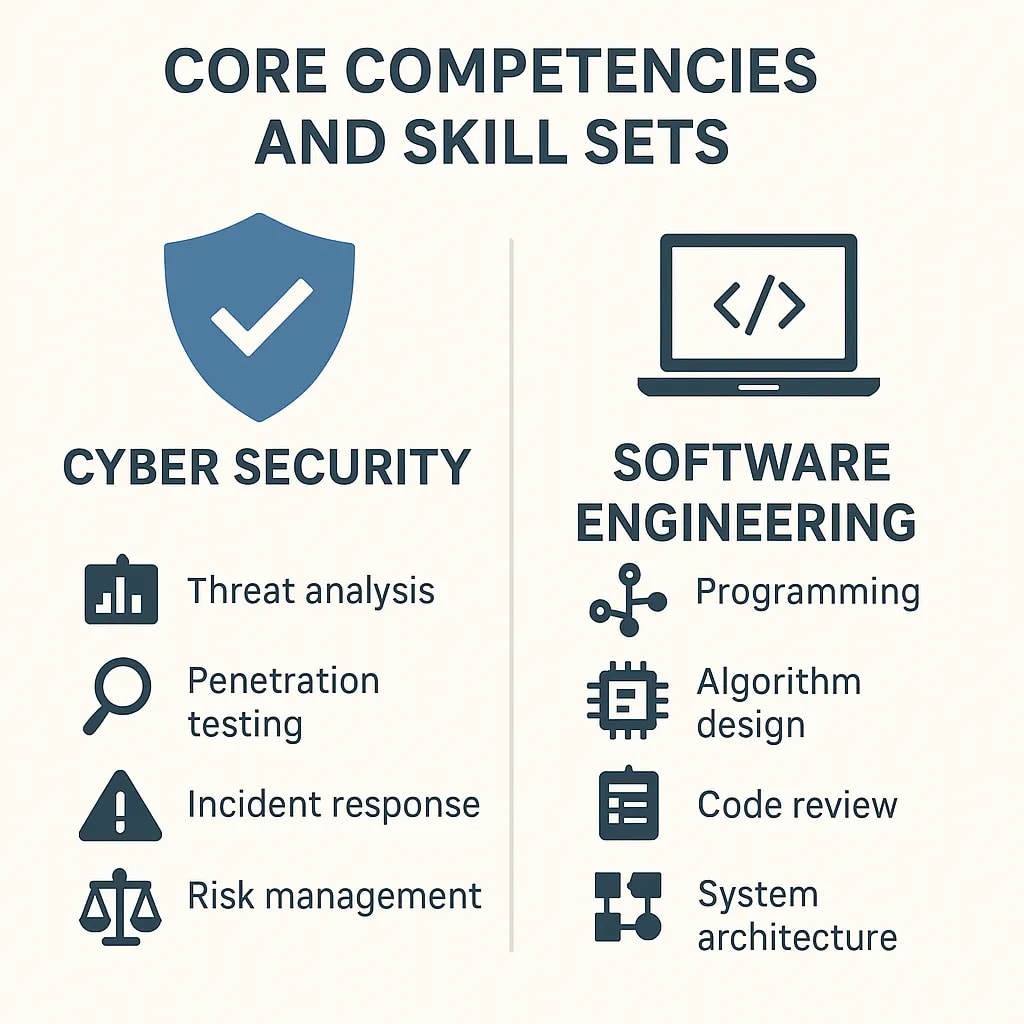
Understanding the difference between Cyber Security and Software Engineering means going beyond surface-level job descriptions.
These are two high-impact fields within the tech ecosystem, each with its own distinct set of competencies, tools, and intellectual frameworks.
Whether you’re entering the industry or evaluating team roles, knowing what each discipline demands is critical.
Read More On: How to Start a Cyber Security Company Off-Grid
Cyber Security: Core Skills for Digital Defense and Adversarial Thinking
Cybersecurity experts operate in a world of persistent threats, where every asset is a potential attack vector and every weakness is a future headline. Their core competencies are centered on prevention, detection, response, and recovery.
Technical Skills:
Vulnerability Assessment and Management
Use tools like Nessus, OpenVAS, and Qualys to detect misconfigurations, weak encryption, and outdated software. Prioritize vulnerabilities using CVSS scores and real-world exploitability.Penetration Testing and Red Team Operations
Simulate attacker behavior with Kali Linux, Metasploit, Cobalt Strike, and custom scripts. Red teamers mimic adversaries; blue teamers counter with logging, detection, and hardening.Reverse Engineering and Malware Analysis
Disassemble binaries using Ghidra or IDA Pro. Analyze behavior in sandbox environments and extract indicators of compromise (IOCs).Network Security and Packet Analysis
Understand protocols (TCP/IP, DNS, HTTP/S), sniff traffic using Wireshark, and detect anomalies like beaconing or data exfiltration.Cryptography and Secure Protocols
Implement and audit cryptographic systems using OpenSSL, GPG, or modern libraries. Understand key exchange, digital signatures, and hash functions.Security Monitoring and Incident Response
Build and tune SIEM systems like Splunk or Elastic. Create playbooks for rapid containment and remediation after a breach.
Read More On: What Is Baiting in Cyber Security? Don’t Fall For It
Soft Skills:
Risk Management and Threat Modeling
Use frameworks like STRIDE, DREAD, and MITRE ATT&CK to anticipate threats and prioritize defenses.Communication and Policy Writing
Translate technical findings into clear risk reports for C-level execs and compliance teams. Influence security posture with documentation, awareness training, and clear incident reports.Ethical Judgment and Legal Awareness
Navigate gray areas with ethical integrity, especially when dealing with exploit development, disclosure, or surveillance technologies.
Read More On: Candle Search Engine: Lightning Fast Private Search
Certifications and Frameworks (SEO Boosters):
CompTIA Security+, CISSP, CEH, OSCP, CISM, and ISO 27001
Familiarity with NIST 800-53, OWASP Top 10, GDPR, and PCI-DSS
Cybersecurity is both reactive and preemptive. It’s about understanding systems well enough to exploit them and then designing controls to stop others from doing the same.
Read More On: What Is CSAM in Cybersecurity? Everything You Need to Know
Software Engineering: Core Skills for Building Systems That Scale
Software engineers are the architects and bricklayers of the digital world. Their work forms the functional core of every application, device, and service that runs on code. The best engineers are meticulous about efficiency, readability, and long-term maintainability.
Read More On: How can you prevent viruses and malicious code?
Technical Skills:
Programming Proficiency and Algorithmic Thinking
Deep knowledge of at least one systems-level and one high-level language (e.g., C++, Python, Go, TypeScript). Mastery of recursion, graph theory, and algorithm optimization.System Design and Architecture
Design RESTful APIs, event-driven services, or distributed systems that meet business requirements. Know when to use monoliths vs. microservices. Understand scalability patterns, sharding, and load balancing.Version Control and Code Collaboration
Use Git like a pro: rebase, squash, handle merge conflicts, and set up pre-commit hooks. Collaborate via GitHub, GitLab, or Bitbucket.Build Automation and Continuous Deployment
Set up CI/CD pipelines using Jenkins, CircleCI, or GitHub Actions. Automate testing, builds, and deployments with containers and cloud platforms.Testing, Debugging, and Observability
Write comprehensive unit, integration, and end-to-end tests. Use debuggers, profilers, and logging frameworks to trace and squash bugs.Database Design and Optimization
Choose between SQL (PostgreSQL, MySQL) and NoSQL (MongoDB, Redis) based on use case. Optimize queries, index wisely, and understand ACID vs. BASE tradeoffs.
Soft Skills:
Agile Development and Product Collaboration
Work in sprints, refine backlog items, conduct code reviews, and integrate user feedback. Familiarity with Agile, Scrum, and Kanban practices.Code Documentation and Maintainability
Write code that others can understand, extend, and refactor. Use tools like Swagger for API docs and JSDoc for inline documentation.Lifelong Learning and Adaptability
Stay updated with new frameworks (React, Svelte, Next.js), languages (Rust, Elixir), and paradigms (serverless, edge computing).
Certifications and Frameworks (SEO Boosters):
AWS Certified Developer, Microsoft Certified: Azure Developer, Certified Kubernetes Application Developer (CKAD)
Familiarity with SOLID principles, Domain-Driven Design (DDD), and the Twelve-Factor App methodology
Software engineering is about creation but also about abstraction, orchestration, and constant refinement. Great code isn’t just functional, it’s elegant, testable, and future-proof.
Read More On: Incognito vs VPN: Which Protects Your Privacy Better?
While there’s some overlap in tooling and technical foundations, the skill sets for cyber security vs software engineering reflect fundamentally different objectives.
One safeguards systems from compromise; the other brings those systems into existence.
If you thrive on adversarial puzzles, forensic investigation, and digital defense, cybersecurity might be your calling.
If you love building things from scratch, solving logic problems, and optimizing systems, software engineering may be a better fit.
Both fields are critical, and the future belongs to those who understand how they intersect.
Read More On: How Can Generative AI Be Used In Cybersecurity
Career Trajectories and Opportunities
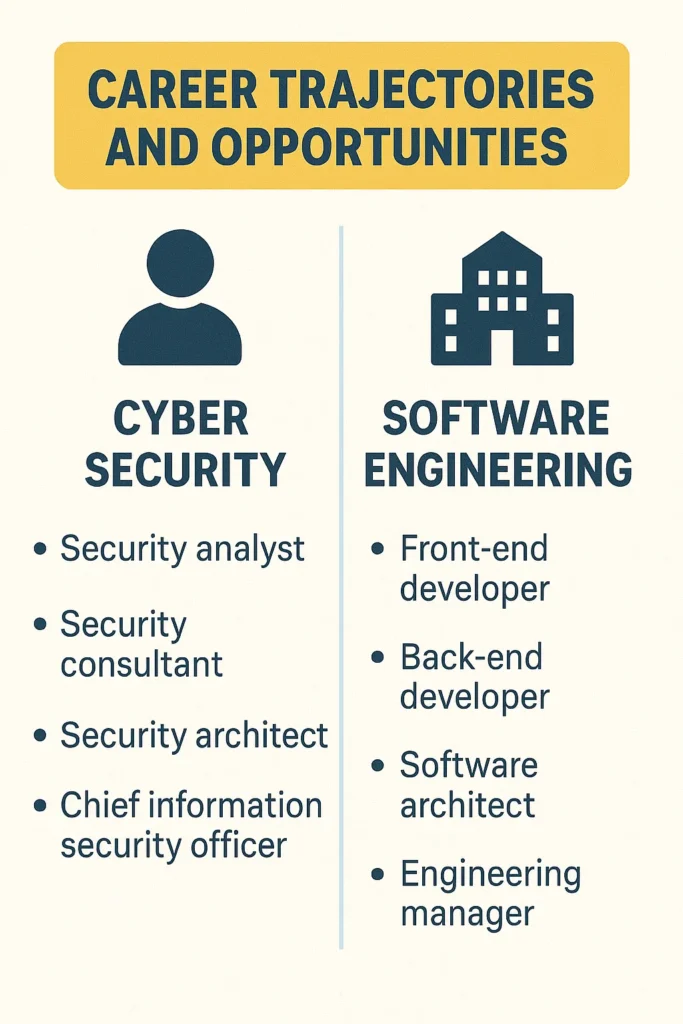
In the ongoing debate of Cyber Security vs Software Engineering, understanding the career outlook for each field is essential.
These aren’t just job paths, they’re ecosystems of evolving roles, specialties, and vertical mobility. As digital infrastructure expands, so does the demand for professionals who can either secure or build it.
Read More On: Which Of The Following Is Not A Function Of A Cybersecurity Framework?
Cyber Security Career Path: From Analyst to Cyber Strategist
Cybersecurity careers often begin in high-stakes environments, and the climb is as much about trust as it is about technical skill.
Early roles are deeply hands-on, but over time, professionals can branch into leadership, offensive research, or policy-driven roles.
Common Entry-Level Roles:
Security Analyst: Monitor SIEM dashboards, respond to alerts, and run basic forensic investigations.
SOC Analyst (Tier I/II): Work in security operations centers, triaging incidents, and escalating threats.
GRC Associate: Help organizations meet regulatory compliance through audits, policies, and controls.
Mid-Level Opportunities:
Penetration Tester / Ethical Hacker: Simulate attacks to uncover real-world vulnerabilities. Often hired by consultancies or in-house red teams.
Incident Responder / Threat Hunter: Analyze breach impact, contain threats, and harden defenses post-incident.
Security Engineer: Architect security into systems, firewalls, IDS/IPS, IAM, and secure cloud configurations.
Advanced and Specialized Roles:
Cyber Threat Intelligence Analyst: Profile APTs, track dark web chatter, and assess geopolitical cyber risk.
Security Architect / CISO: Design enterprise-wide security strategies, manage budgets, and report to exec teams.
Exploit Developer / Vulnerability Researcher: Find zero-days, reverse-engineer malware, and sometimes operate in gray/black markets.
Emerging Fields:
AI Security / ML Adversarial Expert
IoT and Embedded Systems Security
Post-Quantum Cryptography Researcher
With global cybercrime expected to cost $10.5 trillion annually by 2025, cybersecurity is a bulletproof career in every sense.
Government agencies, banks, startups, and cyber mercenaries all compete for elite talent.
Read More On: Will Cybersecurity Be Replaced By AI?
Software Engineering Career Path: From Developer to CTO
Common Entry-Level Roles:
Software engineering offers a more linear progression in many organizations, but with countless branches from frontend design to backend systems, DevOps, data science, and AI engineering. Its depth is matched only by its breadth.
Junior Developer / Software Engineer I: Build features, fix bugs, and get onboarded into production systems.
QA Engineer / Test Automation Engineer: Ensure product reliability through testing frameworks and CI pipelines.
Mid-Level Roles:
Full Stack Engineer: Handle both client-side and server-side development with tools like React, Node.js, or Django.
Backend/Platform Engineer: Build APIs, databases, caching systems, and job queues for scalable applications.
DevOps / Site Reliability Engineer (SRE): Focus on uptime, monitoring, automation, and infrastructure as code.
Advanced and Specialized Roles:
Staff Engineer / Principal Developer: Solve high-impact, cross-team technical problems. Write architecture specs and mentor others.
Engineering Manager / Tech Lead: Balance hands-on coding with team management and product strategy.
CTO / VP of Engineering: Drive technical vision, oversee hiring, define engineering culture.
Specialized Tracks:
Machine Learning / AI Engineer
Blockchain Developer
Game Developer / Graphics Programmer
Embedded Systems Developer
AR/VR Engineer
Software engineers are increasingly moving into hybrid roles, blending product thinking, security knowledge, and DevOps skills to become more autonomous and valuable.
Read More On: Does Cybersecurity Require Coding?
Comparative Outlook: Cyber Security vs Software Engineering
Category | Cyber Security | Software Engineering |
Demand Growth | Exploding due to rising cybercrime and regulation | Strong, especially with AI and SaaS growth |
Remote Opportunities | High, but some roles require clearance or on-site presence | Very high, especially in startups and open source |
Entry Barriers | Moderate – certs help, but real-world skills matter more | – A strong coding foundation usually required |
Upward Mobility | Fast for specialized skill sets | Fast with experience, especially in product-driven orgs |
Salary Potential | High – especially for offensive security and leadership roles | High – especially for engineers at scale or in niche domains |
Risk / Burnout | – A strong coding foundation is usually required | Moderate, depends on company culture and codebase complexity |
Educational Pathways and Certifications
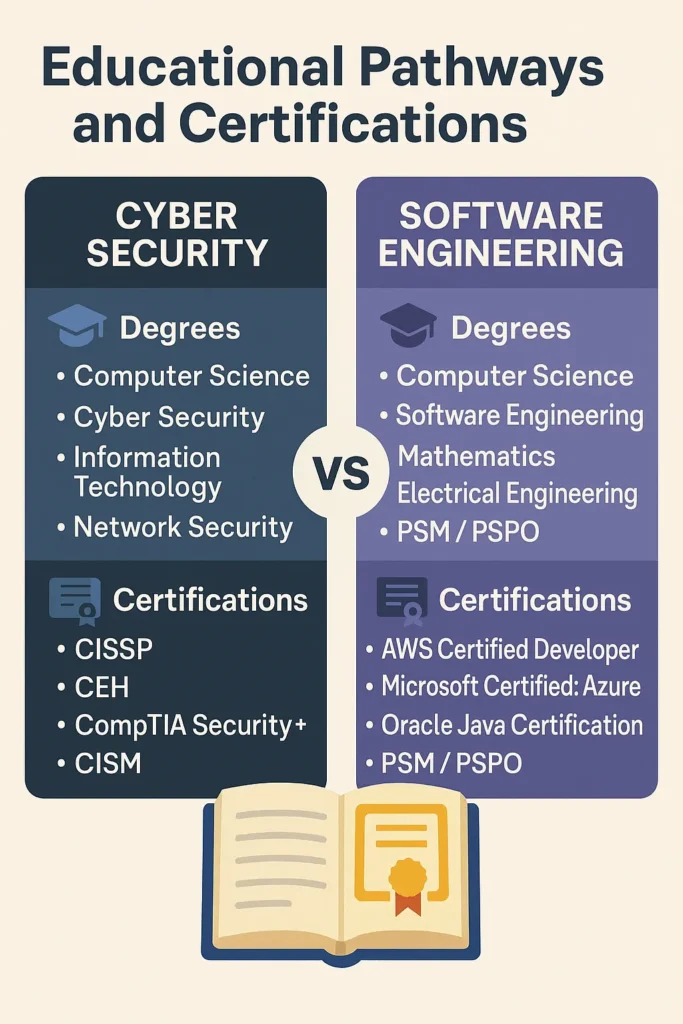
Whether you’re breaking into tech or leveling up in your career, the educational roadmaps for Cyber Security vs Software Engineering diverge in structure, depth, and philosophy.
While both fields reward hands-on experience, their academic pipelines, credential requirements, and certification ecosystems are uniquely tailored to their goals.
Read More On: Cybersecurity YouTube Channels: Top 10 You Must Follow [2025]
Cyber Security Education: From Self-Taught Hacker to Certified Defender
Cybersecurity attracts a wide spectrum of learners from autodidacts coming up through CTFs and bug bounty platforms to professionals with formal degrees and military backgrounds. It’s one of the few tech fields where real-world skills can rival formal education.
Academic Degrees:
Associate’s or Bachelor’s in Cyber Security, Information Assurance, or Computer Science
Focus on systems architecture, network security, and policy frameworks. Often includes labs or capstone projects.Master’s in Cybersecurity / Digital Forensics / Cyber Operations
Suitable for leadership roles or federal career tracks. Programs like those from NYU, Georgia Tech, and SANS Technology Institute stand out.
Certifications (SEO-heavy keywords for visibility):
CompTIA Security+ – A baseline cert that covers foundational concepts in risk, threat types, and cryptography.
Certified Ethical Hacker (CEH) – Focuses on penetration testing and tools used by offensive security professionals.
Certified Information Systems Security Professional (CISSP) – A gold-standard cert for security leadership and policy enforcement.
Offensive Security Certified Professional (OSCP) – Hardcore hands-on exam involving real-world exploitation and post-exploitation.
GIAC Certifications (GSEC, GCIH, GCIA, etc.) – Highly respected certs from SANS that target niche domains like incident response or malware analysis.
Alternative Learning Paths:
Capture The Flag (CTF) Challenges – Platforms like Hack The Box, TryHackMe, and OverTheWire sharpen offensive and defensive skills.
Bug Bounty Platforms – HackerOne, Bugcrowd, and Synack allow you to earn money and build a reputation by finding real-world vulnerabilities.
Bootcamps and Online Courses – Programs from Cybrary, INE, and Offensive Security provide practical, lab-heavy training.
Software Engineering Education: From Computer Science Degrees to Bootcamp Coders
Software engineering has a more traditional academic pedigree, but it’s also more open to alternative routes, especially if you can prove yourself through code. What matters most: can you build things that work and scale?
Read More On: Deep Search Engine: Explore Beyond Google
Academic Degrees:
Bachelor’s in Computer Science / Software Engineering
Covers data structures, operating systems, algorithms, compilers, and systems design. Still the most common entry point into top-tier engineering roles.Master’s in Computer Science / Data Science / AI
Often a requirement for research positions or roles involving heavy math (ML, NLP, cryptography).
Coding Bootcamps & Accelerated Programs:
General Assembly, Flatiron School, Hack Reactor, Lambda School – Full-time immersive programs that teach web development, DevOps, or data engineering in months, not years.
Best suited for frontend/backend devs, but with strong portfolios, grads can break into infrastructure or ML roles.
Certifications (Less essential, but increasingly valued):
AWS Certified Developer / Solutions Architect – Validate cloud application and infrastructure skills.
Microsoft Certified: Azure Developer Associate
Certified Kubernetes Application Developer (CKAD)
Google Associate Cloud Engineer
Alternative Learning Paths:
Open Source Contribution – Contributing to GitHub projects demonstrates collaboration, real-world impact, and technical skill.
Competitive Programming & Hackathons – Build algorithmic muscle and showcase rapid problem-solving skills.
Online CS Degrees (MOOCs) – CS50 (Harvard), MIT OpenCourseWare, and Georgia Tech’s OMSCS offer low-cost, high-impact learning.
Cyber Security vs Software Engineering: Learning Curve and Entry Points
Category | Cyber Security | Software Engineering |
Traditional Degree Needed? | Helpful, but not required | Often expected at top companies |
Certifications? | Crucial for credibility and hiring | Optional, but useful in niche areas (cloud, devops) |
Hands-On Experience? | Vital – labs, CTFs, real-world attacks | Essential – build projects, ship code |
Time to Job-Ready? | 6–12 months with intense focus | 6–18 months depending on specialization |
Best for Autodidacts? | Yes – especially offensive security | Yes, especially offensive security |
Salary Expectations and Job Market Trends

Cybersecurity and Software Engineering rank among the most in-demand and high-paying professions in the global tech economy.
However, their salary trajectories, hiring trends, and market pressures differ, driven by unique challenges, technological shifts, and organizational priorities. Here’s how these two powerhouses stack up worldwide.
Read More On : NotEvil Search Engine: How It Works and What You Can Find
Cyber Security Salaries: Pay for Protection in a High-Risk Landscape
Cybersecurity salaries reflect the escalating cost of digital threats. As ransomware, nation-state cyber ops, and insider threats multiply, organizations are investing heavily in skilled defenders and ethical hackers.
Global Average Salaries (Approximate, USD):
Entry-Level (0–2 years): $60,000 – $85,000/year
Mid-Level (3–6 years): $90,000 – $130,000/year
Senior-Level (7+ years): $140,000 – $200,000+/year
Top Roles (CISO, Cyber Threat Lead, Offensive Researcher): $200,000 – $400,000+/year
Top-Paying Countries:
United States, Switzerland, Germany, Singapore, and Australia
High-Demand Specialties:
Cloud security, threat intelligence, red teaming, security architecture, and compliance (GDPR, HIPAA, NIST)
Market Trends:
Cybersecurity job openings outnumber qualified professionals by millions globally.
Post-COVID remote work expansion has increased attack surfaces, creating more demand for endpoint and cloud security experts.
Governments and Fortune 500s are raising salaries to retain top talent amid aggressive poaching by Big Tech and defense contractors.
Software Engineering Salaries: Building the Code That Runs the World
Software engineers command premium salaries for building everything from mobile apps to distributed systems and AI models. Pay varies by stack, experience, and geography, but strong developers are rarely underpaid.
Global Average Salaries (Approximate, USD):
Entry-Level (0–2 years): $70,000 – $100,000/year
Mid-Level (3–6 years): $110,000 – $160,000/year
Senior-Level (7+ years): $150,000 – $250,000/year
Top Roles (Staff Engineer, Engineering Manager, CTO): $200,000 – $500,000+/year
Top-Paying Countries:
United States (particularly Silicon Valley, NYC, Seattle), Canada, Germany, the Netherlands, and Australia
High-Demand Stacks:
Cloud (AWS, GCP, Azure), full-stack JavaScript (React + Node), Rust, Go, Python for data science, and C++ for low-level performance
Market Trends:
Demand surges in AI/ML, DevOps, blockchain, and cybersecurity-adjacent roles (e.g., secure code engineers).
Open-source contributions, bootcamps, and remote-first jobs are leveling the playing field globally.
Engineers with AI experience (e.g., LLMs, transformers, RLHF) are commanding premium compensation across sectors.
Cyber Security vs Software Engineering: A Salary and Market Comparison
Metric | Cyber Security | Software Engineering |
Entry-Level Salary | $60k – $85k/year | $70k – $100k/year |
Mid-Level Salary | $90k – $130k/year | $110k – $160k/year |
Senior-Level Salary | $140k – $200k+/year | $150k – $250k+/year |
Leadership Salary | $200k – $400k+/year (CISO, Architect) | $200k – $500k+/year (CTO, Staff Engineer) |
Remote Work Availability | High, but limited by clearance in some roles | Extremely high, especially for devs and SREs |
Job Market Growth (Global) | 10x open roles to qualified candidates | Stable growth with high competition in top firms |
The Verdict: Salary Power and Career Velocity
Both careers offer high-income potential and future-proof trajectories. The key differences:
Cybersecurity pays for trust and readiness. If you’re defending banks, governments, or infrastructure, salaries rise with specialization and clearance.
Software Engineering pays for innovation and scale. If you can build fast, reliable systems or work in bleeding-edge AI, you’ll rarely hit a ceiling.
Want to maximize salary potential? Combine both domains. A software engineer who understands security is invaluable. A cybersecurity expert who can write secure code is unstoppable.
Read More On: How Long Does It Take to Learn Cybersecurity with No Experience?
Work Environment and Lifestyle Considerations
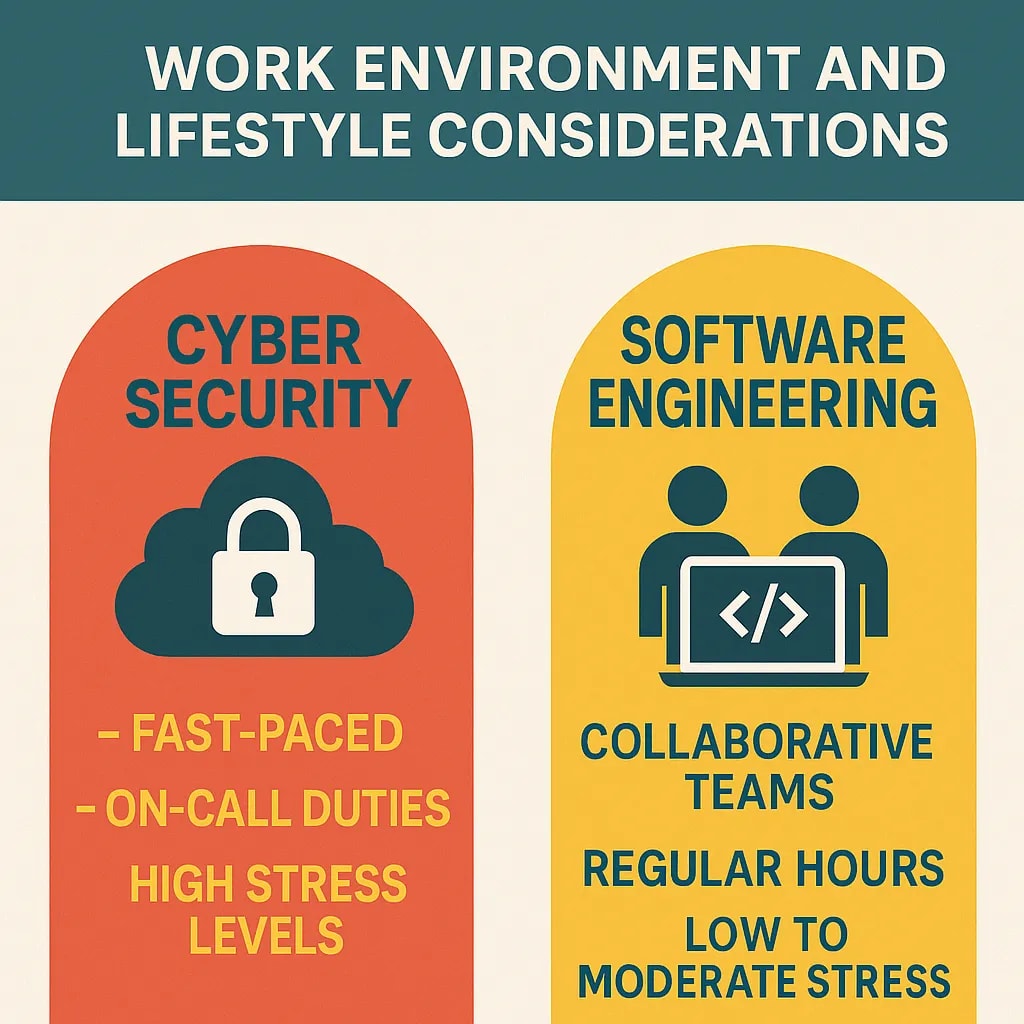
Beyond the technical specs and salary charts, there’s the human cost of your chosen path. Where will you work? How will it affect your time, autonomy, and mental bandwidth?
When comparing Cyber Security vs Software Engineering, the work environment and lifestyle implications are just as critical as skills or pay.
Read More On: Cybersecurity vs Web Development: Which Is Better?
Cyber Security: High Stakes, High Pressure, High Vigilance
Cybersecurity professionals often operate in mission-critical environments where downtime equals disaster. The role demands continuous alertness and, in some cases, an “always-on” mindset. It’s reactive, adversarial, and often intense.
Work Settings:
Security Operations Centers (SOCs): High-tech war rooms where alerts stream in 24/7.
Consulting Firms: Rapid engagements, travel-heavy schedules, and shifting client needs.
In-House Security Teams: Steady work, but with occasional fire drills during breach events.
Lifestyle Traits:
On-Call Stress: Incident response can mean late nights, weekends, or sudden calls during dinner.
Information Overload: New CVEs, exploits, and APT techniques emerge constantly.
Clearance and Surveillance: Government or defense work may restrict privacy and require background checks.
Ethical Weight: Dealing with breach data, surveillance systems, or red teaming for military clients carries ethical weight.
Remote Work Viability:
Increasingly viable, especially in advisory and cloud security roles, but still limited by security clearance or access to sensitive infrastructure.
Software Engineering: Flexible, Focused, and Deep Work Friendly
Software engineers enjoy a broad spectrum of work environments from scrappy startups to megacorp R&D divisions. The culture tends to value deep focus, clean code, and iteration over firefighting.
Read More On: Clearnet vs Darknet: Key Differences Explained
Work Settings:
Product Teams: Feature-building with designers and PMs. Iterative, Agile-based sprints.
Engineering-Oriented Orgs: High code quality standards, strong mentorship, and technical leadership.
Freelance & Open Source: Total freedom to choose your hours, tools, and contributions.
Lifestyle Traits:
Autonomy & Deep Work: Engineers often have focused hours with fewer reactive interruptions.
Flexible Schedules: Many companies offer asynchronous work, especially for remote devs.
Creative Satisfaction: Seeing your product come to life, scaled, or used globally is a rare dopamine hit.
Burnout Risk: Long hours, tech debt, or toxic management can burn devs out, especially in high-growth startups.
Remote Work Viability:
Exceptionally high. Many roles are now remote-first or remote-only, with global teams and asynchronous workflows becoming the norm.
Cyber Security vs Software Engineering: Lifestyle Comparison Table
Factor | Cyber Security | Software Engineering |
Work Hours | Can be unpredictable (especially during breaches) | Generally consistent; depends on company culture |
On-Call Duties | Common, especially in SOC or IR roles | Less common, unless in DevOps or SRE roles |
Remote Work | Possible, but limited by clearance/data rules | Extremely common and supported globally |
Travel Requirements | High in consulting and auditing roles | Low to moderate; mostly optional |
Stress Levels | High developers often choose tools and architectures | Moderate; varies with workload and company size |
Creative Freedom | Limited by compliance and risk posture | High; developers often choose tools and architectures |
Community Culture | Tighter-knit, high-trust, often ethical-hacker vibe | Open, diverse, and strongly collaborative |
The Real Question: What Kind of Pressure Do You Thrive Under?
If you excel in high-stress, high-urgency environments where every second counts, and you’re driven by securing the digital world, cybersecurity will feel like a calling.
If you prefer structured problem-solving, focused work, and the satisfaction of building from scratch, software engineering will be your playground.
Work isn’t just what you do, it’s how you live while doing it. Pick the path that doesn’t just pay, but also fits your lifestyle.
Read More On: How Do Macros Pose A Cybersecurity Risk?
Challenges and Rewards

Every career comes with trade-offs. When comparing Cyber Security vs Software Engineering, it’s critical to examine not just what you gain but what you endure. Both fields offer high impact and high compensation, but the pressures, pitfalls, and payoffs are vastly different.
Cyber Security: The Defender’s Dilemma
Cybersecurity professionals operate in a world where perfection is expected and failure is public. The stakes are high: a single misconfigured firewall or unpatched system can lead to data breaches, financial loss, or geopolitical fallout.
Challenges:
Constantly Evolving Threats: Attackers innovate faster than most defenders can adapt. Staying current means non-stop learning.
Incident Burnout: Breach response is intense. IR teams face long hours, unpredictable schedules, and high-stakes decisions.
Tool Sprawl: Many orgs deploy dozens of overlapping tools with poor integration, creating alert fatigue and workflow chaos.
Compliance Overload: Navigating frameworks like NIST, PCI-DSS, and GDPR can overshadow proactive security work.
Cultural Friction: Security is often seen as a blocker to dev teams. Pushing back on insecure deployments can create political tension.
Rewards:
Clear Purpose: You’re protecting real people, systems, and data. The work matters, and the impact is tangible.
Adversarial Mindset: It’s intellectually stimulating. You think like an attacker, reverse-engineer exploits, and harden systems.
Diverse Career Paths: You can specialize in forensics, cloud security, red teaming, or threat intel and pivot between technical and strategic roles.
Job Security: With talent shortages and increasing threats, skilled defenders are always in demand.
Software Engineering: The Creator’s Paradox
Software engineers are builders tasked with turning abstract problems into scalable, elegant systems. But creation comes at a cost: long hours, shifting requirements, and technical debt can be just as brutal as zero-day threats.
Challenges:
Complexity Creep: As systems grow, maintaining clean, modular code gets exponentially harder. Refactoring is constant.
Rapid Obsolescence: Languages, frameworks, and stacks evolve fast. Staying relevant means learning nonstop.
Unclear Requirements: Engineering is often hindered by vague product specs or changing priorities, leading to rework and burnout.
Pressure to Deliver: Tight sprint cycles and feature deadlines can compromise testing, documentation, and stability.
Scaling Pain: Building a system is easy. Scaling it to millions of users while maintaining uptime? Brutal.
Rewards:
Creative Control: You get to build things from scratch, whether it’s a web app, an API, or a machine learning pipeline.
Visible Impact: Your code runs businesses, powers devices, or supports millions of users. The feedback loop is real.
Deep Specialization: From graphics and game dev to ML and infrastructure, engineers can dive deep and master specific domains.
Global Mobility: Code is universal. With the rise of remote-first teams, skilled engineers can work from anywhere.
Cyber Security vs Software Engineering: Challenge & Reward Matrix
Aspect | Cyber Security | Software Engineering |
Learning Curve | Highly rapid threat evolution, heavy compliance layer | Highly fast-changing tech stacks and frameworks |
Workload Stress | High rapid threat evolution, heavy compliance layer | Moderate to high – delivery pressure and technical debt |
Intellectual Rigor | Very High – red teaming, cryptography, forensics | Very High – algorithmic design, architecture, performance |
Creative Freedom | Moderate – often constrained by security policy | High–stopping breaches, saving reputations |
Tangible Impact | Low success is silence (no breach) | High – building real products used globally |
Recognition | High–incident response, adversarial pressure | Higher – visible features, products, and shipped code |
Job Security | Extremely High – talent shortage, global demand | Very High – universal need for software across industries |
The Payoff: Security Through Impact, Engineering Through Innovation
Cybersecurity offers mission-driven work, intellectual depth, and long-term job stability, but it demands sharp reflexes, mental stamina, and a thick skin.
Software Engineering rewards creativity, precision, and innovation, but the price is constant learning, tight deadlines, and technical sprawl.
Ultimately, the right path depends on what you value more: protecting systems from chaos or building the systems themselves.
Read More On: How to block radiation from wifi router?
Making the Choice: Which Path Aligns with You?
Choosing between Cyber Security vs Software Engineering comes down to mindset, motivation, and method. This isn’t about what’s “better,” it’s about what fits you.
Ask yourself:
Do you thrive under pressure, enjoy unraveling adversarial puzzles, and want to protect systems from digital chaos?
→ You’re wired for Cyber Security.Do you love building, solving logical challenges, and creating scalable systems from scratch?
→ You’re built for Software Engineering.
Here’s a quick alignment matrix:
Personal Trait | Best Fit |
Adrenaline in high-stakes ops | Cyber Security |
Obsession with clean design | Software Engineering |
Enjoys breaking systems | Cyber Security |
Enjoys building abstractions | Software Engineering |
Passion for ethics/privacy | Cyber Security |
Passion for innovation/UX | Software Engineering |
Neither path is easy. Both demand rigor, lifelong learning, and discipline. But the fulfillment comes from choosing a role that channels your instincts and drives your purpose.
Final Thoughts
The digital world is expanding, and its foundations need both architects and defenders. Cyber Security vs Software Engineering isn’t just a career debate, it’s a question of how you want to shape the future:
Do you fortify systems to resist entropy and exploitation?
Or do you engineer new realities, shipping features that move markets?
Whatever you choose, dive deep. Master your stack. Think critically. Build with intent. Break with ethics. And never trust hype over hands-on proof.
In tech, the curious and committed win. Every time.
Frequently Asked Questions
Which field is better for remote work?
Software engineering leads in remote flexibility. Cybersecurity is catching up, but roles involving sensitive data may require on-site work.
Can I switch between cyber security and software engineering?
Yes. Skills like scripting, system architecture, and cloud infrastructure overlap. Many professionals pivot between the two as their interests evolve.
Is cybersecurity a secure career path?
Definitely. With growing demand and a shortage of skilled professionals, cybersecurity offers long-term stability and consistently strong compensation.
Should you focus on coding or cybersecurity?
If career growth is your priority, cybersecurity typically offers faster advancement due to a global talent shortage and escalating threats. Coding can be highly profitable, but climbing the ladder may require more time and differentiation in a crowded field.
Do I need a degree to work in either field?
Not necessarily. Certifications, portfolios, and hands-on experience often carry more weight, especially in cybersecurity and modern dev roles.