Cybersecurity vs Web Development: Which Is Better?
Cybersecurity vs Web Development: Which Career Is Better?
Cybersecurity vs web development compares two high-demand tech fields cybersecurity protects digital systems from attacks, while web development builds websites and applications.
Cybersecurity vs Web Development: Which Career Actually Wins in 2026?
Let’s cut through the hype. Cybersecurity vs web development isn’t just a career choice; it’s a clash of two digital ideologies.
One protects, the other creates. One thrives on paranoia, the other on precision. But which one pays off more? Which one won’t be replaced by AI?
And which one will still matter five years from now? This guide breaks it all down: salaries, skills, job security, and the hidden tradeoffs they don’t tell you about.
Cyber Security vs Web Development: Quick Comparison
| Factor | Cybersecurity | Web Development |
|---|---|---|
| Main Focus | Protect systems, networks, and data | Build websites and applications |
| Best For | Analytical thinkers, problem-solvers | Creative builders, designers |
| Learning Curve | Steeper | Easier to start |
| Entry Barrier | Medium to high | Low to medium |
| Salary Potential | Higher on average | High but varies widely |
| Freelance Opportunities | Limited | Very high |
| Stress Level | Higher (critical systems) | Moderate |
| Job Demand | Very strong (growing fast) | Strong but competitive |
Cyber Security vs Web Development: Which Is Better?
If you’re trying to decide between cybersecurity and web development, the better option depends on your goals.
Cybersecurity is better if you want higher long-term salaries, strong job security, and a career focused on protecting systems and data. It’s ideal if you enjoy problem-solving, investigating threats, and working in high-stakes environments.
Web development is better if you want a faster entry into tech, more flexibility, and the ability to freelance or build your own products. It’s a great choice if you enjoy creating websites, apps, and user experiences.
There’s no one-size-fits-all answer. If your priority is stability and security, go with cybersecurity. If you want freedom and creativity, web development is the better choice.
Learn how to improve organic visibility and generate qualified leads with our cyber security SEO guide.
Cyber Security vs Web Development: Key Differences
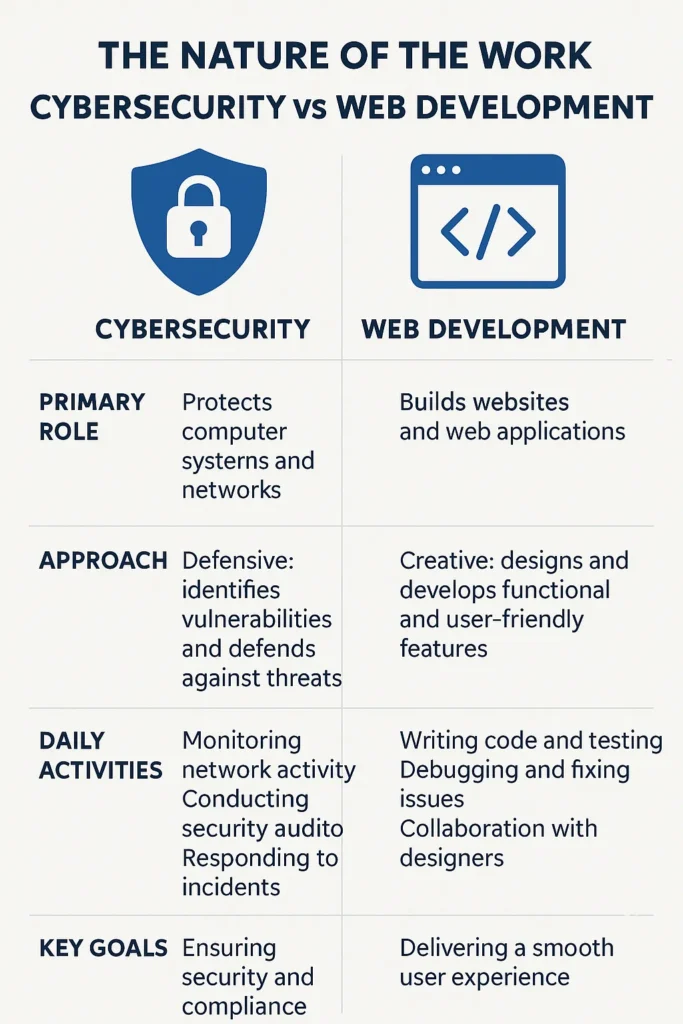
When you strip away the job titles, cybersecurity and web development reflect two fundamentally different mindsets and daily realities.
Use Our Cybersecurity Risk Calculator
Web Development: The Builder’s Mindset
Web developers are creators. Their job is to design, develop, and maintain websites and web applications. They work with front-end languages like HTML, CSS, and JavaScript, and back-end tech like Node.js, Python, or PHP. A typical day might include:
- Writing and testing code
- Collaborating with designers or product teams
- Deploying new features
- Fixing bugs or optimizing performance
- Ensuring cross-browser compatibility
It’s a structured, iterative process. You’re building something users will directly interact with. Success is measured in usability, performance, and visual appeal. For some, it’s deeply satisfying to craft functional beauty out of raw logic.
Read More On: Top 10 SIEM Use Cases for 5G Security
Cybersecurity: The Breaker’s Mindset
Cybersecurity professionals live on the edge of chaos. Their mission is to identify vulnerabilities, detect intrusions, and protect digital infrastructure from attackers. They think like adversaries. A day in the life could involve:
- Monitoring network traffic for suspicious activity
- Running penetration tests or red team ops
- Analyzing logs and threat intelligence
- Responding to active incidents or breaches
- Hardening systems against exploits
Unlike devs, cybersecurity isn’t about creating; it’s about defending. And it’s not always clean. You’re often working under pressure, dealing with legacy systems, zero-days, or careless users.
Read More On: How can you prevent viruses and malicious code?
The stakes are high, and the wins aren’t always visible to end users, but when systems don’t get hacked, that’s your invisible success.
Builder vs Breaker: The Philosophical Divide
- Web developers build functionality and features. They create digital experiences and focus on usability.
- Cybersecurity experts break, test, and secure those systems. They look for what can go wrong and how to stop it.
Both roles require technical skill and creativity, but one is driven by innovation, the other by defense. One sees possibilities; the other sees threats.
Read More On: Is Cybersecurity Oversaturated? Career Guide Inside
So ask yourself:
Do you want to build the digital world or protect it from burning down?
| Trait/Preference | You Might Prefer Cybersecurity | You Might Prefer Web Development |
| Curiosity style | “How can this be exploited?” | “How can this be improved?” |
| Thinking style | Adversarial, analytical, risk-focused | Creative, logical, user-focused |
| Tolerance for pressure | High – thrives in high-stakes situations | Moderate – prefers structured challenges |
| Interest in aesthetics | Low – function over form | High – loves clean UI/UX design |
| Tools you enjoy | Kali Linux, Wireshark, Metasploit | VS Code, React, Figma |
| Typical work style | Reactive, unpredictable | Project-based, more predictable |
| Problem-solving mindset | “What’s the weakest link?” | “What’s the best solution?” |
| Career goal | Securing systems, fighting cybercrime | Building apps, creating user experiences |
| Enjoys testing limits | Yes – ethical hacking, stress-testing systems | Sometimes – mostly for performance or UX |
| Collaboration style | Often works solo or in small, focused teams | Frequently collaborates with multiple teams |
Cybersecurity vs Web Development: Skills and Learning Curve
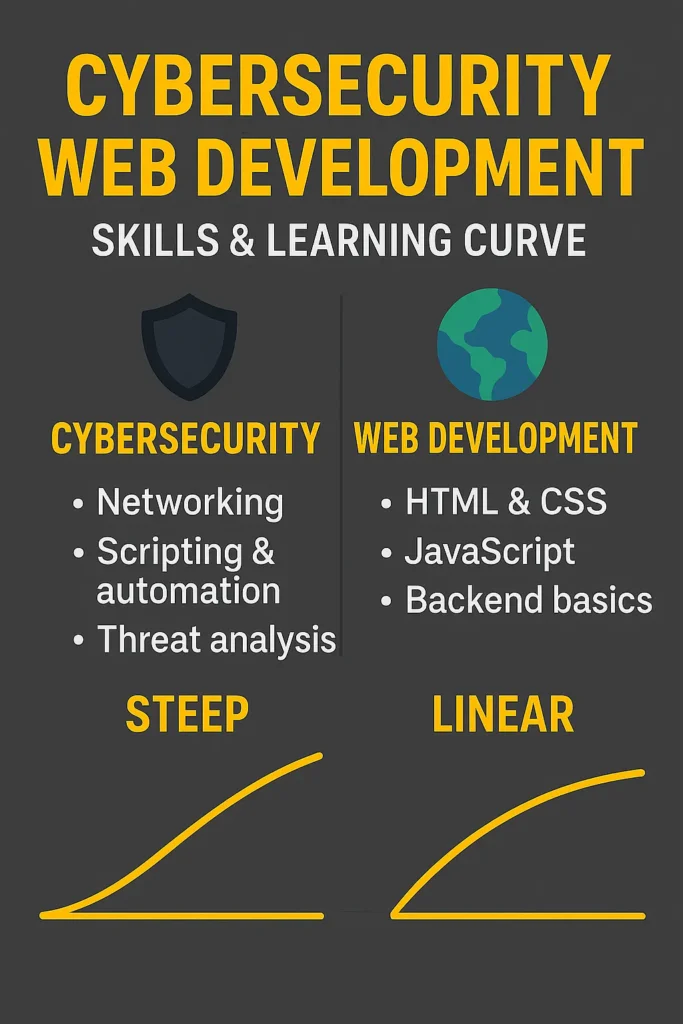
Web Development: The Structured Sprint
If you’re entering web development, the skills come in neat little boxes. You learn the core triad HTML, CSS, JavaScript and start stacking frameworks like LEGO bricks: React, Vue, Node.js, Tailwind, Next.js, etc.
The community is massive, tutorials are everywhere, and Stack Overflow becomes your best friend.
You build fast. You see results. A portfolio of polished UIs and working apps speaks louder than a résumé.
Want to freelance? Spin up a Shopify store or Webflow clone. Want a job? Show you can deploy to Vercel and talk clean code.
But here’s the catch: it’s a treadmill. Frameworks get deprecated, JavaScript fatigue is real, and there’s always another “must-know” tool. The curve is shallow at the start, but sustaining relevance is a marathon.
Read More On: Cybersecurity YouTube Channels: Top 10 You Must Follow [2025]
Core Web Dev Skills:
- Semantic HTML & CSS, responsive design
- JavaScript (ES6+), TypeScript
- Frameworks (React, Angular, Vue)
- Backend basics (Node.js, Express, REST, GraphQL)
- Git, CI/CD, deployment platforms (Netlify, Vercel)
- Basic security hygiene (input validation, auth, HTTPS)
Cybersecurity: The Infinite Climb
Cybersecurity doesn’t hand you a manual; it hands you chaos. To get good, you have to understand how computers work: how memory is allocated, how packets move, how firewalls think, and how humans mess up every system they touch.
The skill tree is wide and tangled. There’s offensive (pentesting, red teaming), defensive (blue teaming, SIEM, threat detection), forensic (incident response), and governance (GRC, compliance).
Want to go deep? Learn assembly. Reverse engineer malware. Write your tools in Python or C. Want to go wide? Master the kill chain, social engineering, and exploit chains.
Read More On: Candle Search Engine: Lightning Fast Private Search
There’s no endpoint, just layers. Every skill opens a new attack surface.
Core Cybersecurity Skills:
- Networking (TCP/IP, DNS, routing, VPNs)
- Operating systems (Linux internals, Windows logs, system calls)
- Scripting & automation (Python, Bash, PowerShell)
- Threat analysis, malware behavior, MITRE ATT&CK framework
- Penetration testing (Metasploit, Burp Suite, Nmap, Wireshark)
- Cryptography basics and implementation flaws
- Security certifications (OSCP, CEH, CISSP) are not always essential, but often expected
Comparative Pain Points
| Topic | Web Dev | Cybersecurity |
| Entry Point | Beginner-friendly, visual feedback | Steep; requires system-level understanding |
| Tools | Modern, well-documented, UX-first | Fragmented, CLI-heavy, often arcane |
| Progress Tracking | Clear project-based milestones | Murky; labs, CTFs, certs, case studies |
| Time to Proficiency | Months | Years |
| Pace of Change | Fast (framework churn) | Constant (threat evolution) |
Web Development in Cybersecurity: Why It Matters
Web development and cybersecurity are more connected than most people think.
Modern cybersecurity relies heavily on understanding how web applications work. Many attacks target websites, APIs, and web-based systems.
If you’re a web developer, learning cybersecurity helps you:
- Write secure code
- Prevent common vulnerabilities like SQL injection and XSS
- Build safer authentication systems
- Understand OWASP Top 10 risks
If you’re in cybersecurity, understanding web development helps you:
- Identify vulnerabilities faster
- Perform penetration testing
- Analyze real-world attack scenarios
The strongest professionals today combine both skills. A web developer with security knowledge is far more valuable than one without it.
Web Development vs Cyber Security Salary and Job Demand
When choosing a career, two things matter more than hype: job availability and earning potential.
Both cybersecurity and web development offer solid opportunities, but the paths diverge when you dig into hiring trends, salary brackets, global demand, and economic resilience.
Read More On: Incognito vs VPN: Which Protects Your Privacy Better?
Job Demand: Who’s Hiring More in 2026?
Cybersecurity has witnessed a dramatic surge in demand post-2020, with the rise of remote work, cloud migration, ransomware-as-a-service, and data privacy regulations. According to
Cybersecurity Ventures, there will be 3.5 million unfilled cybersecurity roles globally in 2025. Enterprises, governments, and startups alike are hunting for security talent to guard digital assets, ensure compliance, and respond to incidents.
In contrast, web development remains a foundational skill for the internet. Every business, from bakeries to billion-dollar SaaS firms, needs a fast, functional, and mobile-friendly website.
However, demand has become more competitive due to the rise of no-code platforms, AI-based website builders, and global freelancing marketplaces.
Front-end and full-stack developers are still in high demand, but junior roles face saturation unless paired with strong portfolios or specialization (e.g., Web3, React, UX-focused design).
Read More On: The Role of ZTNA and VPN in Modern Cybersecurity Strategies
Role Types and Career Pathways
- Cybersecurity Careers: SOC Analyst, Threat Hunter, Security Engineer, Governance Risk & Compliance (GRC) Specialist, Penetration Tester, Cloud Security Architect, CISO.
- Web Development Careers: Front-end Developer, Back-end Developer, Full-Stack Engineer, WordPress Developer, UI/UX Engineer, DevOps-integrated roles, Tech Leads.
Cybersecurity roles often follow a corporate ladder, with certifications (like CISSP, CEH, or CompTIA Security+) playing a key role in advancement. Web developers can pursue agency jobs, freelance gigs, product development, or even entrepreneurship (e.g., launching apps or SaaS tools).
Read More On: Clearnet vs Darknet: Key Differences Explained
Web Development vs Cyber Security salary
Let’s talk money.
| Role Level | Cybersecurity (Avg Global Salary) | Web Development (Avg Global Salary) |
| Entry-Level | $55,000 – $75,000 | $45,000 – $65,000 |
| Mid-Level | $85,000 – $110,000 | $70,000 – $95,000 |
| Senior/Lead | $120,000 – $180,000+ | $100,000 – $160,000+ |
| Freelance | $40–$150/hour | $25–$100/hour |
Cybersecurity professionals generally earn more, especially in compliance-heavy or high-risk industries like finance, healthcare, and critical infrastructure. Their work has a direct legal and reputational impact, which boosts salary negotiations.
Read More On: Deep Search Engine: Explore Beyond Google
Web developers, however, have uncapped potential through freelance projects, SaaS ventures, or working with global clients. A senior developer who builds and scales products or joins early-stage startups can out-earn traditional employees quickly.
Regional Trends and Remote Work
- U.S. & Europe: Cybersecurity salaries are higher due to strict data regulations and a shortage of skilled workers. Web dev roles remain strong, especially for React, Node.js, and Next.js developers.
- India & Southeast Asia: Web development offers more gig-based and agency roles, but cybersecurity is catching up, especially in cloud and GRC positions.
- UAE & Middle East: Cybersecurity is a national priority, especially for government, finance, and telecom sectors. Skilled security professionals are in high demand and often get relocation benefits.
- Remote Work: Both fields offer remote potential, but web development is slightly more freelance-friendly. Cybersecurity, especially in threat detection or compliance, often requires secure environments or on-site access.
Job Stability During Recession or AI Disruption
- Cybersecurity is considered recession-proof and AI-resistant. Security threats evolve as fast as defenses, and companies cannot afford to be breached.
- Web Development, especially at the basic front-end level, is increasingly vulnerable to automation. AI tools can now generate functional web pages with minimal human input, but skilled developers who understand UX, performance optimization, and integrations are still very much needed.
Final Verdict on Jobs & Paychecks
If your goal is long-term stability, higher pay, and impact cybersecurity offers the edge. But if you value creativity, freelancing, and rapid prototyping, web development gives you flexibility and a faster start.
Still not sure? Consider where you see yourself thriving: Do you want to defend systems from attackers, or build digital experiences from scratch?
Read More On: How to block radiation from wifi router?
Risk, Burnout, and Mental Load
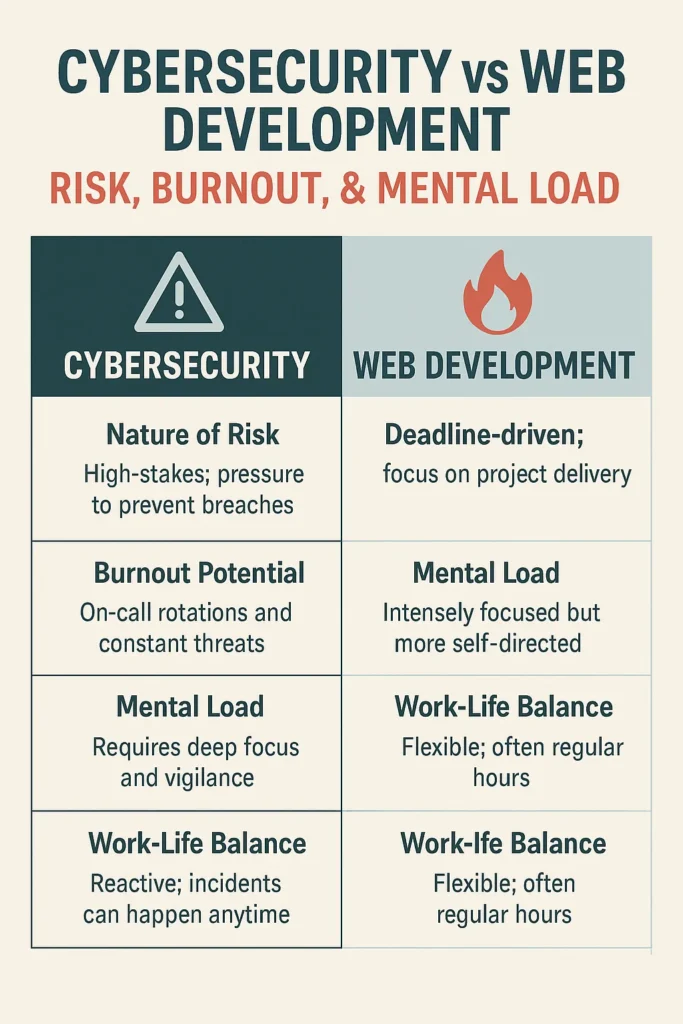
Every career has its pressure points, but cybersecurity and web development come with very different mental and emotional tolls. In this section, we’ll explore the kinds of stress each field brings, what causes burnout, and how much cognitive load professionals in each space typically manage.
Read More On: Does Cybersecurity Require Coding?
The Nature of Risk
Cybersecurity is a high-stakes environment. One missed alert, one misconfigured firewall, or one unpatched vulnerability can lead to catastrophic breaches.
Professionals in this field often work under constant threat pressure, with the awareness that adversaries are always trying to break in. Roles in incident response, threat hunting, or red teaming can feel like digital warfare, fast-paced, high-pressure, and mission-critical.
Web development, by contrast, has a different kind of risk. Most projects are deadline-driven, with expectations from clients or marketing teams to ship fast, iterate faster, and meet design standards.
The risks usually involve technical debt, website failures, performance issues, or customer dissatisfaction, not legal liabilities or multi-million-dollar data leaks. While still stressful, the consequences of mistakes are usually lower in severity.
Burnout Potential
Cybersecurity burnout is real and rising. Studies by ISACA and (ISC)² show high burnout rates among cybersecurity professionals, especially in SOC teams and blue-team roles. Contributing factors include:
- On-call rotations and incident response at odd hours
- Lack of resources or staffing
- Constant exposure to worst-case scenarios
- Pressure to meet compliance and audit requirements
Web developers, especially freelancers or agency employees, often burn out due to:
- Endless revisions and scope creep
- Unrealistic client demands or changing specs
- Long coding hours without proper breaks
- Pressure to keep up with ever-evolving tools and frameworks (e.g., “JavaScript fatigue”)
In both careers, burnout often stems not from the work itself but from poor team structure, toxic management, or unmanageable expectations.
Mental Load & Decision Fatigue
- Cybersecurity roles demand constant vigilance, fast threat triage, and deep focus. You’re juggling logs, alerts, threat intelligence feeds, SIEM dashboards, and evolving adversary tactics all at once. The cognitive load is high, and mistakes can be unforgiving.
- Web development also requires intense focus, but in different ways. Developers must plan architecture, debug code, manage front-end/backend dependencies, ensure browser compatibility, and handle integrations. However, the pace is often more self-directed, and the consequences of failure are typically less severe.
Work-Life Balance
- Cybersecurity can be reactive and unpredictable. Incidents don’t respect weekends or holidays. Some roles (especially in government, finance, or critical infrastructure) demand 24/7 availability or high-pressure war room scenarios.
- Web development usually allows for better planning and flexibility, especially in freelance or remote setups. Sprints and deadlines exist, but the work can often be paused and resumed.
Verdict: Which Career Is Mentally Healthier?
If you thrive in high-pressure, mission-driven environments and enjoy solving security puzzles with real-world consequences, cybersecurity may energize you but prepare for high mental load.
If you prefer structured creativity, clear project scopes, and a more flexible pace of work, web development may offer a healthier long-term balance, especially if you set boundaries with clients or teams.
Read More On: Cyber Security vs Software Engineering: Code or Defend?
Web Development vs Cyber Security Demand in 2026
When thinking long-term, choosing a career isn’t just about current salaries or short-term demand; it’s about adaptability, automation resistance, and relevance in a world dominated by AI, cloud, and evolving business models.
This section delivers a timeline of change, real job market statistics, and future projections to help you understand which field cybersecurity or web development, stands the test of time.
Timeline of Industry Shifts (2015–2030)
| Year | Cybersecurity Milestone | Web Development Milestone |
| 2015 | First big wave of ransomware (CryptoLocker) | React.js becomes dominant front-end framework |
| 2017 | WannaCry hits 200,000+ systems globally | Surge in demand for responsive design skills |
| 2019 | Cloud security demand surges with Azure & AWS adoption | JAMstack & static site generators gain traction |
| 2023 | Rise of AI-based security (ML threat detection, anomaly hunting) | AI site builders like Wix ADI & Framer disrupt beginner dev work |
| 2025 | CISOs become essential in boardrooms | Most basic frontend tasks now assisted by AI tools |
| 2030* | 3.5 million+ cybersecurity roles remain unfilled globally | Only advanced web developers (UX, motion design, product-minded) stay in high demand |
*Forecasts based on data from Cybersecurity Ventures, GitHub Trends, and Gartner
Cybersecurity: Built for Uncertainty
Cybersecurity is resilient by nature. As technology expands, so do attack surfaces and so does the need to secure them.
Real-World Data:
- 3.5 million global cybersecurity jobs unfilled by 2025 (Cybersecurity Ventures)
- 32% job growth projected from 2022–2032 in the U.S. alone (U.S. BLS)
- Global market size expected to reach $538 billion by 2030 (Fortune Business Insights)
Key Reasons It’s Future-Proof:
- Human adversaries evolve faster than software.
- Regulatory environments (GDPR, HIPAA, NIS2, DPDPA) demand continual security oversight.
- AI augments security work but can’t fully replace analyst judgment or breach response.
Web Development: A Field Under Reinvention
Web development is not dying, but it’s undergoing a massive transformation.
Real-World Data:
- 60% of dev teams now use AI-assisted coding tools (GitHub Copilot Report, 2024)
- No-code platforms have replaced junior web devs in 34% of surveyed startups (2023, Bubble & Webflow UX Report)
- Front-end roles show slower YoY growth compared to DevOps and ML-based engineering (Stack Overflow Developer Survey, 2024)
Key Risks to Future Viability:
- Most basic tasks (forms, layout, SEO tweaks) can now be handled by AI or templates.
- Web is becoming less about “coding pixels” and more about integrating ecosystems (APIs, AI agents, edge functions, etc.)
Automation & AI Disruption Scorecard (2025 Projection)
| Factor | Cybersecurity | Web Development |
| Risk of AI Replacement | Low | Moderate to High |
| Value of Human Judgment | Very High | Medium |
| Long-Term Demand Forecast | Strong Growth | Specialized Only |
| Need for Compliance Expertise | Essential | Low |
| Freelance-Friendly | Moderate | Very High |
Strategic Advice for the Next Decade
- If you want a stable, policy-driven, and evergreen career, cybersecurity is the better bet. It aligns with government needs, enterprise risk posture, and evolving compliance frameworks.
- If you’re pursuing web development, don’t stay basic. Invest in user experience, performance optimization, animation, low-code automation, or even product development. These higher-order skills will stay valuable even if HTML/CSS is commoditized.
Ethics and Impact: Who’s Shaping the Web?
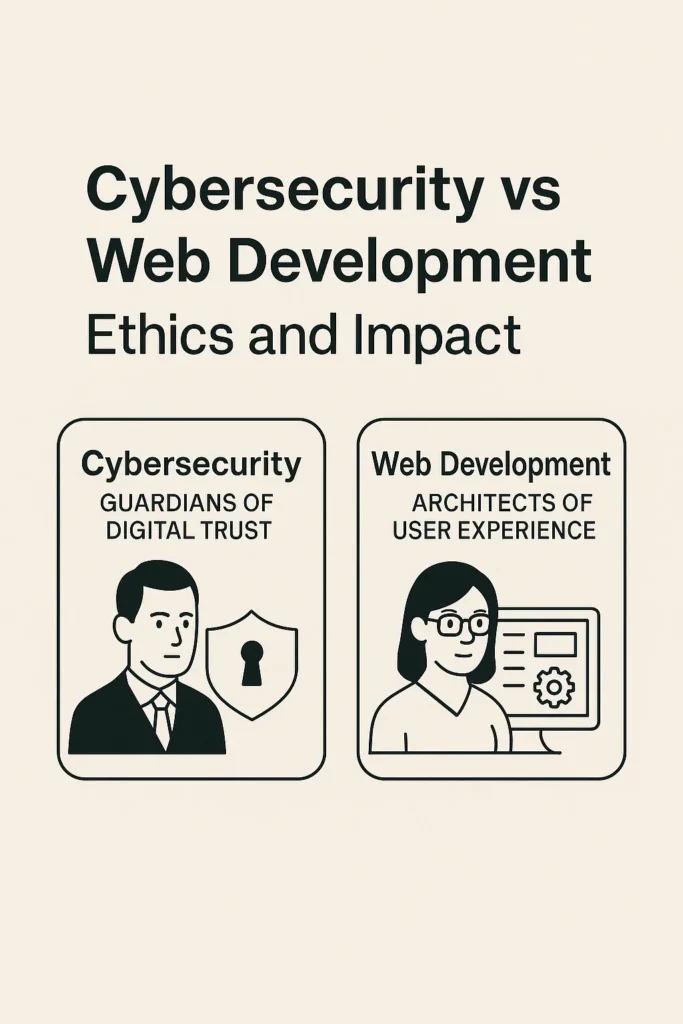
Technology doesn’t just shape systems it shapes society. From online privacy to digital accessibility, from misinformation to national security, the ethical implications of your tech career are profound.
In this section, we’ll break down how cybersecurity and web development influence the digital world not just through technical skills, but through moral responsibility, social impact, and regulatory influence.
Read More On: What Is CSAM in Cybersecurity? Everything You Need to Know
Cybersecurity: Guardians of Digital Trust
Cybersecurity professionals aren’t just fighting malware; they’re defending human rights, freedom of information, and critical infrastructure. The ethical weight of the job is significant.
Ethical Responsibilities:
- Protecting personal and sensitive data from misuse
- Preventing cybercrimes (identity theft, financial fraud, espionage)
- Ensuring the uptime and safety of life-critical systems (hospitals, transportation, utilities)
- Navigating ethical grey areas like surveillance vs privacy and offensive security vs defense
Real-World Impact:
- In 2023, over 422 million individuals were affected by data breaches globally (Risk Based Security).
- Cyberattacks on hospitals during COVID-19 put lives at risk, prompting global outcry and UN discussions on cyber ethics.
- Governments now enforce security-by-design laws (e.g., the EU’s CRA & India’s DPDP Act) to hold engineers legally accountable.
Bottom line: Cybersecurity isn’t just technical it’s geopolitical, social, and increasingly moral. One bad policy or blind spot can affect millions.
Web Development: Architects of the User Experience
Web developers are often seen as “builders,” but their ethical role is just as critical. They determine how people interact with technology, who gets included, and what experiences shape digital behavior.
Ethical Responsibilities:
- Designing accessible websites for users with disabilities (WCAG compliance)
- Avoiding manipulative design (dark patterns, deceptive popups)
- Building equitable interfaces across devices, languages, and regions
- Ensuring inclusive design that doesn’t exclude underserved communities
Real-World Impact:
- 98.1% of home pages fail basic accessibility tests (WebAIM Million Report, 2024)
- Only 2 in 10 sites meet global standards for screen readers or mobile-first UX (Google Dev Survey, 2023)
- Web devs can also inadvertently amplify misinformation via poor content architecture or unchecked user-generated content.
Bottom line: Web developers shape the user journey but also risk creating barriers, biases, and behavioral nudges if ethics aren’t considered.
Comparison: Ethical Weight and Influence
| Aspect | Cybersecurity | Web Development |
| Primary Ethical Concern | Data privacy, system trust, national security | Accessibility, inclusion, UX manipulation |
| Risk of Harm from Negligence | Very High (breaches, attacks) | Medium (exclusion, confusion, dark UX) |
| Regulatory Scrutiny | High (GDPR, HIPAA, NIS2, DPDPA) | Increasing (accessibility laws, ADA) |
| Role in Society | Defends societal infrastructure | Shapes user behavior & perception |
| Influence on Public Policy | Significant (cyber norms, gov standards) | Emerging (digital ethics, accessibility) |
Real-World Scenarios
- A CISO at a fintech firm must decide whether to report a critical breach that could crash the stock, knowing delay could cost millions or ruin customers.
- A web designer at an e-commerce brand is pressured to add hidden fees late in the checkout process dark UX that boosts conversions but erodes trust.
In both cases, ethical choices define not just the outcome but the professional integrity and public perception of the work.
Final Verdict: Who’s Shaping the Web?
Cybersecurity professionals defend the architecture of digital life. Their ethical impact is systemic, protecting nations, industries, and people at scale. If you’re drawn to justice, privacy, and resilience, you’ll shape the web at its core.
Web developers craft the face of the internet. They decide what people see, feel, and do. If you’re driven by inclusion, usability, and empathy, you’ll shape the web at its surface, where billions interact daily.
Together, both fields build and defend the internet. But in terms of systemic ethical influence, cybersecurity carries a heavier weight while web development offers more visible, user-facing moral decisions.
Read More On: How can you protect your home computer cyber awareness?
Cybersecurity vs Web Development: Which One’s for You?
If you’re still undecided, it helps to reflect on your interests, temperament, and long-term career vision.
Choose Cybersecurity if:
- You thrive under pressure and enjoy problem-solving in high-stakes scenarios
- You’re drawn to national security, data protection, and digital ethics
- You want to work in a field with strong job growth and long-term demand
- You’re comfortable with compliance, certifications, and working behind the scenes
Choose Web Development if:
- You enjoy building, designing, and experimenting visually
- You want a faster entry into tech and potentially freelance early on
- You prefer creative control and working on user-facing products
- You’re excited about evolving front-end frameworks, UI/UX, and SaaS
Ultimately, both careers offer viable, well-paying, and impactful paths, but they require very different mindsets. Your decision should be based on more than salary; it should align with how you think, work, and want to grow.
Final Thoughts
When comparing Cybersecurity vs Web Development, you’re looking at two critical pillars of the digital economy. They’re not competitors, they’re collaborators with fundamentally different missions:
- Cybersecurity defends the integrity, privacy, and resilience of digital systems.
- Web development encompasses the creation of user interfaces, experiences, and infrastructure that underpin the modern web.
In terms of future-proofing, income stability, and societal impact, cybersecurity has the edge. But in terms of creativity, fast project cycles, and freelancing flexibility, web development shines.
The best choice comes down to this:
Do you want to secure the system or create the experience?
Frequently Asked Questions
Which is better, cyber security or web development?
Cybersecurity is better for long-term job security and higher average salaries, while web development is better for flexibility, freelancing, and faster entry into tech. The best choice depends on your career goals.
Which is easier, web development or cyber security?
Web development is generally easier to start because it has a lower barrier to entry. Cybersecurity requires deeper knowledge of networks, systems, and security concepts, making it more challenging initially.
Who earns more, a web developer or a cybersecurity professional?
On average, cybersecurity professionals earn more than web developers, especially in mid to senior roles. However, web developers can earn more through freelancing or building their own products.
Can a web developer switch to cybersecurity?
Yes, many web developers transition into cybersecurity by learning secure coding, penetration testing, and network security. Having a development background is a strong advantage in security roles.
Is software development better than cyber security?
Software development is better if you want to build applications and work creatively. Cybersecurity is better if you prefer protecting systems, analyzing threats, and working in a high-demand, security-focused field.